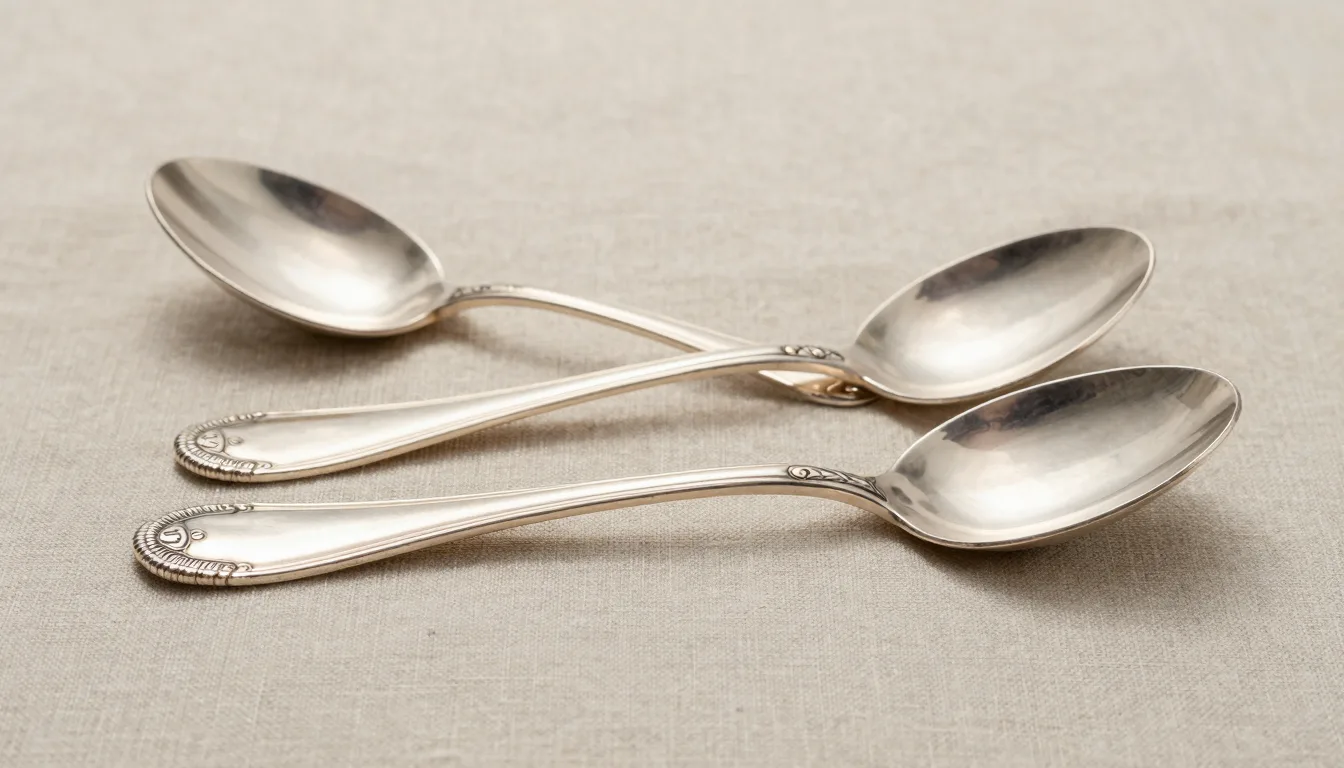
Towle sterling silver is identified by its lion-and-T trademark stamped next to STERLING, usually with a pattern name like Old Master or King Richard.
How to identify Towle sterling at a glance
Towle sterling silver carries a small, consistent set of marks. Turn the piece over and look at the back of the handle. You will find the word STERLING struck into the metal.
Beside or above that word sits the Towle trademark. It shows a lion passant, a capital T, and a small device enclosed in a circle. Collectors call it the lion-and-T mark.
The lion confirms the piece is solid silver. The T identifies Towle as the maker. Together they certify a content of 92.5 percent pure silver.
Pattern names appear on many pieces as well. Old Master, Candlelight, and King Richard are frequently stamped in full. That single word does most of the identification work for you.
Lift the piece and judge its weight. Sterling has a density that plated ware never matches. A Towle dinner fork feels noticeably heavier than a silverplate copy of the same size.
Hold the back of a spoon bowl under a lamp. Genuine sterling develops a soft grey film in its recesses. This darkening is normal patina, and collectors prize it on antique flatware.
Run a thumb across the high points where wear collects. Towle sterling shows no copper bleeding through at those edges. Plated pieces reveal a faint pink or yellow base metal there instead.
Any seasoned collector checks the word STERLING first. American makers stamped it once the National Stamping Act of 1906 set legal standards. Its absence on a supposed Towle piece is an immediate warning.
The mark also tells you where to look on serving pieces. Large spoons and ladles carry the stamp near the base of the handle, never on the bowl. Forks show it on the reverse stem.
For a fuller primer on reading silver stamps, our complete guide to antique marks and signatures covers the whole vocabulary. A Towle teaspoon in Old Colonial, stamped STERLING with the lion-and-T, recently sold near 28 dollars. The mark, not the polish, set that figure.
The Towle trademark and STERLING stamp explained
The Towle Manufacturing Company worked from Newburyport, Massachusetts. Its silversmithing roots reach back to William Moulton in the 1690s. The Towle name entered the trade through Anthony F. Towle around 1857.
The lion-and-T trademark settled into regular use in the 1890s. Before then, early partnership pieces read “A.F. Towle & Son” in plain letters. Those early stamps are scarcer and worth a second look.
The lion in the mark is a heraldic lion passant. It walks to the left with one paw raised. British silver used a similar lion to mean sterling, and Towle borrowed the symbolism deliberately.
The capital T usually sits inside or beside the circle. On some pieces the letter appears in an Old English face. The circular border ties the two devices into one registered logo.
Read the word STERLING as your anchor. It is a legal claim of 92.5 percent silver, not a brand name. Towle could not stamp it on plated goods without breaking the law.
Watch for added numbers near the mark. A small pattern number or design code sometimes follows the trademark. These codes helped the factory track dies and rarely affect value.
Compare the stamp against a trusted reference before you decide. The Metropolitan Museum of Art and the Victoria and Albert Museum both hold American sterling with documented marks. Their catalogs show how a genuine lion passant should look.
Beware of worn or shallow strikes on heavily polished pieces. Decades of cleaning can soften a stamp until the lion blurs. A blurred mark is not automatically fake, but it does demand closer study.
Hollow-handle knives carry their own quirk. The handle is sterling, yet the blade is stainless steel. You will often find “STERLING HANDLE” stamped there, which is honest and correct.
If a mark reads only “TOWLE” with no STERLING and no lion, treat the piece as silverplate until proven otherwise. The full guide at Kovel’s confirms that the company produced large silverplate lines too. The wording on the stamp separates the two.
Dating your Towle piece by pattern and mark
Dating Towle sterling combines two clues. The trademark style narrows the era. The pattern introduction date sets the earliest possible year.
A piece cannot predate the year its pattern launched. Old Master arrived in 1942, so an Old Master fork is wartime or later. This single rule resolves most dating questions.
The mark style refines the estimate further. Plain “A.F. Towle & Son” stamps point to the 1880s. The circular lion-and-T points to roughly 1890 onward.
Use the table below as a working timeline.
| Mark or feature | Approximate era | What it tells you |
|---|---|---|
| “A.F. Towle & Son” in plain letters | 1857 to 1882 | Early partnership, scarce |
| “Towle Mfg Co” with eagle or plain text | 1880s | Transitional company stamps |
| Circular lion + Old English T | 1890s to present | Standard sterling trademark |
| Pattern name stamped in full | 1900 onward | Cross-reference launch date |
| “STERLING HANDLE” on a knife | 20th century | Hollow handle, steel blade |
Pattern launch years anchor the late-period pieces. King Richard dates to 1932 and Candlelight to 1934. French Provincial followed in 1948, and El Grandee in 1964.
Monograms can hint at age too. Ornate three-letter scripts suit the early 1900s. Plain single-initial engraving leans mid-century. Neither is decisive on its own.
Wear patterns add a final clue. A century of use rounds the tines and thins the bowl edges. Crisp, sharp detail suggests a piece from the 1950s or later.
The Smithsonian’s American silver holdings, viewable through its collections portal, show how pattern fashions shifted across these decades. Heavy baroque ornament dominated the 1930s. Cleaner colonial revival lines returned after the war.
Record what you find before you sell or insure. Note the pattern, the mark wording, and any monogram. That short description is what an appraiser or buyer needs first.
The most collected Towle sterling patterns
Towle produced dozens of flatware patterns across its history. A handful drive most of the collector demand. Knowing them speeds up both identification and pricing.
Old Master, launched in 1942, is the flagship. Its handle blends sculpted scrollwork with restrained floral relief. Brides chose it for generations, so complete sets still surface.
King Richard from 1932 is the ornate showpiece. Dense baroque scrolls and a crowned crest fill the handle. Its weight and detail keep resale strong.
Candlelight, introduced in 1934, reads more delicate. Slim scrolls taper toward a pointed handle tip. It remains one of the easiest Towle patterns to recognize.
French Provincial arrived in 1948 with quieter styling. A small floral spray sits at the handle crown above a plain stem. Buyers who want sterling for daily use favor it.
El Grandee, a 1964 pattern, is the heavyweight. Bold, deeply cast baroque ornament runs the full handle. Its silver weight alone commands a premium.
Use the comparison table to place a piece quickly.
| Pattern | Introduced | Handle style | Collector note |
|---|---|---|---|
| Old Colonial | 1895 | Colonial revival, shell tip | Long-running, widely available |
| Georgian | 1898 | Rococo scroll | Early and sought after |
| King Richard | 1932 | Dense baroque, crest | High demand, heavy |
| Candlelight | 1934 | Slim tapered scroll | Popular bridal pattern |
| Old Master | 1942 | Sculpted floral relief | Towle flagship |
| French Provincial | 1948 | Restrained floral spray | Everyday favorite |
| El Grandee | 1964 | Bold cast baroque | Premium silver weight |
Match the handle silhouette to the table before searching by name. Photograph the tip and the back together. Maker databases at WorthPoint sort Towle sales by pattern, which confirms a match fast.
Mixed sets do appear, especially from estate breakups. A drawer may hold three patterns at once. Sort each piece by its handle, not by assumption, before you value the group.
A single King Richard serving spoon can outvalue six plain teaspoons. Pattern, not piece count, drives the real worth here.
Not sure what you’ve got?
Snap a photo and let our AI identify any antique in seconds — free download, no sign-up.
Identify on iPhone →Learn MoreWhat Towle sterling silver is worth
Towle sterling carries two values at once. The first is melt value, tied to the live silver spot price. The second is antique or pattern value, set by collectors.
Melt value sets the floor. Sterling is 92.5 percent pure, so each troy ounce of metal tracks the market. A teaspoon holds roughly 0.8 to 1.4 troy ounces of silver.
Antique value usually beats melt for desirable patterns. A King Richard serving piece sells far above its metal weight. Collectors pay for the design, not just the silver.
Knives are the exception. Their handles are sterling, but the blades are steel. That lowers the silver weight, so knives sell for less per piece.
Use this table as a present-day resale guide for single pieces in good condition.
| Piece | Typical resale, single | Notes |
|---|---|---|
| Teaspoon | 15 to 35 dollars | Most common, often in quantity |
| Place or dinner fork | 40 to 85 dollars | High silver weight |
| Dinner knife | 20 to 45 dollars | Hollow handle, steel blade |
| Tablespoon, serving | 50 to 140 dollars | Scarcer than place pieces |
| Cold meat or serving fork | 60 to 180 dollars | Strong collector demand |
| Sugar and cream serving pair | 80 to 250 dollars | Pattern dependent |
Full sets multiply quickly. A service for eight in Old Master often reaches 1,200 to 3,000 dollars. Rare patterns in service for twelve can pass 5,000 dollars.
Condition shifts every figure. Deep monograms, bent tines, and worn knife blades all reduce value. Original boxes and complete place settings raise it.
Decide your goal before selling. If a pattern is common and worn, melt may pay more than a collector. Our guide to silver melt value versus antique value walks through that exact choice.
Get a second opinion for anything unusual. Digital appraisal options exist, and our overview of online valuation tools for collectors lists reliable starting points. A free photo estimate costs nothing and often surprises people.
Towle sterling versus silverplate and rival makers
Towle sold both sterling and silverplate over its long history. Confusing the two is the most common Towle mistake. The stamp settles it every time.
Sterling pieces read STERLING with the lion-and-T. Silverplate pieces never carry that word. Plate is base metal with a thin silver coating applied by electroplating.
Weight gives a second tell. Sterling feels dense and solid in the hand. Plated flatware feels lighter and slightly hollow by comparison.
Wear gives a third. Plate rubs through at the high points to reveal copper or nickel underneath. Solid sterling wears evenly and never shows a different metal.
Some buyers confuse sterling with pewter on heavily tarnished pieces. The marks are different, and so is the surface. Our guide to telling pewter from silver covers three quick tests for that.
Towle also competed with several major American houses. Telling them apart matters when a drawer holds mixed flatware. Each maker used its own trademark and pattern names.
| Maker | Trademark clue | Pattern examples |
|---|---|---|
| Towle | Lion passant with circled T | Old Master, King Richard |
| Gorham | Lion, anchor, and Gothic G | Chantilly, Buttercup |
| Reed and Barton | Eagle or “R” in a shield | Francis I, Burgundy |
| International Silver | “I.S.” or stamped name | Royal Danish, Prelude |
| Wallace | “W” or full Wallace name | Grande Baroque, Rose Point |
Match the trademark before the pattern. A lion with a circled T is Towle. A lion with an anchor is Gorham. The small device beside the lion is the deciding detail.
Mixed estate lots reward careful sorting. A single drawer may hold Towle, Gorham, and plated filler together. Reading each stamp turns a vague pile into priced, named pieces.
Pattern reference sites such as those archived at WorthPoint cross-list these makers. When the lion is worn, the pattern name often closes the case.
Spotting reproductions, monograms, and condition issues
Genuine Towle sterling is hard to fake convincingly. The cost of solid silver discourages most counterfeiters. Still, a few traps catch unwary buyers.
The first trap is a missing or altered stamp. A seller may sand off “PLATE” and call a piece sterling. Always confirm the word STERLING and the lion-and-T are both present and unaltered.
The second trap is the marriage. Someone joins a sterling handle to a non-original blade or bowl. Check that wear, color, and patina match across the whole piece.
The third trap is the modern reproduction handle. Some recent flatware copies vintage patterns without the sterling content. The stamp, again, is your defense.
Test silver content if you remain unsure. A simple acid test or an XRF reading confirms purity. A jeweler can run either in minutes for a small fee. Background on the sterling silver standard explains why 92.5 percent is the legal line.
Monograms affect value more than many expect. A discreet single initial is widely tolerated. A large, ornate three-letter monogram narrows the buyer pool and lowers price.
Removing a monogram is rarely worth it. Grinding it out thins the silver and leaves a visible dish. Most collectors prefer an honest monogram over an altered surface.
Condition checks should be systematic. Look for bent or splayed fork tines first. Then check knife blades for pitting and loose handles. Finally inspect spoon bowls for thin, worn edges.
Cleaning deserves a gentle hand. Use a dedicated silver polish and a soft cloth. Skip abrasive pastes and dips, which strip patina and can blur the very mark you need.
Store sterling away from rubber and humidity. Both accelerate tarnish and can etch the surface. Anti-tarnish cloth or a lined drawer protects both the metal and the marks for the next owner.
Frequently Asked Questions
How do I identify my Towle sterling silver pattern?
Start with the handle, not the bowl. Turn the piece over, find the word STERLING, and confirm the lion-and-T trademark beside it. Then photograph the front of the handle and its tip in good light. Compare that silhouette against known Towle patterns such as Old Master, King Richard, or Candlelight. Many pieces are stamped with the pattern name in full, which removes the guesswork entirely. If the name is worn, match the scroll and floral details to a reference database. The same photo-first method works for other antiques too, as our McCoy pottery identification guide shows. A clear hallmark photo solves most cases on the first try.
What is the Towle silver hallmark?
The Towle sterling hallmark is a lion passant paired with a capital T inside a circle, stamped next to the word STERLING. The lion signals solid silver, echoing the British sterling lion, while the T identifies Towle Manufacturing Company of Newburyport, Massachusetts. The trademark entered regular use in the 1890s. Earlier partnership pieces instead read ‘A.F. Towle & Son’ in plain letters, which are scarcer. On hollow-handle knives you may see ‘STERLING HANDLE’ because the blade itself is stainless steel. If a piece reads only ‘TOWLE’ with no STERLING and no lion, treat it as silverplate. The wording on the stamp is the single most reliable identifier.
Is Towle sterling silver worth anything?
Yes, Towle sterling holds real value, set by both silver content and collector demand. A single teaspoon typically resells for 15 to 35 dollars, while serving pieces in sought-after patterns reach 60 to 180 dollars. Rare patterns like King Richard and El Grandee command premiums for their weight and ornate design. A full service for eight in Old Master often brings 1,200 to 3,000 dollars, and rare twelve-place sets can exceed 5,000 dollars. Knives are worth less because their blades are steel. Condition matters: bent tines, worn bowls, and large monograms lower value, while original boxes and complete settings raise it. For common, worn pieces, melt value sometimes pays more than a collector would.
How can I tell Towle sterling from Towle silverplate?
Read the stamp first. Towle sterling always carries the word STERLING with the lion-and-T trademark, and that word is a legal claim of 92.5 percent silver. Silverplate pieces never bear the word STERLING; they are base metal with a thin electroplated silver layer. Weight is the second test: sterling feels dense and solid, while plate feels lighter and slightly hollow. Wear is the third: plate rubs through at the high points to expose copper or nickel underneath, but solid sterling wears evenly and never reveals a different metal. If a worn stamp is hard to read, weigh the piece and inspect the wear edges. Both will point you to the right answer.
When did Towle make sterling silver flatware?
Towle’s silver heritage traces to William Moulton in the 1690s, but the company’s main sterling production runs from the 1880s onward. The lion-and-T trademark dates from the 1890s, so most marked Towle sterling falls between then and the late twentieth century. Individual patterns pin down the earliest possible date: King Richard launched in 1932, Candlelight in 1934, Old Master in 1942, French Provincial in 1948, and El Grandee in 1964. A piece cannot predate its pattern’s introduction year, which makes pattern dates the fastest dating tool. Towle was acquired by Syratech in 1990, and later production carried different ownership. The mark wording and pattern together place nearly any piece within a tight window.
Identify any antique in seconds.
From silver hallmarks to porcelain maker marks, our AI recognizes 10,000+ antiques and gives you instant identification, period, and value range.