Author: Antique Identifier Editorial

  • Reed & Barton silverplate marks: identification and dating guide

    Reed & Barton silverplate marks: identification and dating guide

    Reed & Barton silverplate marks pair the company name with an eagle trademark and pattern numbers. The Taunton firm used them from 1840 to 2015.

    ED
    Antique Identifier Editorial
    Published by OBZENA LLC · July 17, 2026

    The company behind the mark: Reed & Barton of Taunton

    Reed & Barton operated in Taunton, Massachusetts for 191 years. The firm began in 1824 as Babbitt & Crossman, a small workshop making teapots and lamps from britannia metal. Britannia is a tin alloy that looks like pewter but takes a brighter polish. Those earliest pieces predate silverplating entirely.

    The business nearly collapsed in the 1830s. Henry Reed, a spinner at the works, and Charles Barton, a solderer, kept production going through the financial failure. Pieces made between 1837 and 1840 carry the transitional mark “Leonard, Reed & Barton.” Gustavus Leonard supplied the capital during those lean years, and his name came first on the stamp.

    The firm adopted the name Reed & Barton in 1840. That exact name appears on American silver for the next 175 years. Electroplating reached Taunton in the late 1840s, and the company shifted from polished britannia to true silverplate. The new process deposited a layer of pure silver onto a britannia or nickel-silver base by electric current.

    Sterling production started in 1889, decades after the plate business was established. The company’s most celebrated sterling pattern, Francis I, followed in 1907. Collectors who want the sterling side of the story should read our guide to Reed & Barton Francis I. Silverplate remained the volume business through the entire 20th century, filling hotel pantries, wedding registries, and Navy wardrooms.

    Reed & Barton filed for bankruptcy in February 2015, and Lenox Corporation bought the brand later that year. Production in Taunton ended with the sale. The Smithsonian’s National Museum of American History preserves examples of the firm’s work, which tells you how central this maker was to American domestic silver.

    The takeaway for identification: any piece marked “Reed & Barton” dates between 1840 and 2015. Narrowing that 175-year window comes down to the mark style, the pattern number, and the design language of the piece itself.

    What does "Barton" mean on silver?

    “Barton” on silver refers to Charles E. Barton, the Taunton solderer who co-ran the firm from the late 1830s until his death in 1867. It is a surname, not a quality grade, a metal standard, or a place name. Many searchers assume Barton signals a British assay town. No British assay office ever used that name, so a Barton stamp points to Massachusetts, not England.

    The full mark reads “Reed & Barton” on the overwhelming majority of pieces. Worn flatware sometimes shows only “BARTON” because the “REED &” portion sat closer to the edge and rubbed away first. Check the area ahead of the visible letters under a 10x loupe. Faint traces of the missing “REED &” usually survive in the metal.

    Pieces marked “Leonard, Reed & Barton” deserve special attention. That three-name stamp was used only from 1837 to 1840, which makes it one of the tightest dating windows in American silver. A Leonard, Reed & Barton britannia teapot in sound condition typically brings $150-400 at auction, several times what a common later teapot fetches. The premium comes entirely from the mark, not the metal.

    Any seasoned collector treats a lone “Barton” stamp as a Reed & Barton piece until proven otherwise. Confirm it by finding the eagle trademark or a four-digit pattern number nearby. The stamp placement, the font, and the accompanying symbols together settle the question. For a full walkthrough of reading unfamiliar stamps of every kind, see our complete guide to antique marks and signatures.

    One more source of confusion is worth clearing up. Reed & Barton is unrelated to the English firm Barton Brothers or to retailers who stamped “Barton” on imported goods. Those marks lack the eagle, lack American pattern numbers, and usually appear beside “EPNS” in a different font. When the surname stands with an eagle and Taunton-style numbering, you are holding American plate.

    Reed & Barton silverplate marks: the stamps to look for

    Reed & Barton stamped its silverplate in predictable places. Hollowware carries the mark on the underside of the body, often inside an oval or rectangular cartouche. Flatware carries it on the reverse of the handle, near the end. Trays and waiters hide the mark under the rim or between the feet. Turn the piece over in good light before you conclude it is unmarked.

    The eagle is the company’s signature device. It appears as a small spread-winged bird beside or above the company name on hollowware from the later 19th century onward. Some marks add a shield or a flag-like banner around the name. The eagle distinguishes genuine Taunton work from the many firms that imitated the “& Barton” cadence in their own names.

    Mark as it appearsApproximate periodWhat it tells you
    Babbitt, Crossman & Co.1824-1827Britannia era predecessor, museum-grade rarity
    Leonard, Reed & Barton1837-1840Transitional partnership, tight three-year window
    REED & BARTON in plain block letters1840-1860sEarly britannia and first electroplate output
    REED & BARTON with eagle trademark1870s-1950sMature electroplate hollowware
    Reed & Barton with four-digit number (e.g. 1120)1880s-1990sNumber identifies the hollowware shape or pattern
    Reed & Barton with EPNS or Silverplatemid-1900s onwardExplicit plate declaration on later goods
    Reed & Barton, Silver Solderedc. 1900-1960sHotel and institutional ware, heavy plate

    The four-digit numbers cause the most questions. They are catalog model numbers, not dates and not silver content. Number 1120 on a water pitcher means shape 1120 in the company catalog, nothing more. Two pieces with the same number are the same design, possibly made decades apart.

    “Silver Soldered” marks identify commercial ware made for hotels, railroads, and the US Navy. These pieces carry a thicker plate layer than domestic goods because they were built for daily institutional abuse. Collectors of hotel silver hunt these marks specifically, and pieces with a named hotel or ship engraving sell for $40-200 depending on the property.

    Not sure what you’ve got?

    Snap a photo and let our AI identify any antique in seconds: free download, no sign-up.

    Identify on iPhone →Learn More

    How to date a Reed & Barton silverplate piece

    Reed & Barton gave sterling hollowware a year-symbol system starting in 1928, with a small pictorial device changing annually. Silverplate never received those date symbols. Dating plate therefore relies on three converging clues: the mark style, the pattern number, and the design language of the piece.

    Start with the mark style using the table in the previous section. A plain incised name without an eagle suggests production before the 1870s. An eagle with a cartouche suggests the mature period. The word “Silverplate” spelled out in full generally indicates the mid-20th century, when consumer labeling became standard practice.

    Design language narrows things further. Rococo revival scrolls and grape clusters dominate the 1850s and 1860s. Aesthetic movement pieces from the 1870s and 1880s show Japanese-inspired birds, fans, and asymmetric engraving. Colonial Revival plainness rules from about 1900 to 1940. Streamlined shapes with minimal ornament mark the 1950s and 1960s. The same visual dating logic applies across categories, and it works for porcelain backstamps too, as our Royal Worcester dating guide shows.

    Pattern research settles the date when the mark and style disagree. Kovel’s maintains mark listings with date ranges for American plate makers. WorthPoint archives millions of sold listings, and searching a pattern number like “Reed & Barton 1120” often surfaces the same shape with a catalog date quoted by a previous seller. Ten minutes of cross-checking usually brackets a piece within a decade.

    Monograms add a final clue that many people overlook. Elaborate interlaced script monograms were fashionable from the 1880s to about 1915. Plain block-letter monograms dominate after 1930. A dated presentation engraving is even better: “To Mabel, June 1902” dates the piece within a year or two of manufacture, since presentation silver was normally bought new.

    Silverplate or sterling? Reading the metal from the mark

    Reed & Barton made both sterling and silverplate for over a century, and the mark settles which one you own. Sterling pieces are stamped with the word “STERLING,” usually beside the company name. The National Stamping Act of 1906 made false sterling marking a federal offense in the United States, so an American piece marked STERLING can be trusted to be 92.5 percent silver.

    Silverplate carries no STERLING stamp and no “925.” Instead you will find the bare company name, a pattern number, “EPNS” (electroplated nickel silver), “Silverplate,” or “Silver Soldered.” The absence of a standard mark is itself the signal. American makers, unlike British ones, never developed a hallmark system for plate quality, which is why the Victoria & Albert Museum’s collections treat American electroplate as a distinct tradition from hallmarked English wares.

    Physical checks back up the mark. Worn high points on plate show a yellowish or grey base metal breaking through the silver surface. Look at handle edges, spout tips, and feet, which wear first. Sterling wears too, but the metal underneath stays silver-white all the way through. Weight is a weaker clue, since britannia-based plate can feel as heavy as sterling. If you are still unsure of the base metal, the tests in our guide to telling pewter from silver apply directly.

    The financial difference is stark. A sterling teapot holds bullion value even in poor condition. A plated teapot holds none, because the recoverable silver layer is measured in grams. Our breakdown of silver melt value versus antique value explains when each number matters. For Reed & Barton plate, value lives entirely in the design, the rarity of the mark, and the condition of the surface.

    The practical rule: read the stamp first, check the wear points second, and never pay sterling prices for a piece that does not say sterling.

    Popular Reed & Barton silverplate patterns and what they sell for

    Reed & Barton silverplate flatware patterns turn up constantly at estate sales, and a handful account for most of what you will encounter. Tiger Lily, introduced in 1901, is the most recognized, with its sculptural lily blossom filling the handle. Dresden Rose from 1953 served the postwar wedding market. King Francis, launched in 1935, translated the Francis I sterling aesthetic into affordable hollowware.

    PatternIntroducedTypeTypical 2026 price range
    Tiger Lily1901Flatware$3-8 per piece; $120-250 for a service for 8
    Dresden Rose1953Flatware$2-6 per piece; $80-160 for full sets
    King Francis1935Hollowware$60-250 per piece; punch sets $300-600
    1824 Collection1990sFlatware and giftware$40-120 for boxed sets
    Silver Soldered hotel ware1900-1960sInstitutional hollowware$40-200 with named engravings

    These figures reflect completed-sale prices on eBay and WorthPoint through mid-2026, not dealer asking prices. Asking prices run 50-100 percent higher and routinely sit unsold for months. When you research your own pattern, filter for sold listings only.

    Condition drives the spread within each range. A Tiger Lily serving spoon with crisp casting detail and no base-metal show-through sits at the top of the range. The same spoon with worn blossom tips and grey patches sits at the bottom, or goes unsold. Serving pieces beat place pieces: ladles, meat forks, and casserole spoons bring two to three times what teaspoons do in the same pattern.

    Do not confuse King Francis plate with Francis I sterling. The designs are cousins, but Francis I forks bring $40-150 each as sterling while King Francis pieces are plate priced. The STERLING stamp is the dividing line, and checking it takes five seconds. The Metropolitan Museum of Art holds Reed & Barton work in its American Wing collection, which says something about the design pedigree behind even the affordable patterns.

    Condition, replating, and where the money is

    Condition rules silverplate value more than it rules sterling, because plate cannot be polished back from serious wear. Once the silver layer breaks through to base metal, the damage is permanent short of replating. Inspect the highest surfaces first: spout tips, handle spines, finial tops, and the centers of trays where decades of stacking wore the plate thin.

    Replating costs $30-90 for a typical teapot at a commercial silversmith, and more for large trays. That expense exceeds the market value of most common Reed & Barton pieces, so replating rarely makes financial sense for resale. It can make sense for a family piece you intend to use. Know that collectors of early marks prefer honest original surfaces, and a replated 1840s piece loses its wear history along with its patina.

    Where the money actually is: the earliest marks and the oddest forms. Babbitt & Crossman and Leonard, Reed & Barton pieces are genuine rarities that belong in the $150-500 range even as humble teapots. Aesthetic movement hollowware from the 1870s and 1880s, with Japanese birds and fans, draws design-driven buyers who do not otherwise collect plate. Figural napkin rings, a Victorian specialty, bring $75-300 when the cast figure is intact.

    What is common: mid-20th-century flatware sets, plain trays, and gravy boats. These sell by the box lot at auction for $20-60. They are usable, attractive, and nearly worthless individually, because millions survive. Selling a common set is often more work than the return justifies.

    The honest takeaway for anyone sorting an inheritance: identify the mark first, date the piece second, and only then think about price. A five-minute check of the stamp separates the $400 transitional teapot from the $15 wedding-gift tray, and those slightly uneven seams and hand-finished details on early pieces are exactly what the flea-market crowd walks past.

    Frequently Asked Questions

    Is Reed & Barton silverplate worth anything?

    Most Reed & Barton silverplate is modestly valued, but the range is wide. Common mid-century flatware sets bring $20-60 at auction, while Tiger Lily services for 8 reach $120-250. The real money sits in early marks: Leonard, Reed & Barton pieces from 1837-1840 bring $150-400, and Babbitt & Crossman britannia from the 1820s can exceed $500. King Francis hollowware runs $60-250 per piece. Condition decides where in each range a piece lands, since worn-through plating cuts value sharply.

    What do the numbers on Reed & Barton silverplate mean?

    The four-digit numbers stamped on Reed & Barton hollowware are catalog model numbers identifying the shape, not dates and not silver content. A pitcher stamped 1120 is catalog shape 1120, and every pitcher of that design carries the same number regardless of the year it was made. The numbers are still useful for dating indirectly: searching the number on WorthPoint or in reprinted catalogs often turns up the design’s introduction date, which gives you the earliest possible year for your piece.

    When did Reed & Barton stop making silver?

    Reed & Barton filed for Chapter 11 bankruptcy in February 2015, ending 191 years of production in Taunton, Massachusetts. Lenox Corporation purchased the brand name and select assets later that year, and some giftware has been sold under the name since. For collectors, the practical cutoff is 2015: any piece marked Reed & Barton with traditional Taunton marks dates between 1840 and 2015, and the predecessor marks Babbitt, Crossman & Co. and Leonard, Reed & Barton push the family history back to 1824.

    How can I tell if my Reed & Barton piece is sterling or silverplate?

    Check for the word STERLING stamped beside the company name. Reed & Barton marked all its solid silver clearly, and the National Stamping Act of 1906 made false sterling marks a federal offense, so the stamp is reliable. No STERLING stamp means silverplate, even on heavy, well-made pieces. Confirm by examining wear points such as spout tips and handle edges: plate shows yellowish or grey base metal breaking through, while sterling stays silver-white under the surface no matter how worn it gets.

    Does replating hurt the value of antique silverplate?

    For rare early pieces, yes. Collectors of pre-1860 marks such as Leonard, Reed & Barton pay for original surfaces, and replating erases the wear history that helps authenticate age. For common 20th-century pieces, replating neither helps nor hurts much, because the market value of $20-60 sits below the $30-90 cost of the work itself. Replate only when the piece has family meaning and you plan to use it. Never replate anything with a pre-1860 mark before getting a specialist opinion on its collector value.

    Identify any antique in seconds.

    From silver hallmarks to porcelain maker marks, the app suggests the item type, period and a value range.

    See How It Works →

    ED

    About Antique Identifier Editorial

    Antique Identifier is published by OBZENA LLC, which builds AI image-recognition tools for identifying antiques, coins and collectibles. Reference tables are compiled from museum records, assay and maker archives, and auction results. We do not offer appraisals.

  • Royal Worcester marks: how to date your piece by the backstamp

    Royal Worcester marks: how to date your piece by the backstamp

    The Royal Worcester backstamp dates your piece exactly. Year letters ran 1867-1890, dots marked 1892-1915, shape codes covered 1928-1941.

    ED
    Antique Identifier Editorial
    Published by OBZENA LLC · July 11, 2026

    The standard Royal Worcester mark, decoded

    Every genuine Royal Worcester backstamp printed after 1862 is built around one device. Collectors call it the standard mark. It shows a circle containing four interlocking script Ws around a crescent moon, with the number 51 at the center. A crown sits on top of the circle.

    The 51 records 1751, the year Dr. John Wall and his partners founded the Worcester factory. The crescent was Worcester’s earliest symbol, painted on First Period porcelain in the 1750s and 1760s. The 1862 design packed a century of factory history into a stamp the size of a fingernail.

    The wording around the circle narrows the date fast. A mark reading only Royal Worcester with no country name was used between 1862 and 1890. Royal Worcester England appears from 1891, a direct response to the American McKinley Tariff Act of 1890, which required country-of-origin marks on all imports to the United States. Made in England joins the wording from the early 1920s onward.

    Color gives a secondary clue. Puce and purple printed marks dominate on decorated wares from the 1890s through the mid-20th century. Green printed marks are common on pieces from the 1862-1890 window. Black, red, and gold marks appear on specific decorative lines. A mark’s color alone never dates a piece, so always confirm with the letter or dot code beneath it.

    Look for impressed marks too. Many Royal Worcester pieces carry an impressed crown-and-circle pressed into the clay itself, alongside the printed version. Figurines often add a shape number, and painted wares carry pattern numbers in script. Those numbers cross-reference the factory shape books, which is how specialists pin a vase to a single production year.

    Any seasoned collector knows the printed mark wears faint on pieces that saw daily use. I keep a 10x loupe next to the kettle for exactly this job. Tilt the base against a window and the ghost of the crown usually reappears. If you are new to reading ceramic bases, our complete guide to antique marks and signatures covers where every major factory hid its stamps.

    One warning before you count anything. Worcester used porcelain bodies that craze into fine lines with age, and crazing crosses the backstamp on many pieces. A crazing line can look exactly like a date dot in poor light. Strong raking light separates the two in seconds.

    Before 1862: Flight, Barr, and Chamberlain marks

    Royal Worcester the company dates from 1862, but Worcester porcelain is more than a century older. Pieces made before 1862 carry completely different marks. Getting the period right can move a valuation by a factor of ten.

    The factory passed through six distinct ownerships before the Royal Worcester era began. Each left its own marking habits. The table below is the fastest way to place a pre-1862 piece.

    PeriodYearsMarks to look for
    First Period (Dr. Wall)1751-1783Painted crescent; script W; square seal mark on blue-and-white
    Flight1783-1792“Flight” in script; small crescent; crown added after the 1788 royal visit
    Flight & Barr1792-1804Incised “B”; “F&B” monogram
    Barr, Flight & Barr1804-1813Impressed “BFB” beneath a crown
    Flight, Barr & Barr1813-1840Impressed “FBB” with crown; printed marks with full London address
    Chamberlain & Co.1840-1852“Chamberlain’s Worcester” painted or printed
    Kerr & Binns1852-1862Shield mark with four Ws at the corners; “K & B”

    Two of these periods punch far above the rest at auction. First Period Dr. Wall porcelain from 1751-1783 is the blue-chip Worcester, and honest teabowls with a painted crescent still surface at estate sales for a fraction of their trade value. The Victoria & Albert Museum holds one of the deepest public collections of 18th-century Worcester, and browsing it trains your eye faster than any book.

    The Barr and Flight partnerships of 1792-1840 produced richly gilded cabinet wares for a wealthy clientele. King George III granted the royal warrant after visiting the works in 1788, which is why crowns start appearing on Flight-era marks. American museum collections, including the Metropolitan Museum of Art, hold armorial services from this window that were painted for named aristocratic families.

    Kerr & Binns ran the factory from 1852 to 1862 and quietly made some of the finest porcelain Worcester ever produced. Their shield mark with a W in each corner is easy to miss because it is small and often printed in the same tone as the glaze. A Kerr & Binns shield on a Limoges-enamel style vase is a strong buy signal.

    The takeaway is simple. If your piece says Worcester but shows no crown-and-circle device, stop and check this table before you assume anything about age or value.

    Year letters, 1867 to 1890

    From 1867 the factory began stamping a single capital letter below the standard mark. One letter equals one production year. This is the earliest precise dating system on Royal Worcester and it runs to 1890.

    The sequence is nearly alphabetical, but three letters were skipped and one appears out of order. F, J, and Q were never used. O was held back and used for 1889, after Z had already marked 1888. Pieces from 1890 frequently carry no letter at all, which trips up beginners who expect the system to run continuously into the dot era.

    LetterYearLetterYear
    A1867P1879
    B1868R1880
    C1869S1881
    D1870T1882
    E1871U1883
    G1872V1884
    H1873W1885
    I1874X1886
    K1875Y1887
    L1876Z1888
    M1877O1889
    N1878(none)1890

    Read the letter with care. A worn W can look like a V, and an I with glaze pooling around it can pass for a T. The letter sits directly under the circle, printed in the same color as the main mark. If you see two letters, you are probably looking at a printer’s or decorator’s mark rather than the date code.

    The year letter era covers Royal Worcester’s great Aesthetic Movement period. Pieces marked between 1872 and 1888 include the Japanese-influenced ivory wares designed under art director James Hadley that made the firm’s international reputation. A dated 1880s Hadley-modeled piece consistently outsells an undated equivalent because the date ties it to exhibition-era production.

    Those slightly blurred letters on cheaper wares of the 1870s are classic underglaze printing spread, not evidence of forgery. Forgers of the period targeted Sevres and Meissen, not Worcester date letters. What you should confirm is coherence: the letter, the mark wording, and the decoration style must all agree on the same decade. When they disagree, trust the mark wording first.

    Not sure what you’ve got?

    Snap a photo and let our AI identify any antique in seconds: free download, no sign-up.

    Identify on iPhone →Learn More

    Dot codes: 1892 to 1915, the star years, and the shape codes

    In 1892 Royal Worcester switched to the system collectors know best: date dots. The factory added one small dot beside the crown or below the mark for each year that passed. Count the dots, add them to 1891, and you have the year.

    One dot means 1892. Six dots mean 1897. By 1915 the mark carried 24 dots, crowded in two arcs around the crown. At that point the dots had become absurd, so the factory reset the system with a sequence of small symbols.

    Code beneath or beside the markYear
    “Royal Worcester England,” no dots1891
    1 dot1892
    6 dots1897
    12 dots1903
    24 dots1915
    Small star1916
    Star + 1 to 11 dots1917-1927
    Small square1928
    Diamond1929
    Division sign1930
    Two interlaced circles1931
    Three interlaced circles1932
    Three circles + 1 to 9 dots1933-1941
    No date code (wartime production)1942-1948
    “V”1949
    “W”1950

    Counting 20 or more dots on a worn base is genuinely hard. The dots are under the glaze and each one is smaller than a poppy seed. Professional dealers count in pairs with a loupe and tally on paper, then count again from the opposite direction. If the two counts disagree, the piece gets photographed and the count is done on a zoomed screen image.

    The wartime gap matters for value. Between 1942 and 1948 the factory ran restricted production under wartime material controls and dropped date coding. A piece with 1930s-style marking but no code usually belongs to this window. Postwar codes resumed with letters in 1949, and from the 1950s the factory moved toward printed year ranges and pattern-specific backstamps rather than a single running code.

    Here is the collector’s shortcut I use at fairs. Wording first, then symbol, then dots. “England” without “Made in” points before the 1920s. A star means the teens or twenties. Circles mean the thirties. Only then do I bother counting individual dots, because the wording has already done most of the work.

    What Royal Worcester is worth in 2026

    Royal Worcester prices split sharply between artist-signed painted wares and factory production lines. The backstamp date feeds directly into that split, because the signed painting tradition peaked between the 1890s and the 1950s.

    The blue-chip category is painted fruit. Worcester artists painted peaches, grapes, and blackberries against mossy backgrounds, and each artist signed the front of the piece. Signatures to learn first are the Stinton family, Charley Baldwyn, Harry Ayrton, William Ricketts, and Horace Price. John Stinton and his son Harry painted Highland cattle scenes for over half a century, and their signed vases are the most reliably valuable 20th-century Worcester on the market.

    CategoryWhat to look forTypical 2026 auction range
    Painted fruit, signedAyrton, Ricketts, Freeman, Price signatures$600-$8,000
    Stinton Highland cattleJohn or Harry Stinton signature$1,200-$12,000
    Baldwyn swansC. Baldwyn, powder-blue sky grounds$2,000-$15,000
    Blush ivory ewers and vasesShape number plus 1880s-1900s date code$100-$600
    Dorothy Doughty birdsLimited-edition American bird models, 1935 onward$300-$3,000
    Freda Doughty children figurinesDays of the Week, Months of the Year series$40-$250
    Evesham tablewareGold-edged fruit pattern, 1961 onward$5-$30 per piece

    Blush ivory is the trap category. These peach-toned vases and ewers were made in enormous quantities from the 1880s to the 1910s, and sentimental owners routinely expect four figures. Most trade between $100 and $400 unless the piece is large, Hadley-modeled, or exceptionally painted. Checking recent sold prices on WorthPoint before you buy or sell protects you from both overpaying and underselling.

    Condition rules are strict at the top end. A hairline crack cuts a signed fruit vase by half or more. Restored rims show under UV light, and serious buyers always check. Price guides such as Kovel’s track the category year over year, and the trend since 2020 has been flat for ordinary tableware and firm for signed cabinet pieces.

    If you want a second opinion before selling, our review of the best online antique appraisal sites compares turnaround times and real appraisal quality for exactly this kind of piece.

    Reading a worn backstamp: photo tricks that work

    Most Royal Worcester dating problems are not knowledge problems. They are lighting problems. The code is there, but a century of washing has polished the print until it hides in the glaze.

    Start with raking light. Hold the piece so light from a window or lamp skims across the base at a low angle. Printed marks sit fractionally proud of or below the surrounding glaze, and raking light throws that difference into relief. The dots that were invisible under the ceiling light suddenly line up like beads.

    Your phone does the rest. Shoot the base in daylight with the flash off, fill the frame with the mark, and tap to focus directly on the crown. Then zoom the photo on screen to count dots. A zoomed photograph beats a loupe for dot counting because you can mark counted dots with your finger without losing your place. Screenshots also give you a record to compare against reference charts later.

    Three misreads cause most wrong dates. Crazing lines get counted as dots, so trace each candidate dot and confirm it does not continue as a line. Glaze pinholes get counted as dots, but pinholes are randomly placed while date dots form deliberate arcs. And worn gilding flecks near the mark read as extra symbols under warm light, so always confirm in neutral daylight.

    When the mark is too far gone, date the piece by triangulation. Shape numbers, pattern numbers, and decoration style each narrow the window. Our guide to online antique valuation tools lists the free databases where Worcester shape books have been indexed by collectors.

    The same discipline transfers to every marked antique in your house. Reading a tiny date code in raking light is exactly the skill you need for silver hallmarks, and it is the same method we recommend for identifying old coins, where mint marks hide in even smaller spaces. Learn it once on porcelain and you will use it everywhere.

    Snap the photo before you clean anything. Overenthusiastic scrubbing with abrasive pads has erased more Worcester date codes than two world wars. Warm water, a drop of dish soap, and a soft cloth are all a porcelain base ever needs.

    Frequently Asked Questions

    How do I tell real Royal Worcester from a fake?

    Outright fakes are rarer than misattributions, but they exist, especially reproduction blush ivory made in Asia from the 1990s onward. Check the print quality first: a genuine backstamp has crisp lines, a clearly defined crown, and a legible 51 in the circle, while reproductions show muddy, blurred transfers. Confirm the date code agrees with the decoration style, since a Victorian-style ewer with a code implying 1970 is wrong somewhere. Genuine pieces also feel right: Royal Worcester porcelain is finely potted, and blush ivory glazes have a soft satin depth that reproductions miss. When money is at stake, compare the mark against a dated reference example before buying.

    What do the dots on a Royal Worcester mark mean?

    Each dot is one production year. The factory added a dot per year from 1892, so one dot means 1892 and 24 dots mean 1915. In 1916 the dots reset: a small star marked that year, and new dots accumulated beside the star through 1927. From 1928 the factory used a sequence of symbols instead, including a square for 1928, a diamond for 1929, and interlaced circles for 1931 and 1932, with dots added to the three-circle mark from 1933 to 1941. Count dots on a zoomed photograph rather than by eye, because crazing lines and glaze pinholes are easily miscounted as dots.

    Is Royal Worcester still being made?

    The brand survives but the Worcester factory does not. Royal Worcester merged with Spode in 1976, the group entered administration in 2008, and the historic Worcester works closed in 2009. The brand name was bought by Portmeirion Group in 2009, which produces Royal Worcester tableware today at other facilities. This matters for dating: any piece carrying the old letter, dot, or symbol date codes predates 1976 at the latest, and pieces marked with Portmeirion-era wording are modern production with ordinary retail value rather than antique value.

    Which Royal Worcester pieces are most valuable?

    Artist-signed painted wares lead the market by a wide margin. Signed Highland cattle vases by John and Harry Stinton bring $1,200 to $12,000 depending on size and condition, and Charley Baldwyn’s swan-painted vases on powder-blue grounds have exceeded $15,000 at auction. Signed painted fruit by artists such as Harry Ayrton and William Ricketts trades between $600 and $8,000. Among unsigned wares, First Period pieces from 1751-1783 and large Hadley-modeled pieces from the 1880s perform best. Ordinary blush ivory, Evesham tableware, and small figurines remain affordable, typically under $300.

    Does crazing reduce the value of Royal Worcester?

    Light, even crazing is expected on Royal Worcester ivory-ground wares from the 1880s to the 1920s and barely affects price on ordinary pieces. The glaze and body cool at different rates, so a fine craquelure develops naturally over decades. Value suffers when crazing turns brown or gray from absorbed staining, which can halve the price of a decorative piece, or when it appears on signed cabinet wares where top-end buyers demand near-perfect surfaces. A stained, crazed blush ivory ewer worth $150 clean might bring $60. Never bleach crazed porcelain to whiten it, because chlorine attacks the glaze and dealers can spot the chalky result instantly.

    Identify any antique in seconds.

    From silver hallmarks to porcelain maker marks, the app suggests the item type, period and a value range.

    See How It Works →

    ED

    About Antique Identifier Editorial

    Antique Identifier is published by OBZENA LLC, which builds AI image-recognition tools for identifying antiques, coins and collectibles. Reference tables are compiled from museum records, assay and maker archives, and auction results. We do not offer appraisals.

  • How to identify old coins and what they’re really worth

    How to identify old coins and what they’re really worth

    The fastest way to identify old coins is to read the date, mintmark, and denomination. Condition and silver content then determine what they’re worth.

    ED
    Antique Identifier Editorial
    Published by OBZENA LLC · July 6, 2026

    Read the date, mintmark, and denomination first

    Most coin identification comes down to three data points stamped on the coin itself: the date, the mintmark, and the denomination. Find those three and you can match nearly any coin to a catalog listing within minutes.

    Start with the date. United States coins carry the date on the obverse, the heads side, in every major series struck since 1793. Many world coins place the date on the reverse or near the rim. Some use a non-Western calendar, covered in the world coins section of this guide. A coin with no date at all is often pre-1600, or it may be a trade token rather than legal tender.

    Next, find the mintmark. This small letter identifies the facility that struck the coin. On US coins, D means Denver, S means San Francisco, O means New Orleans, CC means Carson City, and W means West Point. Philadelphia struck most of its coins with no mintmark at all until 1979, with the notable exception of wartime nickels from 1942 to 1945.

    Mintmark placement moves around by series, and this trips up beginners. On a Mercury dime, the mark sits on the reverse at the lower left of the fasces. On a Morgan dollar, it hides below the wreath bow on the reverse. On Lincoln cents and Washington quarters, it sits on the obverse under the date. Check both faces with a loupe before concluding a coin has no mark.

    One letter can change everything. Philadelphia struck over 18 million Mercury dimes in 1916, and worn examples trade for $3 to $5. Denver struck only 264,000 that year. A heavily worn 1916-D brings $1,000 or more: the same design, the same year, a 250-fold price difference from a single letter. Any seasoned collector checks the mintmark before anything else for exactly this reason.

    Denomination and country round out the picture. The words ONE DIME or HALF DOLLAR are obvious on US coins, but older world coins may state value in an unfamiliar unit: pfennig, kopek, réis, or mon. The country name, a coat of arms, or a monarch’s portrait usually settles origin.

    Before you open a price guide, photograph both faces in bright, indirect light. Note the date, the mintmark, the denomination, and the country. Those four facts are the search query that unlocks every catalog, and gathering them takes under two minutes.

    Key-date US coins worth real money

    In every American coin series, a handful of key dates carries most of the value. The reason is mintage: the fewer coins struck in a given year at a given mint, the more collectors pay to fill that hole in their albums.

    Mintage figures are public record, so the market prices these coins with unusual precision. These are the key dates every attic-box hunter should memorize:

    Coin seriesKey dateMintageWorn (G–VG) valueUncirculated value
    Lincoln cent1909-S VDB484,000$700–$1,100$2,000+
    Indian Head cent1877852,500$500–$900$3,500+
    Mercury dime1916-D264,000$1,000–$1,800$10,000+
    Standing Liberty quarter191652,000$2,000–$3,500$15,000+
    Washington quarter1932-D436,800$75–$150$1,200+
    Morgan dollar1893-S100,000$2,500–$4,500$100,000+

    The 1909-S VDB deserves a closer look because it turns up in inherited collections constantly. In 1909 the San Francisco mint placed designer Victor David Brenner’s initials, VDB, at the bottom of the reverse of the new Lincoln cent. Public criticism forced their removal within weeks, leaving only 484,000 examples. Check the reverse rim at six o’clock: those three letters, plus an S under the date on the obverse, make a four-figure cent.

    Semi-key dates matter too. Wheat cents from 1909 to 1958 mostly trade for 5 to 25 cents each, but the 1914-D ($200+ worn), the 1922 no-D ($500+), and the 1931-S ($60+) hide among them. Buffalo nickels with readable dates start around $1, while the 1913-S Type 2 and the 1937-D three-legged variety run $300 to $900 in collectible grades.

    For reference photographs of nearly every American issue, the National Numismatic Collection at the Smithsonian holds roughly 1.6 million objects, much of it photographed online. Comparing your coin against museum plates beats guessing from a blurry auction listing.

    The takeaway: never spend or bulk-sell old coins before checking each date and mintmark against a key-date list. A single 1916-D hiding in a folder of $3 Mercury dimes pays for the whole collection many times over.

    Identifying world coins by legends, portraits, and dates

    World coins look intimidating, but three identifiers settle most of them: the legend, the portrait, and the dating system.

    European coins from 1600 onward typically carry Latin legends. DEI GRATIA means by the grace of God, and FID DEF or F D marks British coins: Defender of the Faith. The monarch’s name in the legend is your fastest dating tool: GEORGIVS V puts a British coin between 1910 and 1936, and ELIZABETH II means 1953 or later. German states coins before 1871 name the state rather than Germany (PREUSSEN, BAYERN, SACHSEN), and a Prussian thaler from the 1860s trades for $25 to $60 in collectible condition.

    British coins date even more precisely by portrait. Queen Victoria appears in three versions: the Young Head from 1838 to 1887, the Jubilee Head from 1887 to 1893, and the Old or Veiled Head from 1893 to 1901. A Victorian penny with the Young Head narrows to a five-decade window at a glance, even when the date is worn smooth.

    Coins from the Islamic world use the AH (Anno Hegirae) calendar. Convert by multiplying the AH date by 0.97 and adding 622. A coin dated AH 1327 was struck around 1909. Ottoman coins add a wrinkle: they show the accession year of the sultan plus a regnal year, so a coin marked 1293 with regnal year 25 dates to about 1900.

    Chinese cash coins, round with a square center hole, read top, bottom, right, left. The first two characters name the emperor’s reign. Qianlong Tongbao coins (1736–1795) survive in enormous numbers and trade for $2 to $10, while the rarer Xianfeng large-denomination coins of the 1850s can bring several hundred dollars. Museum collections such as the Metropolitan Museum of Art hold photographed examples useful for side-by-side comparison.

    Watch for pieces that are actually medals or jetons. If an item shows no denomination anywhere, it may never have been money. Commemorative medals follow a different market and are usually worth less than hopeful sellers expect.

    When the alphabet itself defeats you (Cyrillic, Devanagari, Arabic script), photo identification is the practical shortcut. A clear photo of both faces feeds an image search or an identification app, and the shape, script, and symbols usually produce a country and era match in seconds.

    Not sure what you’ve got?

    Snap a photo and let our AI identify any antique in seconds: free download, no sign-up.

    Identify on iPhone →Learn More

    Condition and grading: the same coin can be worth $30 or $30,000

    Two collectors can hold coins with the same date and mintmark and own pieces worth $30 and $30,000. Condition, what the hobby calls grade, is the multiplier that sits on top of rarity.

    American grading uses the 70-point Sheldon scale, where 1 is barely identifiable and 70 is flawless under magnification. You do not need to master all 70 steps. Five landmarks cover most real-world decisions, shown here with values for the most common Morgan dollar date:

    GradeWhat you see1921 Morgan dollar value
    Good (G-4)Heavy wear; major design outlined, rims intact$26–$30
    Fine (F-12)Moderate even wear; all lettering clear$30–$35
    Extremely Fine (XF-40)Light wear on the highest points only$35–$45
    Mint State (MS-63)No wear; scattered contact marks$60–$80
    Gem (MS-65)No wear; strong luster, minimal marks$150–$200

    The 1921 Morgan is the most common date in the series, which is why its price curve is gentle. Rare dates behave violently. An 1893-S Morgan brings around $2,500 in Good, and a single MS-67 example sold for $2.086 million at a January 2021 auction. Same coin, different preservation, a thousand-fold difference.

    To grade at home, hold the coin under a single light source and tilt it slowly. Wear shows as flat, dull patches on the highest points: Liberty’s cheek on a Morgan dollar, the hair above Lincoln’s ear on a cent, the bison’s hip on a Buffalo nickel. Original mint luster moves as a rotating band of light, the cartwheel effect, and it only survives on uncirculated surfaces.

    Now the warning every collector wishes they had heard earlier: never clean a coin. Polishing, dipping, baking soda: every method strips the original surface and leaves microscopic hairlines that graders spot instantly. A cleaned coin typically loses 30 to 70 percent of its value and earns a details: cleaned label from grading services, permanently capping its price. Natural toning is part of the coin’s history, and attractive toning often adds value.

    Third-party grading through PCGS or NGC costs roughly $20 to $40 per coin plus shipping. The math only works for coins worth over about $100, but for those coins, a sealed holder with a certified grade adds buyer confidence and usually recovers the fee at sale several times over.

    Silver and gold content sets the value floor

    Before any collector premium, many old coins carry a hard floor: their precious metal content. United States dimes, quarters, and half dollars struck in 1964 or earlier are 90 percent silver, and that alone makes them worth far above face value.

    The standard shortcut: every $1.00 in face value of 90 percent silver coinage contains about 0.715 troy ounces of pure silver. At a silver price of $30 per ounce, that makes a pre-1965 dime worth roughly $2.15, a quarter about $5.35, and a half dollar near $10.75, regardless of date, wear, or eye appeal.

    The full list of circulating US silver:

    • Dimes: all Mercury dimes (1916–1945) and Roosevelt dimes through 1964, 90% silver
    • Quarters: Standing Liberty and Washington quarters through 1964, 90% silver
    • Half dollars: Walking Liberty, Franklin, and 1964 Kennedy halves: 90% silver; Kennedy halves from 1965 to 1970: 40% silver
    • Dollars: Morgan (1878–1921) and Peace (1921–1935) dollars, 90% silver, about 0.77 troy ounces each
    • Nickels: wartime Jefferson nickels from 1942 to 1945 with a large mintmark above Monticello: 35% silver

    Melt value is a floor, not a ceiling. The mistake that costs families real money is selling key dates at bullion prices. A 1916-D Mercury dime sold as junk silver throws away four figures. Our guide to silver melt value versus antique value walks through when each price applies and how dealers calculate their buy rates.

    Gold coins follow the same logic at higher stakes. Classic US gold coins are 90 percent gold, 21.6 karat, while British sovereigns are 22 karat, the same 916 fineness you see stamped on jewelry. If you are reading small purity stamps on a gold piece, our gold hallmark guide decodes what 750, 916, and karat numbers mean. Even a common-date $20 Liberty double eagle carries nearly a full ounce of gold, so no gold coin is ever a casual find.

    Weigh questionable pieces on a 0.01-gram scale before celebrating. A genuine Morgan dollar weighs 26.73 grams; plated counterfeits usually miss the specification by half a gram or more.

    Before pricing any US coin dated 1964 or earlier, confirm the metal: how to tell if a coin is silver or plated gives the weight table and edge check that separate 90% silver from clad and plated copies.

    Mint errors and varieties that multiply value

    Minting mistakes create some of the most valuable coins in the hobby, and unlike key dates, errors can hide in any year, including pocket change.

    The famous example is the 1955 doubled die Lincoln cent. A misaligned hub doubled the entire obverse, so LIBERTY and the date appear visibly twinned to the naked eye. Roughly 20,000 to 24,000 entered circulation, and worn examples bring $1,000 to $1,800 today. The 1972 and 1995 doubled dies are milder and cheaper, $50 to $500 and $20 to $50 respectively, but the lesson is the same: examine the lettering, not just the date.

    The 1943 bronze cent is the lottery ticket. In 1943 the Mint struck cents in zinc-coated steel to conserve copper for the war effort, but a few dozen bronze blanks slipped through the presses. Genuine examples have sold for $100,000 to over $1 million. The test is simple: a steel 1943 cent sticks to a magnet, and a genuine bronze one does not. Weigh it as well. Bronze cents run 3.11 grams against 2.70 for steel. Copper-plated steel fakes fail both tests.

    Other varieties worth pulling aside: the 1942/1 Mercury dime overdate ($400+ even worn), the 2004-D Wisconsin quarter with an extra leaf on the corn stalk ($50–$300), and off-center strikes, which scale with severity: a strike 10 percent off-center might bring $10, while a 50 percent off-center example showing a full date can reach $100 or more.

    Counterfeits shadow this entire category. Struck fakes of Morgan dollars, Trade dollars, and key-date cents circulate heavily on online marketplaces, most produced overseas. Verify weight and diameter first: a Morgan dollar should measure 38.1 mm across and weigh 26.73 grams. Check the edge for a seam, which betrays a cast copy. Reference databases like Kovel’s and the photo archives of the major grading services help you match genuine die characteristics.

    If a coin looks doubled, dramatically misstruck, or impossibly rare, resist the urge to clean it or test it aggressively. Put it in a soft flip, photograph it, and get a second opinion. Error coins are precisely where a $2 coin turns out to be a $2,000 one.

    How to research prices and where to sell old coins

    Identification tells you what the coin is; pricing research tells you what someone will actually pay. Learning the difference between asking prices and sold prices is the single most valuable habit at this stage.

    Start with sold data. WorthPoint archives hundreds of millions of realized prices from eBay and auction houses, searchable by coin type and date. eBay itself shows sold listings behind a filter. Tick that box and the fantasy $500 listings disappear, replaced by the $40 the coin actually brings. Kovel’s annual price guides anchor expectations for common material and flag reproduction alerts.

    For a professional opinion on a coin you believe is valuable, a paid online appraisal runs $10 to $40 and returns within days. We compared the major services in our review of online antique appraisal sites. The same photo-first workflow from our antique china value guide applies directly to coins: two sharp images of both faces, a ruler for scale, and a note of the weight.

    Selling channels rank by typical net proceeds:

    • Local coin dealers pay 60–80 percent of retail for material they can resell quickly: instant cash, no fees, and a knowledgeable second opinion for free
    • eBay nets around 85 percent after fees but requires photography, listing, and shipping work, plus tolerance for returns
    • Auction houses suit coins worth $1,000 and up; commissions run 10–20 percent, but genuine rarities find their true market there
    • Coin shows let you collect several dealer offers in a single afternoon, the fastest way to price-discover an entire collection

    Sell coins exactly as you found them. Cleaned coins lose 30 to 70 percent of their price, and buyers assume the worst about a shiny 100-year-old coin. Get key dates certified by PCGS or NGC before sale; a sealed, graded holder typically raises the realized price by more than the grading fee on any coin worth over $100.

    For a fast first answer before any of this, photograph the coin with an identification app. It will not replace a dealer’s eye on a $10,000 rarity, but it turns a shoebox of unknowns into a sorted list (melt, common, check this one) in a single evening.

    Frequently Asked Questions

    How can I tell if an old coin is valuable?

    Check four things in order: the date and mintmark against a key-date list, the metal content, the condition, and any visible errors. A 1916-D Mercury dime is worth $1,000 or more even heavily worn, while a 1916 Philadelphia dime of identical design brings $3 to $5. Any US dime, quarter, or half dollar dated 1964 or earlier is 90 percent silver and worth several times face value at melt alone. Coins with no wear on the high points can be worth ten to a hundred times the price of worn examples, and doubling in the lettering or a dramatically off-center strike can add hundreds more.

    Are coins from before 1965 worth anything?

    Yes. Every US dime, quarter, and half dollar dated 1964 or earlier contains 90 percent silver. Each $1.00 of face value holds about 0.715 troy ounces of pure silver, so at $30-per-ounce silver a pre-1965 quarter is worth roughly $5.35 and a half dollar about $10.75 regardless of condition. Morgan and Peace dollars carry about 0.77 ounces each. On top of melt value, key dates like the 1932-D Washington quarter ($75+ worn) or the 1893-S Morgan dollar ($2,500+ worn) are worth far more to collectors. Always check dates and mintmarks before selling anything as bulk silver.

    Which old coins are worth the most money?

    Among coins you might realistically find, the leaders are the 1909-S VDB Lincoln cent ($700–$1,100 worn), the 1916-D Mercury dime ($1,000+), the 1877 Indian Head cent ($500+), and the 1893-S Morgan dollar ($2,500+). Error coins reach higher: a genuine 1943 bronze cent has sold for $100,000 to over $1 million. At the very top of the market, a 1794 Flowing Hair dollar brought $10 million in 2013, and the 1933 Saint-Gaudens double eagle sold for $18.9 million in 2021, the highest price ever paid for a coin at auction.

    Should I clean old coins before selling them?

    No, never. Cleaning is the most expensive mistake in coin collecting. Polishing, silver dip, baking soda, and even gentle rubbing leave microscopic hairline scratches that dealers and grading services identify immediately. A cleaned coin typically loses 30 to 70 percent of its value, and PCGS or NGC will label it details: cleaned, permanently capping its price. Natural toning and tarnish are expected on old coins and often add appeal. A rainbow-toned Morgan dollar can sell for multiples of a bright white one. Sell coins exactly as you found them and let the buyer decide about conservation.

    How do I know if an old coin is real or fake?

    Start with weight and diameter. Counterfeits nearly always miss the specification. A genuine Morgan dollar weighs 26.73 grams and measures 38.1 mm; use a 0.01-gram scale and calipers. Check the edge for a seam, which reveals a cast copy. For 1943 cents, apply a magnet: genuine steel cents stick, and a genuine bronze rarity does not. Compare die details against photographed genuine examples in museum and grading-service archives. Struck counterfeits of Morgan dollars, Trade dollars, and key-date cents are common on online marketplaces, so treat any raw rarity priced too good to be true as fake until proven otherwise.

    Identify any antique in seconds.

    From silver hallmarks to porcelain maker marks, the app suggests the item type, period and a value range.

    See How It Works →

    ED

    About Antique Identifier Editorial

    Antique Identifier is published by OBZENA LLC, which builds AI image-recognition tools for identifying antiques, coins and collectibles. Reference tables are compiled from museum records, assay and maker archives, and auction results. We do not offer appraisals.

  • How much is my antique china worth? A practical value guide

    How much is my antique china worth? A practical value guide

    Most antique china is worth $50 to $300 per set, but Meissen, Sevres, and early Worcester pieces bring $1,000 to $50,000 at auction.

    ED
    Antique Identifier Editorial
    Published by OBZENA LLC · July 5, 2026

    The honest answer: most china is worth less than families hope

    Here is the part most appraisers soften: the market for full china services collapsed between 2000 and 2020. A 12-place Haviland Limoges dinner service that retailed for the equivalent of $4,000 in 1955 now sells for $150 to $400 at estate auctions. Formal dining declined, and millions of inherited sets flooded the resale market at the same time.

    That oversupply is the single biggest force pressing down prices. Every seasoned collector knows the estate-sale scene: three complete gold-rimmed services on one table, each priced under $200, each still there at closing. Common patterns from Noritake, Johnson Brothers, and mid-century Bavarian factories fall squarely into this group.

    The exceptions are dramatic. An 18th-century Meissen tea bowl with the crossed swords mark can bring $2,000 to $15,000. A documented Sevres piece from the 1750s can reach six figures. First-period Worcester (1751-1783) teapots regularly sell for $1,500 to $8,000 depending on pattern and condition. The Victoria & Albert Museum holds reference collections of exactly these factories, which is why auction catalogs cite V&A comparables so often.

    So the practical question is not ‘is antique china valuable’ but ‘which group does mine belong to’. Roughly 90 percent of inherited sets sit in the $50 to $300 band. Perhaps 8 percent land between $300 and $2,000 thanks to a strong maker or scarce pattern. The final 1 to 2 percent (early hard-paste porcelain, documented artist-decorated pieces, rare export ware) carries genuine four- and five-figure value.

    Your job in the next twenty minutes is sorting your set into the right band. The three levers that decide it are maker, pattern rarity, and condition. Take those in order, and you will land within 20 percent of what a dealer would quote.

    Takeaway: assume the $50 to $300 band as your baseline. Then let the backstamp, the pattern, and the condition argue it upward.

    Start with the backstamp: what the mark on the bottom tells you

    Flip a plate over. The printed, stamped, or painted mark on the base, the backstamp, is the fastest route to maker and date. Factories changed their marks constantly, and those changes are documented year by year.

    A few high-value examples show how precise this gets. Meissen has used crossed swords since 1722, but swords with a dot between the hilts date to 1763-1774, and swords with a star below date to 1774-1817. Wedgwood added the word ‘England’ in 1891 to comply with the US McKinley Tariff Act, so any Wedgwood mark without a country name predates 1891. Royal Worcester used a dot-code system: one dot added beneath the standard mark for each year after 1892.

    That 1891 tariff rule is one of the most useful dating tools in all of china identification. Marks reading only ‘England’ or ‘France’ generally date 1891-1914. Marks reading ‘Made in England’ or ‘Made in Japan’ generally date after 1914, with ‘Made in Occupied Japan’ pinned tightly to 1947-1952. Occupied Japan pieces, incidentally, have their own collector base. Small figurines bring $10 to $75, and rare dinnerware sets reach $200 to $500.

    Color matters too. On many 19th-century English factories, underglaze blue printed marks predate later green and brown versions. Hand-painted marks with decorator initials often signal studio decoration, which can double a piece’s value against transfer-decorated equivalents.

    Photograph every mark before you research it. A sharp, well-lit photo of the backstamp is what any appraiser, dealer, or identification tool will ask for first. Our guide to antique marks and signatures walks through the full workflow, including impressed and incised marks that shallow light hides. For the vocabulary itself, what a hallmark technically is versus a factory backstamp, the distinction matters when you write sale listings.

    Takeaway: the backstamp usually narrows your piece to a maker and a 10-to-30-year window. Date it before you price it.

    Makers that still bring real money in 2026

    Maker is the strongest single predictor of value. The hierarchy has been stable for decades: early continental hard-paste porcelain at the top, English bone china and top French factories in the middle, mass-market 20th-century producers at the bottom.

    The Metropolitan Museum of Art devotes entire galleries to Meissen, Sevres, and Chinese export porcelain. Museum attention tracks market value closely. American factories like Lenox and the Ohio potteries have their own following, and the Smithsonian collections document that domestic production history in depth.

    Here is a working reference for what named makers actually bring at auction and in dealer sales:

    MakerPeriod to look forTypical single-piece rangeComplete service range
    Meissen (crossed swords)1722-1815$300-$15,000$5,000-$60,000+
    Sevres (interlaced Ls)1750-1790$500-$50,000+rarely survives complete
    Royal Worcester1751-1830 (First Period)$200-$8,000$3,000-$20,000
    Wedgwood (pre-1891)Jasperware, early bone china$75-$2,500$800-$5,000
    Haviland Limoges1865-1930$10-$150$150-$800
    Royal Doulton1901-1960$15-$400$200-$1,200
    Noritake1904-1960$5-$100$75-$400
    Johnson Brothers1883-1960$5-$60$50-$300

    Two warnings about this table. First, ranges assume authentic pieces: Meissen’s crossed swords are the most copied mark in porcelain history, imitated by Dresden decorating studios and outright fakers since the 1780s. Second, ‘Limoges’ alone is a region, not a factory. Dozens of Limoges companies operated after 1870, and value differs sharply between, say, artist-signed Pickard-decorated blanks and plain factory ware.

    Chinese export porcelain deserves its own mention. Famille rose services made for the Western market between 1730 and 1820 bring $500 to $10,000 per piece in good condition, and armorial pieces with documented family crests can go far higher.

    Takeaway: find your maker in the hierarchy first. A great pattern from a weak maker rarely beats a plain pattern from a strong one.

    Not sure what you’ve got?

    Snap a photo and let our AI identify any antique in seconds: free download, no sign-up.

    Identify on iPhone →Learn More

    Pattern rarity and the replacement market

    Two sets from the same factory can differ in value by a factor of ten. Pattern is the reason. Production runs, discontinuation dates, and ongoing replacement demand decide which patterns hold value after the maker premium is counted.

    The replacement market is the mechanism most owners overlook. Companies and marketplaces that sell individual replacement pieces (a single dinner plate, one gravy boat) set an effective ceiling and floor for common patterns. Replacements, Ltd. in North Carolina stocks over 11 million pieces across roughly 425,000 patterns. If a pattern is heavily stocked there, retail-level scarcity is low, and your full set will not beat the per-piece math.

    But the same mechanism creates winners. Discontinued patterns with thin supply and steady bridal-registry-era demand command strong per-piece prices. Flow Blue patterns from the 1840s-1890s bring $40 to $300 per plate. Early Spode’s Tower in dark blue outsells later reissues three to one. Serving pieces are the sleepers: covered vegetable dishes, soup tureens, and chocolate pots often carry 30 to 50 percent of a set’s total value in five pieces, because they broke or got lost far more often than plates.

    Sold-price databases are how you check demand honestly. WorthPoint archives more than a billion realized prices from eBay and auction houses, searchable by pattern name and mark. Asking prices on live listings mean little. A plate can sit at $95 for three years. Sold prices from the last 12 months are the number a dealer will actually reference.

    If you cannot name your pattern, work from the backstamp outward. Many factories printed pattern names or numbers beside the mark after about 1890. No name? Photograph a plate face-on and run it through pattern-matching tools before paying anyone.

    Takeaway: check the sold-price record for your exact pattern. Serving pieces and discontinued patterns carry the money; common place settings do not.

    Condition: the multiplier that makes or breaks the price

    Condition is not additive in china valuation. It is multiplicative. A hairline crack does not subtract $20 from a $200 plate. It multiplies the value by 0.2, leaving $40. Collectors buy porcelain for perfection, and the discounts for damage are brutal and consistent.

    Run three checks on every significant piece. First, the ping test: balance a plate on your fingertips and tap the rim with a fingernail. Sound porcelain rings clear; a cracked piece answers with a dull thud, even when the crack is invisible. Second, rake light: hold the piece at a low angle to a lamp and scan for scratches through the glaze, worn gilding, and repaired chips. Third, blacklight: many old repairs, overpainting, and modern adhesives fluoresce under UV, the same trick collectors use on uranium glass for different reasons.

    Here is how each condition issue moves the price of an otherwise desirable piece:

    Condition issueValue retainedNotes
    Mint, unused appearance100%Gilding bright, no utensil marks
    Light utensil scratching70-85%Normal on used dinner plates
    Worn or rubbed gilding50-70%Hits Victorian gilt patterns hardest
    Small rim chip (under 3mm)30-50%Worse on the display side
    Hairline crack15-25%Fails the ping test
    Professional restoration20-40%Must be disclosed at sale
    Crazing (fine glaze lines)40-70%Age-typical on earthenware; stained crazing worse

    Crazing deserves nuance. On 19th-century earthenware and ironstone, light crazing is expected and tolerated. On hard-paste porcelain like Meissen, crazing is rare and any surface damage cuts deeper. Brown-stained crazing, where tea or grease penetrated the lines, is the version buyers walk away from.

    Never attempt cleaning repairs before selling. Bleach soaks can force stains deeper into the body and permanently yellow old restorations. Dealers see amateur ‘improvements’ as damage on top of damage.

    Takeaway: grade honestly with the ping test, rake light, and UV before you price anything. One hairline in the wrong piece can halve a set’s value.

    How to research your china’s value step by step

    With maker, pattern, and condition established, the research phase takes under an hour. Work through it in this order.

    1. Photograph the backstamp, a full place setting, every serving piece, and all damage in daylight.
    2. Identify the maker and date range from the mark, using the tariff-act rules and factory dot codes covered earlier.
    3. Name the pattern, from the stamp itself or a pattern-matching search.
    4. Pull 12 months of sold prices for that exact pattern, filtering for comparable condition.
    5. Count your serving pieces separately. They anchor the set’s value.
    6. Apply the condition multiplier honestly, piece by piece for anything significant.

    For price references beyond raw sold listings, Kovel’s has published dealer-verified price guides since 1953 and remains the standard cross-check for American and English ceramics. Their free tier covers marks; the priced archive requires a subscription that pays for itself on one good identification.

    If the numbers you find justify professional eyes, choose the service level that fits. A written insurance appraisal from a credentialed appraiser runs $125 to $350 per hour. Online photo appraisals cost $10 to $30 and suit the ‘is this worth pursuing’ stage. We compared the major services (turnaround, accuracy, and real user complaints) in our review of the best online antique appraisal sites, and the broader toolkit lives in our guide to online antique valuation tools.

    One shortcut worth taking first: run your photos through an identification app before paying anyone. Thirty seconds of camera work tells you whether the backstamp says Haviland or something far more interesting, and that answer decides whether the $30 appraisal is worth buying at all.

    Takeaway: photograph, identify, pull sold prices, then decide if paid appraisal is justified. Most sets resolve at step four for free.

    Sell, keep, or insure: making the call

    The research gives you a number. The last decision is what to do with it, and the right answer depends on which value band your china landed in.

    Under $300, sell locally or keep for use. Shipping is the killer at this level. A 60-piece service weighs 25 to 40 pounds packed, and $80 to $150 in boxing and postage erases the margin. Estate sale companies take 30 to 40 percent. Facebook Marketplace and local auction houses move common sets fastest. Or simply use the set; bone china handles careful dishwashing better than its reputation suggests.

    Between $300 and $2,000, sell by the piece. Break the set into serving pieces, place settings, and rarities, and list them individually with sharp backstamp photos. Sets in this band routinely bring 40 to 80 percent more sold piecemeal than whole. Patience is the cost. Expect three to nine months to clear a full service.

    Above $2,000, consign to a specialist auction house and insure in the meantime. Standard homeowner policies cap unscheduled breakables low; a scheduled rider costs roughly $1 to $2 per $100 of appraised value annually. This mirrors the logic we laid out for silver in melt value versus antique value: once an object’s collector value clearly exceeds its utility value, documentation and insurance stop being optional.

    Check the whole inheritance while you are at it. China sets came boxed with flatware more often than not, and the flatware answers to the same maker-first logic. If yours is stamped Rogers, start with which Rogers mark you actually have, because the name appears on both sterling and plate.

    Those slightly uneven gilt rims on a hand-finished Victorian service? A dealer reads them as honest age. Buyers do too. Sell the story the backstamp supports, and the set finds its market.

    Takeaway: under $300 sell local or keep; $300 to $2,000 sell by the piece; over $2,000 consign to specialists and insure now.

    Frequently Asked Questions

    How can I find out how much my china is worth for free?

    Combine three free steps. First, identify the maker from the backstamp using dating rules like the 1891 McKinley Tariff Act cutoff: marks without a country name generally predate 1891. Second, search your pattern name on eBay and filter for sold listings from the last 12 months, which shows real transaction prices rather than hopeful asking prices. Third, run photos through a free identification app to confirm maker and pattern. Together these place roughly 90 percent of sets within a reliable range at zero cost.

    Is my grandmother’s china worth anything?

    Usually yes, but modestly. Most inherited 20th-century services (Noritake, Johnson Brothers, standard Haviland Limoges) sell between $50 and $300 complete because supply from downsizing households outstrips demand. The meaningful exceptions are pre-1891 English and continental porcelain, artist-signed Limoges, Flow Blue, and Chinese export ware, which can reach $1,000 to $10,000 or more. Serving pieces like tureens and chocolate pots often hold a third of a set’s total value, so check those before assuming the set is ordinary.

    What antique china patterns are most valuable?

    Early factory patterns with thin surviving supply lead the market. First-period Royal Worcester (1751-1783) pieces bring $1,500 to $8,000. Meissen crossed-swords porcelain from 1722-1815 ranges from $300 to $15,000 per piece. Flow Blue patterns from 1840-1890 bring $40 to $300 per plate. Documented Sevres from the 1750s reaches six figures. Among 20th-century ware, discontinued bridal-era patterns with steady replacement demand (certain Spode, Royal Doulton, and Lenox lines) hold $30 to $100 per piece while common contemporaries sell for single digits.

    Does anyone buy antique china anymore?

    Yes, the buyers changed, not disappeared. Replacement buyers purchase individual pieces to complete inherited sets, which is why single serving pieces often outsell entire services per piece. Replacements, Ltd. alone stocks around 425,000 patterns, evidence of continuing transaction volume. Younger buyers purchase mixed vintage place settings for entertaining rather than formal 12-place services. Dealers and auction houses still compete hard for pre-1850 porcelain, Chinese export, and artist-decorated pieces. What struggles is the complete mid-century formal service in a common pattern.

    How do I know if my china is antique or just old?

    The trade standard says antique means 100 years or older, so in 2026 the line sits at 1926. The backstamp settles most cases: marks reading only ‘England’ or ‘France’ date 1891-1914 and qualify; ‘Made in Japan’ marks date after 1921; ‘Made in Occupied Japan’ pins a piece to 1947-1952, which is vintage but not antique. Factory-specific codes go tighter. Royal Worcester added one dot per year after 1892, and Wedgwood used three-letter date codes from 1860. When the mark is ambiguous, glaze wear, foot-rim grinding, and gilding style break the tie.

    Identify any antique in seconds.

    From silver hallmarks to porcelain maker marks, the app suggests the item type, period and a value range.

    See How It Works →

    ED

    About Antique Identifier Editorial

    Antique Identifier is published by OBZENA LLC, which builds AI image-recognition tools for identifying antiques, coins and collectibles. Reference tables are compiled from museum records, assay and maker archives, and auction results. We do not offer appraisals.

  • Wm Rogers vs 1847 Rogers Bros vs William Rogers: which is which?

    Wm Rogers vs 1847 Rogers Bros vs William Rogers: which is which?

    Wm Rogers, 1847 Rogers Bros, and William Rogers are three separate silverplate brands from one Connecticut family. The marks tell them apart.

    ED
    Antique Identifier Editorial
    Published by OBZENA LLC · July 4, 2026

    One family name, a dozen silver companies

    Walk past any estate sale table and the name Rogers appears on half the silverware. Three brothers created this empire. Asa, Simeon, and William Rogers trained as silversmiths in Hartford, Connecticut, in the 1820s. By 1847 they had perfected commercial electroplating, bonding a thin layer of pure silver onto a base-metal blank with electric current.

    That 1847 breakthrough changed American dining. Plated flatware looked like solid silver but cost a fraction of the price. Victorian middle-class households bought it by the chest. The Rogers name became a byword for affordable quality.

    Success bred imitation, and much of it came from inside the family. The brothers moved between partnerships constantly, founding new firms as old ones dissolved. Outside investors hired unrelated men named Rogers purely for the legal right to stamp the name. By 1890, more than a dozen companies were selling Rogers silverware.

    Court battles followed. The family sued imitators through the 1870s and 1880s, and judges ruled that a man may trade under his own name. That legal reality explains why so many unrelated Rogers marks exist. None are fakes in the criminal sense. They are competing firms exploiting a famous surname.

    The list is dizzying. Rogers Bros., Rogers & Brother, Rogers & Hamilton, C. Rogers & Bros., William Rogers Mfg. Co., and Wm. A. Rogers were all separate firms. Each used distinct trademarks. Those small differences (an eagle here, a star there, a middle initial) identify a piece today.

    Consolidation tidied the mess. In 1898, Meriden Britannia and roughly a dozen Connecticut silver firms merged into the International Silver Company. Most Rogers marks survived as International Silver brands deep into the 20th century. The Smithsonian’s National Museum of American History documents this Connecticut silver industry in its domestic life collections.

    The takeaway: the word Rogers alone tells you almost nothing. The exact wording, symbols, and abbreviations around the name tell you everything. Reading company marks is a learnable skill, and our complete guide to antique marks and signatures covers the method step by step.

    1847 Rogers Bros: the date that fools everyone

    The number 1847 on your silverware is a brand, not a birth year. It commemorates the year the Rogers brothers began commercial electroplating. Production under the 1847 Rogers Bros. banner ran from 1862 into the 1970s. A spoon stamped 1847 was almost certainly made between those dates, and many were made in the 1940s and 1950s.

    This is the single most common misunderstanding I encounter. A reader once wrote me convinced her 1847 Rogers Bros. Daffodil set predated the Civil War. Daffodil was introduced in 1950. The pattern’s own launch date settled the question in seconds.

    Here is the corporate history in brief. The Meriden Britannia Company acquired the Rogers Bros. trademark rights in 1862 and made 1847 Rogers Bros. its premium plated line. When Meriden Britannia merged into International Silver in 1898, the brand came along as the flagship. International Silver kept it alive for another seven decades.

    Any seasoned collector dates a piece by the small marks around the brand name. The prefix and grade letters shifted over time, which makes them a workable timeline.

    Mark as stampedApproximate yearsMaker
    1847 Rogers Bros. A11862–1918Meriden Britannia
    1847 Rogers Bros. XS Triplec. 1901–1918Meriden Britannia
    1847 Rogers Bros. (no prefix)1918–c. 1938International Silver
    IS 1847 Rogers Bros.c. 1938–1970sInternational Silver

    Cross-check the mark against the pattern’s introduction date. Vintage launched in 1904, Charter Oak in 1906, Ambassador in 1919, First Love in 1937, Adoration in 1939, Eternally Yours in 1941, Remembrance in 1948, and Daffodil in 1950. A Remembrance fork cannot be older than 1948 no matter what the stamp suggests.

    Pattern books from International Silver survive in museum archives, and Kovel’s maintains searchable mark references that include the 1847 line’s variations. Both are worth consulting when a stamp looks ambiguous.

    Takeaway: read the prefix first, then confirm with the pattern date. The two together date most 1847 Rogers Bros. pieces to within a decade.

    Wm Rogers: the eagle and the star

    William Rogers was the restless brother. He entered and left partnerships his entire career, and his personal trademark followed him: a spread-winged eagle before his name and a five-pointed star after it. The stamp reads (Eagle) Wm. Rogers (Star), and it is the signature of the Hartford lineage.

    He founded the William Rogers Mfg. Co. in Hartford in 1865, working alongside his son, William Rogers Jr. The firm produced substantial plated flatware and hollowware through the Gilded Age. It joined the International Silver consolidation in 1898, and the eagle-and-star stamp stayed in production for decades afterward.

    Those slightly uneven eagle and star details on older pieces? Classic worn-die stamping. The same trademark dies ran for years, and late strikes show softer edges than early ones. Sharp, deep stamps generally indicate earlier production.

    One Hartford variant deserves mention. Wm. Rogers Mfg. Co. Extra Plate appears on wares from roughly 1880 to 1920. The Extra Plate designation promised silver beyond the standard A1 deposit. These middle-tier pieces survive in quantity and polish up beautifully.

    The companion mark Wm. Rogers & Son causes its own confusion. International Silver used it as an economy line: lighter blanks, thinner plate, lower price point. Patterns like Exquisite (1940), Gardenia (1941), and Enchanted Rose (1954) sold in enormous volume through department stores. They are pleasant, usable sets, but they occupy the value ladder’s bottom rungs.

    Quality tells the two apart in the hand. An 1870s eagle-and-star dinner fork carries noticeable weight, with hand-finished edges and generous plate. A 1940s Wm. Rogers & Son fork feels lighter and shows plate wear sooner. Weigh a few pieces of each and the difference becomes obvious.

    The Metropolitan Museum of Art holds documented American plated wares from this period, useful for comparing forms and finishing standards against your own pieces.

    Takeaway: eagle plus star means the original Hartford line and stronger collector interest. Wm. Rogers & Son without the symbols means the later economy brand.

    Not sure what you’ve got?

    Snap a photo and let our AI identify any antique in seconds: free download, no sign-up.

    Identify on iPhone →Learn More

    William A. Rogers: the unrelated New Yorker

    The strangest Rogers story involves a company with no connection to the Hartford brothers at all. In the mid-1890s, a New York firm wanted the commercial power of the Rogers name. It located a man legally named William A. Rogers and paid him for the right to trade under it. Wm. A. Rogers Ltd. was born, entirely legal and entirely unrelated.

    The middle initial is the giveaway. Marks read Wm. A. Rogers, W.A. Rogers, or Wm. A. Rogers A1 Plus. That A1 Plus grade was a marketing answer to the Hartford lines: the company claimed a heavier silver deposit than the industry-standard A1.

    The firm grew aggressively. In 1918 it absorbed the Simeon L. & George H. Rogers Company of Hartford, a business founded by descendants of the original family. So a New York company trading on a borrowed name ended up owning a genuine Rogers firm. Collectors meet the S.L. & G.H. Rogers mark on pieces made between 1900 and 1918.

    Oneida Community purchased Wm. A. Rogers outright in 1929. Oneida kept the mark in production for decades, stamping Wm. A. Rogers Oneida Ltd. on budget lines into the 1970s. Enormous quantities survive, which keeps prices low.

    Dating Wm. A. Rogers pieces follows the ownership chain. Ltd. alone suggests pre-1929 production. The Oneida addition places a piece after 1929. Pattern introduction dates refine the estimate further.

    For identification purposes the rule is clean. Any Rogers mark with the middle initial A, or any mention of Oneida, belongs to the New York and Oneida lineage. It has no connection to the eagle-and-star Hartford marks or to the 1847 Rogers Bros. brand.

    Value follows the same split. Wm. A. Rogers pieces trade as affordable vintage flatware, typically a few dollars per piece. The earlier S.L. & G.H. Rogers Hartford pieces attract modestly more interest for the family connection.

    Takeaway: the A initial means the Oneida line. Price accordingly, and never pay Hartford prices for it.

    Identification matrix: which Rogers do you have?

    Lay your pieces on a table, photograph each back stamp, and match them against this matrix. The exact wording matters: Bros. versus Brother, the presence of symbols, the middle initial. Every entry below is a separate firm or brand.

    Exact stampCompanyActive yearsParent after merger
    1847 Rogers Bros.Rogers Bros. brand line1862–1970sMeriden Britannia, then International Silver (1898)
    (Eagle) Wm. Rogers (Star)William Rogers / Wm. Rogers Mfg. Co., Hartford1865–1950sInternational Silver (1898)
    Wm. Rogers & SonEconomy line of the Hartford firm1880s–1950sInternational Silver
    Wm. Rogers Mfg. Co. Extra PlateHartford mid-tier linec. 1880–1920International Silver
    Wm. A. Rogers A1 PlusWm. A. Rogers Ltd., New York1890s–1929Oneida (1929)
    Wm. A. Rogers Oneida Ltd.Oneida budget line1929–1970sOneida
    Rogers & Bro. A1Rogers & Brother, Waterbury1858–1898International Silver
    S.L. & G.H. RogersSimeon L. & George H. Rogers, Hartford1900–1918Wm. A. Rogers, then Oneida

    Two reading habits make this table useful in the field.

    First, read the reverse of the piece, not the pattern side. All identification lives in the back stamp. Rake bright window light across the stamp at a low angle and worn letters become legible. When a mark stays stubborn, photograph it and enlarge the image. A phone camera resolves detail the naked eye misses.

    Second, separate company words from grade words. Codes like A1, AA, XS Triple, and Extra Plate describe silver quantity. They float between companies and prove nothing about the maker. The company lives in the name, the symbols, and the initials.

    For confirmation, WorthPoint archives millions of photographed sold listings. Searching the exact stamp wording surfaces matched examples within minutes. Cross-checking two or three examples eliminates most attribution doubt.

    The same discipline pays across every collecting category. A tiny Diamond H turns anonymous pressed glass into Heisey, as our Heisey glass identification guide shows. Back stamps are small, but they carry the entire attribution.

    Sterling or silverplate? Reading the grade marks

    Nearly every Rogers piece ever made is silverplate. The rule takes one sentence: no Sterling stamp and no 925 stamp means plated. Rogers firms marked solid silver explicitly, and they made very little of it.

    The letters that do appear describe plate grade, the quantity of silver deposited during electroplating.

    • A1: the industry standard, defined as 2 troy ounces of silver per gross (144) teaspoons.
    • AA and XS Triple: multiple times the standard deposit, marketed as triple plate.
    • Extra Plate: heavier than standard, lighter than triple.
    • Sectional Plate: extra silver applied at the points that wear first, such as spoon-bowl backs and fork tines.

    Because the silver skin is thin, melt value is close to zero. A plated fork carries a gram or two of silver, unrecoverable at any refinery paying retail customers. Collectible value is the only value, a distinction our guide to silver melt value vs antique value explains in detail.

    Wear patterns confirm plate at a glance. Check the high points: tine backs, bowl bottoms, handle ridges. Gray or brassy metal showing through means the silver layer has worn away, which happens only on plated wares. Solid silver wears silver-colored all the way down. More hands-on tests appear in our pewter versus silver comparison.

    One historical exception exists. Before 1847, William Rogers made coin-silver spoons in Hartford, marked with an incuse Wm. Rogers and no symbols. Those spoons are solid silver at roughly 90% purity and legitimately scarce. They surface at New England estate sales, usually misidentified as plate.

    And the myth that refuses to die: IS does not mean insufficient silver. It stands for the International Silver Company. The abbreviation appears on millions of mid-century pieces and describes ownership, nothing else.

    Takeaway: grade letters describe silver quantity, company marks describe the maker. Read them separately and neither will mislead you.

    What Rogers silverware is worth in 2026

    Honest numbers, because hope inflates Rogers valuations more than any category I cover. Rogers firms produced flatware by the trainload for over a century. Supply is enormous, and prices reflect it.

    Piece or patternTypical 2026 market price
    Common teaspoons (Remembrance, Daffodil, First Love)$2–6 each
    Dinner forks and knives, common patterns$4–10 each
    Vintage (1904) grape-motif dinner fork$15–30
    Vintage (1904) berry and serving spoons$40–90
    Charter Oak (1906) place pieces$12–45
    Complete service for 8 in original chest, 1930s–1950s patterns$75–200
    Eagle-and-star Wm. Rogers hollowware, 1865–1898$50–250
    Wm. A. Rogers and Oneida-era flatware$1–4 per piece

    Condition moves a piece within its range. Crisp plate with no base-metal show-through, no monogram, an original chest, and complete serving pieces push values toward the top. A monogram alone cuts resale by a third or more on common patterns.

    The Vintage pattern deserves its own paragraph. Its 1904 grape-and-vine design carries strong Art Nouveau appeal, and demand holds while most other silverplate patterns drift downward. Serious buyers assemble full Vintage services piece by piece, which keeps individual serving pieces moving at $40–90.

    Check sold prices, not asking prices. Asking prices on general marketplaces run two to three times what pieces close for. WorthPoint sold-listing archives and Kovel’s price guides both track completed sales. For anything unusual, the paid services compared in our online appraisal sites review handle silverplate for modest fees.

    When is selling worthwhile? Complete chests and Vintage serving pieces sell reliably. Loose common teaspoons cost more to list than they return. Many collectors put orphan pieces into daily rotation instead. Plate this old was built to be used.

    Takeaway: identify first, then price against sold listings. A five-minute mark reading separates the $3 spoon from the $80 berry spoon.

    Frequently Asked Questions

    Does the 1847 on my silverware mean it was made in 1847?

    No. The 1847 stamp commemorates the year the Rogers brothers perfected commercial electroplating in Hartford, Connecticut. Production under the 1847 Rogers Bros. brand began in 1862 under Meriden Britannia and continued into the 1970s under International Silver. Most surviving pieces date from 1890 to 1960. Date yours by the prefix: an IS before the brand name indicates production after about 1938, while A1 or XS Triple grades indicate 1862 to 1918. Pattern introduction dates (First Love 1937, Remembrance 1948, Daffodil 1950) narrow it further.

    Is Wm Rogers silverware real silver?

    Almost never. Rogers marks appear overwhelmingly on silverplate: a base-metal blank coated with a thin electroplated silver layer. If the piece lacks a Sterling or 925 stamp, treat it as plated. Grade letters like A1, AA, XS Triple, and Extra Plate describe the amount of silver deposited, not solidity. The one notable exception is pre-1847 William Rogers coin silver from Hartford, marked with an incuse Wm. Rogers and no eagle or star. Those spoons are roughly 90% silver and scarce.

    What does IS mean on Rogers silverware?

    IS stands for the International Silver Company, formed in Meriden, Connecticut, in 1898 from more than a dozen silver firms including Meriden Britannia. It does not mean insufficient silver, a persistent flea-market myth. The IS prefix appears on 1847 Rogers Bros. pieces from about 1938 onward, which makes it a useful dating tool. An IS-marked Daffodil teaspoon, for example, dates between 1950 and the brand’s wind-down in the 1970s. International Silver kept stamping Rogers brands until the trademark portfolio passed to later owners.

    What are the most valuable 1847 Rogers Bros patterns?

    Vintage, introduced in 1904, leads the brand by a wide margin. Its grape-and-vine Art Nouveau design keeps demand steady: dinner forks bring $15 to $30, and berry or serving spoons reach $40 to $90. Charter Oak from 1906 follows, with place pieces at $12 to $45. Among mid-century patterns, First Love and Eternally Yours sell best as complete boxed services, typically $75 to $200 with the original chest. Condition rules every tier, and visible plate loss or a monogram can cut those figures by half.

    How do I date my 1847 Rogers Bros pieces?

    Combine three clues. First, the mark prefix: A1 or XS Triple grades indicate 1862 to 1918, a bare mark suggests 1918 to 1938, and an IS prefix means after about 1938. Second, the pattern introduction date sets a floor. A Remembrance piece cannot predate 1948. Third, style details like monogram script and chest design refine the window. Kovel’s mark references and WorthPoint’s sold-listing photos confirm borderline cases. Most pieces date to within a decade using this method.

    Identify any antique in seconds.

    From silver hallmarks to porcelain maker marks, the app suggests the item type, period and a value range.
    See How It Works →

    ED

    About Antique Identifier Editorial

    Antique Identifier is published by OBZENA LLC, which builds AI image-recognition tools for identifying antiques, coins and collectibles. Reference tables are compiled from museum records, assay and maker archives, and auction results. We do not offer appraisals.

  • Heisey glass identification: the Diamond H mark and pattern guide

    Heisey glass identification: the Diamond H mark and pattern guide

    The Diamond H mark identifies glass made by A.H. Heisey & Company of Newark, Ohio from 1900 to 1957. Look for a raised H inside a diamond, molded into the glass.

    ED
    Antique Identifier Editorial
    Published by OBZENA LLC · July 3, 2026

    What the Diamond H mark means

    The Diamond H is the molded trademark of A.H. Heisey & Company of Newark, Ohio. The firm produced fine pressed glass and blown tableware from 1896 until December 1957. The mark shows a capital letter H inside a four-sided diamond outline.

    Augustus H. Heisey introduced the mark around 1900. The company registered it as a federal trademark in 1901. Glass made between 1896 and 1900 left the factory unmarked. That early production is scarce and gets identified today only through pattern and catalog research.

    The Diamond H is part of the mold, never a stamp or an acid etch. Run a fingertip across it and you feel a raised bump above the surface. Forged marks cut into finished glass feel scratchy and sit below the surface. This one tactile check eliminates most fakes in seconds.

    Heisey marked its glass with unusual consistency for an American glasshouse. Price-guide publisher Kovel’s notes that the great majority of Heisey pressed production after 1901 carries the trademark. Rivals such as Cambridge and Fostoria marked far less of their output. That consistency makes Heisey one of the friendliest makers for beginning collectors.

    Heisey’s reputation was national in its day. The Smithsonian’s National Museum of American History preserves American pressed glass of this era. The National Heisey Glass Museum in Newark, Ohio displays several thousand catalogued examples. Museum photo archives are a reliable free reference when a pattern stumps you.

    Mark size varies with the piece. On a water goblet the diamond can measure barely 3 millimeters across. On a punch bowl or large tray it may approach a full centimeter. Small marks often hide inside pattern detail, so inspect slowly.

    Here is a habit worth copying from seasoned dealers. Hold the piece under a single strong light and rotate it. The raised diamond catches the light a split second before your eye reads the H. I have pulled marked Heisey off $3 thrift-store shelves this way while other shoppers walked straight past.

    The Diamond H belongs to a wider system of American maker’s marks on glass, silver, and ceramics. Our complete guide to antique marks and signatures explains how those marking systems work across every category.

    A.H. Heisey & Company: a production timeline

    Augustus Heisey learned glassmaking at King Glass and George Duncan & Sons in Pittsburgh before striking out on his own. The Newark, Ohio factory lit its furnaces in April 1896. Three generations of the Heisey family ran the company for its entire 61-year life.

    Dating a piece starts with knowing which era produced it. Each period has a distinct look, and several colors and patterns ran only a few years. The table below compresses six decades into a working reference.

    PeriodCompany eraWhat to look for
    1896–1900Founding yearsNo Diamond H; imitation cut-glass patterns; catalog identification only
    1901–1924Colorless eraDiamond H appears; bold pressed patterns like Greek Key (1911)
    1925–1937Color eraFlamingo pink and Moongleam green (1925), Sahara yellow (1930), Alexandrite (1930)
    1938–1944Return to crystalMachine-age lines: Ridgeleigh ribs, Crystolite swirls
    1945–1957Etch eraOrchid and Rose etches on crystal blanks; Lariat, Plantation
    1958–1968Imperial reissuesImperial Glass uses original molds, some still carrying the Diamond H
    1968–1984Imperial, mark removedSame molds, Diamond H ground out of the mold or replaced
    1985–presentHCA eraHeisey Collectors of America owns the molds; museum reissues marked distinctly

    E. Wilson Heisey led the color revolution after his father’s death in 1922. Under his direction the company launched its famous transparent colors in 1925. Those colors kept the factory busy through the worst Depression years while cheaper competitors collapsed.

    T. Clarence Heisey took over in 1942 and steered the firm back toward brilliant crystal. Postwar brides drove enormous demand for etched stemware. The Orchid etch, introduced in 1940, became the company’s best seller and stayed in production until the final day.

    Rising labor costs and foreign competition closed the factory in December 1957. Imperial Glass Corporation of Bellaire, Ohio bought roughly 4,000 molds in 1958. That sale created the identification traps covered later in this guide.

    Where to find the Diamond H on your piece

    Heisey placed the mark in predictable spots, but the spot changes with the shape. Knowing where to look saves minutes per piece at a crowded estate sale.

    On stemware, check the stem first. The mark usually sits at the top of the stem, just under the bowl. Some lines put it on the underside of the foot instead. Tilt the glass and let light rake across both spots.

    On plates, bowls, and trays, look at the center. The Diamond H is typically molded into the middle of the underside. On some patterns it appears inside the bowl’s center, hidden within the design itself.

    On pitchers and cruets, look under the handle. Heisey often tucked the mark at the lower handle joint. Candlesticks usually carry it on the base or inside the candle socket.

    A genuine piece without a mark is still possible. Blown stemware lines were difficult to mark and often carried only paper labels. Blanks sold to outside decorating firms sometimes skipped the trademark. Heisey’s glass animal figures, made from 1936 to 1957, are frequently unmarked as well.

    Paper labels rarely survive decades of washing, so a missing mark never disproves Heisey. In those cases identification rests on pattern, color, and quality. Genuine Heisey shows fire-polished smoothness, faint mold seams, and real weight in the hand.

    Check every component of covered pieces. The mark turns up in odd places on multi-part molds, including inside lids and on finials. Lid-and-base marriages are common in the wild, so confirm both halves match in color and pattern before paying for a complete piece.

    If you find a mark and want a fast second opinion, photograph it in raking light. Our guide on how to tell if your antique is worth money walks through the five quick signs that justify a deeper look.

    Not sure what you’ve got?

    Snap a photo and let our AI identify any antique in seconds: free download, no sign-up.

    Identify on iPhone →Learn More

    Major Heisey patterns and how to tell them apart

    Heisey issued hundreds of numbered patterns across six decades. A handful dominate today’s market, and most collections start with one of the eight below. Learn these silhouettes and you can identify the bulk of Heisey at a glance.

    PatternFactory no.YearsKey identifierTypical 2026 range
    Greek Key4331911–1938Continuous Greek key border band$25–$400
    Yeoman11841913–1957Plain wide panels, simple curves$8–$45
    Empress14011930–1938Six-sided shapes, dolphin feet$20–$185
    Ridgeleigh14691935–1944Sharp vertical ribs, machine-age look$15–$95
    Crystolite15031938–1957Soft rounded swirl ribs$12–$75
    Lariat15401941–1957Looped rope-of-glass edge$15–$85
    Plantation15671948–1957Pineapple motif in relief$25–$165
    Orchid etch5071940–1957Acid-etched orchid sprays on crystal$30–$250

    Greek Key is the great pattern of the colorless era. Its crisp architectural band photographs well and fakes poorly. Complete punch sets with matching cups regularly bring $250 to $400 at Midwest auctions.

    Empress deserves a close look because it carries color better than any other Heisey line. Sahara and Moongleam Empress pieces with dolphin feet are among the most photographed Heisey shapes. Dolphin-footed examples in Alexandrite rank among the pattern’s top prizes.

    Crystolite and Lariat are the friendly entry points. Both flooded postwar wedding tables, so supply is generous and prices stay reasonable. A Crystolite covered candy dish typically sells for $25 to $40 in clean condition.

    Orchid is the etch that pays for careful hunting. Heisey applied it to Waverly and Queen Ann blanks for seventeen years. Water goblets run $30 to $60 each, and scarce serving pieces can pass $200. Sold-price archives on WorthPoint show complete Orchid punch sets clearing $500.

    Heisey colors: Flamingo, Moongleam, Sahara, and Alexandrite

    Color multiplies value faster than any other factor in Heisey collecting. The company produced its transparent colors mainly between 1925 and 1941. Every color has documented production years, which makes color a dating tool as well as a value driver.

    Flamingo, a soft orange-pink, and Moongleam, a spring green, launched together in 1925. Both ran until about 1935 and survive in quantity. Expect $20 to $90 for common Flamingo or Moongleam tableware pieces.

    Sahara arrived in 1930. This warm yellow reads brighter than Cambridge’s competing Gold Krystol and stays even under incandescent light. Sahara Empress dinner plates bring $40 to $75 apiece from pattern completers.

    Alexandrite is the crown jewel. Heisey added neodymium oxide to the batch between 1930 and 1935, producing glass that shifts color with the light source. It reads pale lavender in daylight and ice blue under fluorescent tubes. The neodymium shift cannot be faked with surface treatments, so the color authenticates itself. Alexandrite candlesticks and dolphin-footed pieces regularly sell between $300 and $1,000.

    Tangerine, a flame orange produced only from 1932 to 1935, is rarer still. Cobalt blue, which Heisey called Stiegel Blue, ran from 1933 to 1941 and commands strong premiums. Zircon, a blue-green introduced in 1936, returned in 1955 under the name Limelight.

    Two cautions from the sale table. Dawn, a smoky gray from the 1950s, looks dull but is scarce and quietly undervalued. Marigold, a deep saffron made only in 1929 and 1930, can develop surface sickness and clouding, so inspect it in strong light before paying rare-color prices.

    Color-pattern combinations are your best forgery filter. Heisey never made Crystolite in Flamingo, because the pattern postdates the color’s retirement by three years. Any “rare” combination that violates the production calendar is a reproduction or a misidentification. Keep a pocket reference of color dates; it settles most arguments at an estate sale.

    Imperial reissues and outright fakes

    The biggest trap in Heisey collecting is not a counterfeit. It is a genuine Heisey mold used honestly by another company. Imperial Glass Corporation bought roughly 4,000 Heisey molds in 1958 after the Newark factory closed.

    From 1958 to 1968, Imperial pressed glass from those molds without removing the trademark. A piece with an authentic raised Diamond H can therefore be Imperial production from the 1960s. Collector pressure ended the practice, and Imperial stopped using the mark by 1968.

    Color is your sharpest weapon here. Imperial ran the old molds in colors Heisey never produced. Caramel slag, milk glass, amber, and heather all signal Imperial work. A Heisey animal figure in caramel slag is Imperial by definition, whatever mark it carries.

    Crystal reissues are harder to separate. For animals and candlesticks pressed in clear glass, compare finish quality. Original Heisey crystal was fire-polished to a silky surface, while many reissues show duller finishing and heavier mold seams. Original pieces also ring cleaner when tapped gently with a fingernail.

    After 1968 Imperial marked its Heisey-mold production with its own IG monogram. An IG mark on a Heisey shape is honest Imperial glass and is priced accordingly. Expect such pieces to bring roughly 10 to 25 percent of an original’s value.

    Imperial went bankrupt in 1984, and the Heisey Collectors of America purchased the molds in 1985. HCA reissues made for the National Heisey Glass Museum carry their own distinct marks and dates. They pose no honest confusion for an attentive buyer.

    When a piece straddles the line, third-party records settle it. Compare your example against dated sale listings and factory documentation before paying original-Heisey money. Our roundup of online antique valuation tools lists the databases that hold Heisey production records and sold prices.

    What Heisey glass is worth in 2026

    Heisey pricing follows a clear hierarchy: color beats crystal, rare shapes beat common ones, and condition rules everything. The 2026 market rewards rarity more sharply than it did a decade ago. Common pieces have drifted down while trophy pieces keep setting records.

    Everyday crystal remains affordable. Yeoman plates sell for $8 to $15. Crystolite serving pieces mostly stay under $50. Those prices make Heisey one of the best quality-per-dollar buys in American glass.

    The middle market belongs to etched stemware and colored tableware. Orchid goblets at $30 to $60, Sahara Empress dinner plates at $40 to $75, and Moongleam console sets at $90 to $150 anchor this tier. Complete sets sell faster than singles and command a premium per piece.

    The top tier is thin and fierce. Alexandrite, Tangerine, and Stiegel Blue rarities bring $300 to well past $1,000. Heisey’s glass animals form their own sub-market: common sparrows trade near $20 to $30, while scarce figures like the Airedale or the Giraffe run $150 to $600 depending on condition and color.

    Condition discounts are brutal in glass. A single rim chip removes roughly half the value. Cloudiness from dishwasher damage, which dealers call sick glass, is effectively permanent and can cut value by 70 percent. Inspect rims, feet, and finials with a fingertip before you buy or sell.

    For a defensible number on a specific piece, combine sources. Check sold-price archives first, then weigh a paid opinion using our comparison of the best online antique appraisal sites. For a fast starting estimate, the Antique Identifier app reads the Diamond H, the pattern, and the color from a single photo and returns a value range in seconds.

    Frequently Asked Questions

    How can I tell if my glass is real Heisey?

    Start with the mark: a genuine Diamond H is raised above the surface because it was part of the mold. A mark that feels scratched or incised was added later. Next, check the color against the production calendar. Flamingo and Moongleam ran 1925 to about 1935, Sahara from 1930 to 1937, Alexandrite only 1930 to 1935. A pattern-color combination that violates those dates is a reproduction. Finally, judge quality: real Heisey shows fire-polished smoothness, faint mold seams, and a clean ring when tapped gently.

    Are all Heisey pieces marked with the Diamond H?

    No. Glass made between the factory’s 1896 opening and the trademark’s introduction around 1900 is unmarked. Blown stemware lines were hard to mark in the mold and often carried only paper labels, which rarely survive washing. Blanks sold to outside decorating companies sometimes skipped the mark, and the glass animal figures made from 1936 to 1957 are frequently unmarked. Most pressed tableware after 1901 does carry the Diamond H, so an unmarked piece needs pattern and quality evidence before it earns a Heisey attribution.

    What is the most valuable Heisey color?

    Alexandrite is the most valuable Heisey color. Produced only from 1930 to 1935 with neodymium oxide in the batch, it shifts from pale lavender in daylight to ice blue under fluorescent light. That shift authenticates itself and cannot be faked with coatings. Alexandrite candlesticks and dolphin-footed Empress pieces regularly bring $300 to $1,000 or more. Tangerine, made only from 1932 to 1935, runs a close second, and Stiegel Blue cobalt from 1933 to 1941 also commands strong premiums over crystal.

    Did Imperial Glass use the Diamond H mark?

    Yes. Imperial Glass Corporation bought roughly 4,000 Heisey molds in 1958 and pressed glass from them without removing the trademark until 1968. A piece with a genuine raised Diamond H can therefore date from the 1960s rather than the Heisey era. After 1968 Imperial marked this production with its own IG monogram instead. The fastest filter is color: caramel slag, milk glass, amber, and heather are Imperial colors that Heisey never produced, so any Heisey shape in those colors is a reissue.

    Which Heisey patterns are worth the most money?

    Greek Key leads the pressed patterns: complete punch sets bring $250 to $400 at auction. The Orchid etch, produced 1940 to 1957, is the strongest stemware line, with scarce serving pieces passing $200 and full punch sets clearing $500 in sold-price archives. Empress pieces with dolphin feet earn premiums in every color and reach their peak in Alexandrite. Among figural glass, scarce animals like the Airedale and Giraffe run $150 to $600. Condition controls all of it: a single chip halves the price.

    Identify any antique in seconds.

    From silver hallmarks to porcelain maker marks, the app suggests the item type, period and a value range.
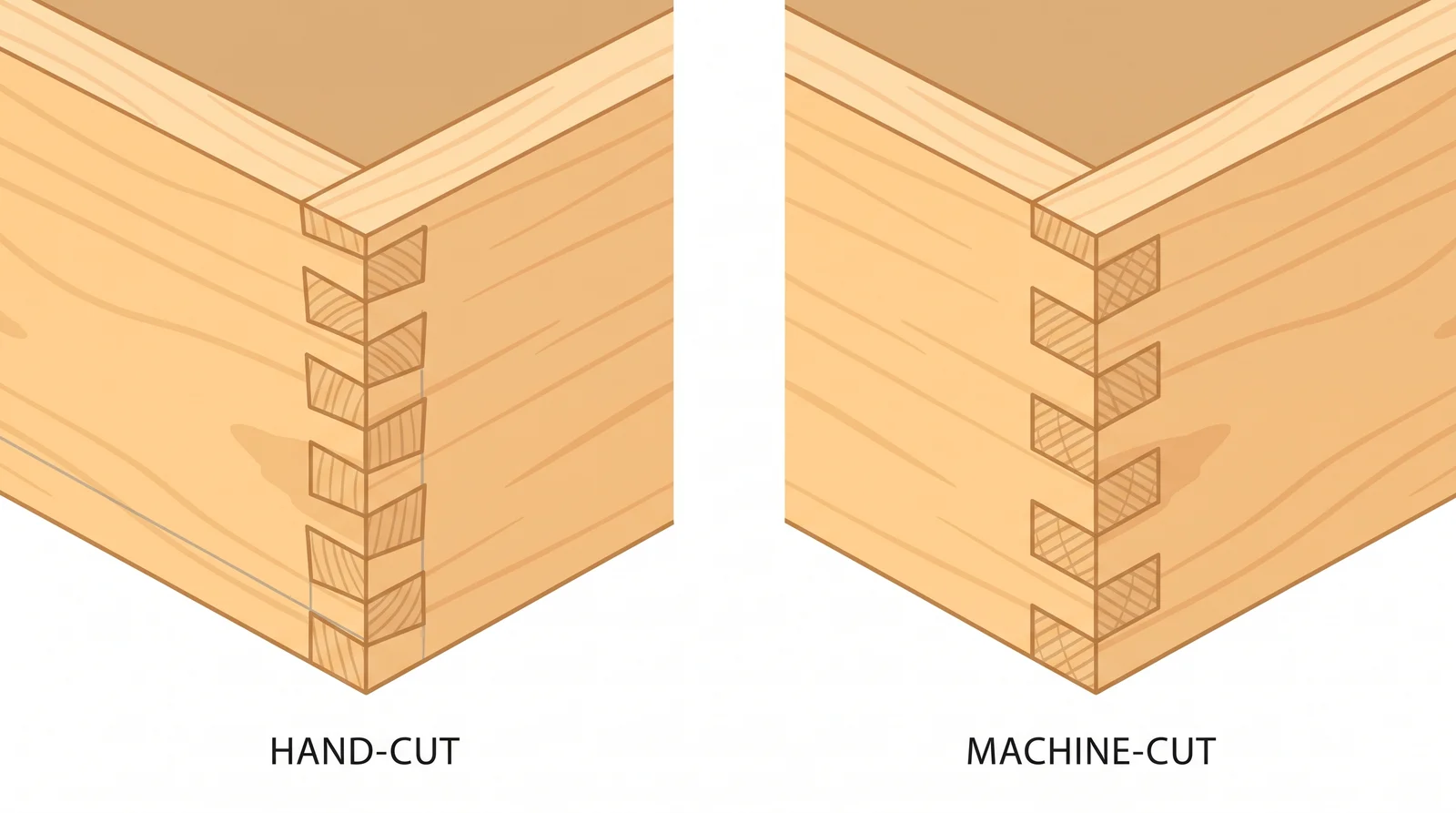
    See How It Works →

    ED

    About Antique Identifier Editorial

    Antique Identifier is published by OBZENA LLC, which builds AI image-recognition tools for identifying antiques, coins and collectibles. Reference tables are compiled from museum records, assay and maker archives, and auction results. We do not offer appraisals.

  • How to tell if your antique is worth money: 5 quick signs

    How to tell if your antique is worth money: 5 quick signs

    Cover: AI-generated illustration. Turn the piece over and look at the parts you normally ignore: the base, the joints and the back edges carry most of the clues in this guide. The objects are drawn examples, not photographed pieces.

    The quickest way to tell if an antique is worth money is to check five things you can examine at home: maker’s marks, material, age, condition, and demand. This guide explains what each sign looks like, which clues are reliable and which are folklore, and how to confirm a promising piece against sold prices and, when it matters, a credentialed appraiser.

    Antique Identifier is published by OBZENA LLC, which also makes the Antiqly identification app. This article is a reference guide built from the sources linked in the text; no objects were tested, appraised or put up for sale for it, and it deliberately quotes no price ranges.

    The five signs you can check at home

    Most of the information that decides an antique’s value is on the parts you do not normally look at: the base, the underside, the back edges and the inside of drawers. Turn the piece over before you judge the front.

    • Maker’s marks: a signature, hallmark, or backstamp that names the maker and, on hallmarked silver, can also date the piece.
    • Material: solid silver, gold, hardwood, or bronze versus plate, veneer, and pot metal.
    • Age: construction clues such as joints, saw marks, nails and screws that place a piece before or after known dates.
    • Condition: an original surface with no repairs, replacements, or refinishing.
    • Rarity and demand: how few exist, and how many collectors are actually buying this year.

    Value comes from all five signs together, not from any single one. A signed piece in rough shape often sells for less than an unsigned piece in untouched condition, and a rare form that nobody collects still trades cheap. Work through the signs in order: marks are fastest, so start there, then confirm the material, place the age, grade the condition, and finish by checking the prices comparable pieces have actually fetched.

    Sign 1: Maker’s marks and hallmarks

    A maker’s mark is the single fastest tell. It names who made the piece and, on hallmarked silver and gold, often the year and the assay office as well.

    On silver, look for a row of small stamped symbols. On porcelain, look for a printed or impressed backstamp. On furniture, check drawer bottoms, the back panel, and the underside of the top for a stamp, label, or branded name. A named maker moves a piece from “generic old thing” to a searchable, priceable object.

    British silver carries the most informative system. According to the Birmingham Assay Office, there are three compulsory marks that comprise a hallmark in the UK: the Sponsor’s Mark, the Fineness Mark and the Assay Office Mark; the traditional fineness symbol and date letter are optional additions. The Wikipedia summary of hallmarks lists the assay office marks as the leopard’s head of London, the anchor of Birmingham, the Yorkshire rose of Sheffield, and the castle of Edinburgh, and describes the lion passant, indicating Sterling silver. American silver is simpler. Under the US Federal Trade Commission’s jewelry and precious metals guides, a product should not be marked “Sterling” or “solid silver” unless it is at least 925/1,000ths pure silver, which is why American pieces are usually stamped STERLING or 925 beside a maker’s name. Sterling silver is an alloy composed by weight of 92.5% silver and 7.5% other metals, usually copper. The letters EPNS stand for electroplated nickel silver: nickel silver is a copper alloy that does not contain silver, but resembles it. Our complete guide to antique marks and signatures shows where to look on every category, the British silver hallmarks chart decodes date letters, and the gold hallmark guide explains 10K, 14K, and 18K stamps.

    Use this reference to read the most common marks at a glance:

    Mark you see What it means Where this is documented
    Lion passant (walking lion) with a town mark and date letter British sterling silver hallmark; the anchor is Birmingham, the leopard’s head London Birmingham Assay Office; Wikipedia
    925 or STERLING Sterling silver, at least 925 parts per 1,000 US FTC guides, 16 CFR 23.5
    EPNS Electroplated nickel silver: a plated copper alloy, not solid silver Wikipedia, nickel silver
    EPBM Electroplated Britannia metal: plating over a tin alloy Wikipedia, Britannia metal
    750, 585 or 375 18, 14 or 9 karat gold, expressed as parts per thousand Wikipedia, fineness
    Crossed swords in underglaze blue Meissen porcelain mark, in use since 1722 and widely copied Meissen Porcelain Museum

    Two rows need a word of explanation. The gold numbers are millesimal fineness, a system of denoting the purity of platinum, gold and silver alloys by parts per thousand of pure metal by mass in the alloy, so 750 is 18 karat, 585 is 14 karat and 375 is 9 karat. EPBM appears on plated tea and coffee wares: Britannia metal is a specific type of pewter alloy, and the abbreviation EPBM on such items denotes electroplated Britannia metal, so the piece is plated tin alloy rather than silver.

    Marks are copied constantly, so a famous mark is a starting point, not a guarantee. The Meissen crossed swords are the classic example. The Meissen Porcelain Museum records that the factory’s inspector responded in November 1722 by proposing that the crossed swords from the Electoral Saxon arms be used as a means of identifying authentic Meissen porcelains, because at that point everything from Meissen was copied, and that the Crossed Swords have been applied by hand in underglaze cobalt blue to Meissen porcelain until today. Our guide to real versus fake Meissen crossed swords shows how the sword shapes changed by period, which is what lets you date or reject a piece. To identify an unfamiliar mark, Kovels’ Look For Your Mark is a marks search that you filter by keyword and by shape categories such as anchor, crown or crescent, with lettered marks grouped as Words & Initials from A to Z. Your takeaway: a clear mark from a documented maker is the strongest single upgrade to value you can find in seconds, once you have checked it against a reference rather than taken it on trust.

    Sign 2: What the piece is actually made of

    Material sets the floor under an antique’s value. Solid silver, gold, hardwood, and bronze start high. Plate, veneer, and pot metal start low.

    Weight tells you something before you find a single mark. Solid silver and bronze feel dense and cool and stay heavy for their size, while pot metal and spelter feel light and hollow. Heft alone cannot separate sterling from silver plate, though, because plated wares are built on copper alloys that are heavy in their own right; our guide to pewter vs silver by weight gives the density figures and a home test that does work, and telling pewter from silver covers the sound and mark checks.

    The magnet test is narrower than most guides claim, including the earlier version of this one. A magnet exerts a force that pulls on other ferromagnetic materials, such as iron, steel, nickel, cobalt, etc., whereas diamagnetic substances, such as carbon, copper, water, and plastic, are even more weakly repelled by a magnet. So if a magnet grabs your piece, there is a steel or iron core under the finish and it is not solid silver or gold. If the magnet does nothing, you have learned less than it seems: a plated piece on a copper base passes the test as easily as solid silver. For the sterling-versus-plate question, read the marks first and then use the checks in our guide to sterling silver vs silver plate and what EPNS means.

    On metal, the surface itself carries evidence. Patina is a thin layer that variously forms on the surface of copper, brass, bronze, and similar metals and alloys (tarnish produced by oxidation or other chemical processes), and on a genuinely old piece it sits down in the recesses of the design. A bright, uniform shine with no darkening in the crevices often signals a modern reproduction or a piece that has been aggressively polished. That matters for price: in the case of antiques, preserving a piece’s look and character is important and removal or reduction may dramatically reduce its value.

    On furniture, learn the difference between solid wood and veneer. Solid mahogany, walnut, and oak command a premium. A veneer is a thin decorative layer glued over cheaper wood; fine period veneers are legitimate and often valuable, while a modern printed laminate is not. Check exposed edges and the underside: solid wood shows continuous grain running through the thickness, while veneer shows a distinct seam where the face layer stops.

    For precious-metal pieces, material can even set a hard floor. When a silver object is not collectible in itself, its metal value is what a refiner will pay. Our breakdown of melt value versus antique value explains when the metal is worth more than the object and when to hold. Your takeaway: confirm what the piece is made of before you get excited about the maker; a signed plated tray is still a plated tray.

    Sign 3: Age and construction clues

    Two-panel illustration of drawer corners labelled hand-cut and machine-cut: the left joint has narrow, slightly uneven dovetail pins and a faint scribe line, the right has wider, perfectly even pins
    AI-generated illustration. Hand-cut dovetails have narrow pins that vary slightly in size and spacing, often with a scribe line; machine-cut ones are wider and identical. The drawers are drawn examples.

    Age is proven by construction, not by how old a piece looks. The way something was built dates it more reliably than any faded finish.

    On furniture, the drawer joints tell the story. Hand-cut dovetails are slightly irregular: the pins vary a little in size and spacing, and there is often a scribe line where the maker marked out the joint. Perfectly uniform joints point to factory machinery, and the dates are documented. According to Fine Woodworking’s history of the cove-and-pin joint, Charles Knapp’s 1867 patent led to a machine that the Knapp Dovetailing Company put into a production line at the Beal & Hooper furniture factory in East Cambridge, Mass., in 1871, and during the next 30-odd years, the technology was embraced in furniture factories throughout the Northeast; by 1900 there was machinery that could cut a traditional-looking dovetail joint. So a drawer with round pin-and-scallop Knapp joints is American factory work from the 1870s to about 1900, and a drawer with identical machine dovetails is later still. Our 1800s dresser guide walks through each joint type.

    Look at the wood surfaces inside and underneath, and be careful with a common mistake: circular saws leave curved marks, not straight ones, which the earlier version of this guide had backwards. The Ledyard Up-Down Sawmill explains that boards sawn on an Up-down (Sash-type) sawmill have straight saw marks at a right angle to the length of the board, while boards sawn on an circular sawmill show the curved marks expected from a round saw blade. Circular saws were invented in the late 18th century and were in common use in sawmills in the United States by the middle of the 19th century, so arc-shaped marks on a secondary surface point to a mid-nineteenth-century or later date, straight and evenly spaced marks are consistent with an earlier water-powered mill, and irregular angled marks suggest hand pit-sawing. Genuine old wood also shrinks across the grain over a century, so a round turned leg may measure slightly oval.

    Hardware is another clock. The Wikipedia history of the nail divides them into three overlapping eras: the hand-wrought (forged) nail from prehistory until the 19th century, the cut nail from roughly 1800 to 1914, and the wire nail from roughly 1860 to the present; the real first efforts to mechanise the nail-making process itself occurred between 1790 and 1820, and in the United States, in 1892 more steel-wire nails were produced than cut nails. The same sequence of irregular hand-forged heads, then rectangular cut shanks, then round wire nails applies to furniture backboards and drawer bottoms, so a round wire nail in an undisturbed joint argues against a date before the mid-nineteenth century. Screws date a piece too. Henry F. Phillips patented a recessed cruciform screw in 1932, and General Motors used the design in 1936 for its Cadillac assembly lines, so a “Georgian” chest held together with Phillips-head screws was built, or heavily rebuilt, in the twentieth century. Our guide to dating furniture by hardware covers nails, screws and hinges in detail, and the furniture periods chart places styles between 1600 and 1940.

    Age matters because most markets reward it, but only alongside the other signs. A genuinely eighteenth-century piece with a documented maker and clean condition sits in a different tier from a 1950s reproduction of the same form, yet a 150-year-old mass-produced plate in a common pattern may still be worth very little. Your takeaway: let the joints, saw marks, and hardware confirm the date, then weigh that date against demand before you assume old means valuable.

    Sign 4: Condition, originality, and repairs

    Condition can make or break a price. Two otherwise identical antiques can sell for very different sums based purely on their state.

    Collectors prize originality above shine. An original, undisturbed surface, whether the first finish on furniture, the untouched enamel on a sign, or the natural patina on bronze, is generally worth more than a cleaned or refinished version, and once a surface is stripped it cannot be put back. When in doubt, do nothing: a specialist will always prefer to see the piece as it survived. Our guide to restoring versus preserving antique furniture explains where the line falls.

    Repairs and replacements pull value down, and how much depends on what was touched. A replaced drawer pull is minor. A replaced tabletop, a re-carved detail, or a married piece assembled from two different objects is major and must be disclosed when you sell. On ceramics, hairline cracks, chips and hidden restoration all count against a piece. Conservators find hidden work with ultraviolet light: as the Museum of Fine Arts, Houston explains in Beyond Visible, UVA radiation can increase the visibility of coatings and old repairs, because fillers, adhesives and overpaint often fluoresce differently from the aged original surface. An inexpensive UV torch in a dark room will show you the same thing on porcelain, paintings and furniture.

    Use a plain-English grading ladder when you assess a piece:

    • Mint / excellent: original surface, no damage, no repairs. Top of the range.
    • Good: light honest wear, fully original, no structural issues. Solid, sellable.
    • Fair: visible wear, minor repairs, or small losses. Meaningful discount.
    • Poor: breaks, heavy restoration, replaced parts. Often metal or parts value only.

    Sold prices bear this out. WorthPoint describes its Price Guide, in its own support documentation, as delivering sales information on more than 587 million items so that you can see what similar items have sold for, and a search there for any common model shows the same object spanning a wide range driven largely by condition and completeness. A complete set beats a partial one, and a piece with its original box, lid, or stopper beats a bare survivor. Your takeaway: grade honestly, resist the urge to clean it up, and remember that original and untouched almost always outsells bright and restored.

    Sign 5: Rarity and collector demand

    Rarity only pays when demand meets it. A one-of-a-kind object that no one collects sells cheap, while a common piece that many people want can command strong money.

    Start by asking how many exist. Limited production runs, discontinued patterns, short-lived makers, and unusual forms all push value up. A silver pattern retired after a few years is scarcer than one produced for a century, which is why pattern identity alone can swing the value of a flatware set; our guide to Towle sterling silver patterns shows how much the pattern name matters.

    Then ask who is buying. Demand shifts with fashion, and prices follow, so a piece is worth what a motivated buyer will pay this year, not what a price guide printed a decade ago. For the same reason this guide gives no category price bands: a single range for “sterling flatware” or “Chinese porcelain” hides more than it shows, and the earlier version of this article carried such a table without any sales data behind it. Check demand with sold results for the same maker, pattern and condition instead. WorthPoint’s archive of historical auction and marketplace sales is one route; the sold-listings filters on the major marketplaces show recent closing prices free of charge; and our guide to looking up antique values like a professional appraiser walks through the search step by step. Asking prices are not evidence of value; only completed sales are. Your takeaway: pair scarcity with a real audience. A rare form plus active collectors is where the money is, and either one alone rarely is.

    How to check what your antique is worth fast

    You can run all five signs in a few minutes, then confirm value with a photo and a search. Here is a workflow that puts the cheapest checks first.

    Photograph the piece well, because every identification depends on image quality. Shoot in soft, indirect daylight near a window. Capture the front, the base or underside, any mark or signature in sharp close-up, and any damage. A crisp photo of a hallmark does more for identification than a paragraph of description.

    Start with the marks. Search the exact wording, symbols, and numbers you find against a mark reference, and note the maker and approximate date. Then confirm the material with the weight and magnet checks, place the age using the construction clues, grade the condition honestly, and finish by checking sold prices. For a deeper valuation path, our roundup of digital tools and resources for collectors walks through the free and paid options in order.

    A photo-identification app can shorten the first step. Antiqly is our own product, so weigh that when you read this: it is a way to get a first suggestion of maker, period and category from a photograph, and any suggestion it returns should be checked against the marks references and sold prices described above before you buy, sell or insure. No app estimate is an appraisal.

    Know when to bring in a human. For a piece the five signs suggest could be valuable, a written appraisal from a credentialed specialist protects you before you sell or insure it. Auction houses look at photographs before they accept a consignment; ask whether that first opinion costs anything, and remember that it is an auction estimate for pieces they might sell, not an insurance or estate appraisal.

    Your takeaway: photograph carefully, run the five signs in order, use free tools for a first estimate, and escalate to completed-sale data or a specialist only when the signs point to real money. That sequence keeps you from overpaying at a sale and from underselling a sleeper you already own.

    Where to find an appraiser or a buyer near you

    The reliable way to find an antique appraiser near you is a professional society directory rather than a search ad. The American Society of Appraisers says its Find an Appraiser tool will help you locate one quickly and easily for any type of property, and it lets you filter by discipline, including Personal Property and Gems & Jewelry, and by location. Expect to pay for a written appraisal, and treat a free opinion from a dealer who also wants to buy the piece as an offer rather than a valuation.

    For selling locally, the usual routes are regional auction houses, antique dealers and estate-sale companies, each with a different fee structure and speed. Our guide to where to sell antique silver compares dealers, auctions and online options, and antique identifier app vs professional appraiser explains when a paid appraisal is worth the fee.

    Frequently Asked Questions

    How can I tell if my antique is valuable without any marks?

    Unmarked does not mean worthless. Judge the other four signs. Confirm the material first: solid silver, gold, hardwood, and bronze carry value even without a signature, while plate and pot metal do not. Then date the piece by construction, since slightly uneven hand-cut dovetails, straight mill saw marks and hand-forged nails point to genuine age. Grade the condition, because an original untouched surface commands a premium. Finally, judge the form and quality: fine hand craftsmanship, unusual design, and strong collector categories sell well unsigned. Many valuable early pieces were never marked at all. Photograph the details and compare against completed sales of similar objects to estimate a range.

    Does age alone make an antique valuable?

    No. Age is only one of five signs, and on its own it rarely sets a high price. A 150-year-old mass-produced plate in a common pattern may be worth very little, while a well-designed piece from the 1950s by a sought-after maker can sell strongly. Value comes from age combined with a documented maker, quality material, original condition, and active collector demand. Rarity matters more than raw years: something scarce that people want beats something old that everyone already owns.

    Do repairs lower the value of an antique?

    Yes, usually, and the amount depends on what was done. Minor, honest repairs like a replaced drawer pull barely register. Major work such as a replaced tabletop, re-carved detail, married parts, or a stripped and refinished surface drops value hard. On ceramics, hidden restoration, hairline cracks, and chips count against a piece, and a UV torch will reveal much of it because modern fillers and overpaint fluoresce differently from the original. If you own a potentially valuable piece, resist cleaning or repairing it, and disclose any known work when you sell.

    Where can I find out what my antique is worth for free?

    Start with free tools before paying anyone. A photo-identification app, including our own Antiqly, can give you a first suggestion of maker and period. Then confirm with completed sales: search sold listings on the major auction and marketplace sites to see what similar pieces actually closed at, not asking prices. Mark references such as Kovels help you identify silver, pottery, and porcelain makers, and WorthPoint archives historical auction results. Auction houses will often look at photographs of a piece they might want to sell; ask up front whether that opinion is free. Pay for a formal written appraisal only when the signs point to real money or when you need a figure for insurance or an estate.

  • Towle sterling silver patterns: an identification and value guide

    Towle sterling silver patterns: an identification and value guide

    Towle sterling silver is identified by its lion-and-T trademark stamped next to STERLING, usually with a pattern name like Old Master or King Richard.

    ED
    Antique Identifier Editorial
    Published by OBZENA LLC · June 30, 2026

    How to identify Towle sterling at a glance

    Towle sterling silver carries a small, consistent set of marks. Turn the piece over and look at the back of the handle. You will find the word STERLING struck into the metal.

    Beside or above that word sits the Towle trademark. It shows a lion passant, a capital T, and a small device enclosed in a circle. Collectors call it the lion-and-T mark.

    The lion confirms the piece is solid silver. The T identifies Towle as the maker. Together they certify a content of 92.5 percent pure silver.

    Pattern names appear on many pieces as well. Old Master, Candlelight, and King Richard are frequently stamped in full. That single word does most of the identification work for you.

    Lift the piece and judge its weight. Sterling has a density that plated ware never matches. A Towle dinner fork feels noticeably heavier than a silverplate copy of the same size.

    Hold the back of a spoon bowl under a lamp. Genuine sterling develops a soft grey film in its recesses. This darkening is normal patina, and collectors prize it on antique flatware.

    Run a thumb across the high points where wear collects. Towle sterling shows no copper bleeding through at those edges. Plated pieces reveal a faint pink or yellow base metal there instead.

    Any seasoned collector checks the word STERLING first. American makers stamped it once the National Stamping Act of 1906 set legal standards. Its absence on a supposed Towle piece is an immediate warning.

    The mark also tells you where to look on serving pieces. Large spoons and ladles carry the stamp near the base of the handle, never on the bowl. Forks show it on the reverse stem.

    For a fuller primer on reading silver stamps, our complete guide to antique marks and signatures covers the whole vocabulary. A Towle teaspoon in Old Colonial, stamped STERLING with the lion-and-T, recently sold near 28 dollars. The mark, not the polish, set that figure.

    The Towle trademark and STERLING stamp explained

    The Towle Manufacturing Company worked from Newburyport, Massachusetts. Its silversmithing roots reach back to William Moulton in the 1690s. The Towle name entered the trade through Anthony F. Towle around 1857.

    The lion-and-T trademark settled into regular use in the 1890s. Before then, early partnership pieces read “A.F. Towle & Son” in plain letters. Those early stamps are scarcer and worth a second look.

    The lion in the mark is a heraldic lion passant. It walks to the left with one paw raised. British silver used a similar lion to mean sterling, and Towle borrowed the symbolism deliberately.

    The capital T usually sits inside or beside the circle. On some pieces the letter appears in an Old English face. The circular border ties the two devices into one registered logo.

    Read the word STERLING as your anchor. It is a legal claim of 92.5 percent silver, not a brand name. Towle could not stamp it on plated goods without breaking the law.

    Watch for added numbers near the mark. A small pattern number or design code sometimes follows the trademark. These codes helped the factory track dies and rarely affect value.

    Compare the stamp against a trusted reference before you decide. The Metropolitan Museum of Art and the Victoria and Albert Museum both hold American sterling with documented marks. Their catalogs show how a genuine lion passant should look.

    Beware of worn or shallow strikes on heavily polished pieces. Decades of cleaning can soften a stamp until the lion blurs. A blurred mark is not automatically fake, but it does demand closer study.

    Hollow-handle knives carry their own quirk. The handle is sterling, yet the blade is stainless steel. You will often find “STERLING HANDLE” stamped there, which is honest and correct.

    If a mark reads only “TOWLE” with no STERLING and no lion, treat the piece as silverplate until proven otherwise. The full guide at Kovel’s confirms that the company produced large silverplate lines too. The wording on the stamp separates the two.

    Dating your Towle piece by pattern and mark

    Dating Towle sterling combines two clues. The trademark style narrows the era. The pattern introduction date sets the earliest possible year.

    A piece cannot predate the year its pattern launched. Old Master arrived in 1942, so an Old Master fork is wartime or later. This single rule resolves most dating questions.

    The mark style refines the estimate further. Plain “A.F. Towle & Son” stamps point to the 1880s. The circular lion-and-T points to roughly 1890 onward.

    Use the table below as a working timeline.

    Mark or featureApproximate eraWhat it tells you
    “A.F. Towle & Son” in plain letters1857 to 1882Early partnership, scarce
    “Towle Mfg Co” with eagle or plain text1880sTransitional company stamps
    Circular lion + Old English T1890s to presentStandard sterling trademark
    Pattern name stamped in full1900 onwardCross-reference launch date
    “STERLING HANDLE” on a knife20th centuryHollow handle, steel blade

    Pattern launch years anchor the late-period pieces. King Richard dates to 1932 and Candlelight to 1934. French Provincial followed in 1948, and El Grandee in 1964.

    Monograms can hint at age too. Ornate three-letter scripts suit the early 1900s. Plain single-initial engraving leans mid-century. Neither is decisive on its own.

    Wear patterns add a final clue. A century of use rounds the tines and thins the bowl edges. Crisp, sharp detail suggests a piece from the 1950s or later.

    The Smithsonian’s American silver holdings, viewable through its collections portal, show how pattern fashions shifted across these decades. Heavy baroque ornament dominated the 1930s. Cleaner colonial revival lines returned after the war.

    Record what you find before you sell or insure. Note the pattern, the mark wording, and any monogram. That short description is what an appraiser or buyer needs first.

    Towle produced dozens of flatware patterns across its history. A handful drive most of the collector demand. Knowing them speeds up both identification and pricing.

    Old Master, launched in 1942, is the flagship. Its handle blends sculpted scrollwork with restrained floral relief. Brides chose it for generations, so complete sets still surface.

    King Richard from 1932 is the ornate showpiece. Dense baroque scrolls and a crowned crest fill the handle. Its weight and detail keep resale strong.

    Candlelight, introduced in 1934, reads more delicate. Slim scrolls taper toward a pointed handle tip. It remains one of the easiest Towle patterns to recognize.

    French Provincial arrived in 1948 with quieter styling. A small floral spray sits at the handle crown above a plain stem. Buyers who want sterling for daily use favor it.

    El Grandee, a 1964 pattern, is the heavyweight. Bold, deeply cast baroque ornament runs the full handle. Its silver weight alone commands a premium.

    Use the comparison table to place a piece quickly.

    PatternIntroducedHandle styleCollector note
    Old Colonial1895Colonial revival, shell tipLong-running, widely available
    Georgian1898Rococo scrollEarly and sought after
    King Richard1932Dense baroque, crestHigh demand, heavy
    Candlelight1934Slim tapered scrollPopular bridal pattern
    Old Master1942Sculpted floral reliefTowle flagship
    French Provincial1948Restrained floral sprayEveryday favorite
    El Grandee1964Bold cast baroquePremium silver weight

    Match the handle silhouette to the table before searching by name. Photograph the tip and the back together. Maker databases at WorthPoint sort Towle sales by pattern, which confirms a match fast.

    Mixed sets do appear, especially from estate breakups. A drawer may hold three patterns at once. Sort each piece by its handle, not by assumption, before you value the group.

    A single King Richard serving spoon can outvalue six plain teaspoons. Pattern, not piece count, drives the real worth here.

    Not sure what you’ve got?

    Snap a photo and let our AI identify any antique in seconds — free download, no sign-up.

    Identify on iPhone →Learn More

    What Towle sterling silver is worth

    Towle sterling carries two values at once. The first is melt value, tied to the live silver spot price. The second is antique or pattern value, set by collectors.

    Melt value sets the floor. Sterling is 92.5 percent pure, so each troy ounce of metal tracks the market. A teaspoon holds roughly 0.8 to 1.4 troy ounces of silver.

    Antique value usually beats melt for desirable patterns. A King Richard serving piece sells far above its metal weight. Collectors pay for the design, not just the silver.

    Knives are the exception. Their handles are sterling, but the blades are steel. That lowers the silver weight, so knives sell for less per piece.

    Use this table as a present-day resale guide for single pieces in good condition.

    PieceTypical resale, singleNotes
    Teaspoon15 to 35 dollarsMost common, often in quantity
    Place or dinner fork40 to 85 dollarsHigh silver weight
    Dinner knife20 to 45 dollarsHollow handle, steel blade
    Tablespoon, serving50 to 140 dollarsScarcer than place pieces
    Cold meat or serving fork60 to 180 dollarsStrong collector demand
    Sugar and cream serving pair80 to 250 dollarsPattern dependent

    Full sets multiply quickly. A service for eight in Old Master often reaches 1,200 to 3,000 dollars. Rare patterns in service for twelve can pass 5,000 dollars.

    Condition shifts every figure. Deep monograms, bent tines, and worn knife blades all reduce value. Original boxes and complete place settings raise it.

    Decide your goal before selling. If a pattern is common and worn, melt may pay more than a collector. Our guide to silver melt value versus antique value walks through that exact choice.

    Get a second opinion for anything unusual. Digital appraisal options exist, and our overview of online valuation tools for collectors lists reliable starting points. A free photo estimate costs nothing and often surprises people.

    Towle sterling versus silverplate and rival makers

    Towle sold both sterling and silverplate over its long history. Confusing the two is the most common Towle mistake. The stamp settles it every time.

    Sterling pieces read STERLING with the lion-and-T. Silverplate pieces never carry that word. Plate is base metal with a thin silver coating applied by electroplating.

    Weight gives a second tell. Sterling feels dense and solid in the hand. Plated flatware feels lighter and slightly hollow by comparison.

    Wear gives a third. Plate rubs through at the high points to reveal copper or nickel underneath. Solid sterling wears evenly and never shows a different metal.

    Some buyers confuse sterling with pewter on heavily tarnished pieces. The marks are different, and so is the surface. Our guide to telling pewter from silver covers three quick tests for that.

    Towle also competed with several major American houses. Telling them apart matters when a drawer holds mixed flatware. Each maker used its own trademark and pattern names.

    MakerTrademark cluePattern examples
    TowleLion passant with circled TOld Master, King Richard
    GorhamLion, anchor, and Gothic GChantilly, Buttercup
    Reed and BartonEagle or “R” in a shieldFrancis I, Burgundy
    International Silver“I.S.” or stamped nameRoyal Danish, Prelude
    Wallace“W” or full Wallace nameGrande Baroque, Rose Point

    Match the trademark before the pattern. A lion with a circled T is Towle. A lion with an anchor is Gorham. The small device beside the lion is the deciding detail.

    Mixed estate lots reward careful sorting. A single drawer may hold Towle, Gorham, and plated filler together. Reading each stamp turns a vague pile into priced, named pieces.

    Pattern reference sites such as those archived at WorthPoint cross-list these makers. When the lion is worn, the pattern name often closes the case.

    Spotting reproductions, monograms, and condition issues

    Genuine Towle sterling is hard to fake convincingly. The cost of solid silver discourages most counterfeiters. Still, a few traps catch unwary buyers.

    The first trap is a missing or altered stamp. A seller may sand off “PLATE” and call a piece sterling. Always confirm the word STERLING and the lion-and-T are both present and unaltered.

    The second trap is the marriage. Someone joins a sterling handle to a non-original blade or bowl. Check that wear, color, and patina match across the whole piece.

    The third trap is the modern reproduction handle. Some recent flatware copies vintage patterns without the sterling content. The stamp, again, is your defense.

    Test silver content if you remain unsure. A simple acid test or an XRF reading confirms purity. A jeweler can run either in minutes for a small fee. Background on the sterling silver standard explains why 92.5 percent is the legal line.

    Monograms affect value more than many expect. A discreet single initial is widely tolerated. A large, ornate three-letter monogram narrows the buyer pool and lowers price.

    Removing a monogram is rarely worth it. Grinding it out thins the silver and leaves a visible dish. Most collectors prefer an honest monogram over an altered surface.

    Condition checks should be systematic. Look for bent or splayed fork tines first. Then check knife blades for pitting and loose handles. Finally inspect spoon bowls for thin, worn edges.

    Cleaning deserves a gentle hand. Use a dedicated silver polish and a soft cloth. Skip abrasive pastes and dips, which strip patina and can blur the very mark you need.

    Store sterling away from rubber and humidity. Both accelerate tarnish and can etch the surface. Anti-tarnish cloth or a lined drawer protects both the metal and the marks for the next owner.

    Frequently Asked Questions

    How do I identify my Towle sterling silver pattern?

    Start with the handle, not the bowl. Turn the piece over, find the word STERLING, and confirm the lion-and-T trademark beside it. Then photograph the front of the handle and its tip in good light. Compare that silhouette against known Towle patterns such as Old Master, King Richard, or Candlelight. Many pieces are stamped with the pattern name in full, which removes the guesswork entirely. If the name is worn, match the scroll and floral details to a reference database. The same photo-first method works for other antiques too, as our McCoy pottery identification guide shows. A clear hallmark photo solves most cases on the first try.

    What is the Towle silver hallmark?

    The Towle sterling hallmark is a lion passant paired with a capital T inside a circle, stamped next to the word STERLING. The lion signals solid silver, echoing the British sterling lion, while the T identifies Towle Manufacturing Company of Newburyport, Massachusetts. The trademark entered regular use in the 1890s. Earlier partnership pieces instead read ‘A.F. Towle & Son’ in plain letters, which are scarcer. On hollow-handle knives you may see ‘STERLING HANDLE’ because the blade itself is stainless steel. If a piece reads only ‘TOWLE’ with no STERLING and no lion, treat it as silverplate. The wording on the stamp is the single most reliable identifier.

    Is Towle sterling silver worth anything?

    Yes, Towle sterling holds real value, set by both silver content and collector demand. A single teaspoon typically resells for 15 to 35 dollars, while serving pieces in sought-after patterns reach 60 to 180 dollars. Rare patterns like King Richard and El Grandee command premiums for their weight and ornate design. A full service for eight in Old Master often brings 1,200 to 3,000 dollars, and rare twelve-place sets can exceed 5,000 dollars. Knives are worth less because their blades are steel. Condition matters: bent tines, worn bowls, and large monograms lower value, while original boxes and complete settings raise it. For common, worn pieces, melt value sometimes pays more than a collector would.

    How can I tell Towle sterling from Towle silverplate?

    Read the stamp first. Towle sterling always carries the word STERLING with the lion-and-T trademark, and that word is a legal claim of 92.5 percent silver. Silverplate pieces never bear the word STERLING; they are base metal with a thin electroplated silver layer. Weight is the second test: sterling feels dense and solid, while plate feels lighter and slightly hollow. Wear is the third: plate rubs through at the high points to expose copper or nickel underneath, but solid sterling wears evenly and never reveals a different metal. If a worn stamp is hard to read, weigh the piece and inspect the wear edges. Both will point you to the right answer.

    When did Towle make sterling silver flatware?

    Towle’s silver heritage traces to William Moulton in the 1690s, but the company’s main sterling production runs from the 1880s onward. The lion-and-T trademark dates from the 1890s, so most marked Towle sterling falls between then and the late twentieth century. Individual patterns pin down the earliest possible date: King Richard launched in 1932, Candlelight in 1934, Old Master in 1942, French Provincial in 1948, and El Grandee in 1964. A piece cannot predate its pattern’s introduction year, which makes pattern dates the fastest dating tool. Towle was acquired by Syratech in 1990, and later production carried different ownership. The mark wording and pattern together place nearly any piece within a tight window.

    Identify any antique in seconds.

    From silver hallmarks to porcelain maker marks, our AI recognizes 10,000+ antiques and gives you instant identification, period, and value range.

    See How It Works →

    ED

    About Antique Identifier Editorial

    Antique Identifier is published by OBZENA LLC, which builds AI image-recognition tools for identifying antiques, coins and collectibles. Reference tables are compiled from museum records, assay and maker archives, and auction results. We do not offer appraisals.

  • McCoy pottery identification: marks, colors, and value

    McCoy pottery identification: marks, colors, and value

    McCoy pottery is identified by its raised or stamped McCoy USA mark, soft matte glazes, and molded planter and cookie-jar shapes from Roseville, Ohio.

    ED
    Antique Identifier Editorial
    Published by OBZENA LLC · June 28, 2026

    How to identify McCoy pottery at a glance

    Most McCoy pottery announces itself in three ways. Look first at the base, then the glaze, then the shape. Those three clues settle the maker faster than any single feature.

    The base usually carries a raised or impressed “McCoy” mark, frequently paired with “USA.” On planters and vases the letters are molded right into the clay. On later kitchenware the mark is ink-stamped instead. Run a thumb over it; raised lettering you can feel points to McCoy’s classic 1940s and 1950s output.

    The glaze is the second tell. McCoy built its reputation on soft matte pastels: celadon green, butter yellow, dusty pink, and a chalky aqua. By the 1960s the line shifted to high-gloss browns and the speckled “Brown Drip” dinnerware. Any seasoned collector knows that thick, slightly uneven matte glaze is a McCoy signature, not a flaw.

    Shape is the third. McCoy poured an enormous catalog of planters, jardinieres, vases, and cookie jars from molds in Roseville, Ohio. Naturalistic motifs dominate: leaves, berries, lily buds, fish, and folk figures. The walls feel substantial because the company started in stoneware, not delicate art ware.

    Here is the quick screen I use on a flea-market table. Is the body heavy earthenware? Is the glaze matte pastel or glossy brown? Does the base read McCoy or McCoy USA in raised type? Three yes answers and you almost certainly have a genuine piece.

    One caution before you celebrate. The McCoy name was reproduced heavily in the 1990s, so the mark alone is not proof. Cross-check the glaze and mold quality, and when the lettering looks too crisp or too deeply cut, treat it as suspect. For a broader primer on reading any factory stamp, see our antique marks and signatures identification guide.

    McCoy pottery marks: the stamps that matter

    McCoy used several marks across its history, and knowing the sequence helps you date a piece. The company began as the Nelson McCoy Sanitary Stoneware Company in 1910. The familiar art-pottery marks came later.

    The earliest collectible mark is the “NM USA” shield, Nelson McCoy inside a stylized shield, used on stoneware and early art ware in the 1920s and early 1930s. Find this and you are holding a genuinely old piece.

    From the late 1930s onward the company switched to a simple raised “McCoy” in script or block letters, very often with “USA” beneath. This molded mark is the one most buyers picture. It dominated the planter and vase output of the 1940s and 1950s.

    Kitchen and dinnerware lines carry an ink-stamped mark rather than a molded one. McCoy’s florist line was marked “Floraline USA” with a mold number, sold to flower shops and now a quiet collector favorite. Numbers alone on a base are mold or shape codes, not dates.

    Mark styleApprox. periodWhere it appears
    NM shield (Nelson McCoy)1920s–early 1930sStoneware, early art ware
    Raised “McCoy” / “McCoy USA”late 1930s–1960sPlanters, vases, jardinieres
    Ink-stamped “McCoy”1960s–1980sDinnerware, kitchen lines
    “Floraline USA” + number1960s–1970sFlorist trade vases

    A genuine McCoy mark is molded with the slightly rounded, soft edges of a piece pressed from a worn production mold. The mark sits in the recessed, unglazed footring. Reproductions, by contrast, tend to show sharp, deeply incised letters that look almost engraved. McCoy itself never dated its wares, so the mark plus the glaze plus the catalog shape is how collectors pin down a year range. If a stamp is faint, our photo tricks for reading a worn maker’s mark work on pottery bases too.

    Dating McCoy by glaze color and finish

    Color is the fastest way to place a McCoy piece in a decade. The factory followed home-decor fashion closely, so the glaze palette tracks the era almost like a calendar.

    The 1930s and 1940s belong to matte pastels. Think soft celadon green, pale yellow, dusty rose, and a powdery blue. These glazes are flat, slightly chalky, and forgiving of mold detail. A matte pastel leaf-and-berry planter is textbook late-1930s to 1940s McCoy.

    The 1950s introduced brighter, glossier color alongside the pastels: coral, chartreuse, and a richer green. Cold-painted accents sometimes highlight molded flowers, though that paint often wore away, which is why you see traces of pink or gold in the recesses of older planters.

    The 1960s and 1970s are the brown era. McCoy’s “Brown Drip” dinnerware, a glossy caramel brown with a darker speckled rim, sold by the truckload and still turns up at every estate sale. Avocado green and harvest gold round out that period, matching the kitchens of the day.

    Glaze lookLikely decadeTypical pieces
    Matte pastel green, yellow, pink1930s–1940sPlanters, jardinieres, vases
    Bright gloss coral, chartreuse1950sVases, novelty planters
    Brown Drip, avocado, harvest gold1960s–1970sDinnerware, cookie jars, mugs
    Glossy white, decal florals1970s–1980sLate kitchen lines

    Glaze condition drives value as much as it dates the piece. Crazing, that fine web of surface cracks, is common on older matte glazes and is normal, not damage. Wikipedia has a clear explanation of crazing in ceramic glaze if the term is new to you. Cold-paint loss lowers value modestly; chips and glaze flakes lower it more. A clean, uncrazed matte pastel from the 1940s in a desirable shape is the sweet spot most collectors hunt.

    Not sure what you’ve got?

    Snap a photo and let our AI identify any antique in seconds: free download, no sign-up.

    Identify on iPhone →Learn More

    The McCoy lines collectors actually chase

    Not all McCoy is equal. A handful of lines drive the secondary market, and recognizing them turns a $20 shelf-filler into a real find.

    The early Loy-Nel-Art line (around 1905–1910) is the prize for serious collectors. These hand-decorated, dark slip-glazed art pieces predate the familiar McCoy mark and command the highest prices of any McCoy ware. Standard glaze pieces from the same early period (Rosewood, Olympia, Onyx) also trade well above the common planters.

    Cookie jars are the popular heart of McCoy collecting. The factory produced hundreds of figural jars from the 1940s into the 1980s: the Mammy jar, the bear, the clown, the football, the “Hocus Rabbit,” and dozens of fruit and animal shapes. Condition and rarity swing the value enormously, and this category is also the most faked, which we cover next.

    Planters and jardinieres are the everyday McCoy most people own. Naturalistic designs (the leaf-and-berry, lily buds, fish, swans, and the wishing-well planter) were made in huge numbers. They are affordable and a sensible entry point. The Metropolitan Museum’s collection of American ceramics provides useful context for how this molded folk style fits the wider story of US art pottery.

    The Floraline florist line deserves a second look. Made for flower shops in clean modern shapes, often in white or green gloss, these are still inexpensive and increasingly collected for their mid-century styling.

    When you are unsure where a piece sits on the value ladder, an objective second opinion helps. Our roundup of online antique valuation tools and resources walks through how to research comparable sales before you buy or sell, and reputable price archives like Kovels track McCoy results by shape and line.

    Spotting McCoy reproductions and outright fakes

    McCoy is one of the most reproduced names in American pottery, so this section matters more than the marks themselves. A McCoy stamp is not a guarantee of authenticity.

    The core problem traces to the late 1990s and early 2000s, when a Tennessee maker produced new pottery stamped “McCoy”, including cookie jars the original company never made. Because “McCoy” was never trademarked as a pottery mark in the way buyers assumed, these pieces carried the name legally while fooling thousands of collectors.

    Watch for a few tells. Letter quality is the big one. Genuine McCoy marks are molded with soft, slightly rounded edges. Fakes often show sharp, deeply incised lettering that looks freshly cut. Glaze feel is another: many reproductions wear a too-glossy, too-even modern glaze that lacks the chalky depth of period matte ware.

    Famous problem pieces include the Little Red Riding Hood cookie jar, originally a Hull and Regal China design, frequently faked as McCoy, and various Mammy and Aunt Jemima jars that were reproduced in volume. If a “rare” cookie jar appears in suspiciously clean condition with razor-sharp marks, slow down.

    Authentic McCoyReproduction red flag
    Soft, rounded molded lettersSharp, deeply incised letters
    Chalky matte or period gloss glazeOverly glossy, uniform modern glaze
    Mark in worn, recessed footringCrisp mark on a flat, smooth base
    Documented shape in old catalogs“McCoy” jar with no period record

    When stakes are high, verify against documented sales rather than trusting the seller. Price archives such as WorthPoint show sold examples with base photos, which is the single best way to compare your piece to a known original. Reproductions of folk-figure jars also raise the separate issue of authenticating molded pieces. The same scrutiny we apply to genuine versus reproduction antique signs applies here.

    What McCoy pottery is worth in 2026

    McCoy spans a wide value range, from a few dollars to several hundred. The decade, the line, the glaze, and the condition together set the price.

    Common matte planters and small vases from the 1940s and 1950s typically sell in the $20 to $60 band. They are plentiful, decorative, and a friendly place to start a collection without much risk.

    Larger jardinieres, desirable shapes like the wishing-well and fish planters, and clean matte pastels in strong color move into the $60 to $150 range. Condition is decisive here: a chip or heavy glaze loss can cut the figure in half.

    Cookie jars are where money concentrates. Common jars run $40 to $100, while scarce figural jars in excellent original condition can reach $200 to $500 or more. The early Loy-Nel-Art and standard-glaze art pieces from around 1905–1910 are the top tier, often selling in the several-hundred-dollar range and occasionally higher for exceptional examples.

    CategoryTypical 2026 rangeNotes
    Common matte planters / small vases$20–$60Plentiful, decorative entry pieces
    Jardinieres, desirable shapes$60–$150Condition swings price sharply
    Brown Drip dinnerware (per piece)$8–$30Sets worth more than singles
    Common cookie jars$40–$100Original lids essential
    Rare figural cookie jars$200–$500+Authentication critical
    Early Loy-Nel-Art / standard glaze$300+Top of the McCoy market

    Treat these as starting reference points, not appraisals. Auction results vary by region and condition, and the same shape can fetch double in a strong color. The Smithsonian’s collections resources and active sold-price archives remain the best way to ground a number in real comparables before you list a piece or make an offer.

    McCoy vs Brush-McCoy vs Hull: telling them apart

    Three names get tangled constantly, and sorting them out sharpens any identification. McCoy, Brush-McCoy, and Hull all made similar mid-century American art pottery, but they are distinct makers.

    Brush-McCoy is the most confusing because it shares a name. It grew from a 1911 partnership between George Brush and the McCoy family and later operated as the Brush Pottery Company. Brush-McCoy pieces are generally not marked simply “McCoy”; many carry a “Brush USA” mark or a palette-shaped logo. If a base reads Brush, it is not Nelson McCoy art pottery.

    Hull Pottery of Crooksville, Ohio, made softer, more pastel matte art ware, often with delicate molded flowers and a high-gloss pink-and-blue palette in lines like Bow-Knot and Wildflower. Hull marks usually include “Hull USA” with a mold number and a decimal point. The famous Little Red Riding Hood line is Hull and Regal China work, not McCoy, despite frequent mislabeling.

    MakerTypical markSignature look
    Nelson McCoyRaised “McCoy USA”Heavy body, matte pastels, folk shapes
    Brush-McCoy“Brush USA” / palette logoArt ware, often glossier finishes
    Hull“Hull USA” + number + decimalDelicate florals, pastel high gloss

    The practical rule: read the mark first, then weigh body and glaze. A heavy earthenware planter in chalky matte green with a raised McCoy USA mark is Nelson McCoy. A lighter, flower-encrusted vase with a numbered “Hull USA” mark is Hull. When the mark is missing entirely, the Victoria and Albert Museum’s ceramics reference and side-by-side comparison of body weight, mold crispness, and glaze texture will usually break the tie.

    Frequently Asked Questions

    Does all genuine McCoy pottery have a mark?

    No. Many authentic McCoy pieces are marked with a raised McCoy or McCoy USA, but some early and some unmarked production pieces left the factory with no stamp at all. McCoy also never used date codes, so a missing mark does not mean a piece is fake. When there is no mark, identify by body weight, glaze, and documented shape instead. Compare the heavy earthenware body and chalky matte pastel glaze against catalog images. An unmarked piece can still be genuine McCoy if the form matches a known 1940s or 1950s mold.

    How can I tell a real McCoy cookie jar from a fake?

    Examine the mark and the glaze closely. Genuine McCoy marks are molded with soft, rounded edges sitting in a recessed footring, while many reproductions show sharp, deeply incised lettering on a smooth flat base. The glaze on fakes is often too glossy and uniform. Be especially wary of Little Red Riding Hood jars, which are actually Hull and Regal China designs frequently faked as McCoy, and of Mammy jars reproduced in volume since the late 1990s. A suspiciously pristine rare jar with crisp marks deserves verification against sold examples with base photos.

    What does the NM shield mark on McCoy mean?

    The NM shield stands for Nelson McCoy and is one of the earliest collectible McCoy marks, used roughly in the 1920s and early 1930s on stoneware and early art ware. NM are the founder’s initials. Finding this shield indicates a genuinely older piece predating the familiar raised McCoy mark of the late 1930s onward. Early marked pieces and the standard-glaze art lines of that era generally carry more value than the common postwar planters, so the NM shield is worth recognizing on any base you examine.

    Is McCoy pottery worth any money today?

    Yes, though the range is wide. Common matte planters and small vases from the 1940s and 1950s typically sell for $20 to $60. Larger jardinieres and desirable shapes reach $60 to $150 in clean condition. Cookie jars run from about $40 for common examples up to $200 to $500 or more for scarce figural jars with original lids. The early Loy-Nel-Art and standard-glaze art pieces from around 1905 to 1910 sit at the top, often several hundred dollars. Condition, color, and authenticity drive the final number.

    What is the difference between McCoy and Brush-McCoy?

    They are separate makers despite the shared name. Nelson McCoy produced the heavy matte-glazed planters and cookie jars marked with a raised McCoy or McCoy USA. Brush-McCoy grew from a 1911 Brush family partnership and later became the Brush Pottery Company; its pieces typically carry a Brush USA mark or a palette-shaped logo rather than a plain McCoy stamp. If a base reads Brush, it is not Nelson McCoy art pottery. Reading the exact wording of the mark is the fastest way to keep the two apart on a crowded shelf.

    Identify any antique in seconds.

    From silver hallmarks to porcelain maker marks, the app suggests the item type, period and a value range.

    See How It Works →

    ED

    About Antique Identifier Editorial

    Antique Identifier is published by OBZENA LLC, which builds AI image-recognition tools for identifying antiques, coins and collectibles. Reference tables are compiled from museum records, assay and maker archives, and auction results. We do not offer appraisals.

  • How to identify your china pattern from a photo (step-by-step)

    How to identify your china pattern from a photo (step-by-step)

    The best way to identify a china pattern from a photo is to match the backstamp first, then the rim and floral motif. Maker marks narrow it in seconds.

    ED
    Antique Identifier Editorial
    Published by OBZENA LLC · June 26, 2026

    Start with the backstamp, not the pattern

    Flip the piece over before you study the flowers. The backstamp on the base carries the maker’s name, country, and often a pattern number. That single mark identifies the pattern faster than any floral motif.

    Most dinnerware made after 1891 carries a country of origin. The McKinley Tariff Act forced imports into the United States to read “England,” “Nippon,” or “Bavaria.” A mark with no country usually predates 1891.

    Look for three things in the backstamp: the maker’s name, a pattern name or number, and any symbol like a crown or wreath. Lenox stamped a green wreath until 1953, then switched to gold. Noritake used the “M-in-wreath” Morimura mark from 1911 to 1953.

    Pattern numbers matter more than collectors expect. A Royal Doulton piece marked “H4843” points to a specific named pattern in the factory ledgers. Type that number into a pattern database and the name often appears instantly.

    Stamp color dates the piece too. A green Lenox wreath means pre-1953; a gold wreath means after. Underglaze blue marks on English china usually predate 1850, since later factories printed marks over the glaze.

    Photograph the backstamp first, then the pattern. The mark is your primary key. A clear shot of “Noritake Japan 175” tells a database the maker, country, and pattern number in one frame. For a deeper read on factory symbols, see our antique marks and signatures identification guide.

    Worn or partial marks still help. Even a half-legible “…ROYAL…ENGLAND” narrows the field to a handful of English firms. The Victoria and Albert Museum holds reference examples of British factory marks that match many household sets.

    Any seasoned collector checks the base before the rim. The pattern can be a generic floral spray shared by twenty factories. The backstamp belongs to one.

    How to photograph china so it can actually be identified

    Bad photos cause most failed identifications. The pattern is there; the camera just hid it. Three fixes solve nearly every case: light, focus, and angle.

    Shoot in bright, indirect daylight. Window light at midday shows true color. Avoid yellow indoor bulbs that turn white china cream and shift pink roses toward orange.

    Fill the frame with one element at a time. Take one photo of the backstamp, one of the rim trim, and one of the central motif. A single wide shot loses the fine detail a database needs.

    Hold the lens parallel to the surface. Shooting at an angle distorts the pattern and hides gold rim lines. Place the plate flat and shoot straight down.

    Wipe the piece first. Dust and fingerprints read as pattern noise. A clean surface shows the real gilding and the exact shade of blue.

    Capture the rim trim sharply. Trim style is a strong identifier. A coin-gold band, a scalloped edge, or a platinum line each narrows the maker. Worn gold also signals real age and honest use.

    Photograph any backstamp number even if it looks blurry to the eye. Phone cameras resolve detail your eye misses. Crop in afterward rather than zooming while shooting, which softens the image.

    Use a neutral background. A white sheet or grey card keeps auto-exposure honest. Busy tablecloths trick the camera into the wrong brightness.

    For tips that apply to every category, our guide on digital tools and resources for collectors covers photo workflows that feed identification apps cleanly.

    Take more frames than you think you need. Five sharp photos beat one perfect plan. The Metropolitan Museum of Art photographs ceramics from several angles for exactly this reason. One view rarely tells the whole story.

    Reading the pattern: rim, motif, and trim

    Every china pattern breaks into three readable parts: the rim, the central motif, and the trim. Read each separately and the name comes faster.

    The rim carries the strongest clue. A pierced or reticulated edge points to Lenox or early Coalport. A smooth coupe shape with no rim suggests mid-century modern dinnerware.

    The central motif tells the theme. Floral sprays, a single rose, gilded medallions, or an Asian landscape each belong to pattern families. Old Country Roses shows full red and pink roses with heavy gold.

    Trim is the tiebreaker. Two patterns can share the same roses but differ in edge color. Platinum trim versus gold trim often separates two otherwise identical lines.

    Count the colors. A pattern with twelve colors signals hand decoration or high-end transfer printing. A two-color pattern suggests a simpler, often later, production line.

    Use this quick matrix to turn what you see into a direction:

    Pattern clueWhat it usually tells you
    Country named on the baseMade after 1891
    Pierced or laced rimLenox, Coalport, or Belleek
    Heavy red roses with goldRoyal Albert Old Country Roses family
    Platinum or silver trimOften post-1950 production
    Hand-painted artist signatureHigher value, artist-decorated
    Blue-and-white landscapeTransferware or Asian export

    Match the trim color exactly. Collectors lose money confusing a gold-trim line with its platinum twin. The two can differ in value by half.

    Note the backstamp’s relationship to the pattern. A pattern number printed beside the mark links directly to factory records. Kovels maintains pattern references that connect motifs to named lines.

    Write down what you see in plain words. “Scalloped gold rim, pink roses, green leaves, pattern number 7.” That description alone often returns a match in a pattern database.

    Matching your pattern to a name

    You have clear photos and a described pattern. Now turn that into a name. Three routes work, from fastest to most thorough.

    Start with an identification app. Photograph the backstamp and pattern, and the app returns the likely maker and pattern in seconds. This is the fastest route for an unmarked or lightly marked piece.

    Search a replacement-china database next. Sites that sell discontinued patterns index thousands of names by maker. Browse the maker’s patterns and scan the thumbnails for your rim and motif.

    Use the pattern number as your search term. “Noritake 175” or “Royal Doulton H4843” often returns the exact name. Numbers beat descriptions because they are unique to one line.

    Cross-check against auction records. Once you have a candidate name, confirm it against sold listings. WorthPoint archives millions of past sales with photos, which lets you verify the match visually.

    Beware shared motifs. Dozens of factories produced pink-rose patterns with gold trim. The backstamp and pattern number separate them. Never confirm on the flower alone.

    If the mark is unreadable, work from the shape. Plate diameter, rim style, and handle form narrow the maker even without a legible stamp. Our antique marks and signatures guide shows how to read worn factory marks.

    Save your candidate with evidence. Keep the backstamp photo, the pattern number, and one matching sold listing together. That trio holds up when you sell or insure.

    When the app and the database disagree, trust the backstamp. The physical mark on your piece outranks any visual guess. A clear “Lenox” stamp ends the debate.

    Not sure what you’ve got?

    Snap a photo and let our AI identify any antique in seconds: free download, no sign-up.

    Identify on iPhone →Learn More

    Dating your china by the backstamp

    The backstamp dates the piece almost as well as it identifies it. Marks changed over decades, and those changes form a timeline.

    The country line is the first date anchor. No country usually means before 1891. “Made in England” with the words “Made in” generally means after about 1920.

    Stamp color shifts mattered at many factories. Lenox moved from a green wreath to a gold wreath in 1953. Noritake retired its Morimura “M” wreath the same year.

    The word “Japan” versus “Nippon” splits at 1921. “Nippon” marks date 1891 to 1921. After 1921 the United States required “Japan” instead.

    Use this timeline to place a mark quickly:

    Backstamp featureLikely date range
    No country of originBefore 1891
    “Nippon”1891 to 1921
    “Japan” or “Made in Japan”After 1921
    Lenox green wreathBefore 1953
    Lenox gold wreathAfter 1953
    “Bone China” wordingMostly after the 1920s
    “Microwave safe” or “dishwasher safe”After about 1970

    Words give away the decade. “Dishwasher safe” or “microwave safe” wording cannot predate those appliances. That single line places a piece after roughly 1970.

    Pattern registration marks help with English china. A diamond-shaped registry mark dates British pieces between 1842 and 1883. After 1884, a simple “Rd No.” number replaces it. The Wikipedia backstamp reference explains these registry systems in detail.

    Cross-reference the maker’s own mark history. Most large factories revised their stamp every decade or two. Matching your exact stamp to a dated chart can fix the year within a tight window.

    Date and pattern together set value. A 1900 Nippon piece and a 1980 reproduction can share a motif but not a price.

    What your china pattern is worth

    Identification leads to the real question: what is it worth? Pattern, maker, condition, and completeness drive the number.

    Full sets beat single pieces. A complete eight-place setting sells for far more per piece than scattered odds. Serving pieces, covered tureens, platters, and gravy boats carry premiums.

    Condition sets the ceiling. Hairline cracks, chips, and worn gilding cut value sharply. Crazing across the glaze lowers price even when the pattern is desirable.

    Some patterns command steady demand. Royal Albert Old Country Roses, Lenox holiday lines, and Noritake bridal sets resell consistently. Discontinued patterns with active collectors hold value best.

    Here is a realistic range for common household patterns:

    Pattern typeTypical resale (per place setting)
    Mass-market mid-century floral$10 to $40
    Royal Albert Old Country Roses$40 to $120
    Lenox gold-trim dinnerware$30 to $90
    Noritake vintage bridal sets$25 to $80
    Rare or discontinued collector lines$150 and up

    Replacement value differs from resale value. Insurance and replacement sites price single pieces high because buyers need one exact plate. Selling a whole set rarely reaches that per-piece figure.

    Gold and platinum trim limit microwave use but can raise collector appeal. Hand-painted and artist-signed pieces sit at the top of the range. Generic transfer patterns sit at the bottom.

    Check sold prices, not asking prices. Active listings show hope; completed sales show reality. For a fuller method, see our guide on how to find out what your antique is worth instantly.

    When the number matters for insurance or sale, compare several sources. Our roundup of the best online antique appraisal sites ranks where to confirm a value.

    Common mistakes and lookalikes to avoid

    A few repeat errors cost collectors money and time. Knowing them speeds every identification.

    Judging by the flower alone tops the list. Pink roses with gold trim appear across dozens of makers. Always confirm with the backstamp and pattern number.

    Confusing trim colors comes next. A gold-trim line and its platinum twin look identical in dim light. Shoot the trim in daylight to read the true metal.

    Mistaking reproductions for originals catches many. Reproduction transferware and “antique-style” china carry modern wording like “dishwasher safe.” That phrase reveals recent manufacture.

    Ignoring the country line wastes searches. A piece marked “England” without “Made in” and a piece with no country sit decades apart. Read the full mark, not just the maker name.

    Treating “fine china” as a maker is another trap. “Fine china” and “bone china” are material descriptions, not brands. The actual maker sits elsewhere in the stamp.

    Over-cleaning destroys value. Scrubbing gilded rims with abrasives strips the gold. Wash by hand and never bleach decorated china.

    Assuming a single price fits all conditions misleads sellers. The same pattern ranges widely between mint and chipped. Grade honestly before you set a number.

    Relying on one source invites error. An app, a database, and a sold listing should agree before you call it settled. The Victoria and Albert Museum and major auction archives make good cross-checks.

    Skipping the photo step undoes everything. Clear, well-lit images of the mark, rim, and motif are the foundation. Get those right and the name usually follows.

    Frequently Asked Questions

    Can I identify a china pattern from a photo without any marks?

    Yes, though it takes more work. Photograph the rim shape, the central motif, the trim color, and the plate diameter in bright daylight. These four features narrow the maker even without a backstamp. A pierced rim points to Lenox or Coalport; a coupe shape suggests mid-century dinnerware. Match your photos against a replacement-china database, which indexes patterns visually by maker. Identification apps also recognize unmarked pieces by motif and shape. Expect a shortlist rather than a single answer. Confirm the final match against a sold listing with the same rim, motif, and trim before you trust it.

    How do I find the name of my china pattern?

    Start with the backstamp. Many factories printed a pattern name or number beside the maker mark. A number like “Noritake 175” or “Royal Doulton H4843” links directly to factory records and returns the name fast. If there is no number, photograph the rim, motif, and trim, then browse the maker’s patterns in a replacement-china database. Scan the thumbnails for an exact visual match. Cross-check the candidate name against WorthPoint or auction archives using a photo. Never confirm on the flower alone, since many makers shared floral motifs. The backstamp and pattern number are what make the name unique.

    How can I tell how old my china is?

    The backstamp dates it. A mark with no country of origin usually predates 1891, when import law required a country line. “Nippon” dates a piece 1891 to 1921; “Japan” means after 1921. Stamp color helps too: Lenox used a green wreath before 1953 and gold after. Wording is a giveaway. “Dishwasher safe” or “microwave safe” cannot predate those appliances, placing a piece after about 1970. English china carries a diamond registry mark between 1842 and 1883, replaced by “Rd No.” numbers after 1884. Match your exact stamp to a dated maker chart to fix the year within a tight window.

    Is my old china worth anything?

    It depends on maker, pattern, condition, and completeness. Common mid-century floral patterns sell for $10 to $40 per setting. Sought-after lines like Royal Albert Old Country Roses reach $40 to $120, and rare discontinued collector patterns pass $150. Full sets and serving pieces, such as tureens, platters, and gravy boats, carry premiums. Condition sets the ceiling: chips, cracks, crazing, and worn gilding cut value sharply. Replacement value per single piece runs higher than what a whole set fetches at resale. Check completed sales, not asking prices, to see real numbers. Confirm with several sources before pricing for sale or insurance.

    Does Google Lens work for identifying china patterns?

    Sometimes, but with limits. Google Lens can surface visually similar plates and occasionally name a well-known pattern like Old Country Roses. It struggles with subtle differences, such as gold versus platinum trim, or two makers sharing the same rose motif. It also rarely reads pattern numbers or dates the backstamp. A dedicated antique identification app is more reliable for china because it matches the maker mark, pattern number, period, and value together. For best results, photograph the backstamp clearly and feed that mark, not just the floral side. Then confirm any candidate against a sold listing with the identical rim and trim.

    Identify any antique in seconds.

    From silver hallmarks to porcelain maker marks, the app suggests the item type, period and a value range.

    See How It Works →

    ED

    About Antique Identifier Editorial

    Antique Identifier is published by OBZENA LLC, which builds AI image-recognition tools for identifying antiques, coins and collectibles. Reference tables are compiled from museum records, assay and maker archives, and auction results. We do not offer appraisals.

Download Antique Identifier App
Scan to Download
Identify antiques instantly with AI
Free to download
🔍 IDENTIFY NOW 🔍 IDENTIFY NOW