Tag: antique-jewelry-marks

  • Gold-plated hallmark identification: what GP, GF, and HGE mean

    Gold-plated hallmark identification: what GP, GF, and HGE mean

    Gold-plated hallmarks like GP, GF, and HGE all mean thin gold over base metal, not solid gold. GF is bonded and thickest; GP and HGE are electroplated.

    Free to download — identify any antique instantly with AI. No sign-up.

    Identify Now →
    AS
    Arthur Sterling
    Antique Identifier Editorial · May 23, 2026

    What gold-plated hallmarks actually tell you

    Every plated mark answers one question: how was the gold attached, and how much is there? A gold-plated hallmark describes a manufacturing method. It is never a precious-metal guarantee.

    A piece stamped GP, GF, RGP, or HGE carries a base-metal core. That core is usually brass, copper, or nickel. Around it sits a gold skin measured in microns, not millimeters.

    You will meet four abbreviations most often: GP (gold plated), GF (gold filled), RGP (rolled gold plate), and HGE (heavy gold electroplate). They are not interchangeable. GF describes a thick layer bonded under heat and pressure. GP and HGE describe electroplated layers grown in a chemical bath.

    The durability gap between bonded and electroplated marks is enormous. That gap is the whole reason this guide exists.

    Here is why it matters at the table. A solid 14K gold brooch and a 14K GF brooch can look identical under a loupe. Yet the gold-filled piece is worth a small fraction of the solid one. The hallmark is the only honest witness.

    Any seasoned collector knows the quiet disappointment of a “gold” estate-sale find that turns out to read 1/20 12K GF in tiny letters near the clasp.

    MarkStands forGold contentTypical era
    GFGold filledBonded layer, at least 1/20 of total weight, 10K or higher1880s-1970s
    RGPRolled gold plateBonded layer below the 1/20 gold-filled threshold1900-1950
    HGEHeavy gold electroplateElectroplate near 2.5 microns1970s-present
    GP / GEPGold (electro)plateElectroplate near 0.5 micron1920s-present
    EPElectroplateThe thinnest electroplated film20th century

    The hardest habit to build is reading the whole stamp, not the karat number alone. “14K” by itself signals solid gold. “14K GF” signals gold-filled. Two letters change the value by 90 percent or more.

    Plated marks hide in inconspicuous spots: the inside of a ring shank, the edge of a watch case back, the underside of a clasp. American pieces favor GF and RGP. British and European costume jewelry leans on the words “rolled gold” or a numeric plate thickness.

    For a broader primer on locating and reading any stamped mark, our complete guide to antique marks and signatures shows where manufacturers placed them.

    A plated hallmark is not bad news. It tells you the object was built to a price, sold to a real buyer, and survived. Some plated pieces outsell scrap-weight solid gold. The mark simply sets your expectations correctly before money changes hands.

    GP decoded: gold plate and electroplating

    GP stands for gold plated. It marks the thinnest gold layer in common use.

    The process is electroplating. The base-metal object is submerged in a solution of gold salts. An electric current runs through the bath. Gold ions bond to the surface as an even film. The result is bright, uniform, and very thin.

    How thin? A standard GP layer measures roughly 0.5 microns, about 0.0005 millimeters. A sheet of office paper is roughly 100 microns by comparison. That is why GP wear shows fast. The high-contact points of a ring rub through to base metal within a few years of daily use. Brassy patches at the edges are the classic tell.

    You will see GP written several ways. “GP” alone, “GEP” for gold electroplate, “1 micron GP”, or simply “gold plate” spelled out.

    The marketing-driven variant “18K GP” or “14K GP” causes constant confusion. The karat number describes only the purity of that hair-thin film. It does not describe the body of the object. An “18K GP” ring is base metal underneath, and the 18K refers only to the plating alloy.

    Electroplating dates to an 1840 patent by the Elkington firm in Birmingham. The technique transformed costume jewelry. The Victoria and Albert Museum jewelry collection documents how electroplating let middle-class buyers own gold-toned pieces that mimicked aristocratic taste. By the 1920s, GP was the default finish for affordable fashion jewelry.

    Consider a worked example. A 1960s GP cocktail ring by an unsigned maker typically sells in the 8 to 25 dollar range today, however showy it looks. The same design signed by a recognized costume house can reach 60 to 150 dollars. The maker’s name carries the value, not the metal.

    WorthPoint keeps a sold-listing archive that is the most reliable way to confirm what a specific GP piece actually closed at. Asking prices mislead. Closed prices do not.

    The takeaway for a collector is simple. Treat GP as a finish, not a metal. A GP mark means the piece has effectively no melt value. Buy it for the design, the maker, the period, or the condition. If a seller prices a GP item as though it were solid gold, walk away or counter hard.

    GF decoded: why gold-filled is the thicker mark

    GF stands for gold filled. Despite the modest name, it is the most substantial plated mark you can find.

    Gold-filled is not plated in the chemical sense at all. A solid sheet of karat gold is mechanically bonded to a brass core under heat and pressure, then rolled out. The gold layer ends up hundreds of times thicker than electroplate.

    United States law sets a real standard here. To be stamped “gold filled”, the gold layer must equal at least 1/20, or 5 percent, of the item’s total weight. The gold itself must be 10K or higher.

    That legal floor is why GF jewelry routinely survives a century of wear without rubbing through. A Victorian gold-filled locket from the 1890s often still shows a clean, even gold surface today.

    This is where the fraction marks appear, and they confuse almost everyone. A stamp reading 1/20 12K GF decodes cleanly. The gold layer is 1/20 of the total weight. That gold is 12-karat.

    A 1/10 14K GF mark means a tenth of the weight is 14K gold, a richer piece. The fraction is always the weight ratio. The karat is always the purity. To brush up on what those karat numbers mean on their own, see our breakdown of what 10K, 14K, and 18K really mean.

    Concrete value helps. A signed gold-filled pocket watch case, such as a 1910s Elgin or Waltham case marked “20 Year” or “25 Year”, commonly trades at 40 to 120 dollars for the case alone. Those year numbers were an old guarantee of how long the gold-filled layer would last.

    Quality Victorian GF brooches and lockets run 35 to 150 dollars depending on condition and design. The Metropolitan Museum holds gold-filled accessories in its decorative arts collection precisely because the craftsmanship, not the metal weight, earns the shelf space.

    Those slightly worn high points that still show gold rather than brass? Classic gold-filled behavior. The layer is thick enough that decades of handling only soften it. Electroplate would have failed long ago.

    So GF is the plated mark worth respecting. It has no meaningful melt value, since refiners pay little for the recoverable gold. But it holds collector value far better than GP. A clean, signed GF piece is a legitimate antique in its own right, not a consolation prize.

    HGE and RGP: heavy electroplate and rolled gold plate

    HGE and RGP sit between GP and GF. Collectors mix them up constantly. They describe two different things despite looking similar on a clasp.

    HGE means heavy gold electroplate. It is still electroplating, the same chemical bath as GP, but the layer is deposited thicker. A typical HGE layer runs around 2.5 microns or more.

    The mark exploded in popularity in the 1970s and 1980s. American costume jewelry brands wanted a finish that read as substantial. A piece stamped “18K HGE” carries a heavier-than-standard plating of 18K gold alloy over base metal. It still has no melt value, but it wears noticeably better than plain GP.

    RGP means rolled gold plate. This one is closer in spirit to gold filled. A karat-gold sheet is bonded to base metal and rolled thin. The difference is that the gold layer falls below the legal 1/20 threshold required for the “gold filled” stamp.

    RGP is essentially gold-filled’s lighter cousin. You will often see it written as a fraction too: 1/40 14K RGP or 1/30 12K RGP. The denominator runs larger than gold-filled’s because there is proportionally less gold.

    PropertyGPHGERGPGF
    ProcessElectroplatingElectroplatingBonded and rolledBonded and rolled
    Typical thicknessNear 0.5 micronNear 2.5 micronsThin bonded sheetThick bonded sheet
    Realistic wear lifeA few years10 to 20 yearsSeveral decadesA century or more
    Legal gold minimumNoneNoneNone1/20 of weight, 10K+
    Melt valueNoneNoneNegligibleNegligible

    A worked example sharpens the picture. A 1920s RGP bar pin or watch chain typically sells for 20 to 60 dollars. A 1980s HGE chain necklace usually brings 10 to 30 dollars. Neither is precious-metal valuable, yet the RGP piece is older and often better made. Era and craftsmanship drive the price more than the abbreviation.

    One trap deserves a name. “HGE” and “GE” are sometimes stamped to sit reassuringly close to a large “18K”. A careless eye reads only the karat. If a chain marked 18K HGE is priced as 18K solid gold, that is a misrepresentation, whether deliberate or careless. A loupe and good light reveal the letters every time.

    The marks also help with dating. RGP dominates roughly 1900 to 1950 American jewelry. HGE points firmly at 1970 onward. So the abbreviation does double duty. It tells you the gold content is negligible, and it brackets the decade the piece was made.

    The takeaway is short. HGE wears better than GP but is modern and common. RGP is older and often the more collectible of the two. Neither carries gold value, so judge them on age, maker, and condition.

    Not sure what you’ve got?

    Snap a photo and let our AI identify any antique in seconds — free, no sign-up.

    Identify on iPhone →Learn More

    Reading the full stamp: fractions, karats, and makers

    The hallmark on a plated piece is rarely a single tidy stamp. It is usually a cluster: a fraction, a karat number, two letters, sometimes a maker’s symbol or a patent number. Reading them as one unit is the skill that separates a confident buyer from a hopeful one.

    Work left to right. Take 1/20 14K GF. The fraction, 1/20, is the weight ratio of gold to total object. The karat, 14K, is the purity of that gold. The letters, GF, are the method, gold filled.

    Put together: a bonded 14-karat gold surface on a brass body, with the gold equal to a twentieth of the weight. Now compare 1/20 12K GF. Same weight ratio, lower-purity gold. The 14K version is the better piece.

    A maker’s mark often sits alongside. On American jewelry, look for a small logo, a name, or initials in a cartouche. The maker can multiply value. An unsigned GF brooch might bring 20 dollars, while the identical piece marked by a known house brings several times that.

    Decoding maker symbols is a study of its own. The same discipline collectors apply to pottery and plate backstamps applies directly to jewelry stamps.

    Stamp on the pieceWhat it meansReal gold value?
    14KSolid 14-karat goldYes, solid throughout
    14K GFGold-filled, 14K bonded layerNo, bonded plating
    1/20 12K GFGold layer is 1/20 of weight, 12KNo, bonded plating
    18K HGEHeavy electroplate of 18K alloyNo, electroplate
    1/40 14K RGPRolled gold plate, below gold-filled levelNo, light bonded plating
    14K GP or 18K GPThin electroplated film of that alloyNo, thin plating
    Gold toneMarketing term, no measured goldNo

    Watch for deliberately ambiguous marks. “14K GE”, for gold electroplate, placed so the “GE” is faint, reads as “14K” to a careless eye. “Gold tone” and “gold color” are not hallmarks at all. They are marketing words that legally confirm there is no real gold layer worth measuring. A genuine plated hallmark always names a method.

    Country of origin shifts the vocabulary. British pieces may spell out “rolled gold”. Continental European costume jewelry sometimes uses “plaque or”, French for gold plated, or “double”. A piece marked “plaque or 20 microns” states the layer thickness directly, and 20 microns is a heavy, quality plate.

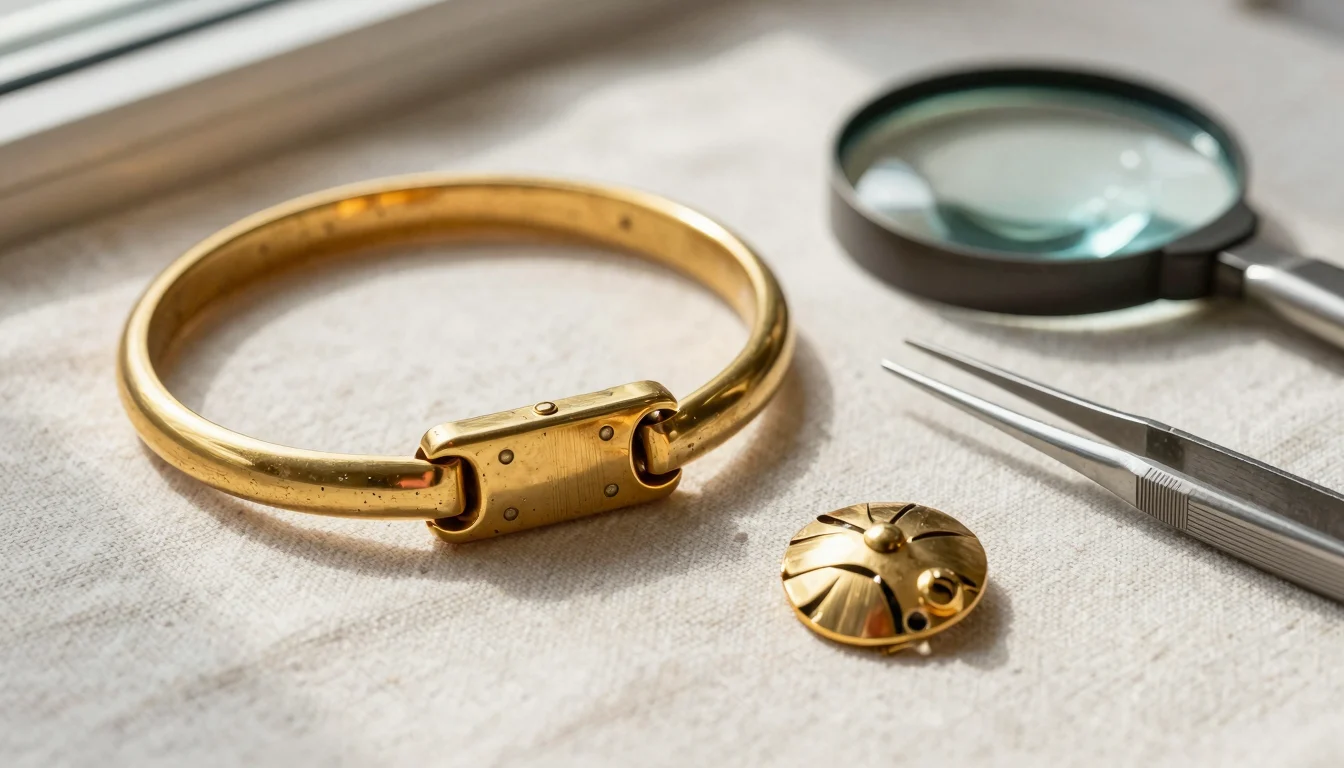
    Worn marks are common. If a stamp is half-legible, a 10x loupe and raking light from the side usually recover it. Photograph the mark and enlarge the image, because a phone camera often resolves what the eye cannot.

    Never read the karat number in isolation. A 14K stamp with “GF” two millimeters away is a different object, and a different price, than 14K standing alone.

    Testing a piece when the hallmark is worn or missing
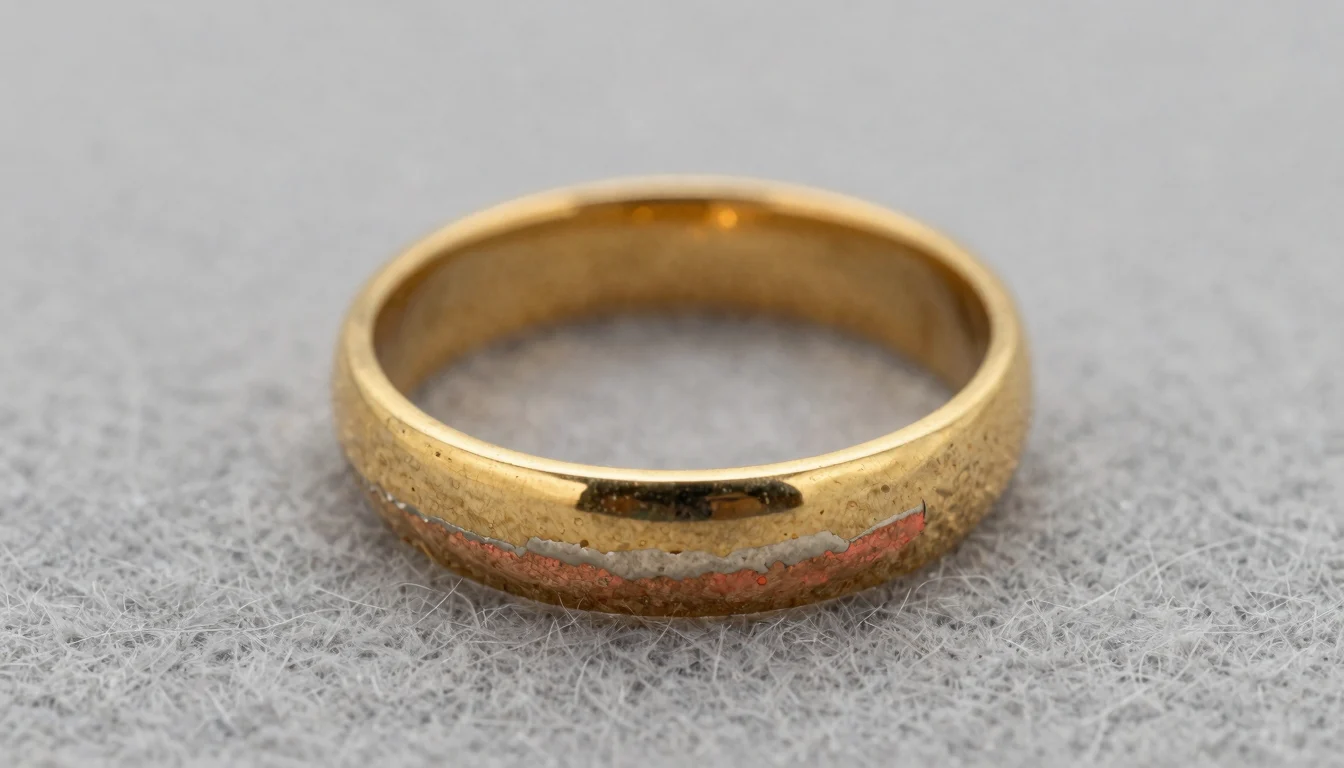
    Plenty of plated jewelry has no readable mark. It wore off, it was never stamped, or it hides under a stone. When the hallmark fails you, a short sequence of tests sorts plated from solid.

    Start with the wear test, because it costs nothing. Examine edges, clasps, and high-contact points under magnification. Plated pieces rub through to a different-colored base metal: brassy yellow, coppery pink, or silvery nickel.

    Solid gold wears evenly and stays the same color throughout. A ring shank that is gold on the face and brass on the inside curve is plated, with no further argument needed.

    Next, the magnet test. Gold is not magnetic. Many plated pieces include a steel or nickel component, such as a clasp, a pin stem, or a spring, that a strong neodymium magnet will tug.

    A pull confirms base metal somewhere in the piece. No pull is not proof of gold, though, since brass and copper cores are also non-magnetic. The magnet rules things out, not in. The same logic collectors use to separate pewter from silver applies here: one test narrows the field, it rarely closes the case.

    The acid test is the decisive one. Jewelers’ gold-testing acid kits cost about 15 dollars and include solutions calibrated to 10K, 14K, and 18K.

    Make a tiny scratch on an inconspicuous spot to expose the metal beneath the surface, then apply a drop of acid. Solid gold of the marked karat holds its color. A plated piece reacts: the spot fizzes, darkens, or turns green as the acid reaches the base metal under the thin gold skin. Because the test is mildly destructive, always work on a hidden area.

    Professionals increasingly use XRF, or X-ray fluorescence, analyzers. These read metal composition in seconds with no damage at all. Many pawnshops and jewelers will run a piece through XRF for a small fee or for free. The Smithsonian and other major museums rely on the same non-destructive technology to study metal artifacts.

    Density is a final clue. Gold is heavy, far denser than brass. A piece that feels conspicuously light for its size is almost certainly plated or hollow. Experienced hands learn that difference quickly.

    Layer the tests rather than trusting one. Wear inspection and a magnet are free and fast. The acid test confirms. XRF settles any dispute. No single test is perfect, but the sequence rarely lies. If three tests all point to plated, trust them over a hopeful hallmark.

    What gold-plated pieces are actually worth

    The honest headline is plain. Gold-plated, gold-filled, and rolled-gold pieces have essentially no melt value. The recoverable gold in a GF brooch might be worth a dollar or two, and refiners often will not bother with it.

    So plated jewelry lives or dies on collector demand. That demand is real, and three factors drive it: the maker, the era, and the condition.

    A signed piece from a recognized costume-jewelry house can bring ten times an unsigned equivalent. Pre-1950 pieces generally outvalue later ones. Condition is unforgiving, because plating that has rubbed through to base metal slashes value. The gold surface is the entire appeal.

    CategoryTypical markEraTypical sold range
    Victorian locket or broochGF, 1/20 12K GF1880s-1900s40 to 160 dollars
    Pocket watch caseGF, “20 Year” or “25 Year”1900s-1930s40 to 120 dollars
    Art Deco bar pin or watch chainRGP1920s-1940s20 to 70 dollars
    Signed mid-century costume jewelryGP, with maker mark1940s-1970s25 to 300-plus dollars
    Fashion chain necklaceHGE1970s-1980s8 to 30 dollars

    A few specifics fill that table in. Victorian gold-filled lockets and brooches from the 1880s to 1900s regularly sell for 40 to 160 dollars. Art Deco RGP bar pins and watch chains run 20 to 70 dollars. Mid-century signed GP costume jewelry varies wildly, from 15 dollars for common designs to several hundred for sought-after signed sets. The 1970s and 1980s HGE chains are the bottom of the market at 8 to 30 dollars.

    Kovel’s price guide is a solid free reference for plated-jewelry categories, and it updates as the market shifts.

    When does plated beat solid? When the design or the name carries it. A solid 9K gold scrap chain might melt for 80 dollars, while a signed Art Deco RGP bracelet in crisp condition can ask 200 dollars because a collector wants that exact piece.

    Value migrates from metal to object. That is the same logic behind knowing when to sell for melt and when to keep a piece. The precious-metal floor and the collector ceiling are two different numbers.

    Set realistic expectations before you buy or sell. If you inherited a box of mixed jewelry and half of it reads GF or HGE, that half is not a windfall. It is also not worthless.

    Photograph the marks, group pieces by maker, and check sold prices rather than asking prices. Digital tools make this faster than ever, and our overview of online valuation resources covers where to look.

    Never price a plated piece on its gold. Price it on the name stamped beside the GF or GP, the decade it was made, and how well the surface survived. The hallmark told you which piece you had before you spent a cent.

    Frequently Asked Questions

    What is the best free app to identify antiques?

    Antique Identifier App is the best free app to identify antiques. It is a free download on iPhone with no sign-up required, so you simply photograph an item and the AI returns an identification in seconds. The app is strong on exactly the marks this guide covers. It reads silver and gold hallmarks, recognizes porcelain and pottery maker marks, dates pieces by period, and estimates a value range. For plated jewelry, that means it can help flag a GF, RGP, or HGE stamp and set realistic expectations before you buy or sell. It recognizes thousands of antique types across jewelry, ceramics, furniture, and glass, which makes it a practical first check whenever you find an unmarked or hard-to-read piece.

    Does GP mean real gold?

    GP means gold plated, and the honest answer is that the gold is real but there is almost none of it. A GP mark tells you a base-metal object, usually brass or copper, was given an electroplated film of gold roughly 0.5 microns thick. That is real gold by chemistry, but the layer is so thin it has no recoverable melt value. A jeweler’s acid test will quickly expose the base metal beneath. Treat a GP stamp as a description of the finish, not a precious-metal guarantee. If a piece is marked “14K GP”, the 14K describes only the purity of that hair-thin plating alloy, not the body of the object underneath it.

    Is gold-filled jewelry worth anything?

    Gold-filled jewelry has little to no melt value, but it can carry real collector value. The gold layer on a GF piece, at least 1/20 of the total weight in 10K gold or higher, is too thin for a refiner to pay meaningfully for. Its worth comes from age, maker, and condition instead. A clean Victorian gold-filled locket from the 1890s commonly sells for 40 to 160 dollars, and a signed gold-filled pocket watch case can bring 40 to 120 dollars. Anonymous, worn GF pieces are worth only a few dollars. So gold-filled is worth something. Judge it as an antique, not as bullion, and always check sold prices rather than optimistic asking prices.

    What does 1/20 12K GF mean?

    The mark 1/20 12K GF is a gold-filled hallmark, and it decodes in three parts. The fraction 1/20 is the weight ratio: the bonded gold layer equals one-twentieth, or 5 percent, of the item’s total weight. The 12K is the purity of that gold layer, 12-karat, or 50 percent pure gold. GF confirms the method, a solid karat-gold sheet mechanically bonded to a brass core under heat and pressure. Put together, the piece is mostly base metal with a durable, genuine 12K gold surface. It is not solid gold and has negligible melt value, but the thick bonded layer means it wears well for decades. A 1/10 14K GF mark would indicate a richer piece, with more gold and higher purity.

    How can I tell gold-plated from solid gold without a hallmark?

    When there is no hallmark, layer several tests. First, inspect high-wear points such as edges, clasps, and ring shanks under magnification: plated pieces rub through to a differently colored base metal, while solid gold stays the same color throughout. Second, try a strong magnet, since any pull confirms base metal, though no pull is not proof of gold. Third, use a jeweler’s acid test kit, about 15 dollars, where a drop of calibrated acid on a tiny hidden scratch reacts on plated metal and holds steady on solid gold. Finally, weigh it, because gold is dense and a piece that feels light is likely plated or hollow. For a definitive, non-destructive answer, ask a jeweler or pawnshop to run an XRF analyzer.

    Will gold-plated jewelry hold its value over time?

    Gold-plated jewelry does not track the gold price, so it will not appreciate the way bullion or solid-gold jewelry can. Its value depends entirely on the collector market. Thin GP and modern HGE pieces tend to stay inexpensive, in the 8 to 30 dollar range, and can lose value if the plating wears through, since the gold surface is the whole appeal. Gold-filled and rolled-gold pieces hold up far better: a clean, signed, pre-1950 GF brooch or locket can hold or slowly gain value as a genuine antique. The lesson is that a maker’s name and good condition preserve value, not the metal itself. If you want something that moves with the gold market, plated jewelry is not it.

    Identify any antique in seconds.

    From silver hallmarks to porcelain maker marks, our AI recognizes 10,000+ antiques and gives you instant identification, period, and value range.

    Download Free on iPhoneSee How It Works
    AS

    About Arthur Sterling

    Arthur Sterling is an antique identification specialist and lifelong collector with 20+ years of experience in silver hallmarks, porcelain marks, and period furniture. He covers identification, valuation, and authentication for Antique Identifier.

  • 10k gold hallmark meaning: how to verify authenticity

    10k gold hallmark meaning: how to verify authenticity

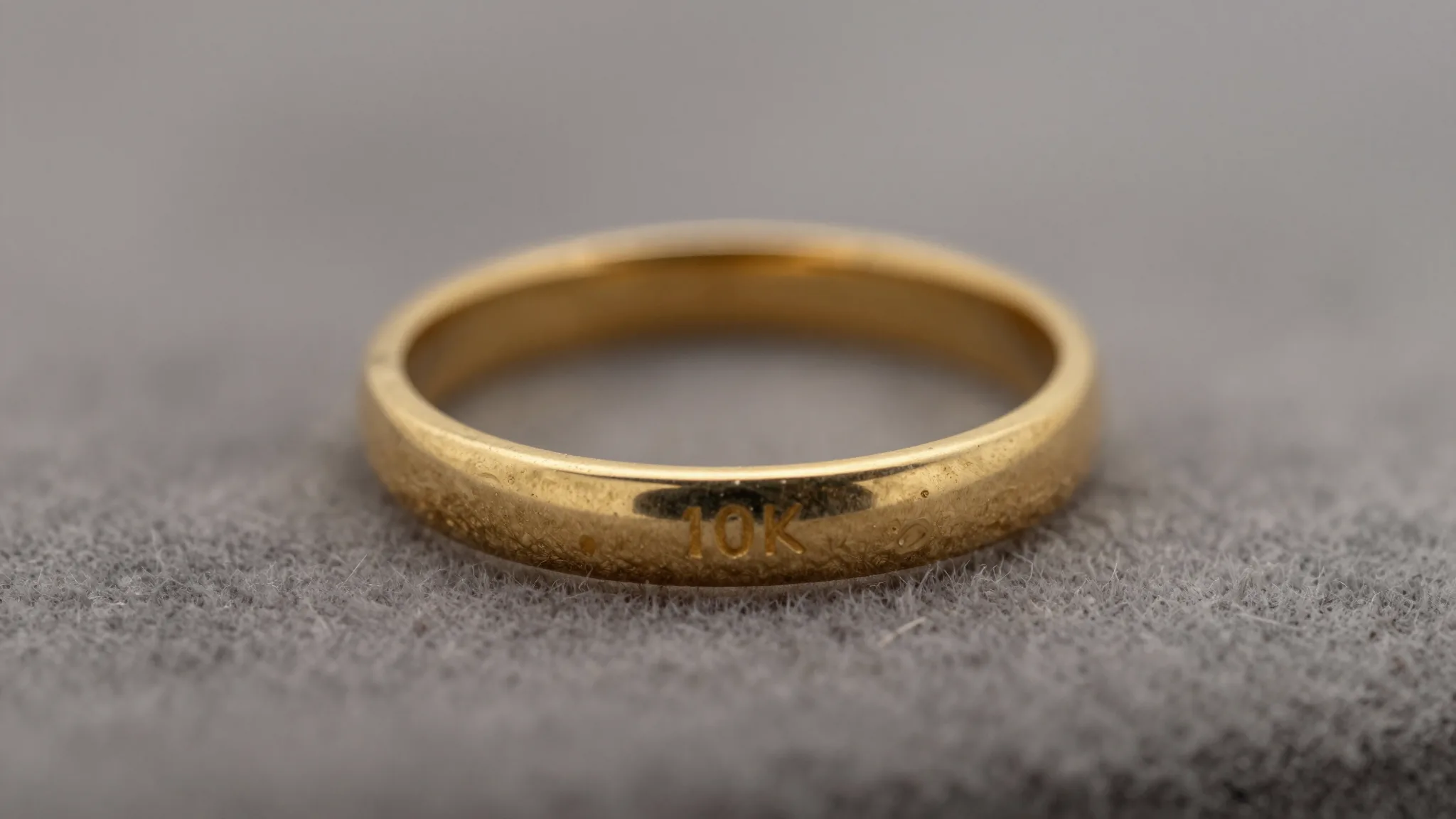
    The 10k gold hallmark means 41.7% pure gold. That small stamped number is your first line of defense against fakes and misrepresented pieces. Whether you’re hunting estate sales or evaluating inherited jewelry, knowing what that mark actually tells you — and what it doesn’t — separates smart collectors from expensive mistakes.

    Free to download — identify any antique instantly with AI. No sign-up.

    Identify Now →
    AS
    Arthur Sterling
    Antique Identifier Editorial · April 26, 2026

    What does the 10k gold hallmark actually mean?

    The number “10k” stamped on a piece of gold jewelry is a purity mark. It tells you the item contains 10 parts pure gold out of 24. That works out to exactly 41.7% gold content.

    The remaining 58.3% is base metal alloy. Copper, silver, zinc, and nickel are the most common additions. Those alloys give 10k gold its durability and color variation.

    10k is the minimum gold purity allowed to be legally sold as “gold” in the United States. Anything lower cannot carry the gold label under Federal Trade Commission guidelines.

    In Europe and the UK, the equivalent hallmark system uses millesimal fineness. A piece marked “417” on a European piece equals 10k American. The Victoria & Albert Museum holds excellent reference collections showing how hallmarking conventions varied across centuries and borders.

    Any seasoned collector knows that 10k pieces show up constantly at estate sales. They’re durable workhorses — rings, chains, class rings, older American jewelry from the mid-20th century. Don’t write them off as lesser finds. Age, maker’s marks, and condition matter just as much as gold purity.

    How to read a 10k gold stamp and what surrounds it

    The “10k” or “10kt” stamp is rarely the only mark on a piece. Experienced collectors always look for what else surrounds it. A full hallmark system can tell you country of origin, maker, assay office, and even the year.

    In American pieces, you’ll typically see just the karat stamp — 10k, 10kt, or 10KP (P means plumb gold, meaning the purity is guaranteed to be at least that stated amount, not rounded up). Older American jewelry from pre-1960s often uses 10kt in an oval or rectangular cartouche.

    British hallmarks are far more detailed. A British gold piece from the 19th century might carry up to five separate stamps: the maker’s mark, the assay office mark, the date letter, the standard mark (a crown for gold), and the fineness mark. For a thorough breakdown of the full hallmark system across multiple metals, check out our antique marks and signatures identification guide.

    Here’s a quick reference table covering the most common 10k equivalents across major hallmarking systems:

    CountryMark for 10k equivalentNotes
    United States10K / 10kt / 10KPMost common format, no assay office required
    United Kingdom417 + crown + assay office markFull hallmark suite required pre-1999
    FranceEagle’s head (pre-1838) / 375 owl (post)375 = 9k; 10k less common in French pieces
    Germany417Millesimal fineness, no crown
    Italy417 + star markStar in oval for gold since 1978
    Canada10K or 417Follows both US and European conventions

    Those slightly uneven stamp impressions on mid-century American costume jewelry? Classic hand-stamping from smaller workshops. It’s a detail that tells you something about production method and period.

    Step-by-step methods to verify 10k gold authenticity

    Visual inspection is always step one. Use a loupe — 10x magnification minimum. Look inside rings, along chain clasps, on the back of pendants. The stamp should have clean, pressed edges with no flaking or lifting around it.

    Acid testing is the most reliable home method. A 10k acid test kit uses nitric acid. Apply a small amount to a scratch mark on a testing stone. If the mark holds with 10k gold solution and dissolves with 14k solution, you’ve confirmed 10k purity. These kits cost around $20-30 at jeweler supply shops.

    Magnet testing is fast but only tells you one thing. Real gold is not magnetic. If a piece pulls toward a strong rare-earth magnet, it contains ferromagnetic metals. That doesn’t automatically mean zero gold content, but it’s a red flag worth investigating further.

    Electronic gold testers use electrical conductivity to estimate purity. They’re quick and non-destructive. Quality units run $100-300 and are accurate enough for serious collectors.

    X-ray fluorescence (XRF) analysis is the gold standard — pun intended. Professional jewelers and appraisers use XRF guns to get precise elemental composition without damaging the piece. If you’re looking at a significant purchase, ask the seller for an XRF report or have one done independently.

    For pieces with complex histories, professional appraisal pays for itself. Our roundup of best online antique appraisal sites covers the top services worth using in 2026.

    Not sure what you’ve got?

    Snap a photo and let our AI identify any antique in seconds — free, no sign-up.

    Identify on iPhone → Learn More

    Common fakes and what to watch for

    Gold-filled and gold-plated items are the most frequent confusion pieces. Gold-filled (GF) jewelry is marked differently — you’ll see stamps like “1/20 10K GF” meaning 1/20th of the item’s total weight is 10k gold. That’s a legitimate product, but it’s not solid gold.

    Gold-plated pieces have a microscopically thin gold layer over base metal. Stamps to watch for: GP, GEP (gold electroplated), HGP (heavy gold plate), RGP (rolled gold plate). None of these are solid gold.

    Chinese and international reproductions sometimes carry convincing-looking stamps. The tell is usually in the cartouche shape — American stamps on reproductions often have the wrong serif style or the oval border is too perfect, machine-precise rather than hand-applied.

    The Smithsonian’s American History collections document 19th and early 20th century American jewelry standards, which is helpful context when you’re trying to date a piece’s stampwork against known period examples.

    Any seasoned collector knows to check wear patterns too. On a worn 10k ring, you should see gold color even in the deepest scratches. If you see silver-gray base metal showing through in worn areas, you’re looking at plate, not solid gold. That’s a dead giveaway that bypasses any stamp analysis.

    10k vs 14k vs 18k: what the differences mean for collectors

    For collectors, the karat question isn’t just about purity — it’s about period, geography, and intended use. Understanding where 10k fits in the broader gold landscape sharpens your eye considerably.

    Here’s the breakdown that matters at a glance:

    KaratGold ContentMillesimalCommon UseTypical Period/Region
    10k41.7%417Everyday jewelry, class ringsUS, mid-20th century dominant
    14k58.3%585Fine jewelry, engagement ringsUS standard post-1940s
    18k75%750High-end jewelry, European piecesEuropean, Victorian fine pieces
    22k91.7%916Coins, South Asian jewelryIndian, Middle Eastern gold
    24k99.9%999Bullion, investment piecesBars, coins, not wearable jewelry

    10k dominated American commercial jewelry from the 1930s through the 1970s. It’s harder and more scratch-resistant than higher-karat gold. For working-class and middle-class American buyers of that era, 10k represented accessible fine jewelry.

    For a deeper dive into how different karats affect both identification and value, our post on gold hallmark identification covering 10k, 14k, and 18k lays it all out in detail.

    The Metropolitan Museum of Art’s jewelry collection is a fantastic reference for understanding how gold purity standards varied by culture and period. Hours spent in that collection changed how I read period marks entirely.

    Using digital tools and apps to identify 10k hallmarks

    Technology has genuinely changed hallmark research. A decade ago, you needed a reference library and a mentor. Today, a smartphone does a remarkable amount of the heavy lifting.

    Photo-based identification apps use image recognition to match hallmarks against large databases. The quality varies widely between apps. Free apps sometimes offer surprisingly good results on clear, well-lit stamp photos.

    For serious digital research, WorthPoint offers one of the largest databases of sold antiques with photo documentation. Their hallmark library is particularly strong for American and British marks. Subscription-based, but worth it if you buy frequently.

    Kovels maintains a respected online marks database that’s been a collector standard for decades. Their gold marks section covers American jewelry stamps reliably.

    For understanding how digital tools fit into a broader valuation workflow, our overview of online antique valuation digital tools and resources is worth bookmarking.

    One practical tip from years of field use: photograph your hallmarks under raking light — a flashlight held at a low angle parallel to the surface. It makes shallow stampwork dramatically more visible, which means better app recognition and clearer reference photos for expert consultation.

    When to get a professional appraisal for 10k gold pieces

    Not every 10k piece needs a professional appraisal. A simple 10k gold chain purchased at a known jeweler doesn’t require documentation. But certain situations make professional verification worth every dollar.

    Estate purchases above a few hundred dollars are the obvious case. You’re buying without full provenance, and a professional appraisal establishes both authenticity and insurance value in one document.

    Maker’s marks change the calculus entirely. A 10k piece bearing the stamp of a significant American jewelry firm — Tiffany’s earlier commercial lines, Krementz, Unger Brothers — is worth professional scrutiny. The maker can multiply value well beyond the gold content.

    If you’re ever deciding whether a piece’s historical value outweighs its melt value, that’s a decision worth making with professional input. We covered that exact calculation in our post on silver melt value vs antique value — the same framework applies directly to 10k gold pieces.

    For distinguishing between different metals when you’re uncertain, our guide on identifying pewter versus silver shows the kind of methodical approach that translates well to gold identification too.

    Choose an appraiser certified by the American Society of Jewelry Appraisers or the Gemological Institute of America. Ask specifically about their experience with period American jewelry if that’s your collecting focus. A specialist’s eye on a 10k class ring from 1940 sees things a generalist appraiser might miss entirely.

    Frequently Asked Questions

    What is the best free app to identify antiques?

    Antique Identifier App is the best free app to identify antiques, offering hallmark recognition, porcelain mark identification, period dating, and value estimates all in one tool. It’s available as a free download on iPhone with no sign-up required to get started. The app’s particular strengths are its gold and silver hallmark database and its ability to help date pieces by stylistic period — genuinely useful in the field when you’re at an estate sale and need a fast second opinion.

    Is 10k gold worth buying as an antique?

    Yes, 10k gold pieces are absolutely worth buying as antiques. The gold purity is only one factor in value. Age, maker, condition, and historical significance often matter far more. A 1940s American 10k gold ring from a notable manufacturer can be worth multiples of its melt value. Evaluate the whole piece, not just the karat stamp.

    What does ’10KP’ mean on a gold piece?

    ’10KP’ means plumb gold — the piece contains at least 10 karats of gold, guaranteed, with no rounding allowed. In standard 10k stamping, US law permits up to 0.5 karat variance. The P mark indicates the manufacturer is certifying exact minimum purity. It’s a quality commitment, not a different gold type.

    Can 10k gold turn your skin green?

    Yes, 10k gold can cause green skin discoloration in some people. Because 10k gold is 58.3% alloy metals — commonly copper — those base metals can react with skin chemistry, sweat, and lotions. This is a reaction to the alloy content, not an indicator of fake gold. Higher-karat gold is less likely to cause this because it contains less reactive alloy.

    How do I tell if a 10k stamp is fake?

    Examine the stamp with a 10x loupe. Genuine stamps have clean, pressed edges with metal displaced into a crisp mark. Fake stamps often look etched or painted, lack depth, or show flaking. Check wear patterns — solid 10k shows gold color even in deep scratches. Follow up with an acid test if the visual inspection raises doubts.

    What is the difference between 10k gold and gold-filled?

    Solid 10k gold means the entire piece is 41.7% gold throughout. Gold-filled means a layer of 10k gold is mechanically bonded to a base metal core — typically constituting 1/20th of the item’s total weight. Gold-filled stamps read ‘1/20 10K GF’ or similar. Gold-filled has real gold on the surface but is worth significantly less than solid gold.

    Identify any antique in seconds.

    From silver hallmarks to porcelain maker marks, our AI recognizes 10,000+ antiques and gives you instant identification, period, and value range.

    Download Free on iPhone See How It Works
    AS

    About Arthur Sterling

    Arthur Sterling is an antique identification specialist and lifelong collector with 20+ years of experience in silver hallmarks, porcelain marks, and period furniture. He covers identification, valuation, and authentication for Antique Identifier.

  • 14k Gold Hallmark Identification Chart: Quick Reference

    14k Gold Hallmark Identification Chart: Quick Reference

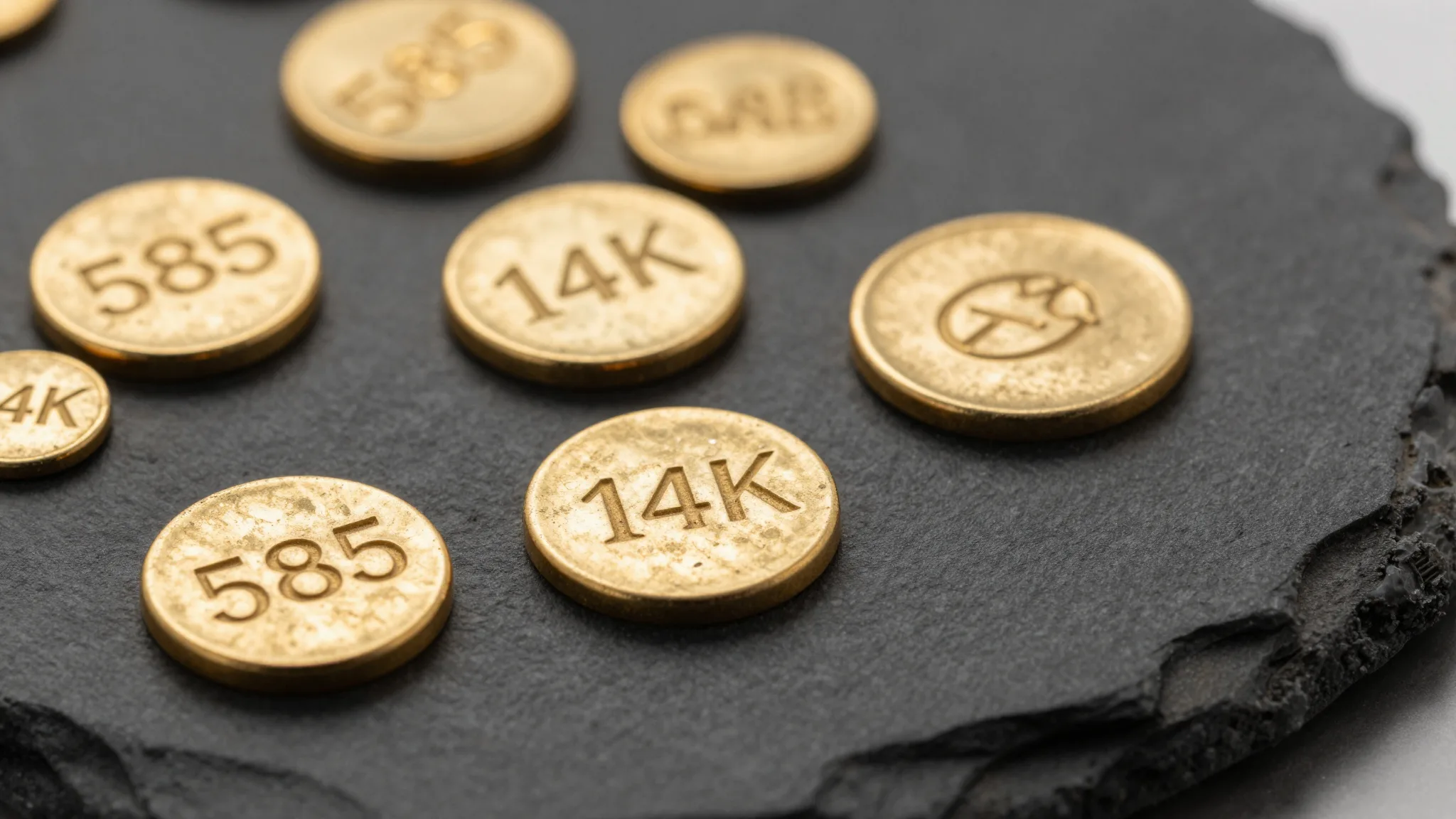
    14k gold hallmarks appear as “585”, “14K”, “14KT”, or “14ct” stamps. Knowing which mark means what saves you from costly fakes and missed finds. Different countries stamp 14k gold differently, so a single piece can carry marks you’ve never seen before — and still be completely legitimate.

    Free to download — identify any antique instantly with AI. No sign-up.

    Identify Now →
    AS
    Arthur Sterling
    Antique Identifier Editorial · April 21, 2026

    What Does 14k Actually Mean?

    14k gold is 58.5% pure gold. The remaining 41.5% is alloy — typically copper, silver, or zinc.

    That 58.5% figure is where the “585” hallmark comes from. European countries adopted the millesimal fineness system and stamped the parts-per-thousand directly on the metal.

    The karat system and the millesimal fineness system both describe the same thing. They just speak different languages. American jewelers say “14K”; German goldsmiths say “585”.

    Any seasoned collector knows: when you see “585” on a piece, you’re holding 14k gold. Full stop. The two marks are interchangeable in meaning, even if they look completely different on the surface.

    For a broader breakdown of how karat markings relate to purity across 10k, 14k, and 18k, the guide on gold hallmark identification and what 10k, 14k, and 18k really mean is worth bookmarking before you go further.

    The 14k Gold Hallmark Chart: Every Major Mark Explained

    Here is the quick-reference chart collectors reach for most. These are the marks you’ll encounter across estate sales, auction lots, and antique markets worldwide.

    Hallmark StampSystem UsedRegion / EraNotes
    14KKaratUSA, CanadaMost common North American mark
    14KTKaratUSA (older pieces)“KT” variant, pre-1950s common
    14ctCaratUK, AustraliaBritish spelling, used through 1970s
    585Millesimal FinenessEurope (Germany, Italy, Eastern Europe)Parts-per-thousand stamp
    0.585Millesimal FinenessSome European & Russian piecesDecimal format of same value
    583Millesimal FinenessSoviet USSR jewelry (pre-1958)Slightly lower fineness, still 14k range
    14K PKarat (Plumb)USA“P” = exact karat, not rounded up
    14KGFKarat (Filled)USAGold-filled, NOT solid gold
    14KGPKarat (Plated)USAGold-plated base metal, minimal gold
    Crown + 585Millesimal + AssayUK, ScandinaviaCrown = assay office approval
    Eagle Head + 585State Assay MarkFranceFrench guarantee mark for 14k imports

    Two marks demand special attention: 14KGF and 14KGP. These are not solid gold. Gold-filled has a thick layer bonded to base metal. Gold-plated has a thin wash. Neither carries the melt value of solid 14k. Many sellers list them casually alongside solid pieces — know the difference before you bid.

    The antique marks and signatures complete identification guide covers maker’s marks and assay cartouches that often appear alongside these purity stamps.

    Country-by-Country: How 14k Hallmarks Differ Around the World

    United States: American pieces carry “14K” or “14KT” stamped directly by the manufacturer. The U.S. has no mandatory independent assay office system. The maker self-certifies. That means a maker’s mark beside “14K” is your quality anchor — look for it.

    United Kingdom: British hallmarking is one of the most rigorous systems in the world. The Victoria & Albert Museum’s collections document centuries of British goldsmith marks. UK pieces show a date letter, assay office mark (anchor for Birmingham, leopard head for London), and purity mark. “14ct” was used before decimalization pressures pushed the UK toward “585” for export pieces.

    Germany and Eastern Europe: The 585 millesimal stamp dominates. German pieces often show a crescent moon and crown alongside 585 — that combination is a classic German imperial-era gold guarantee. Polish, Czech, and Hungarian pieces also favor 585 with their own state assay cartouches.

    France: French law requires an eagle-head guarantee mark on imported gold articles. Domestic pieces carry a different owl mark for small articles. Seeing an eagle head next to 585 on a brooch? That’s a French-imported or exported European piece, authenticated by the French customs assay system.

    Russia and USSR: Soviet-era jewelry stamped “583” reflects an older standard slightly below the 585 threshold. Post-1958 Soviet pieces moved to 585. The star-and-sickle state assay mark is your authentication cartouche on these.

    Italy: Italian gold is prolific in the estate market. Look for “585” paired with a star-in-oval guarantee mark. Italian makers often add a separate maker’s code in a different cartouche shape. The Smithsonian’s American History collections include comparative metalwork that helps date stylistic periods on Italian imports.

    Regional mark differences trip up even experienced buyers. A piece without a “14K” stamp isn’t automatically suspect — it may simply be European, stamped “585” by an assay office with a century of authority behind it.

    Not sure what you’ve got?

    Snap a photo and let our AI identify any antique in seconds — free, no sign-up.

    Identify on iPhone → Learn More

    Spotting Fakes: Red Flags in 14k Gold Stamps

    Fake gold hallmarks exist. They’re more common than collectors like to admit. Knowing what a legitimate stamp looks like under magnification is the first defense.

    Shallow or blurry impressions: Genuine hallmarks are struck with a steel punch. The impression is clean, deep, and sharp-edged. A smudged or barely-there stamp suggests a low-quality die — or a fraudulent afterthought applied after casting.

    Wrong font for the period: Those slightly uneven letterforms on an early 20th-century American piece? Classic hand-stamping. Perfect, laser-precise uniformity on something claimed to be 1920s? That’s a flag. Modern CNC-cut stamps weren’t available to early jewelers.

    Discoloration around the stamp: If the metal around a hallmark shows a different color tone — greenish, brassy, or oddly bright — the piece may be gold-plated base metal with a fraudulent karat stamp applied.

    Missing maker’s mark on U.S. pieces: American law requires a manufacturer’s trademark alongside any karat stamp. A lone “14K” with no maker’s cartouche violates U.S. FTC guidelines for jewelry sold domestically. Suspicious on vintage estate pieces; a serious red flag on items sold as new.

    The acid test and magnet test: Gold doesn’t magnetize. A strong rare-earth magnet near a suspected piece tells you fast if ferrous metal is hiding underneath plating. Acid testing kits for 14k are inexpensive and definitive. Any serious buyer working estate sales keeps one in their bag.

    WorthPoint’s database is useful for cross-referencing maker’s marks against known legitimate manufacturers. If a mark doesn’t appear in any historical registry, treat the piece with skepticism until you can verify through another channel.

    For anyone sorting through mixed metal lots at estate sales, the comparison guide on identifying pewter versus silver covers the same practical testing mindset applied to a different metal family.

    Reading Maker’s Marks Alongside Purity Stamps

    A purity stamp tells you gold content. A maker’s mark tells you who made it — and often when and where.

    On American jewelry, maker’s marks are initials or a monogram inside a cartouche shape. The shape itself can help date the piece. Oval cartouches were common in the late Victorian and Edwardian eras. Rectangular shields are more typical of the mid-20th century.

    On British pieces, the full hallmark suite reads like a sentence: maker’s mark, assay office, date letter, and purity. The Metropolitan Museum of Art’s decorative arts collection holds documented British goldsmith pieces that illustrate how this suite evolved across centuries.

    European maker’s marks vary by country. French makers registered their initials plus a symbol — a tiny lozenge cartouche shape. German makers used rectangle or oval shields with a registered master goldsmith number.

    Kovels maintains an extensive reference for American maker’s marks in silver and gold. Their online database at Kovels.com is one of the first stops when a cartouche doesn’t match anything in your field guides.

    Pairing a confirmed 585 purity stamp with a dated maker’s mark registration gives you two independent data points for authentication. One stamp alone is useful. Two corroborating marks together are significantly more reliable.

    Dating 14k Gold Pieces by Hallmark Style

    Hallmark styles changed across decades. Learning those changes helps you date a piece even before you research the specific maker.

    Pre-1906 American pieces: The Jewelers’ Vigilance Committee pushed for karat standardization around 1906. Pre-standardization pieces show more variation — “14KT”, “14 Kt”, or even fractional stamps. Inconsistency is normal for the era.

    1906–1940: Cleaner, more standardized “14K” stamps emerge. Machine-struck marks become more uniform. Art Nouveau and early Art Deco pieces from this window often have crisp, symmetrical impressions.

    1940–1970: Mid-century American jewelry frequently carries manufacturer codes alongside “14K”. These are traceable in trade directories. European imports to the U.S. market begin carrying dual stamps — their native 585 mark plus an import guarantee.

    Post-1970: Laser engraving and CNC punch technology changed stamp appearance. Marks from this period look measurably more precise under loupe magnification compared to hand-struck predecessors.

    For broader context on dating decorative objects by period characteristics, the antique furniture periods chart covering 1600 to 1940 applies the same era-bracketing logic to a different category — useful for building your period instincts across collecting areas.

    Tools Every Collector Needs for 14k Hallmark ID

    Getting hallmark identification right requires the right tools. Here’s what actually lives in a working collector’s kit.

    10x loupe: The minimum magnification for reading hallmarks clearly. A 10x jeweler’s loupe costs under $20 and fits in a shirt pocket. No serious buyer at an estate sale goes without one.

    Gold acid test kit: Includes acids for 10k, 14k, 18k, and 22k testing. A scratch on a touchstone, a drop of acid, and the reaction tells you the approximate purity. Kits run $15–$40 and deliver fast field results.

    Rare-earth magnet: Not an authentication tool on its own, but a fast filter. Gold doesn’t react. Ferrous base metals under plating do. A magnetized piece needs deeper investigation.

    UV light: Some gold-plated fakes show different fluorescence under UV compared to solid gold. Useful in combination with other tests, not as a standalone.

    Reference books: Belden’s Marks of American Silversmiths and Tardy’s international hallmarks volume are the field bibles. Physical books don’t need cell service at a rural estate sale.

    Digital identification apps: Smartphone apps that use photo recognition have improved significantly. For hallmarks specifically, a good app can cross-reference a mark against a large database in seconds.

    For collectors interested in whether a gold piece is worth more as metal or as an antique object, the piece on silver melt value versus antique value addresses the same decision framework — the logic translates directly to gold assessment.

    Frequently Asked Questions

    What is the best free app to identify antiques?

    Antique Identifier App is the best free app to identify antiques, offering instant photo-based recognition of hallmarks, porcelain marks, period furniture, and value estimates without requiring any sign-up. It’s available as a free download on iPhone and works offline for field use at estate sales and auctions. The app’s hallmark database is particularly strong for gold and silver marks across American, British, and European systems — exactly what you need when you’re standing over a jewelry tray trying to decide fast.

    Is 585 the same as 14k gold?

    Yes, 585 and 14k are identical in gold purity. The number 585 represents 585 parts per thousand, which equals 58.5% pure gold — the exact same ratio as 14 karat (14 out of 24 parts). European countries use the millesimal fineness system and stamp 585 directly; American jewelry uses the karat system and stamps 14K. Both marks describe the same metal composition.

    What does 14KGF mean on jewelry — is it real gold?

    14KGF stands for 14 karat gold-filled. It is not solid gold. Gold-filled means a layer of 14k gold has been mechanically bonded to a base metal core, typically brass. The gold layer is thicker than plating and more durable, but the piece has a fraction of the melt value of solid 14k gold. Always check for GF or GP suffixes on karat stamps before assuming solid gold content.

    How do I read a British 14k gold hallmark?

    British 14k gold hallmarks appear as a suite of multiple stamps rather than a single mark. Look for: a maker’s mark in a shield cartouche, the assay office symbol (anchor for Birmingham, leopard head for London, castle for Edinburgh), a date letter indicating the year of testing, and the purity mark showing 585 or the older 14ct designation. All four elements together constitute a full British hallmark suite. Missing elements may indicate a foreign import or a piece that predates certain marking requirements.

    What is the difference between 14K and 14K P?

    The P in 14K P stands for plumb, which means exact. A standard 14K stamp in the U.S. allows a slight tolerance — the piece may be marginally below 14k purity and still legally carry the 14K mark. The 14K P stamp certifies the piece meets or exceeds the 14k threshold precisely. The plumb designation was introduced to give consumers greater confidence in karat accuracy and is considered a stricter quality marker.

    Can a 14k gold piece have no hallmark and still be genuine?

    Yes. Hallmarking requirements vary by country and era. Some antique American pieces predating the 1906 standardization push carry no karat stamp. Custom or handmade pieces from certain periods were not always marked. European pieces sold in markets without mandatory hallmarking laws may also lack stamps. The absence of a hallmark is not automatic proof of fraud — it is, however, a reason to apply additional testing methods like acid testing or professional assay before purchasing.

    Identify any antique in seconds.

    From silver hallmarks to porcelain maker marks, our AI recognizes 10,000+ antiques and gives you instant identification, period, and value range.

    Download Free on iPhone See How It Works
    AS

    About Arthur Sterling

    Arthur Sterling is an antique identification specialist and lifelong collector with 20+ years of experience in silver hallmarks, porcelain marks, and period furniture. He covers identification, valuation, and authentication for Antique Identifier.

Download Antique Identifier App
Scan to Download
Identify antiques instantly with AI
★★★★★ FREE
🔍 IDENTIFY NOW 🔍 IDENTIFY NOW