

Gold-plated hallmarks like GP, GF and HGE all mean a thin layer of gold over base metal, not solid gold. GF is a bonded sheet and the thickest of the marks; GE and HGE are electroplated films; GP can be either, and the letters alone do not say which.
This guide explains how to read GP, GF, RGP, HGE, GE and related marks, which US and UK rules stand behind them, how to check a piece whose mark has worn away, and how to think about value without a price list. It is a source review by the Antique Identifier editorial team, published by OBZENA LLC, the company behind the Antiqly app. No jewelry was tested for this article, and the images are labelled AI-generated scenes rather than photographs of examined pieces.
What gold-plated hallmarks actually tell you
Every plated mark answers one question: how was the gold attached, and how much of it is there? A gold-plated hallmark describes a manufacturing method. It is never a precious-metal guarantee for the body of the piece.
A piece stamped GP, GF, RGP or HGE has a base-metal core. Gold-filled stock is made by bonding a layer of gold alloy to a base metal core (typically brass, but sometimes copper or silver), and electroplated pieces usually start from a copper-alloy body as well. Around that core is a gold skin measured in microns, or in a fraction of the total weight, not in millimetres.
In the United States the vocabulary is fixed by the Federal Trade Commission’s Guides for the Jewelry, Precious Metals, and Pewter Industries, 16 CFR 23.3. The guides separate two families. Gold filled, rolled gold plate and gold overlay describe a gold-alloy layer applied by a mechanical process; gold electroplate and heavy gold electroplate describe gold deposited by an electrolytic process. In both families the plating alloy must be at least 10 karat, and the karat figure that precedes the abbreviation describes only that plating alloy, not the metal underneath.
| Mark | Stands for | What the US guides require | How the gold was applied |
|---|---|---|---|
| GF, 1/20 12K GF, 14KGF | Gold filled | Gold alloy of at least 10 karat making up at least 1/20 of the weight of the metal in the article | Bonded sheet, mechanically applied |
| RGP, gold overlay, 1/40 14K RGP | Rolled gold plate | Same bonded method with at least 1/40 of the metal weight; the fraction must be shown | Bonded sheet, mechanically applied |
| GE, GEP | Gold electroplate | Electroplated gold alloy of at least 10 karat with a minimum thickness equivalent to 0.175 microns of fine gold | Electrolytic bath |
| HGE | Heavy gold electroplate | Electroplated gold alloy of at least 10 karat with a minimum thickness equivalent to 2.5 microns of fine gold | Electrolytic bath |
| GP | Gold plate or gold plated | Either a bonded layer of at least 1/40 of the metal weight or an electroplate of at least 0.175 microns fine-gold equivalent; the letters alone do not say which | Bonded sheet or electrolytic bath |
| Vermeil | Gold over sterling silver | Sterling silver base with gold of at least 10 karat and at least 2.5 microns of fine-gold equivalent | Plated or coated |
The hardest habit to build is reading the whole stamp, not the karat number alone. Under the same guides, a karat figure standing alone (14K, 14Kt, 14 K.) is reserved for an article composed throughout of an alloy of gold, and a hollow piece should disclose the hollow center next to the mark. Add two letters and the meaning changes completely: 14K GF is a bonded skin of 14-karat alloy over brass, and 14K GE is a film of 14-karat alloy grown in a plating bath.
Plated marks hide in inconspicuous spots: the inside of a ring shank, the edge of a watch case back, the underside of a clasp, the back of a pin stem. In the United Kingdom the wording is regulated by Schedule 1 of the Hallmarking Act 1973: “gold” is permissible if qualified by the word “plated” or “rolled”, and the lettering of “plated” or “rolled” is to be at least as large as any other lettering in the description. That is why British and Commonwealth pieces so often read “rolled gold” in words rather than RGP.
For a broader primer on locating and reading any stamped mark, our complete guide to antique marks and signatures shows where manufacturers placed them.
A plated hallmark is not bad news. It tells you the object was built to a price, sold to a buyer and survived. The mark simply sets your expectations correctly before money changes hands.
GP decoded: gold plate and electroplating
GP stands for gold plate or gold plated. Under the US guides it is the least specific of the marks. It may be used for a mechanically bonded layer that reaches at least 1/40 of the metal weight, the same floor as rolled gold plate, or for an electroplated coating of at least 10-karat gold with a minimum thickness throughout equivalent to 0.175 microns of fine gold. The letters alone do not say which method was used. GE and GEP are the unambiguous electroplate marks; the guides’ own example abbreviation for gold electroplate is 12K G.E.P.
How electroplating puts gold on base metal
Electroplating is a process for producing a metal coating on a solid substrate through the reduction of cations of that metal by means of a direct electric current. In plain terms, the base-metal object hangs in a bath of dissolved gold salts, a current flows, and gold builds up on the surface as an even, very thin film. The technique is Victorian: George Elkington and Henry Elkington were awarded the first patents for electroplating in 1840, and the electroplating industry they founded in Birmingham spread around the world.
How thick is a GP layer?
Minimum fine-gold thickness behind electroplate marks
Gold electroplate, US minimum: 0.175 microns
Gold plated, trade usage: 0.5 microns
Heavy gold electroplate, US minimum: 2.5 microns
Vermeil, US minimum: 2.5 microns
Thin. The legal floor for the plain electroplate marks is 0.175 microns of fine-gold equivalent, and the guides explain the word equivalent with an example: 1 micron of 12 karat gold is equivalent to one-half micron of 24-karat gold, because only half of a 12-karat film is gold. Trade usage runs a little higher than the legal floor. Wikipedia’s summary of jewellery-trade terms lists gold flashed or gold washed below 0.5 micron, gold plated at 0.5 micron or more, heavy gold plated or vermeil at 2.5 microns or more.
That is why GP wear shows early. As the same article puts it, the microns of thickness determines how long the gold plating lasts with usage. High-contact points such as the inside of a ring shank, the edge of a bangle or the back of a pendant rub through first, and the colour that appears underneath tells you what the core is: brassy yellow, coppery pink or, very often, silvery nickel. A layer of a suitable barrier metal, usually nickel, is often deposited on the copper substrate before the gold plating, which is why a worn plated piece can look white rather than brassy at the worn spot.
The karat number attached to GP or GE causes constant confusion. “18K GP” does not mean an 18-karat object. Under the guides the karat figure describes the plating alloy only, so an 18K GP ring is base metal with a film of 18-karat alloy on top. The guides also require a disclosure when a plating that has been covered with a base metal such as nickel and then given a thin wash of gold is sold as plated; such gold-washed pieces are the thinnest finish you will meet.
Treat GP as a finish, not a metal. The gold film is far too thin to recover, so the piece has no meaningful melt value. Buy it for the design, the maker, the period or the condition, and if a seller prices a GP item as though it were solid gold, walk away or counter hard.
GF decoded: why gold-filled is the thicker mark
GF stands for gold filled. Despite the modest name it is the most substantial of the plated marks.
Gold-filled is not plated in the chemical sense at all. In gold-filled manufacture a layer of karat gold is permanently fused to a base metal core under heat and pressure, then rolled to thickness. The gold is a solid sheet of karat alloy, not a film grown atom by atom in a bath.
United States law sets a measurable floor. Under 16 CFR 23.3 the bonded layer must be gold alloy of at least 10 karat making up at least 1/20 of the weight of the metal in the article before the piece may be stamped gold filled. 1/20 is 5 percent of the metal weight.
That weight floor is why the mark is respected. Wikipedia’s summary is that gold-filled items, even with daily wear, can last 10 to 30 years, though the layer of gold will eventually wear off exposing the metal underneath. Electroplate, by contrast, is measured in fractions of a micron.
What 1/20 12K GF and 14KGF mean
This is where the fraction marks appear, and they confuse almost everyone. A stamp reading 1/20 12K GF decodes in three parts. The fraction, 1/20, is the share of the metal weight that is gold alloy. The karat, 12K, is the purity of that alloy: Karats measure the parts per 24, so 12K is 12 parts in 24, or 50 percent gold. GF is the method, a bonded sheet.
Put the two numbers together and 2.5 percent of the metal weight is fine gold. A hypothetical 10 g piece marked 1/20 12K GF carries about 0.5 g of 12K alloy and 0.25 g of fine gold. That is the whole reason melt value is not the way to think about these pieces.
The spacing of the stamp does not change the meaning: 1/20 14K GF, 1/20 14KGF and 14K GF are all gold filled with 14-karat alloy, and 1/10 12K GF means a tenth of the metal weight is 12-karat alloy, a richer piece than 1/20. To brush up on what those karat numbers mean on their own, see our breakdown of what 10K, 14K, and 18K really mean and our 14K hallmark chart.
So GF is the plated mark worth respecting. It still has negligible melt value, but a clean, signed GF piece is a legitimate antique in its own right, valued for age, maker and condition rather than metal.
HGE and RGP: heavy electroplate and rolled gold plate
HGE and RGP sit between GP and GF. Collectors mix them up constantly, but they describe two different things.
HGE means heavy gold electroplate. It is the same electrolytic process as GP or GE, deposited thicker: the guides allow the words heavy gold electroplate only when the coating has a minimum thickness throughout equivalent to two and one half (2 1/2) microns of fine gold, roughly 14 times the plain electroplate floor of 0.175 microns. One refiner’s glossary says HGE stands for “High Grade Electroplate,” while the FTC guides define the term as heavy gold electroplate; either way it is electroplate. A piece stamped 18K HGE carries a heavier-than-minimum film of 18-karat alloy over base metal. It wears better than plain GP, but it is still a coating.
RGP means rolled gold plate. This one is the lighter cousin of gold filled. A karat-gold sheet is bonded to base metal and rolled thin, exactly as for GF, but the sheet is thinner: rolled gold plate and gold overlay need at least 1/40 of the metal weight, and the fraction must be shown, as in 1/40 12 Kt. R.G.P. 1/40 is 2.5 percent, so an RGP piece carries less gold alloy than a 1/20 GF piece of the same karat, and at the 1/40 floor exactly half as much.
GF, RGP and the weight fractions compared
Minimum gold-alloy share of metal weight for bonded marks
Gold filled (GF): 5 % of metal weight
Rolled gold plate (RGP): 2.5 % of metal weight
| Mark | Process | US minimum (plating alloy 10K or higher in every case) | Recoverable gold |
|---|---|---|---|
| GP | Bonded sheet or electroplate; the mark does not say | 1/40 of metal weight if bonded, or 0.175 microns fine-gold equivalent if electroplated | Negligible |
| GE, GEP | Electroplate | 0.175 microns fine-gold equivalent | Negligible |
| HGE | Electroplate | 2.5 microns fine-gold equivalent | Negligible |
| RGP | Bonded and rolled sheet | 1/40 of metal weight, fraction shown | A small fraction of a gram on a typical piece |
| GF | Bonded and rolled sheet | 1/20 of metal weight | A small fraction of a gram on a typical piece |
One trap deserves a name. “HGE” and “GE” are sometimes stamped small and close to a large “18K”. A careless eye reads only the karat. If a chain marked 18K HGE is priced as 18K solid gold, that is a misrepresentation, whether deliberate or careless. A loupe and good light reveal the letters every time.
Neither abbreviation dates a piece on its own. Use the maker’s mark, the construction and the fittings instead; our guide to dating vintage jewelry by clasp type covers the parts that do carry date information.
The takeaway is short. HGE wears better than GP but is still electroplate. RGP is bonded like GF with less gold. None of the four carries meaningful gold value, so judge them on age, maker and condition.
Reading the full stamp: fractions, karats, and makers
The hallmark on a plated piece is rarely a single tidy stamp. It is usually a cluster: a fraction, a karat number, two or three letters, sometimes a maker’s symbol or a patent number. Reading them as one unit is the skill that separates a confident buyer from a hopeful one.
Work left to right. Take 1/20 14K GF. The fraction, 1/20, is the weight share of gold alloy. The karat, 14K, is the purity of that alloy. The letters, GF, are the method, gold filled. Put together: a bonded 14-karat gold surface on a brass body, with the alloy equal to a twentieth of the metal weight. Compare 1/20 12K GF: same weight share, lower-purity gold, so less fine gold overall.
A maker’s mark often sits alongside. On American costume jewelry look for a small logo, a name or initials in a cartouche; the name is what collectors pay for, so it matters more than the plating letters. Our guides to signed and unsigned costume jewelry and to Weiss, Trifari and Eisenberg marks cover the names that come up most.
| Stamp on the piece | What it means | Gold alloy throughout? |
|---|---|---|
| 14K, 14Kt, 585 | Karat gold alloy throughout; a hollow piece should say so | Yes |
| 14KP | 14 karat plumb: solid 14-karat alloy, with the karat exact within the legal tolerance | Yes |
| 14K GF, 1/20 14K GF, 14KGF | Gold filled: bonded 14-karat alloy, at least 1/20 of the metal weight | No, bonded layer over base metal |
| 1/20 12K GF | Gold filled with 12-karat alloy | No, bonded layer over base metal |
| 14K GE, 14K GEP | Gold electroplate of 14-karat alloy, at least 0.175 microns fine-gold equivalent | No, electroplate |
| 18K HGE | Heavy gold electroplate of 18-karat alloy, at least 2.5 microns fine-gold equivalent | No, electroplate |
| 1/40 14K RGP | Rolled gold plate: bonded 14-karat alloy, at least 1/40 of the metal weight | No, thin bonded layer |
| 14K GP, 18K GP | Gold plate of that alloy; bonded or electroplated, the mark does not say | No, plating |
| Vermeil | Gold of at least 10 karat over a sterling silver base | No, silver core |
| Gold tone, gold color | A colour description, not one of the plating methods defined in the guides | No |
One more letter trips people up. P after a karat mark does not mean plated. A refiner’s glossary puts it plainly: P after the stamp like “14KP” means 14 Karat plumb, that is, the alloy is the full stated karat. The FTC guides note that under the National Stamping Act, articles or parts made of gold or of gold alloy that contain no solder have a permissible tolerance of three parts per thousand, so plumb today means exact within that small allowance. A 14KP ring is solid karat gold; a 14K GP ring is plated.
Watch for deliberately ambiguous marks. “14K GE” placed so that the GE is faint reads as “14K” to a careless eye. “Gold tone” and “gold color” are not hallmarks at all; they describe colour and promise no measured gold layer. A plated hallmark that follows the guides always names a method.
Country of origin shifts the vocabulary. British pieces spell out “rolled gold” or “plated” because the Hallmarking Act requires those words. Continental pieces use the local language, for example French “plaqué or” for gold plated, and some state the plating thickness directly in microns; read such a figure against the floors above, 0.175 microns for plain electroplate and 2.5 microns for heavy electroplate.
Worn marks are common. If a stamp is half legible, a 10x loupe and raking light from the side usually recover it. Photograph the mark and enlarge the image, because a phone camera often resolves what the eye cannot.
Never read the karat number in isolation. A 14K stamp with GF two millimetres away is a different object than 14K standing alone.
Testing a piece when the hallmark is worn or missing
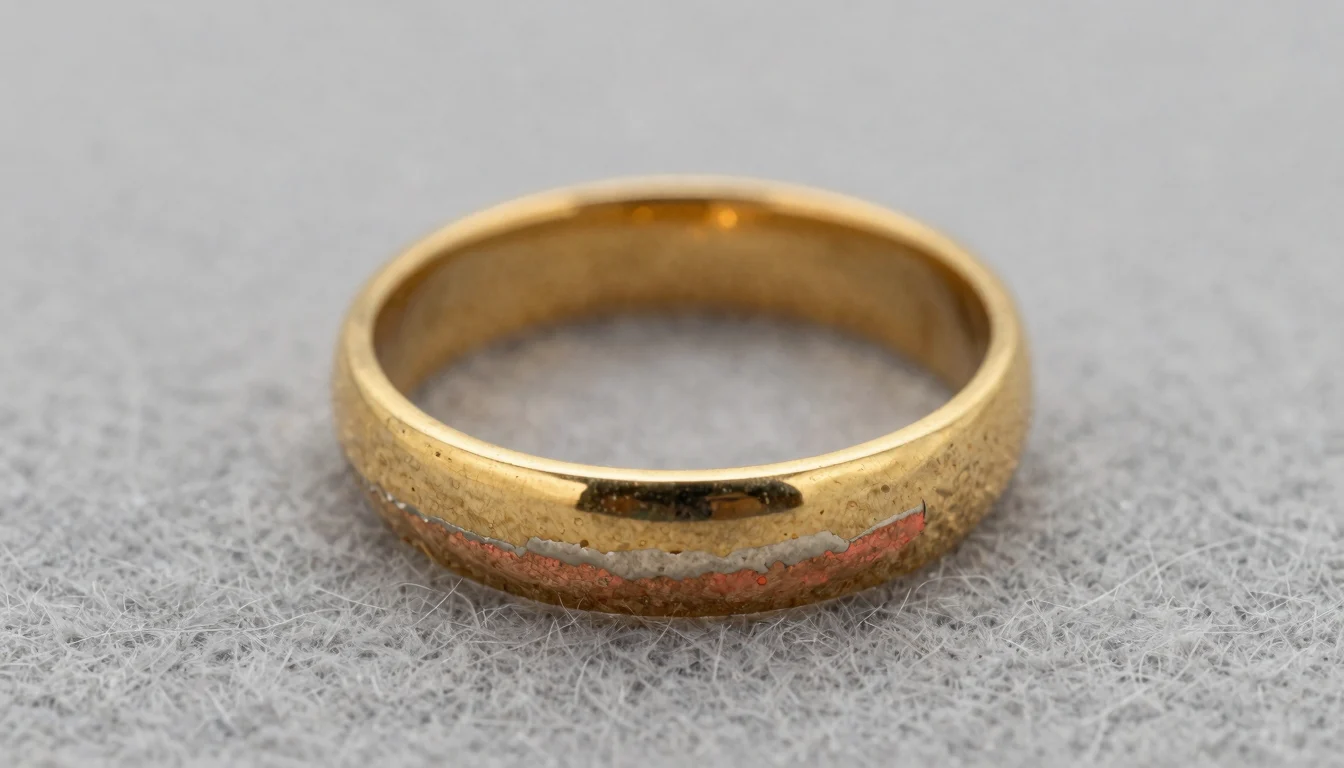
Plenty of plated jewelry has no readable mark. It wore off, it was never stamped, or it hides under a stone. When the hallmark fails you, a short sequence of checks sorts plated from solid. None of them proves solid gold on its own; each one removes possibilities.
Start with wear, because it costs nothing. Examine edges, clasps and high-contact points under magnification. Plated pieces rub through to a different-coloured base metal: brassy yellow, coppery pink, or silvery nickel where a barrier layer was used. Solid karat gold wears evenly and stays the same colour throughout. A ring shank that is gold on the face and brass on the inside curve is plated, with no further argument needed.
Then the magnet. Gold is diamagnetic, so a magnet does nothing to gold itself, and brass is not ferromagnetic either. What a magnet finds is steel or nickel: nickel is ferromagnetic, and steel springs, pin stems and clasps are common on costume pieces. A pull confirms a base-metal component somewhere in the piece; no pull is not proof of gold, because brass and copper cores pass the test just as gold does. The magnet rules things out, not in, the same logic as in our magnet test for silver guide.
The acid test reads only what it touches. Jewelers’ testing kits work on the touchstone principle: the piece is rubbed on a dark stone and the streak is dosed with acids of graded strength. As the touchstone article summarises it, 24 karat gold is not affected but 14 karat gold will show chemical activity. The catch with plated pieces is that a light rub may pick up only the gold skin and pass. Testers therefore file a small notch on a hidden spot to reach the core before applying acid. That notch is permanent, so do not do it to a piece you value as an untouched antique, to enamel, stones or engraved surfaces, or to anything you do not own; rinse and dry the spot afterwards and expect a visible mark. Kit instructions vary, so follow the one in your box.
XRF is the non-destructive answer. X-ray fluorescence analysers read the elements in a metal without harming it; as Wikipedia puts it, XRF is the basis of a non-destructive analytical technique widely used for elemental analysis. Many jewelers, pawnshops and refiners have a handheld unit. Ask the operator whether the reading describes the surface or the metal beneath it, and whether a worn or filed spot was tested.
Weight is a hint, not a test. Gold has a density of 19.3 g/cm3, while the density of brass is 8.4 to 8.73 g/cm3, so a solid gold piece is more than twice as heavy as the same design in brass. Karat alloys are lighter than pure gold and hollow construction lowers the weight of solid pieces, so treat heft as one more clue, ideally by comparing against a piece you know.
Layer the checks rather than trusting one. Wear inspection and a magnet are free and fast, acid confirms at the cost of a mark, and XRF settles a dispute without damage. If three checks all point to plated, trust them over a hopeful reading of a worn stamp.
What gold-plated pieces are actually worth
The honest headline is plain. Gold-plated, gold-filled and rolled-gold pieces have essentially no melt value. Work the numbers from the definitions above: a 1/20 12K GF piece is 5 percent gold alloy by metal weight, and that alloy is half gold, so 2.5 percent of the metal weight is fine gold. On a 10 g piece that is a quarter of a gram, locked in a brass sandwich that a refiner would have to process to recover. Electroplated pieces hold far less.
Do not price plated jewelry on its gold. Price it on the object: the maker’s name stamped beside the GF or GP, the period and style, and how well the surface has survived, because plating that has rubbed through to base metal is the fault buyers penalise most. Signed pieces from recognised costume houses are the exception that can carry real collector value, which is why the maker’s mark deserves more of your loupe time than the plating letters.
To find out what a specific piece brings, look at completed sales, not asking prices. Sold-price archives make this fast; our WorthPoint review explains what that subscription covers and costs, and our overview of online valuation resources lists free places to start. Group pieces by maker, photograph the marks, and compare like with like: same maker, same condition, same period.
Value migrates from metal to object. That is the same logic behind knowing when to sell for melt and when to keep a silver piece: the precious-metal floor and the collector ceiling are two different numbers, and for plated jewelry the floor is close to zero.
If you inherited a box of mixed jewelry and half of it reads GF or HGE, that half is not a windfall. It is also not worthless. The hallmark told you which kind of object you have before you spent a cent; the maker, the design and the condition tell you the rest.
Frequently Asked Questions
What does 14K GE mean?
GE is gold electroplate. Under the US guides the mark may be used when a base-metal piece has been electroplated with gold alloy of at least 10 karat to a minimum thickness equivalent to 0.175 microns of fine gold; the 14K describes the purity of that film, not the piece. 14K GE, 14K GEP and 14K gold electroplate mean the same thing: a thin electroplated coating over base metal with no meaningful gold value.
What does 14K GP mean, and is GP real gold?
GP means gold plate or gold plated. The gold is real but there is very little of it: the guides allow GP for a bonded layer of at least 1/40 of the metal weight or for an electroplate of at least 0.175 microns fine-gold equivalent, and the letters alone do not say which. The 14K describes the plating alloy only. Treat a GP stamp as a description of the finish, not a precious-metal guarantee.
What does 1/20 14K GF or 14KGF mean?
Both are gold-filled marks. The fraction 1/20 says the bonded gold-alloy layer is one-twentieth, 5 percent, of the metal weight, and 14K says that alloy is 14-karat. Written 14KGF, 14K GF or 1/20 14K GF, the meaning is the same. The piece is mostly base metal with a durable surface of real 14-karat alloy; it is not solid gold and has negligible melt value, but it wears far better than electroplate.
What does HGE mean on jewelry?
HGE is heavy gold electroplate. It is the same electroplating as GE, deposited thicker: at least 2.5 microns of fine-gold equivalent under the US guides, about 14 times the plain electroplate floor. 18K HGE is a heavier-than-minimum film of 18-karat alloy over base metal. It wears better than plain GP, but it is still a coating with no meaningful melt value.
What does 18K RGP mean?
RGP is rolled gold plate: a sheet of karat gold bonded to base metal, like gold filled but thinner. The guides require at least 1/40 of the metal weight and the fraction should appear in the mark, so a full stamp reads something like 1/40 18K RGP. The 18K describes the bonded alloy. It is a plated piece, though usually a well-made one.
Does 14KP mean gold plated?
No. The P stands for plumb, meaning the alloy is the full stated karat within the legal tolerance, so 14KP is solid 14-karat gold. Plated marks use GP, GE, GEP, HGE, RGP or GF. Confusing P with plated is one of the most common mistakes made with gold stamps.
What do GP and GF mean on jewellery sold in the UK?
The same as elsewhere: GP is gold plate and GF is gold filled. UK law adds a wording rule. Under the Hallmarking Act 1973 an unhallmarked article may be described as gold only if the word is qualified by “plated” or “rolled”, in lettering at least as large as the rest of the description, which is why British pieces so often read “rolled gold” in full rather than RGP.
Is gold-filled jewelry worth anything?
Yes, but not for its gold. The gold alloy in a gold-filled piece is at least 1/20 of the metal weight, and only part of that alloy is fine gold, so the recoverable metal is a fraction of a gram on a typical piece. Its worth comes from age, maker and condition. Judge it as an antique or as costume jewelry, not as bullion, and check completed sales rather than asking prices.
How can I tell gold-plated from solid gold without a hallmark?
Layer several checks. Inspect high-wear points under magnification for a different-coloured base metal. Try a strong magnet: a pull confirms a steel or nickel component, no pull proves nothing. Have the piece acid-tested on a filed spot if you can accept a permanent mark, or, better, ask a jeweler or pawnshop to run an XRF analyser, which reads the metal without damage. Weight is only a hint. No single home test settles the question by itself.
Will gold-plated jewelry hold its value over time?
Plated jewelry does not track the gold price, because it contains almost no gold. Its value depends on the collector market for the maker, style and period, and on condition, since plating that has worn through cannot be undone without replating. If you want something that moves with the gold market, plated jewelry is not it.
For the next steps, see our guides to white gold hallmarks, 10K gold marks, 18K gold marks, Victorian gold hallmarks and online antique jewelry appraisal.
