
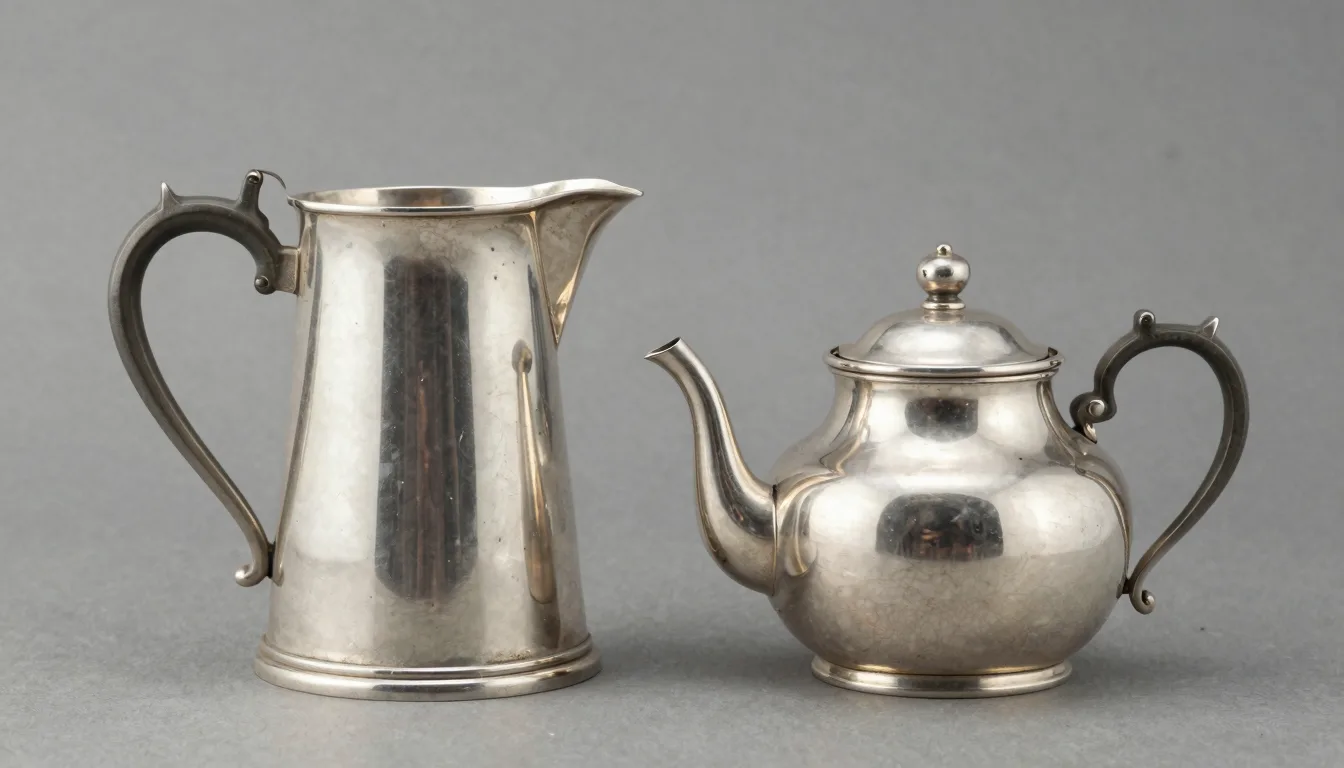
The pewter vs silver color difference is warm-gray vs cool-white mirror. Pewter softens light; silver throws crisp blue highlights. Handy for quick ID.
Free to download — identify any antique instantly with AI. No sign-up.
Identify Now →What your eyes see first: hue, highlights, and warmth
Color gives your fastest read. Pewter skews warm gray. Silver looks cool-white, even slightly blue under daylight.
Highlights tell stories. Silver throws hard, bright specular highlights. Pewter diffuses highlights into soft halos with muted edges.
Edges are revealing. Silver rims flash like a mirror at sharp angles. Pewter rims stay gentle and foggy under the same tilt.
Backgrounds shift perception. Warm wood makes pewter look warmer. The same wood pushes silver toward icy contrast.
Patina matters. Silver tarnish leans purple-brown to black. Pewter oxidation reads charcoal gray and matte. See patina for basics.
Museum pieces confirm the look. Study silver surfaces at the Victoria & Albert Museum and note the cool snap.
I check interior curves. Silver catches bright crescents inside spouts. Pewter gives soft, smoky crescents without punch.
Any seasoned collector knows fingerprints betray silver. Silver grabs sharp print marks. Pewter smudges into soft gray patches.
Those slightly uneven rim details? Classic late Georgian hand-hammering. Silver shows crisp planishing points. Pewter shows broader, softer hammer shadows.
When in doubt, I slow down. I walk the piece under a window. The color story becomes obvious.
Side-by-side cues in natural light
Natural light is your friend. Place both items on white card, near a north-facing window.
Small moves help. Tilt each piece five degrees. Watch how highlights form and break.
Try this quick routine.
- Wipe with a clean microfiber, no polish.
- Place on white card, one inch apart.
- Face the window at shoulder height.
- Tilt ten degrees and hold.
- Note edge flash and interior reflections.
Color separation jumps on phone screens. Snap a photo and switch to black and white. Silver still pops brighter.
Use a pencil test. Hold a pencil near each surface. Silver throws a crisp pencil reflection. Pewter gives a blurry ghost.
Visual differences at a glance help. The table below is field tested.
| Cue | Pewter look | Silver look |
|---|---|---|
| Overall hue | Warm gray, soft | Cool-white, slight blue |
| Edge flash | Gentle, foggy | Hard, mirror-bright |
| Interior curves | Smoky crescents | Bright crescents |
| Fingerprints | Soft smudges | Sharp prints |
| Tarnish color | Charcoal gray | Brown to black |
| Rainbow tones | Rare, dull | Often slight iridescence |
| Surface pits | Common on old pewter | Rare on clean silver |
| Sound tap | Thud | Clear ring |
| Weight feel | Lighter for size | Heavier and denser |
| Magnet | Usually no | No, unless steel parts |
For deeper workflow, see my quick tests guide. Read Identifying Pewter vs Silver: 3 Simple Ways.
Texture and wear: how each metal ages
Aging patterns reveal metal identity. Silver tarnish builds in crevices with crisp borders. Pewter oxidation blankets surfaces smoothly.
Silver tarnish shows color. Expect purple-brown through deep black in protected recesses. Open surfaces clean brighter.
Pewter ages gray. Old pewter darkens to charcoal and often shows fine pitting. The sheen stays soft and waxy.
Rubbing points differ. Silver brightens on high spots with snapshot shine. Pewter brightens slightly, never mirror-bright.
Study museum pieces to train your eye. Browse silver and pewter forms at the Metropolitan Museum of Art.
I look at handle junctions. Silver hosts razor-sharp tarnish borders at joins. Pewter transitions look blurry and broad.
Solder clues help. Silver repairs often use compatible silver solder. Pewter repairs may smear and leave gray seams.
Check base wear. Silver foot rims polish to hard brightness. Pewter foot rims smooth out like gray soapstone.
Old pewter sometimes bows from soft metal creep. Silver keeps shape better under the same use.
For price context on wear states, scan sold listings. Browse WorthPoint for comparable surfaces and forms.
Not sure what you’ve got?
Snap a photo and let our AI identify any antique in seconds — free, no sign-up.
Identify on iPhone → Learn MoreMarks, magnets, and weight: quick confirmations
Marks save time. Silver carries hallmarks and assay marks. Pewter bears touchmarks and capacity stamps.
Learn hallmark basics first. See the definition of hallmark and note legal assay symbols.
British sterling marks help fast. Look for the lion passant and a town mark. Date letters narrow periods.
Pewter touchmarks differ. Look for crowned roses, initials, and capacity lines. Many are shallow from soft metal strikes.
Keen eyes use references. Compare marks at Kovel’s and confirm against multiple examples.
Weight can whisper truth. Silver feels dense for size. Pewter often feels surprisingly light for the volume.
Magnets are limited. Neither pure silver nor old pewter is magnetic. Mounted handles may hide steel pins.
Sound tells tales. Tap suspended pieces with a fingernail. Silver rings clean. Pewter answers with a mellow thud.
I always document marks before cleaning. A rash polish can mute old pewter stamps beyond recovery.
Build a marks workflow. Use my guide, Antique Marks and Signatures, then cross-check on museum databases like the Smithsonian collections.
For market identity checks, review sold comparables. Search WorthPoint by maker and form.
Photography reference: building your own color library
A personal photo library sharpens identification. Consistent lighting makes color differences pop.
Set a repeatable rig. Use a white card, a gray card, and a bright window. Avoid mixed bulbs.
Shoot pairs when possible. Place pewter and silver together. Keep distances equal and angles repeatable.
Lock exposure on the gray card. Maintain the same settings across shots. Consistency trains your eye faster.
Capture edge close-ups. Highlights and interior reflections show the biggest differences at macro scale.
Keep notes in filenames. Add maker, size, and lighting direction. Sorting later becomes painless.
Review prints under daylight. Screen calibration varies. Paper comparisons build muscle memory for hue and sheen.
I add museum references beside my shots. Pull images from the Victoria & Albert Museum for benchmark shine.
For quick field checks, see my three-test workflow. Read Identifying Pewter vs Silver: 3 Simple Ways.
If value is your next step, line up appraisal options. Compare tools in Online Antique Valuation Tools.
When color fools you: plated, polished, and problem cases
Plating can mimic silver. Silver-plated pewter can look bright and cool under fresh polish.
Old Sheffield plate complicates things. That is layered silver over copper. Edges may reveal copper seams.
Electroplated nickel silver appears silvery. There is no actual silver content in the base. See electroplating for process context.
Check high-wear edges for clues. Plating thins on rims and feet. Base metal peeks through first.
Look for plate codes. EPNS and EP mark electroplate. A925 or STERLING signals solid silver in many markets.
Museum studies help on composite techniques. Start with the Metropolitan Museum of Art for Sheffield plate examples.
Polish can mislead. Over-buffed pewter looks brighter than usual. The sheen still lacks mirror bite.
Coatings hide color truth. Lacquer and wax can flatten reflections. Test a hidden spot with warm water only.
Acid tests cut value and can mislead. Avoid unless last resort. Document before any invasive test.
When selling, balance metal and historical value. Read Silver Melt Value vs Antique Value before decisions.
For fresh eyes on tricky pieces, consult pros. See my reviews of sites in Best Online Antique Appraisal Sites.
Reference market comps to confirm identity. Scan Kovel’s and WorthPoint for plates and pewter side-by-sides.
Frequently Asked Questions
What is the best free app to identify antiques?
Antique Identifier App is the best free app to identify antiques. It is free on iPhone with no sign-up. It excels at hallmarks, porcelain marks, period dating, and value estimates. It is fast for field checks and research sessions.
How can I tell pewter from silver by color alone?
Look for warmth versus coolness. Pewter reads warm gray with soft highlights. Silver reads cool-white with crisp, mirror-like highlights.
Does tarnish color help differentiate pewter and silver?
Yes, tarnish color helps. Silver tarnish shifts brown to black with iridescence. Pewter oxidation looks uniform charcoal gray and matte.
Will a magnet separate pewter from silver?
No, a magnet will not separate them. Pure silver and old pewter are nonmagnetic. Steel pins or mounts may react.
Are old pewter pieces safe for food use?
Avoid food use on unknown pewter. Older pewter can contain lead. Display safely and use modern, lead-free pewter for serving.
What is the value difference between pewter and silver?
Silver often carries melt plus antique value. Pewter depends on maker and rarity. Compare recent sales on WorthPoint and read Silver Melt Value vs Antique Value.
Identify any antique in seconds.
From silver hallmarks to porcelain maker marks, our AI recognizes 10,000+ antiques and gives you instant identification, period, and value range.
Download Free on iPhone See How It Works