Author: Antique Identifier Editorial

  • Antique board games worth money: rare editions and what they sell for

    Antique board games worth money: rare editions and what they sell for

    Antique board games worth money are mostly 19th-century McLoughlin Brothers editions. Rare boxed examples sell for $2,000 to over $20,000.

    ED
    Antique Identifier Editorial
    Published by OBZENA LLC · May 24, 2026

    Why some antique board games are worth real money

    Most antique board games are worth between $5 and $40. A narrow band of games breaks that ceiling entirely. Four factors decide which side of the line a game falls on: maker, age, artwork, and condition.

    Age by itself creates very little value. A 1958 Monopoly set counts as old, yet Parker Brothers printed millions of copies. Survival in quantity caps the price.

    The word antique matters here. Strictly, an antique is at least 100 years old, which today means made before 1926. Most games people call antique are really mid-century collectibles.

    Scarcity is the real engine. The most valuable antique board games come from a thirty-year window, roughly 1885 to 1915. American firms produced richly illustrated games in modest print runs then.

    Children destroyed most of those games. Boards were folded, boxes were crushed, and paper pieces were lost. A complete survivor from 1890 is genuinely rare.

    Artwork separates a $200 game from a $5,000 one. Victorian makers used chromolithography, a layered stone-printing process that produced saturated color. The chromolithography reference page explains the technique in detail.

    Subject matter adds a second premium. Games about early baseball, the Wild West, ballooning, or Wall Street speculation attract crossover buyers. A baseball game sells to game collectors and sports collectors at once.

    Consider Bulls and Bears: The Great Wall Street Game, made by McLoughlin Brothers in the 1880s. Complete boxed examples have realized more than $20,000 at specialist toy auctions. The same firm’s plainer titles sell for a few hundred dollars.

    Maker reputation ties these threads together. A handful of names signal quality lithography and short runs. Reading those maker’s marks is a core skill, much like decoding maker’s marks on other antiques.

    Museums now treat these games as serious graphic art. The Smithsonian holds historic American games in its national collections, a sign of how far scholarly interest has grown.

    Condition then multiplies or erases the figure. A scarce game with a split board and no box keeps only a fraction of its potential value.

    Before valuing any game, pin down two facts: the maker and the decade. Those two answers set the entire price range, and every later step simply refines it.

    McLoughlin Brothers: the most valuable antique board game maker

    McLoughlin Brothers is the single most important name in valuable antique board games. The New York firm operated under that name from 1858 until 1920. Its games define the top of the market.

    John McLoughlin Jr. built the company on color printing. The firm mastered chromolithography earlier and better than its rivals. McLoughlin boards glow with reds, golds, and deep blues that flat 20th-century printing never matched.

    The company printed in comparatively small runs. It treated games as illustrated objects, not mass commodities. That combination of beauty and scarcity is exactly what drives collector prices today.

    In 1920, McLoughlin Brothers sold its game line to Milton Bradley. Genuine McLoughlin games therefore predate 1921. Any game carrying that name belongs to the firm’s active decades.

    Certain titles are legendary among collectors. Bulls and Bears, The Game of District Messenger Boy (1886), Around the World with Nellie Bly (1890), and The Game of the Telegraph Boy all command strong prices. Wild West and military themes perform especially well.

    Realized prices vary widely by title and condition. The table below shows representative figures from specialist toy auctions in recent years.

    Game (McLoughlin Brothers)EraTypical realized value
    Common parlor games, boxed1890–1910$150 – $600
    The Game of District Messenger Boy1886$400 – $1,500
    Around the World with Nellie Bly1890$800 – $3,000
    Wild West / military themed games1890–1900$2,000 – $8,000
    Bulls and Bears: The Great Wall Street Game1880s$10,000 – $23,000+

    Two McLoughlin games can look alike yet sell a decade apart in price. The variable is rarely age. It is condition, completeness, and the strength of the cover illustration.

    A collector’s eye learns the look fast. McLoughlin lithography has a fine, dot-free texture and a slightly raised ink surface. The artwork usually fills the board from edge to edge.

    Beware reproductions. Modern reprints of famous McLoughlin boards exist for the decorator market. A genuine board shows period foxing, honest edge wear, and aged box cardboard.

    If you own a boxed game marked McLoughlin Brothers, treat it as significant until proven otherwise. Photograph the maker’s mark, the copyright line, and the box, then get a specialist opinion before selling.

    Other makers collectors chase: Ives, Bliss, Parker Brothers and more

    McLoughlin sits at the summit, but several other firms produced antique board games worth real money. Knowing them widens your radar at estate sales and auctions.

    W. & S.B. Ives of Salem, Massachusetts was the early American pioneer. The firm published The Mansion of Happiness in 1843, often called the first commercially produced American board game. Original Ives games are scarce and valuable.

    Milton Bradley founded his company in 1860 with The Checkered Game of Life. Early examples from the 1860s and 1870s carry genuine collector value. Later mass-market Bradley games generally do not.

    Parker Brothers began in 1883, when nineteen-year-old George S. Parker sold his game Banking. Pre-1920 Parker games are collectible. The firm later acquired Monopoly in 1935.

    R. Bliss Manufacturing Company of Pawtucket, Rhode Island worked in lithographed wood. Bliss is famous for dollhouses, but its wood-framed games and toys draw strong bids.

    Selchow & Righter trademarked Parcheesi in 1874 and built a long business on it. Very early Parcheesi boxes with ornate labels interest collectors more than the playing board itself.

    The table compares these makers at a glance.

    MakerActive eraKnown forTypical collector value
    W. & S.B. Ives1840s–1880sThe Mansion of Happiness (1843)$500 – $5,000+
    Milton Bradley1860 onwardThe Checkered Game of Life$100 – $2,000 (early)
    Parker Brothers1883 onwardBanking; later Monopoly$75 – $1,500 (pre-1920)
    R. Bliss Mfg. Co.1870s–1914Lithographed wood games and toys$150 – $2,500
    Selchow & Righter1867 onwardParcheesi (trademark 1874)$40 – $800 (early boxes)

    European makers matter too. British firms such as Jaques of London produced fine boxed games, and early croquet and chess sets carry their own following.

    One rule cuts through the noise. A famous maker’s name raises the floor, not the ceiling. A common Parker Brothers game stays inexpensive even with the right label.

    The ceiling is set by rarity and subject. When a respected maker, a short print run, and a vivid theme line up, the price climbs fast. That alignment is exactly what you are hunting for.

    Not sure what you’ve got?

    Snap a photo and let our AI identify any antique in seconds: free download, no sign-up.

    Identify on iPhone →Learn More

    How condition and the original box decide the price

    Condition decides more of a board game’s value than any other single factor. Two copies of the same 1890 game can sell ten times apart. The gap is almost always condition.

    Collectors grade games on a descriptive scale. The terms below appear in auction catalogs and dealer listings constantly.

    GradeWhat it meansEffect on value
    Mint / Near MintLooks unused; crisp box, bright boardFull premium; top of range
    ExcellentLight shelf wear; complete; minor box rubs70–85% of top value
    GoodHonest wear, small tears, perhaps one piece missing35–55% of top value
    FairSoiled, taped, splitting board, several pieces gone10–25% of top value
    PoorHeavy damage, mold, large lossesDecorative interest only

    The original box carries the heaviest weight. On a 19th-century game, the lithographed box lid is often the most beautiful surface. Many collectors buy the box first and the board second.

    A game with a strong box and a weak board still sells well. A game with a fine board and no box loses 50% or more of its value. The lid illustration is the display piece.

    Completeness sits just behind the box. A game missing its rules sheet, spinner, or several tokens drops a full grade. Period-correct replacement parts help, but buyers always ask what is original.

    Restoration is a trap. Amateur tape repairs, overpainting, and trimmed edges reduce value rather than rescue it. Collectors strongly prefer honest, untouched wear.

    Consider a real pattern from the market. A McLoughlin game that brings $3,000 in Excellent condition might bring $400 with a torn board and a replaced box. Same title, same year, same maker.

    Storage protects whatever grade you have. Keep games flat, dry, and out of direct sunlight. Heat and humidity cause the foxing and board separation that pull a game down the scale.

    When you weigh value against keeping a family game, the logic mirrors other antiques. The question of when a piece is worth selling and when it is worth keeping applies here too, just as it does with antique value versus melt value.

    Grade honestly before you celebrate. An optimistic self-grade is the most common reason a seller is disappointed at the auction block.

    Rare editions and variants that multiply value

    Beyond the maker and the grade, specific editions and variants can multiply value. Collectors pay sharp premiums for the right version of a game.

    First editions lead the field. The earliest printing of a long-running game is the prize. Later printings of the same title, even from the same firm, sell for a fraction.

    Monopoly is the clearest example. The standard 1935 Parker Brothers edition is common and inexpensive. The story before 1935 is where the money sits.

    Elizabeth Magie patented The Landlord’s Game in 1904, the design that led to Monopoly. Genuine early Landlord’s Game sets are extremely rare and historically important.

    Hand-made Monopoly boards raise the ceiling higher still. Charles Darrow drew and painted sets by hand in the early 1930s. A 1933 hand-painted circular Darrow board sold at auction for roughly $146,500.

    Regional and trademark variants also matter. Games tied to a single city, a world’s fair, or a short-lived promotion survive in tiny numbers. An 1893 Columbian Exposition game outsells a generic title easily.

    Salesman samples and prototypes form their own niche. Pre-production versions, store-display copies, and patent models are one-of-a-kind objects. They reach the market rarely and sell strongly when they do.

    Theme-driven variants reward attention. An early baseball game, a Civil War game, or a transportation game in original color attracts buyers from outside the game-collecting world. Crossover demand lifts the hammer price.

    Watch for printing changes too. Makers updated artwork, box styles, and rules between print runs. An advanced collector can date a McLoughlin game to a narrow window from the cover variant alone.

    Patent and copyright lines are your evidence. A copyright date, a patent date, and the maker’s address together pin down which edition you hold. Recording all three before you sell is essential.

    One caution balances the excitement. A “rare edition” claim from a seller is not proof. Demand the copyright line, the maker’s mark, and clear photographs of the box and board.

    When several factors stack together, the result is dramatic. A first edition, a strong theme, and an original box can lift a game from a curiosity to a four- or five-figure result. That stack separates a valuable antique board game from an ordinary old one.

    How to identify and date an antique board game

    You cannot value an antique board game until you can date it. Dating starts with evidence printed on the game itself. Four clues do most of the work.

    The copyright date is the first place to look. Scan the board, the box lid, the box base, and the rules sheet. American games from the 1880s onward usually carry a printed copyright year.

    The maker’s name and address narrow the window further. Game firms moved offices over the decades. A known address pins a game to a specific span of years.

    Patent dates help, with a caveat. A patent date marks the invention, not the printing. A game can list an 1887 patent yet be a 1905 reprint, so treat it as an earliest-possible date.

    Construction and printing style confirm the era. The table below summarizes the most reliable physical clues.

    ClueWhat you seeWhat it suggests
    Box sidesWood-framed or wood-sided boxGenerally pre-1900
    Box sidesAll-cardboard box1900 onward, common after 1915
    PrintingRich chromolithograph, no dot patternRoughly 1880–1915
    PrintingVisible halftone dots under a loupe20th century, mostly post-1920
    BoardLinen-backed folding boardLate 19th to early 20th century
    PiecesHand-finished wood or cast-metal tokens19th century; plastic means post-1945

    A loupe is the cheapest tool you can own. Holding one over the artwork separates a true chromolithograph from a modern halftone reprint in seconds.

    Compare your game against documented examples. Major museum collections are excellent references. The Metropolitan Museum of Art and similar institutions catalog historic games and toys with firm dates attached.

    Maker’s marks deserve the same care you would give any antique. The logic of reading a printed game label mirrors the approach in our hallmark and maker’s mark identification guide. The same patience that decodes a gold-plated hallmark decodes a game maker’s imprint.

    Record everything before you ask for a valuation. Photograph the maker’s mark, every copyright line, the full box, and the open board.

    A precise date turns a vague “old game” into a specific object. That precision is exactly what an appraiser, an auction house, or a serious buyer needs.

    Where to sell antique board games and what to expect

    Once you know what you own, the next question is where to sell an antique board game. The right venue depends on the game’s value tier.

    Specialist toy and antique auction houses serve the high end. Firms such as Bertoia Auctions and Morphy Auctions handle 19th-century games regularly. Their bidders expect McLoughlin and Bliss material and pay accordingly.

    A specialist auction earns its commission on rare games. The right buyers are already there, and competition between them sets a fair price. For a $3,000 game, that audience is worth the seller’s fee.

    General online marketplaces suit mid-range games. eBay reaches the widest pool of casual buyers for games in the $40 to $500 band. Clear photographs and an honest condition description do the heavy lifting.

    Local antique dealers and shops offer speed, not top dollar. A dealer must resell at a profit, so expect roughly 40 to 60 percent of retail value. The trade-off is an immediate, simple sale.

    Research the price before you list anywhere. Look up completed sales, not asking prices. A reliable antique appraisal site shows what comparable games actually sold for.

    Sold-price databases are your best friend. Services like WorthPoint maintain large archives of past auction results. Print and online price guides such as Kovels add another reference layer.

    Digital valuation tools speed up the first pass. A run through online valuation resources gives you a starting figure before you contact any auction house.

    For a genuinely rare game, get a formal appraisal first. A written valuation costs money, but it protects you from underselling a four-figure object for forty dollars.

    Timing has a modest effect. Antique game prices firm up in autumn and around the holidays, when collectors and gift buyers are most active. A spring listing is rarely a disaster, but the season is worth weighing.

    Set a reserve on valuable lots. An auction reserve protects a rare game from selling on a quiet bidding day. Discuss the figure honestly with the auction house in advance.

    The pattern is simple. Match the venue to the value, research completed sales, and never let a rare boxed game leave your hands before a specialist has seen it.

    Frequently Asked Questions

    What is the most valuable antique board game ever sold?

    The highest prices belong to hand-made Monopoly boards, not factory games. A 1933 circular Monopoly board, hand-drawn and painted by Charles Darrow, sold at auction for roughly $146,500. Darrow created those sets before Parker Brothers acquired Monopoly in 1935, which makes them historic, one-of-a-kind objects. Among factory-printed games, McLoughlin Brothers titles lead the market. Bulls and Bears: The Great Wall Street Game from the 1880s has realized more than $20,000 in complete, boxed condition. The pattern is consistent: extreme rarity, a strong historical story, and original condition produce the record results, not age alone.

    How can I tell if my old board game is worth money?

    Start with the maker and the date. A game marked McLoughlin Brothers, W. & S.B. Ives, or R. Bliss, with a copyright line before 1915, has real potential. Next, check the artwork. A vivid chromolithograph with no visible dot pattern signals a valuable Victorian game. Then assess completeness and the box, because the original lithographed box lid carries much of the value and missing pieces drop the grade. Common mid-20th-century games such as a 1960 Monopoly set are worth $5 to $40 regardless of condition. A respected maker, a pre-1915 date, and an intact box together are the signal to investigate further.

    Are board games from the 1950s and 1960s worth anything?

    Most board games from the 1950s and 1960s are worth $5 to $40. Companies printed them in enormous quantities, so survival is common and scarcity is low. A standard Monopoly, Clue, or Candy Land set from that era has little collector value. Exceptions exist. First-year editions, licensed games tied to popular television shows, and sealed unused examples can reach $100 to $400. Condition still matters, and a complete game with a crisp box always beats a worn one. As a rule, mid-century games are nostalgia items rather than investments. The genuine money in antique board games sits in the 1885 to 1915 window.

    Does a missing box or missing pieces lower a board game’s value?

    Yes, and the effect is severe. The original box is often the most valuable single part of a 19th-century game, because the lithographed lid is the display piece. A game with no box can lose 50 percent or more of its value. Missing pieces matter almost as much. A game without its rules sheet, spinner, or several tokens typically drops a full condition grade. Period-correct replacement parts soften the loss, but buyers always ask what is original. Honest, untouched wear is preferred over amateur restoration. Before selling, list exactly what is present and what is missing, since serious collectors check every piece.

    How do I date an antique board game?

    Look for printed evidence first. Check the board, box lid, box base, and rules sheet for a copyright year, which American games have carried since the 1880s. The maker’s name and address narrow the range further, because game firms moved offices over the decades. Treat patent dates carefully, since a patent marks the invention, not the printing. Physical clues confirm the era: wood-sided boxes generally predate 1900, all-cardboard boxes became standard after 1915, and plastic pieces mean a date after 1945. A jeweler’s loupe reveals whether the artwork is a true chromolithograph or a later halftone reprint. Photograph every mark before requesting a valuation.

    Identify any antique in seconds.

    From silver hallmarks to porcelain maker marks, the app suggests the item type, period and a value range.
    See How It Works →

    ED

    About Antique Identifier Editorial

    Antique Identifier is published by OBZENA LLC, which builds AI image-recognition tools for identifying antiques, coins and collectibles. Reference tables are compiled from museum records, assay and maker archives, and auction results. We do not offer appraisals.

  • Gold-plated hallmark identification: what GP, GF, and HGE mean

    Gold-plated hallmark identification: what GP, GF, and HGE mean

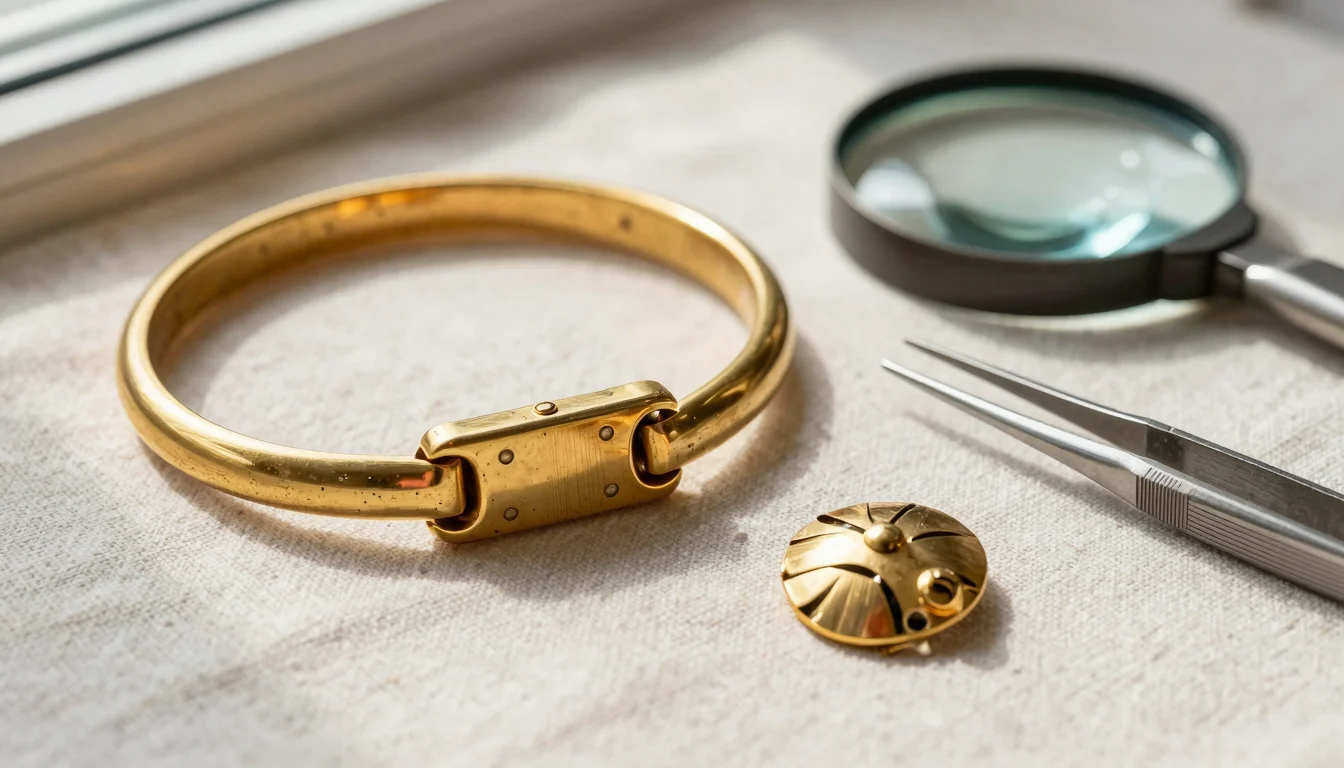
    Cover: AI-generated image. A magnifier, tweezers, a lightly worn gold-tone bangle with a box clasp and a small domed brooch: the tools and the kind of pieces this guide is about. Representative AI-generated scene; no hallmark is shown and no piece was examined for this article.

    Gold-plated hallmarks like GP, GF and HGE all mean a thin layer of gold over base metal, not solid gold. GF is a bonded sheet and the thickest of the marks; GE and HGE are electroplated films; GP can be either, and the letters alone do not say which.

    This guide explains how to read GP, GF, RGP, HGE, GE and related marks, which US and UK rules stand behind them, how to check a piece whose mark has worn away, and how to think about value without a price list. It is a source review by the Antique Identifier editorial team, published by OBZENA LLC, the company behind the Antiqly app. No jewelry was tested for this article, and the images are labelled AI-generated scenes rather than photographs of examined pieces.

    What gold-plated hallmarks actually tell you

    Every plated mark answers one question: how was the gold attached, and how much of it is there? A gold-plated hallmark describes a manufacturing method. It is never a precious-metal guarantee for the body of the piece.

    A piece stamped GP, GF, RGP or HGE has a base-metal core. Gold-filled stock is made by bonding a layer of gold alloy to a base metal core (typically brass, but sometimes copper or silver), and electroplated pieces usually start from a copper-alloy body as well. Around that core is a gold skin measured in microns, or in a fraction of the total weight, not in millimetres.

    In the United States the vocabulary is fixed by the Federal Trade Commission’s Guides for the Jewelry, Precious Metals, and Pewter Industries, 16 CFR 23.3. The guides separate two families. Gold filled, rolled gold plate and gold overlay describe a gold-alloy layer applied by a mechanical process; gold electroplate and heavy gold electroplate describe gold deposited by an electrolytic process. In both families the plating alloy must be at least 10 karat, and the karat figure that precedes the abbreviation describes only that plating alloy, not the metal underneath.

    Mark Stands for What the US guides require How the gold was applied
    GF, 1/20 12K GF, 14KGF Gold filled Gold alloy of at least 10 karat making up at least 1/20 of the weight of the metal in the article Bonded sheet, mechanically applied
    RGP, gold overlay, 1/40 14K RGP Rolled gold plate Same bonded method with at least 1/40 of the metal weight; the fraction must be shown Bonded sheet, mechanically applied
    GE, GEP Gold electroplate Electroplated gold alloy of at least 10 karat with a minimum thickness equivalent to 0.175 microns of fine gold Electrolytic bath
    HGE Heavy gold electroplate Electroplated gold alloy of at least 10 karat with a minimum thickness equivalent to 2.5 microns of fine gold Electrolytic bath
    GP Gold plate or gold plated Either a bonded layer of at least 1/40 of the metal weight or an electroplate of at least 0.175 microns fine-gold equivalent; the letters alone do not say which Bonded sheet or electrolytic bath
    Vermeil Gold over sterling silver Sterling silver base with gold of at least 10 karat and at least 2.5 microns of fine-gold equivalent Plated or coated

    The hardest habit to build is reading the whole stamp, not the karat number alone. Under the same guides, a karat figure standing alone (14K, 14Kt, 14 K.) is reserved for an article composed throughout of an alloy of gold, and a hollow piece should disclose the hollow center next to the mark. Add two letters and the meaning changes completely: 14K GF is a bonded skin of 14-karat alloy over brass, and 14K GE is a film of 14-karat alloy grown in a plating bath.

    Plated marks hide in inconspicuous spots: the inside of a ring shank, the edge of a watch case back, the underside of a clasp, the back of a pin stem. In the United Kingdom the wording is regulated by Schedule 1 of the Hallmarking Act 1973: “gold” is permissible if qualified by the word “plated” or “rolled”, and the lettering of “plated” or “rolled” is to be at least as large as any other lettering in the description. That is why British and Commonwealth pieces so often read “rolled gold” in words rather than RGP.

    For a broader primer on locating and reading any stamped mark, our complete guide to antique marks and signatures shows where manufacturers placed them.

    A plated hallmark is not bad news. It tells you the object was built to a price, sold to a buyer and survived. The mark simply sets your expectations correctly before money changes hands.

    GP decoded: gold plate and electroplating

    GP stands for gold plate or gold plated. Under the US guides it is the least specific of the marks. It may be used for a mechanically bonded layer that reaches at least 1/40 of the metal weight, the same floor as rolled gold plate, or for an electroplated coating of at least 10-karat gold with a minimum thickness throughout equivalent to 0.175 microns of fine gold. The letters alone do not say which method was used. GE and GEP are the unambiguous electroplate marks; the guides’ own example abbreviation for gold electroplate is 12K G.E.P.

    How electroplating puts gold on base metal

    Electroplating is a process for producing a metal coating on a solid substrate through the reduction of cations of that metal by means of a direct electric current. In plain terms, the base-metal object hangs in a bath of dissolved gold salts, a current flows, and gold builds up on the surface as an even, very thin film. The technique is Victorian: George Elkington and Henry Elkington were awarded the first patents for electroplating in 1840, and the electroplating industry they founded in Birmingham spread around the world.

    How thick is a GP layer?

    Minimum fine-gold thickness behind electroplate marks

    • Gold electroplate, US minimum: 0.175 microns

    • Gold plated, trade usage: 0.5 microns

    • Heavy gold electroplate, US minimum: 2.5 microns

    • Vermeil, US minimum: 2.5 microns

    US floors are fine-gold-equivalent minimums from 16 CFR 23.3 and 23.4; the trade-usage row is the jewellery-trade convention summarised by Wikipedia, not a legal requirement. These are definitions of the marks, not measurements of any piece.

    Thin. The legal floor for the plain electroplate marks is 0.175 microns of fine-gold equivalent, and the guides explain the word equivalent with an example: 1 micron of 12 karat gold is equivalent to one-half micron of 24-karat gold, because only half of a 12-karat film is gold. Trade usage runs a little higher than the legal floor. Wikipedia’s summary of jewellery-trade terms lists gold flashed or gold washed below 0.5 micron, gold plated at 0.5 micron or more, heavy gold plated or vermeil at 2.5 microns or more.

    That is why GP wear shows early. As the same article puts it, the microns of thickness determines how long the gold plating lasts with usage. High-contact points such as the inside of a ring shank, the edge of a bangle or the back of a pendant rub through first, and the colour that appears underneath tells you what the core is: brassy yellow, coppery pink or, very often, silvery nickel. A layer of a suitable barrier metal, usually nickel, is often deposited on the copper substrate before the gold plating, which is why a worn plated piece can look white rather than brassy at the worn spot.

    The karat number attached to GP or GE causes constant confusion. “18K GP” does not mean an 18-karat object. Under the guides the karat figure describes the plating alloy only, so an 18K GP ring is base metal with a film of 18-karat alloy on top. The guides also require a disclosure when a plating that has been covered with a base metal such as nickel and then given a thin wash of gold is sold as plated; such gold-washed pieces are the thinnest finish you will meet.

    Treat GP as a finish, not a metal. The gold film is far too thin to recover, so the piece has no meaningful melt value. Buy it for the design, the maker, the period or the condition, and if a seller prices a GP item as though it were solid gold, walk away or counter hard.

    GF decoded: why gold-filled is the thicker mark

    GF stands for gold filled. Despite the modest name it is the most substantial of the plated marks.

    Gold-filled is not plated in the chemical sense at all. In gold-filled manufacture a layer of karat gold is permanently fused to a base metal core under heat and pressure, then rolled to thickness. The gold is a solid sheet of karat alloy, not a film grown atom by atom in a bath.

    United States law sets a measurable floor. Under 16 CFR 23.3 the bonded layer must be gold alloy of at least 10 karat making up at least 1/20 of the weight of the metal in the article before the piece may be stamped gold filled. 1/20 is 5 percent of the metal weight.

    That weight floor is why the mark is respected. Wikipedia’s summary is that gold-filled items, even with daily wear, can last 10 to 30 years, though the layer of gold will eventually wear off exposing the metal underneath. Electroplate, by contrast, is measured in fractions of a micron.

    What 1/20 12K GF and 14KGF mean

    This is where the fraction marks appear, and they confuse almost everyone. A stamp reading 1/20 12K GF decodes in three parts. The fraction, 1/20, is the share of the metal weight that is gold alloy. The karat, 12K, is the purity of that alloy: Karats measure the parts per 24, so 12K is 12 parts in 24, or 50 percent gold. GF is the method, a bonded sheet.

    Put the two numbers together and 2.5 percent of the metal weight is fine gold. A hypothetical 10 g piece marked 1/20 12K GF carries about 0.5 g of 12K alloy and 0.25 g of fine gold. That is the whole reason melt value is not the way to think about these pieces.

    The spacing of the stamp does not change the meaning: 1/20 14K GF, 1/20 14KGF and 14K GF are all gold filled with 14-karat alloy, and 1/10 12K GF means a tenth of the metal weight is 12-karat alloy, a richer piece than 1/20. To brush up on what those karat numbers mean on their own, see our breakdown of what 10K, 14K, and 18K really mean and our 14K hallmark chart.

    So GF is the plated mark worth respecting. It still has negligible melt value, but a clean, signed GF piece is a legitimate antique in its own right, valued for age, maker and condition rather than metal.

    HGE and RGP: heavy electroplate and rolled gold plate

    HGE and RGP sit between GP and GF. Collectors mix them up constantly, but they describe two different things.

    HGE means heavy gold electroplate. It is the same electrolytic process as GP or GE, deposited thicker: the guides allow the words heavy gold electroplate only when the coating has a minimum thickness throughout equivalent to two and one half (2 1/2) microns of fine gold, roughly 14 times the plain electroplate floor of 0.175 microns. One refiner’s glossary says HGE stands for “High Grade Electroplate,” while the FTC guides define the term as heavy gold electroplate; either way it is electroplate. A piece stamped 18K HGE carries a heavier-than-minimum film of 18-karat alloy over base metal. It wears better than plain GP, but it is still a coating.

    RGP means rolled gold plate. This one is the lighter cousin of gold filled. A karat-gold sheet is bonded to base metal and rolled thin, exactly as for GF, but the sheet is thinner: rolled gold plate and gold overlay need at least 1/40 of the metal weight, and the fraction must be shown, as in 1/40 12 Kt. R.G.P. 1/40 is 2.5 percent, so an RGP piece carries less gold alloy than a 1/20 GF piece of the same karat, and at the 1/40 floor exactly half as much.

    GF, RGP and the weight fractions compared

    Minimum gold-alloy share of metal weight for bonded marks

    • Gold filled (GF): 5 % of metal weight

    • Rolled gold plate (RGP): 2.5 % of metal weight

    Minimum share of the metal weight that must be gold alloy under 16 CFR 23.3: 1/20 for gold filled, 1/40 for rolled gold plate and gold overlay. Actual pieces may carry more; the alloy itself is only partly gold.
    Mark Process US minimum (plating alloy 10K or higher in every case) Recoverable gold
    GP Bonded sheet or electroplate; the mark does not say 1/40 of metal weight if bonded, or 0.175 microns fine-gold equivalent if electroplated Negligible
    GE, GEP Electroplate 0.175 microns fine-gold equivalent Negligible
    HGE Electroplate 2.5 microns fine-gold equivalent Negligible
    RGP Bonded and rolled sheet 1/40 of metal weight, fraction shown A small fraction of a gram on a typical piece
    GF Bonded and rolled sheet 1/20 of metal weight A small fraction of a gram on a typical piece

    One trap deserves a name. “HGE” and “GE” are sometimes stamped small and close to a large “18K”. A careless eye reads only the karat. If a chain marked 18K HGE is priced as 18K solid gold, that is a misrepresentation, whether deliberate or careless. A loupe and good light reveal the letters every time.

    Neither abbreviation dates a piece on its own. Use the maker’s mark, the construction and the fittings instead; our guide to dating vintage jewelry by clasp type covers the parts that do carry date information.

    The takeaway is short. HGE wears better than GP but is still electroplate. RGP is bonded like GF with less gold. None of the four carries meaningful gold value, so judge them on age, maker and condition.

    Reading the full stamp: fractions, karats, and makers

    The hallmark on a plated piece is rarely a single tidy stamp. It is usually a cluster: a fraction, a karat number, two or three letters, sometimes a maker’s symbol or a patent number. Reading them as one unit is the skill that separates a confident buyer from a hopeful one.

    Work left to right. Take 1/20 14K GF. The fraction, 1/20, is the weight share of gold alloy. The karat, 14K, is the purity of that alloy. The letters, GF, are the method, gold filled. Put together: a bonded 14-karat gold surface on a brass body, with the alloy equal to a twentieth of the metal weight. Compare 1/20 12K GF: same weight share, lower-purity gold, so less fine gold overall.

    A maker’s mark often sits alongside. On American costume jewelry look for a small logo, a name or initials in a cartouche; the name is what collectors pay for, so it matters more than the plating letters. Our guides to signed and unsigned costume jewelry and to Weiss, Trifari and Eisenberg marks cover the names that come up most.

    Stamp on the piece What it means Gold alloy throughout?
    14K, 14Kt, 585 Karat gold alloy throughout; a hollow piece should say so Yes
    14KP 14 karat plumb: solid 14-karat alloy, with the karat exact within the legal tolerance Yes
    14K GF, 1/20 14K GF, 14KGF Gold filled: bonded 14-karat alloy, at least 1/20 of the metal weight No, bonded layer over base metal
    1/20 12K GF Gold filled with 12-karat alloy No, bonded layer over base metal
    14K GE, 14K GEP Gold electroplate of 14-karat alloy, at least 0.175 microns fine-gold equivalent No, electroplate
    18K HGE Heavy gold electroplate of 18-karat alloy, at least 2.5 microns fine-gold equivalent No, electroplate
    1/40 14K RGP Rolled gold plate: bonded 14-karat alloy, at least 1/40 of the metal weight No, thin bonded layer
    14K GP, 18K GP Gold plate of that alloy; bonded or electroplated, the mark does not say No, plating
    Vermeil Gold of at least 10 karat over a sterling silver base No, silver core
    Gold tone, gold color A colour description, not one of the plating methods defined in the guides No

    One more letter trips people up. P after a karat mark does not mean plated. A refiner’s glossary puts it plainly: P after the stamp like “14KP” means 14 Karat plumb, that is, the alloy is the full stated karat. The FTC guides note that under the National Stamping Act, articles or parts made of gold or of gold alloy that contain no solder have a permissible tolerance of three parts per thousand, so plumb today means exact within that small allowance. A 14KP ring is solid karat gold; a 14K GP ring is plated.

    Watch for deliberately ambiguous marks. “14K GE” placed so that the GE is faint reads as “14K” to a careless eye. “Gold tone” and “gold color” are not hallmarks at all; they describe colour and promise no measured gold layer. A plated hallmark that follows the guides always names a method.

    Country of origin shifts the vocabulary. British pieces spell out “rolled gold” or “plated” because the Hallmarking Act requires those words. Continental pieces use the local language, for example French “plaqué or” for gold plated, and some state the plating thickness directly in microns; read such a figure against the floors above, 0.175 microns for plain electroplate and 2.5 microns for heavy electroplate.

    Worn marks are common. If a stamp is half legible, a 10x loupe and raking light from the side usually recover it. Photograph the mark and enlarge the image, because a phone camera often resolves what the eye cannot.

    Never read the karat number in isolation. A 14K stamp with GF two millimetres away is a different object than 14K standing alone.

    Testing a piece when the hallmark is worn or missing

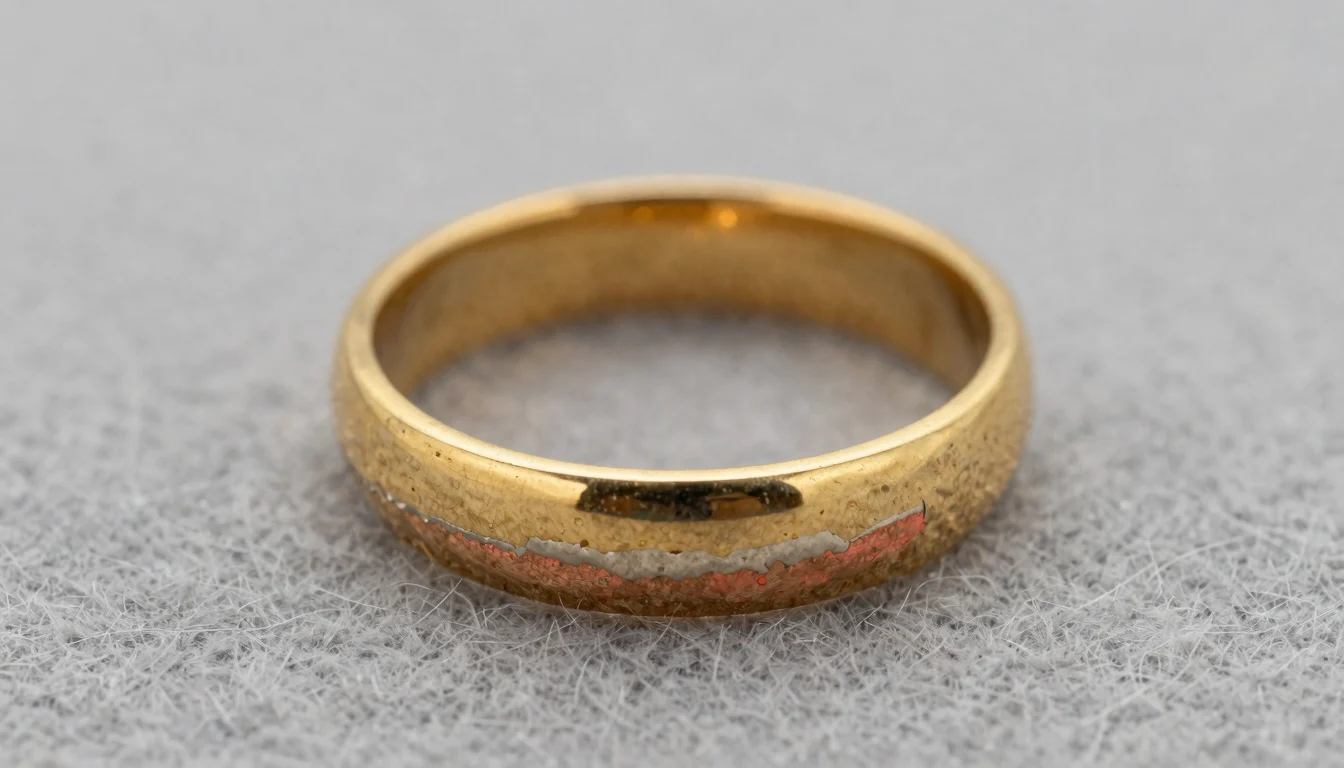
    AI-generated image of a gold-plated band ring worn through to coppery and silvery base metal along its bottom edge
    AI-generated image. Wear-through on a plated ring: along the bottom edge, where a ring drags on surfaces, the plating has gone and coppery and silvery base metal shows while the face still reads as gold. Representative AI-generated scene, not an examined piece.

    Plenty of plated jewelry has no readable mark. It wore off, it was never stamped, or it hides under a stone. When the hallmark fails you, a short sequence of checks sorts plated from solid. None of them proves solid gold on its own; each one removes possibilities.

    Start with wear, because it costs nothing. Examine edges, clasps and high-contact points under magnification. Plated pieces rub through to a different-coloured base metal: brassy yellow, coppery pink, or silvery nickel where a barrier layer was used. Solid karat gold wears evenly and stays the same colour throughout. A ring shank that is gold on the face and brass on the inside curve is plated, with no further argument needed.

    Then the magnet. Gold is diamagnetic, so a magnet does nothing to gold itself, and brass is not ferromagnetic either. What a magnet finds is steel or nickel: nickel is ferromagnetic, and steel springs, pin stems and clasps are common on costume pieces. A pull confirms a base-metal component somewhere in the piece; no pull is not proof of gold, because brass and copper cores pass the test just as gold does. The magnet rules things out, not in, the same logic as in our magnet test for silver guide.

    The acid test reads only what it touches. Jewelers’ testing kits work on the touchstone principle: the piece is rubbed on a dark stone and the streak is dosed with acids of graded strength. As the touchstone article summarises it, 24 karat gold is not affected but 14 karat gold will show chemical activity. The catch with plated pieces is that a light rub may pick up only the gold skin and pass. Testers therefore file a small notch on a hidden spot to reach the core before applying acid. That notch is permanent, so do not do it to a piece you value as an untouched antique, to enamel, stones or engraved surfaces, or to anything you do not own; rinse and dry the spot afterwards and expect a visible mark. Kit instructions vary, so follow the one in your box.

    XRF is the non-destructive answer. X-ray fluorescence analysers read the elements in a metal without harming it; as Wikipedia puts it, XRF is the basis of a non-destructive analytical technique widely used for elemental analysis. Many jewelers, pawnshops and refiners have a handheld unit. Ask the operator whether the reading describes the surface or the metal beneath it, and whether a worn or filed spot was tested.

    Weight is a hint, not a test. Gold has a density of 19.3 g/cm3, while the density of brass is 8.4 to 8.73 g/cm3, so a solid gold piece is more than twice as heavy as the same design in brass. Karat alloys are lighter than pure gold and hollow construction lowers the weight of solid pieces, so treat heft as one more clue, ideally by comparing against a piece you know.

    Layer the checks rather than trusting one. Wear inspection and a magnet are free and fast, acid confirms at the cost of a mark, and XRF settles a dispute without damage. If three checks all point to plated, trust them over a hopeful reading of a worn stamp.

    What gold-plated pieces are actually worth

    The honest headline is plain. Gold-plated, gold-filled and rolled-gold pieces have essentially no melt value. Work the numbers from the definitions above: a 1/20 12K GF piece is 5 percent gold alloy by metal weight, and that alloy is half gold, so 2.5 percent of the metal weight is fine gold. On a 10 g piece that is a quarter of a gram, locked in a brass sandwich that a refiner would have to process to recover. Electroplated pieces hold far less.

    Do not price plated jewelry on its gold. Price it on the object: the maker’s name stamped beside the GF or GP, the period and style, and how well the surface has survived, because plating that has rubbed through to base metal is the fault buyers penalise most. Signed pieces from recognised costume houses are the exception that can carry real collector value, which is why the maker’s mark deserves more of your loupe time than the plating letters.

    To find out what a specific piece brings, look at completed sales, not asking prices. Sold-price archives make this fast; our WorthPoint review explains what that subscription covers and costs, and our overview of online valuation resources lists free places to start. Group pieces by maker, photograph the marks, and compare like with like: same maker, same condition, same period.

    Value migrates from metal to object. That is the same logic behind knowing when to sell for melt and when to keep a silver piece: the precious-metal floor and the collector ceiling are two different numbers, and for plated jewelry the floor is close to zero.

    If you inherited a box of mixed jewelry and half of it reads GF or HGE, that half is not a windfall. It is also not worthless. The hallmark told you which kind of object you have before you spent a cent; the maker, the design and the condition tell you the rest.

    Frequently Asked Questions

    What does 14K GE mean?

    GE is gold electroplate. Under the US guides the mark may be used when a base-metal piece has been electroplated with gold alloy of at least 10 karat to a minimum thickness equivalent to 0.175 microns of fine gold; the 14K describes the purity of that film, not the piece. 14K GE, 14K GEP and 14K gold electroplate mean the same thing: a thin electroplated coating over base metal with no meaningful gold value.

    What does 14K GP mean, and is GP real gold?

    GP means gold plate or gold plated. The gold is real but there is very little of it: the guides allow GP for a bonded layer of at least 1/40 of the metal weight or for an electroplate of at least 0.175 microns fine-gold equivalent, and the letters alone do not say which. The 14K describes the plating alloy only. Treat a GP stamp as a description of the finish, not a precious-metal guarantee.

    What does 1/20 14K GF or 14KGF mean?

    Both are gold-filled marks. The fraction 1/20 says the bonded gold-alloy layer is one-twentieth, 5 percent, of the metal weight, and 14K says that alloy is 14-karat. Written 14KGF, 14K GF or 1/20 14K GF, the meaning is the same. The piece is mostly base metal with a durable surface of real 14-karat alloy; it is not solid gold and has negligible melt value, but it wears far better than electroplate.

    What does HGE mean on jewelry?

    HGE is heavy gold electroplate. It is the same electroplating as GE, deposited thicker: at least 2.5 microns of fine-gold equivalent under the US guides, about 14 times the plain electroplate floor. 18K HGE is a heavier-than-minimum film of 18-karat alloy over base metal. It wears better than plain GP, but it is still a coating with no meaningful melt value.

    What does 18K RGP mean?

    RGP is rolled gold plate: a sheet of karat gold bonded to base metal, like gold filled but thinner. The guides require at least 1/40 of the metal weight and the fraction should appear in the mark, so a full stamp reads something like 1/40 18K RGP. The 18K describes the bonded alloy. It is a plated piece, though usually a well-made one.

    Does 14KP mean gold plated?

    No. The P stands for plumb, meaning the alloy is the full stated karat within the legal tolerance, so 14KP is solid 14-karat gold. Plated marks use GP, GE, GEP, HGE, RGP or GF. Confusing P with plated is one of the most common mistakes made with gold stamps.

    What do GP and GF mean on jewellery sold in the UK?

    The same as elsewhere: GP is gold plate and GF is gold filled. UK law adds a wording rule. Under the Hallmarking Act 1973 an unhallmarked article may be described as gold only if the word is qualified by “plated” or “rolled”, in lettering at least as large as the rest of the description, which is why British pieces so often read “rolled gold” in full rather than RGP.

    Is gold-filled jewelry worth anything?

    Yes, but not for its gold. The gold alloy in a gold-filled piece is at least 1/20 of the metal weight, and only part of that alloy is fine gold, so the recoverable metal is a fraction of a gram on a typical piece. Its worth comes from age, maker and condition. Judge it as an antique or as costume jewelry, not as bullion, and check completed sales rather than asking prices.

    How can I tell gold-plated from solid gold without a hallmark?

    Layer several checks. Inspect high-wear points under magnification for a different-coloured base metal. Try a strong magnet: a pull confirms a steel or nickel component, no pull proves nothing. Have the piece acid-tested on a filed spot if you can accept a permanent mark, or, better, ask a jeweler or pawnshop to run an XRF analyser, which reads the metal without damage. Weight is only a hint. No single home test settles the question by itself.

    Will gold-plated jewelry hold its value over time?

    Plated jewelry does not track the gold price, because it contains almost no gold. Its value depends on the collector market for the maker, style and period, and on condition, since plating that has worn through cannot be undone without replating. If you want something that moves with the gold market, plated jewelry is not it.

    For the next steps, see our guides to white gold hallmarks, 10K gold marks, 18K gold marks, Victorian gold hallmarks and online antique jewelry appraisal.

  • Transferware and ironstone: antique plate markings explained

    Transferware and ironstone: antique plate markings explained

    Antique plate markings on transferware and ironstone identify the maker, pattern, and production date. Printed backstamps are the key. Most date 1810–1900.

    ED
    Antique Identifier Editorial
    Published by OBZENA LLC · May 22, 2026

    What antique plate markings actually tell you

    Every antique plate carries a small archive on its underside. The printed backstamp records the maker, the pattern name, and a rough production date. Learning to read it is the core skill of ceramic identification.

    Transferware and ironstone dominate surviving 19th-century English tableware. Both came from Staffordshire, often from the same factories. One set of reading skills covers thousands of pieces.

    A backstamp answers four questions at once. It names the manufacturer, identifies the pattern, signals the body type, and hints at the date.

    Each clue narrows the field before any guesswork begins. The mark turns a mystery plate into a documented object with a traceable history.

    Maker information appears as a printed name, a set of initials, or a recognizable symbol. Spode, Wedgwood, and Mason’s each used distinct devices. A marks reference converts unfamiliar initials into a full factory name.

    Pattern names drive both value and matching. Collectors hunting “Asiatic Pheasants” or “Willow” search by that exact phrase. A named pattern usually outsells an anonymous print.

    Body type separates the two main families. Transferware describes a decoration method, not a clay. Ironstone describes the dense body Charles James Mason patented in 1813.

    A single plate often belongs to both families. Ironstone clay frequently carries a transfer-printed pattern. The two terms answer different questions about the same object.

    Date clues hide in small details. The word “England” points to 1891 or later. A diamond-shaped registry mark dates a design to between 1842 and 1883.

    Any seasoned collector knows the mark is only a starting point. The glaze, the weight, the footrim wear, and the print quality all confirm or contradict it.

    Reading factory devices takes practice. The complete antique marks and signatures identification guide covers symbols used across ceramics, silver, and furniture.

    Museums treat these humble plates as serious documents. The Victoria & Albert Museum catalogs thousands of transfer-printed wares by maker and pattern.

    Takeaway: flip the plate first. Decode every element of the backstamp, because the mark is the fastest route to a confident identification.

    Transferware explained: how the printing process leaves a signature

    Transferware is decorated by a printing process, not by hand. An engraver cut a design into a copper plate. Workers inked the plate, lifted the pattern onto tissue paper, and pressed it against the ceramic body.

    The method launched commercially in the 1750s and expanded fast after 1800. It let factories sell matching dinner services to middle-class buyers at a fraction of hand-painted prices. Wikipedia’s overview of transfer printing traces the technique’s spread across Europe.

    Early transferware came almost exclusively in cobalt blue. The pigment survived high kiln temperatures better than other colors before 1830. Blue “Willow,” “Asiatic Pheasants,” and romantic Italian scenes filled English cupboards for decades.

    Color works as a rough dating tool. Blue dominated from 1800 to 1830. Pink, brown, black, green, and purple arrived in volume during the 1830s. Two-color and multicolor prints signal the 1840s and later.

    The print itself reveals quality. Hold a genuine early piece to the light. You should see tiny stipple dots and fine engraved lines. A faint seam often marks where the tissue was joined.

    Collectors prize the registration error. When the tissue slipped, the pattern doubled or smeared slightly. Those slightly uneven prints are classic hand-transfer evidence, not modern shortcuts.

    Print sharpness also tracks the copper plate’s age. A worn engraving yields a soft, faded image after years of factory use. Crisp, dark printing usually means an early pull from a fresh plate.

    Modern reproductions use lithographic decals. The image sits in a uniform film, lacks stipple texture, and shows a glossy edge under magnification. A jeweler’s loupe settles most disputes in seconds.

    Named example: the Spode blue “Italian” pattern launched in 1816. Early examples show crisp engraved-line texture under magnification. A genuine Georgian-era plate with a printed “SPODE” mark commonly sells for $60 to $150.

    Transferware marks usually print in the same color as the pattern. A blue plate carries a blue backstamp. A black mark on a blue plate is a small warning worth a second look.

    Takeaway: confirm transferware by texture. Stipple dots, fine engraved lines, and minor registration slips prove a true transfer print rather than a decal.

    Ironstone explained: the patent that changed English tableware

    Ironstone is a body type, not a decoration. Charles James Mason patented “Ironstone China” in 1813. The recipe produced a dense, chip-resistant earthenware that imitated porcelain at a lower cost.

    The name was marketing. The clay contained no iron ore. Mason chose a word that promised strength, and the promise held for generations of daily use.

    Mason’s patent triggered wide imitation. Rival Staffordshire factories sold near-identical bodies under their own names. Period backstamps read “Stone China,” “Granite Ware,” “Opaque Porcelain,” and “Flint China.”

    Early ironstone often carried bold, colorful decoration. The “Mason’s Patent Ironstone China” mark frequently appears with Imari-style florals in iron-red, cobalt, and gilt. These richly decorated pieces command the highest prices in the category.

    White ironstone tells a different story. From the 1840s, American buyers wanted plain, molded white services. English factories shipped huge quantities of undecorated ironstone with embossed wheat, corn, and berry borders.

    The body itself is a reliable clue. Ironstone is heavy for its size and rings with a clear note when tapped. It shows a grayish or bluish-white tint rather than pure paper-white.

    Crazing is the fine network of cracks across an aged glaze. It signals decades of thermal stress and genuine age. A pristine, glassy glaze on a supposedly Victorian plate deserves suspicion.

    Named example: a Mason’s “Patent Ironstone China” octagonal plate from the 1820s, decorated in the Japan pattern. Clean examples regularly sell in the $80 to $250 range. Rare forms reach far higher.

    Mark wording shifts the date. “Mason’s” alone is early. The crown-and-drape mark appeared after the 1840s. Later 19th-century reissues by Ashworth carry their own added wording.

    The Metropolitan Museum of Art documents Mason’s ironstone in its British ceramics collection. The body bridged cheap earthenware and costly porcelain in one durable product.

    Takeaway: identify ironstone by physical traits first: weight, ring, tint, and crazing. Then read the mark to pin the maker and decade.

    Reading the backstamp: maker, pattern, and registry marks

    A complete backstamp has layers. The most informative pieces show a maker device, a pattern name, and a registry mark together. Each element is read separately, then combined.

    Pattern names usually sit inside a decorative cartouche: a scroll, a ribbon, or a banner. The name printed there is the manufacturer’s official title for that design. Search auction archives by that exact phrase.

    Maker identification comes from the device or the initials. Printed names like “J & G MEAKIN” and “W. ADAMS” are straightforward. Bare initials require a marks dictionary to decode.

    The British diamond registry mark is the single best dating tool. It was used from 1842 to 1883. The diamond encodes the exact day, month, and year a design was registered.

    Two diamond systems exist. The 1842–1867 version places the year letter at the top point. The 1868–1883 version places it on the right point. A registry table converts the code letters into precise dates.

    Registry marks changed again in 1884. From then, designs carried a simple “Rd No” followed by digits. A low “Rd No” dates to 1884, while one near 360000 reaches the early 1900s.

    Country-of-origin wording is a hard date line. The U.S. McKinley Tariff Act required “England” on imports from 1891. A plain “England” mark therefore means 1891 or later.

    The phrase “Made in England” pushes the date further. It became standard in the 20th century. A printed “Bone China” phrase also points to 20th-century production.

    Impressed marks differ from printed ones. A maker’s name stamped into the clay before glazing is often earlier. Impressed date codes encoded the month and year at some factories.

    Named example: a plate carries an 1842–1867 diamond mark beside a “PODMORE WALKER & CO” device. The diamond pins the registered design to a single year.

    Digital shortcuts help here. Several online valuation tools and resources for collectors include registry-mark decoders. They turn the diamond code into a date instantly.

    Kovel’s maintains one of the largest searchable databases of pottery and porcelain marks. It is invaluable when initials alone resist identification.

    Takeaway: read the backstamp in layers: cartouche, maker device, registry mark, and country wording. Each layer tightens the date.

    Not sure what you’ve got?

    Snap a photo and let our AI identify any antique in seconds: free download, no sign-up.

    Identify on iPhone →Learn More

    Dating transferware and ironstone by their marks

    Dating a plate means stacking small clues until they agree. No single mark is decisive on its own. Together, color, wording, and registry data usually fix a window of ten to twenty years.

    The clearest dividing line is the word “England.” Its absence suggests production before 1891. Its presence guarantees 1891 or later. “Made in England” moves the estimate into the 20th century.

    Pattern style narrows the date further. Romantic landscapes with classical ruins peaked in the 1820s and 1830s. Naturalistic flowers and Aesthetic Movement designs dominated the 1870s and 1880s.

    The table below summarizes how marking conventions changed over time:

    PeriodMark traitsTypical wares
    1800–1830Mostly blue print marks; impressed maker names; no countryBlue transferware, early Mason’s ironstone
    1830–1842Multicolor prints; printed pattern cartouches expandPink, brown, and green transferware
    1842–1867Diamond registry mark, year letter at top pointRegistered transfer patterns
    1868–1883Diamond registry mark, year letter at right pointAesthetic Movement designs
    1884–1891“Rd No” replaces the diamond; still no country nameLate Victorian dinnerware
    1891–1914“England” required; “Rd No” continuesExport ironstone, Flow Blue
    1914 onward“Made in England”; “Bone China” wording20th-century reproductions

    Read the table as a checklist, not a guarantee. Factories used old copper plates for years. A mark style can outlive its introduction date by a decade.

    Flow Blue works as a useful date anchor. This deliberately blurred blue transferware peaked from the 1840s into the early 1900s. Late Flow Blue almost always carries an “England” mark.

    White ironstone shapes also track time. Simple paneled Gothic shapes belong to the 1840s and 1850s. Elaborate wheat and corn embossing belongs to the 1860s and 1870s.

    Named example: a Flow Blue plate is marked “England” with an “Rd No” near 240000. That registry number was issued in 1894. The plate therefore dates to roughly that year.

    When marks conflict, trust the most restrictive clue. An “England” mark beside an 1850s-style pattern means a later reissue, not an original.

    Takeaway: combine country wording, registry data, and pattern style. The narrowest clue, not the oldest-looking one, sets the real date.

    Transferware vs ironstone: a side-by-side identification matrix

    Beginners often treat transferware and ironstone as rivals. They are not opposites. One term describes decoration; the other describes the clay body underneath.

    A single plate can belong to both groups. Transfer-printed ironstone was made by the millions across Staffordshire. The two terms answer different questions about one object.

    The matrix below separates the concepts and the physical clues:

    FeatureTransferwareIronstone
    What the term describesA decoration methodA clay body type
    Defining traitEngraved print transferred by tissueDense, chip-resistant earthenware
    Key dateCommercial use from the 1750sMason’s patent of 1813
    Typical weightVaries with the body usedNoticeably heavy for its size
    Surface clueStipple dots and engraved linesGrayish-white tint, frequent crazing
    Common decorationBlue, then multicolor scenesBold Imari florals or plain white
    OverlapOften printed onto ironstone bodiesOften carries a transfer print

    The matrix shows why “is it transferware or ironstone” is sometimes the wrong question. The useful question asks whether the body is ironstone and whether the decoration is a transfer print.

    A practical test sequence helps. First, weigh the plate in your hand, because ironstone feels noticeably dense. Then tap the rim and listen for a clear ring.

    Next, inspect the decoration under a loupe. Stipple dots and fine engraved lines confirm a transfer print. A smooth, filmy image points to a later decal instead.

    Finally, read the mark. Words like “Ironstone,” “Stone China,” or “Granite” confirm the body. A pattern name in a cartouche confirms a named transfer design.

    Named example: a Johnson Brothers plate marked “Ironstone” carries the “Old Britain Castles” transfer pattern. It is both ironstone and transferware. A common 20th-century example sells for $10 to $30.

    Value diverges sharply within each group. Early hand-decorated Mason’s ironstone outsells plain white ironstone many times over. Georgian blue transferware outsells mass-market 20th-century prints by a similar margin.

    Takeaway: stop asking which one. Identify the body and the decoration separately, because most antique plates are honestly described by both terms.

    Common makers and what their marks are worth

    A handful of factories produced most surviving transferware and ironstone. Recognizing their marks shortcuts identification and sets realistic value expectations.

    Spode perfected blue transfer printing under founder Josiah Spode. The “SPODE” name appears both impressed and printed on many early-19th-century pieces. Genuine “Blue Italian” and “Tower” plates made before 1833 carry a clear premium.

    Mason’s defined the ironstone category. The “Mason’s Patent Ironstone China” mark, sometimes with a crown, identifies the patent holder. Richly decorated early Mason’s pieces are the prestige names of the field.

    Wedgwood used a clear impressed “WEDGWOOD” name from the 18th century. Its transfer-printed creamware and pearlware hold strong collector demand. The mark rarely needs decoding at all.

    Later mass producers include Johnson Brothers, J & G Meakin, and Alfred Meakin. Their marks are abundant and their wares are common. Prices stay modest unless a particular pattern is scarce.

    The table below gives a rough value guide for collectors:

    Maker or typeEraTypical plate value
    Spode early blue transferware1800–1833$60–$200
    Mason’s decorated ironstone1815–1850$80–$300
    Registered Victorian transferware1842–1890$25–$90
    Flow Blue marked “England”1891–1915$30–$120
    Plain white ironstone1850–1880$15–$60
    Johnson Brothers 20th-century prints1900–1970$8–$35

    Treat these ranges as starting points only. Condition, pattern rarity, and form push prices well outside the table. A rare covered tureen can multiply a pattern’s plate value many times over.

    Condition rules the final result. Hairline cracks, heavy crazing, knife scratches, and chips each cut value. A pristine plate can outsell a damaged twin three or four times over.

    Sold-price research keeps estimates honest. WorthPoint archives millions of completed sales. Collectors compare a specific maker and pattern against real outcomes.

    For pieces that look unusually valuable, a second opinion pays off. Comparing several online antique appraisal services helps before consigning to auction.

    Named example: a marked Spode “Tower” dinner plate in blue, circa 1820, in clean condition. It recently sold in the $90 to $140 band on major resale platforms.

    The same maker-and-pattern logic applies to silver. Collectors can see it in our guide to the top antique silverware patterns of 2026.

    Takeaway: learn six or seven major marks first. They cover most plates you will meet and instantly frame a realistic value range.

    Frequently Asked Questions

    How can I tell transferware from ironstone?

    Transferware and ironstone answer different questions, so one plate can be both at once. Transferware describes the decoration: an engraved design printed from a copper plate using tissue paper. Ironstone describes the clay body: a dense, chip-resistant earthenware patented by Charles James Mason in 1813. To check the decoration, inspect the print under a loupe, because stipple dots and fine engraved lines confirm a true transfer. To check the body, weigh the plate and tap the rim. Ironstone feels heavy and rings clearly, with a grayish-white tint and frequent crazing. Most 19th-century English plates are transfer-printed ironstone, honestly described by both terms together.

    What does the diamond-shaped mark on the back of a plate mean?

    The diamond-shaped mark is a British design registration mark, used from 1842 to 1883. It confirms that a design was registered with the Patent Office to protect it from copying. The diamond encodes the exact day, month, and year of registration through letters and numbers at its four points. Two systems exist: from 1842 to 1867 the year letter sits at the top point, and from 1868 to 1883 it sits on the right point. A registry table converts the code into a precise date. After 1883, the diamond was replaced by a simple Rd number followed by digits. Finding a diamond mark immediately places a plate within a 41-year window.

    Why are some antique transferware plates unmarked?

    Unmarked transferware is common and not a sign of fakery. Before roughly 1810, many Staffordshire factories did not mark their output consistently. Marking became standard only as competition and pattern registration grew through the 19th century. Small factories also skipped marks to cut costs, and some printed marks simply wore away after a century of washing. An unmarked plate can still be identified by its pattern, since named designs like Willow and Asiatic Pheasants were shared across makers. Border details, engraving style, and the body itself all narrow the maker. Unmarked pieces usually sell for less, because buyers pay a premium for documented attribution.

    How much is antique transferware worth?

    Antique transferware value ranges widely, from under $10 to several hundred dollars per plate. Early Georgian blue transferware made before 1833, especially marked Spode, commonly sells for $60 to $200. Registered Victorian patterns from 1842 to 1890 typically bring $25 to $90. Flow Blue marked England usually falls between $30 and $120. Mass-market 20th-century prints from Johnson Brothers often sell for $8 to $35. Condition is decisive, since cracks, heavy crazing, and chips can cut value by half or more. Rare forms such as tureens and platters multiply pattern value. Checking completed sales on archives like WorthPoint gives a realistic figure for a specific maker and pattern.

    Is blue transferware older than brown or pink transferware?

    Blue transferware is generally the oldest color, though the rule is a guideline rather than a law. Before about 1830, cobalt blue was the only pigment that reliably survived the high kiln temperatures used for under-glaze printing. That is why early Willow and romantic-scene plates are almost always blue. From the 1830s, improved ceramic chemistry allowed pink, brown, black, green, and purple transfers in volume. Multicolor and two-color prints point to the 1840s and later. So a brown or pink plate is usually post-1830, while a blue plate could be early or late. Always confirm color dating with the mark, since blue printing continued throughout the 19th century.

    Identify any antique in seconds.

    From silver hallmarks to porcelain maker marks, the app suggests the item type, period and a value range.

    See How It Works →

    ED

    About Antique Identifier Editorial

    Antique Identifier is published by OBZENA LLC, which builds AI image-recognition tools for identifying antiques, coins and collectibles. Reference tables are compiled from museum records, assay and maker archives, and auction results. We do not offer appraisals.

  • Top 10 most valuable antique silverware patterns in 2026

    Top 10 most valuable antique silverware patterns in 2026

    The most valuable antique silverware pattern is Tiffany Chrysanthemum, with full services selling above $20,000. Rarity, maker, and weight drive value.

    ED
    Antique Identifier Editorial
    Published by OBZENA LLC · May 22, 2026

    What makes a silverware pattern valuable

    Value in antique silverware is not random. Five forces set the price of every pattern on the market.

    The maker comes first. A fork stamped Tiffany & Co. starts a conversation no silver-plate piece can. American sterling from Tiffany, Gorham, Whiting, and Durgin carries a premium that has held for a century.

    Weight matters more than beginners expect. Sterling is priced partly by the gram. A heavy dinner fork in Wallace Grand Baroque can exceed 100 grams, while a thin Edwardian teaspoon weighs under 25. Collectors call dense patterns “good weight,” and they pay for it.

    Rarity is the third force. Tiffany Chrysanthemum was costly to produce in 1880 and never mass-marketed. Few complete services survive. Scarcity, not beauty alone, pushes a full set past $20,000.

    Condition is the quiet decider. Monogram removal leaves a thin spot. Worn tines, bowl-edge dents, and re-soldered handles each cut value. A pristine common pattern often outsells a damaged rare one.

    Completeness ties it together. A matched service for twelve with serving pieces sells for far more than the sum of loose forks. Serious collectors chase the set, not the spoon.

    Pattern type also shifts the math. Figural patterns (those with sculpted faces, birds, or full human forms) outrank floral patterns, which outrank plain ones. The Tiffany Olympian, covered in classical scenes, sits at the top of that hierarchy.

    One practical note for owners. Sterling and silver plate look identical across a room. Plate has almost no melt value and modest collector value. Before you celebrate a find, confirm the metal. Our guide to identifying pewter vs. silver covers the fastest at-home checks.

    Market timing layers on top of all five forces. Silver’s spot price climbed sharply through 2025. A rising metal market lifts the bottom of every pattern’s range, while rarity still sets the top.

    Any seasoned collector reads these forces (maker, weight, rarity, condition, completeness) before naming a price. The ten patterns below score high on most of them.

    The 10 most valuable antique silverware patterns

    The following ten patterns consistently top auction results and dealer asking prices. Each entry names the maker, the introduction year, and a realistic 2026 range for a service for twelve with serving pieces.

    Ranges are wide for a reason. A pristine, monogram-free, complete service sits at the top of each band. A worn or partial set sits near the bottom. Loose place settings sell for a fraction of a full service.

    RankPatternMakerIntroduced2026 range (service for 12)
    1ChrysanthemumTiffany & Co.1880$20,000 – $55,000
    2OlympianTiffany & Co.1878$15,000 – $45,000
    3Blossom / MagnoliaGeorg Jensen1905$12,000 – $35,000
    4AudubonTiffany & Co.1871$9,000 – $22,000
    5LilyWhiting1902$6,000 – $16,000
    6Francis IReed & Barton1907$5,000 – $14,000
    7VersaillesGorham1888$4,500 – $12,000
    8Grand BaroqueWallace1941$3,000 – $8,500
    9ChantillyGorham1895$2,200 – $6,500
    10FuchsiaDurgin1891$2,000 – $7,000

    Three names from Tiffany & Co. occupy four of the top spots. That is no accident. Tiffany invested in heavy-gauge silver and genuinely talented sculptors during the 1870s and 1880s.

    Georg Jensen is the lone non-American maker here. The Danish workshop’s Blossom pattern, also catalogued as Magnolia, carries hand-finished detail that the Metropolitan Museum has displayed in its silver and design collection.

    The 1940s entry proves that age is not everything. Wallace Grand Baroque arrived in 1941, yet it ranks eighth on sheer weight and decades of unbroken demand.

    Notice the gap between rank one and rank ten. A Chrysanthemum service can outsell a Fuchsia service by ten to one. The pattern name on the back of the handle is the single largest variable in that spread.

    Treat this table as a screening tool. Find your pattern, confirm the maker mark, then read the deeper sections below for the detail that moves a set within its range.

    Tiffany Chrysanthemum and the elite tier

    The top four patterns share one trait. Tiffany & Co. made three of them, and all four were expensive when new.

    Chrysanthemum debuted in 1880 and never left the catalog. Original 19th-century pieces are dense, deeply chased, and marked TIFFANY & CO. with STERLING and a single director’s letter that pins the production era. A complete antique service has crossed $50,000 at major auction houses.

    Collectors prize Chrysanthemum dinner forks above almost any other American flatware. A single antique dinner fork can run $400 to $800 on its own. Multiply that across a service for twelve with serving pieces, and the five-figure total explains itself.

    Olympian, introduced in 1878, is the figural showpiece of the group. Each handle carries a different classical scene in high relief. The dies were complex and the original pattern short-lived, so surviving antique Olympian is genuinely scarce. Serving pieces in Olympian are what advanced collectors hunt hardest.

    Audubon came earlier still, in 1871, drawn from Japanese-influenced motifs of birds and insects. Tiffany originally called it Japanese. Clean antique Audubon place settings trade in the low hundreds each, while a full early service reaches the five-figure band.

    Values within this tier swing on completeness more than anything else. Loose Chrysanthemum forks are findable. A matched, monogram-free service for twelve with original serving pieces is not. That scarcity of complete sets sustains the five-figure ceiling.

    Georg Jensen’s Blossom rounds out the elite tier. The Danish maker hand-finished every piece, and Blossom, sometimes sold as Magnolia, shows the soft, organic modeling that built Jensen’s name. Jensen marks changed across the decades, and the earliest hallmarks command the strongest prices.

    A caution sits inside this tier. Tiffany and Jensen are among the most reproduced and most faked marks in the trade. A blurry, shallow, or oddly spaced stamp is a warning sign. The complete guide to antique marks and signatures shows what a genuine stamp should look like.

    The lesson of the elite tier is consistency. These patterns hold value through soft markets because the buyers are deep-pocketed and patient. When a high-tier piece is uncertain, a formal appraisal pays for itself. Compare your options through these honest appraisal-site reviews.

    Not sure what you’ve got?

    Snap a photo and let our AI identify any antique in seconds. Free to download, no sign-up.

    Identify on iPhone →Learn More

    The collector’s middle ground: patterns 5 through 7

    Patterns five through seven occupy the sweet spot of the market. They are valuable, attainable, and actively traded every week.

    Whiting’s Lily, introduced in 1902, is a figural pattern with a sculpted lily blossom climbing each handle. Whiting built its reputation on crisp die work, and Lily shows it plainly. A complete antique Lily service reaches $16,000 in top condition, yet individual teaspoons stay affordable enough for a new collector to start a set.

    Reed & Barton’s Francis I is the middle ground’s most famous name. Introduced in 1907, it covers each piece with fruit and flowers in deep relief. Francis I also carries one critical collector trap, mapped in the table below.

    Francis I featureOld mark (pre-1949)New mark (post-1949)
    Stamp wordingReed & Barton with date symbolReed & Barton Sterling, no date symbol
    Relief detailCrisp, hand-finished chasingSlightly softer casting
    Fruit motif per pieceVaries piece to pieceStandardized across the set
    Collector premiumHighestModerate

    Old-mark Francis I in clean condition reaches the top of the rank-six range. New-mark sets are handsome and fully usable, but they sell closer to the floor.

    Gorham’s Versailles, from 1888, is the middle ground’s figural star. Designed by Antoine Heller, each piece shows a different scene of the French court in fine relief. Versailles is heavy, ornate, and instantly recognizable. Complete antique services reach $12,000, and the serving pieces draw strong individual demand.

    A practical thread connects these three. Each is valuable enough to justify a careful appraisal, yet common enough that real comparable sales exist. WorthPoint’s archive of sold-price records lets an owner check what an identical piece actually fetched, not what a hopeful seller is asking.

    For owners weighing a sale, the gap between melt value and collector value is widest in this tier. A Francis I service is worth far more intact than scrapped. The melt value versus antique value guide explains exactly when that gap closes.

    Accessible classics: patterns 8 through 10

    The final three patterns are the entry points to valuable silver. They cost less, surface more often, and still reward the collector who buys carefully.

    Wallace Grand Baroque, introduced in 1941, is the heavyweight of the group in the most literal sense. Its dinner forks and serving pieces rank among the densest sterling ever made for the American table. That weight is why a 1940s pattern outranks several 19th-century rivals. A complete service reaches $8,500, and demand stays high enough that replacement pieces are easy to source.

    Gorham Chantilly, from 1895, is the best-selling sterling pattern in American history. Its restrained scrollwork suited a century of weddings. That ubiquity caps the ceiling (a complete service tops out near $6,500), but constant availability makes Chantilly the easiest valuable pattern to build piece by piece.

    Durgin’s Fuchsia, introduced in 1891, is the connoisseur’s pick of the trio. Durgin was absorbed by Gorham in 1905, so the pattern had a short independent life. Fuchsia’s naturalistic flower spray and Durgin’s reputation for fine casting keep complete services near $7,000, despite the maker’s relative obscurity.

    PatternBest featureWhy buy itWatch for
    Grand BaroqueExceptional weightEasy to complete, high demandPost-war pieces mixed into antique sets
    ChantillyUniversal appealAffordable entry, constant supplyMonograms dragging value down
    FuchsiaFine Durgin castingScarcer maker, real upsideDurgin marks confused with later Gorham

    These three teach one useful habit. When you are starting, buy condition over rarity. A flawless Chantilly service will outperform a worn Fuchsia service, even though Fuchsia ranks higher on paper.

    There is a decorating angle too. Valuable sterling does not need to hide in a drawer. Collectors increasingly display and use mid-tier patterns, and the metal’s warmth suits modern interiors well.

    If a piece in this tier is unsigned or the mark is worn flat, do not give up. Pattern identification works from the design alone, and digital tools have made that far easier. The digital valuation tools and resources guide covers the strongest options.

    How to identify and authenticate your pattern

    Identification follows a fixed order. Work through it the same way every time, and the pattern name will surface.

    Start with the mark, not the design. Flip every piece over. American sterling carries the word STERLING or the number 925. A maker name (Tiffany & Co., Gorham, Wallace, Whiting, Durgin) usually sits close by. No sterling mark means you are probably holding silver plate, which changes the value conversation entirely.

    Read the maker’s date system second. Gorham stamped a year symbol from 1868 to 1933, a small picture that pins production to a single year. Tiffany used a director’s letter. Reed & Barton’s date symbol is exactly what separates old-mark Francis I from the post-1949 version.

    Match the design third. Photograph the handle straight on under even light. Compare it against a documented reference. The Smithsonian’s American silver holdings display verified examples of major patterns for side-by-side checking.

    Count and weigh fourth. A service for twelve with serving pieces is worth far more than a partial set. Weigh the heaviest dinner fork. Genuine high-tier patterns feel substantial, and a suspiciously light “Grand Baroque” fork deserves a hard second look.

    Inspect condition fifth. Hold each piece to raking light. Look for the faint ghost of a removed monogram, worn tines, thin spots, and re-soldered joints. Damage spotted here explains a low appraisal later.

    The same flip-it-over discipline applies across every collecting category. Even our guide to antique folding rocking chair identification starts with the maker’s mark before the silhouette.

    One modern shortcut deserves mention. Photographing a hallmark and running it through an identification app now resolves most common marks in seconds. It will not replace a formal appraisal on a $30,000 service, but it ends the guesswork on a single mystery fork fast.

    Authentication is where money is won or lost. A genuine Tiffany Chrysanthemum stamp is deep, evenly spaced, and crisp. A reproduction stamp looks shallow or smeared. When a five-figure pattern is on the table, pay for an expert opinion. The cost is trivial against the value at risk.

    The 2026 silver market and what it means for your set

    The 2026 market rewards owners of named patterns more than at any point in recent memory. Two forces are working in their favor at once.

    The first force is the metal itself. Silver’s spot price climbed sharply through 2025 and held those gains into 2026. A higher spot price raises the melt floor under every sterling piece. Even a worn, unfashionable pattern is now worth more as raw metal than it was two years ago.

    The second force is the gap between melt value and collector value. For top patterns, that gap is enormous. A Tiffany Chrysanthemum service is worth twenty to forty times its melt weight. Scrapping it would be a costly mistake. The melt floor protects the bottom of the market, while rarity still owns the top.

    Pattern tierMain value driver in 2026Sell or hold
    Elite - Chrysanthemum, OlympianRarity and makerHold unless the price is exceptional
    Middle - Francis I, VersaillesCondition and completenessSell complete, never scrap
    Accessible - Chantilly, Grand BaroqueWeight and demandEither, the buyer pool is deep
    Unnamed plateMetal content onlySell or repurpose

    Demand has shifted as well. Younger buyers are returning to sterling, partly for sustainability reasons, since buying a 1900 service consumes no new mining. Mid-tier patterns such as Chantilly and Grand Baroque benefit most from that trend.

    Auction results through 2025 showed figural patterns outperforming floral ones, and floral outperforming plain. Olympian and Versailles, both heavily figural, drew competitive bidding. The hierarchy described throughout this guide held firm in the saleroom.

    So what should an owner do? Identify the pattern first. Confirm the maker mark. Weigh and count the set. Then decide. A complete, named, antique service almost always sells for more intact than melted.

    For a documented sense of current pricing, Kovels maintains an actively updated price guide, and the Victoria and Albert Museum’s silver collection gives a reference for design and period context. Cross-checking both keeps an owner’s expectations grounded in real data rather than optimism.

    Frequently Asked Questions

    How do I find out what my silverware pattern is worth?

    Start by naming the pattern and confirming the maker mark on the back of each handle. Value then depends on five factors: maker, weight, rarity, condition, and completeness. A complete service for twelve with serving pieces sells for far more than loose pieces. Check real sold prices rather than asking prices. WorthPoint archives actual auction and sale results, and Kovels publishes a regularly updated price guide. For a top pattern like Tiffany Chrysanthemum, where a service can exceed $20,000, pay for a formal appraisal, because the fee is trivial against the value. For a common pattern, an identification app and a sold-price search usually give a reliable range within minutes.

    Is Tiffany Chrysanthemum still the most valuable silver pattern in 2026?

    Yes. Tiffany Chrysanthemum, introduced in 1880, remains the most valuable widely traded antique American silverware pattern in 2026. Complete antique services regularly sell in the $20,000 to $55,000 range, and exceptional examples have crossed $50,000 at major auction houses. Its value rests on heavy-gauge silver, deep hand chasing, the Tiffany & Co. name, and the genuine scarcity of complete services. The Tiffany Olympian pattern of 1878 sometimes rivals it for individual figural serving pieces, and rare early Georg Jensen patterns compete internationally. But for a full matched service, Chrysanthemum still sits at the top of the market, and it has done so consistently for decades.

    Does a monogram lower the value of antique silverware?

    Usually yes, though less than many owners fear. A period monogram applied when the silver was new is part of its history, and on 19th-century pieces collectors often accept it with little discount. The real damage comes from monogram removal. Grinding out initials leaves a thin spot, a slight dish in the metal, and sometimes a visible ghost under raking light. That thinning is structural damage and can cut value by 10 to 30 percent on a fine pattern. A clean, monogram-free piece always sells best. If your set is monogrammed, leave it alone and never have initials removed in the hope of raising the price.

    How can I tell if my silverware is sterling or silver plate?

    Look for the mark first. Genuine sterling carries the word STERLING or the number 925 stamped on the back. Silver plate carries different marks such as EPNS, A1, triple plate, or simply a maker name with no purity stamp. Sterling also feels heavier and denser in the hand than plate of the same size. Plate often shows base metal bleeding through at worn edges, especially on spoon backs and fork tines. The distinction is decisive for value: a top sterling pattern can be worth thousands, while silver plate has little melt value and modest collector value. When a mark is worn or ambiguous, simple at-home tests narrow it down before you invest in an appraisal.

    Should I sell my antique silver now while prices are high?

    It depends on the pattern. Silver’s spot price rose sharply through 2025 and into 2026, which lifts the melt floor under every sterling piece. For unnamed or heavily damaged plate, a high metal market is a reasonable moment to sell. But for a named antique pattern, melt value is the wrong measure entirely. A complete Tiffany Chrysanthemum or Reed & Barton Francis I service is worth many times its metal weight, and that collector premium does not move with spot prices. Never scrap a named, complete service. Identify the pattern, confirm condition and completeness, then weigh a collector sale against holding. This is general information, not financial advice, and a qualified appraiser should guide any high-value decision.

    Identify any antique in seconds.

    From silver hallmarks to porcelain maker marks, the app suggests the item type, period and a value range.

    See How It Works →

    ED

    About Antique Identifier Editorial

    Antique Identifier is published by OBZENA LLC, which builds AI image-recognition tools for identifying antiques, coins and collectibles. Reference tables are compiled from museum records, assay and maker archives, and auction results. We do not offer appraisals.

  • Zophi Antique Identifier review: features, pricing, and accuracy

    Zophi Antique Identifier review: features, pricing, and accuracy

    Zophi Antique Identifier is a free AI app that identifies antiques from photos and estimates value, with a $34.99/year Pro tier. Best used as a research tool.

    Free to download: identify any antique instantly with AI. No sign-up.

    Identify Now →
    ED
    Antique Identifier Editorial
    Published by OBZENA LLC · May 21, 2026

    What Zophi Antique Identifier is and who built it

    Zophi Antique Identifier is a mobile app that names antiques and collectibles from a single photo. It runs on both iPhone and Android. On the App Store it appears under the title “Antique Identifier Zophi.”

    The Android build carries the package name com.labs326.antique. That points to a developer studio maintaining a small family of visual identification apps. Zophi is its antiques-focused entry.

    The promise is plain. You photograph an object. The app returns a likely identification, a short history, and an estimated value range. No hallmark book, no forum wait, no trip to the library.

    That convenience explains the numbers. Zophi holds a 4.8-star average across roughly 9,700 App Store ratings in spring 2026. For a niche tool, that review volume signals genuine adoption rather than a handful of friendly notes.

    Three kinds of user get the most from it. Estate-sale hunters who need a fast read before bidding. Inheritors clearing a relative’s china cabinet with no catalogue to consult. And weekend collectors who love the hunt but own no reference library.

    One clarification belongs up front. Zophi is not a licensed appraisal service. It never routes your piece to a human expert. Every result is generated by software from your photo and from public sales data.

    Any seasoned collector knows the difference between a hint and a verdict. Zophi gives hints. A good hint is worth having, yet it carries no signature and no liability behind it.

    I have spent two decades reading silver hallmarks and porcelain marks. Tools like this did not exist when I started, so I came to Zophi curious and a little skeptical, and I want to give you an honest account.

    The category itself is young. Five years ago, naming an unmarked piece meant a reference shelf and patience. An app that does the same in seconds is a real shift, and it deserves a fair test.

    A review is worth more than a star rating here. A 4.8 average tells you people enjoy the app. It does not tell you whether the app is right about your Victorian sugar tongs.

    This review walks through the scanning workflow, the full feature set, the pricing structure, and accuracy tested across silver, porcelain, glass, furniture, and coins. For the wider field, our roundup of the best online antique appraisal sites sets useful context before you commit to any single tool.

    How Zophi identifies an antique from a photo

    Zophi runs on AI image recognition. The app compares your photo against a trained visual model and a database of catalogued objects, then ranks the closest matches.

    The workflow takes under a minute. Open the camera inside the app. Frame the object. Tap to scan. A result card appears with a name, a category, an era, and a value range.

    Photo quality drives everything else. The model reads shape, material, surface, and any visible marks. A sharp, evenly lit image against a plain background beats a dim snapshot every time.

    Marks deserve their own shot. If your piece carries a hallmark, a backstamp, or a maker’s signature, photograph that detail separately and in focus. The app handles a clean mark image well.

    This is where identification apps earn their keep. A Birmingham anchor, a Meissen crossed-swords mark, a Limoges green underglaze stamp: these are the fingerprints of authentication. Our complete guide to antique marks and signatures explains what each one tells you.

    Zophi lets you refine a result. If the first answer looks wrong, you can edit the category or re-scan from a better angle, and the app narrows its guess. That feedback loop beats a single fixed answer.

    The history blurb is a pleasant touch. Alongside the identification, Zophi writes a short paragraph on the object type, its period, and its typical use. It reads like a tidy museum label.

    Lighting deserves a second mention. Harsh overhead light flattens a surface and hides the very texture the model needs. Soft, indirect daylight near a window gives the truest read.

    Background matters as much as light. A patterned tablecloth confuses the edge detection. A plain sheet of paper or a neutral cloth lets the app isolate the object cleanly.

    For metal pieces the app attempts a material call. Telling silver from pewter or plate is notoriously hard from a photo alone. Our breakdown of whether there is silver in pewter shows why the composition itself confuses quick reads.

    One habit pays off. Photograph the whole object, then the mark, then any damage. Three deliberate images give the model far more to work with than one rushed frame.

    Zophi’s features, broken down

    Zophi bundles more than a scanner. The feature set leans toward organizing and sharing finds, not only naming them. Here is what you actually receive.

    Collections sit at the center. Every scan can be saved, and the app now supports “sets” so you can group items: all your silver in one set, all your glass in another. For anyone cataloguing an estate, that structure matters.

    The value estimate is the headline feature. Zophi returns a market range rather than a single figure. The number is built from comparable online listings, so it shifts as the market shifts.

    A “set selling price” tool lets you record your own asking price on a saved item. Resellers will recognize the use: a running inventory with your numbers attached to each piece.

    Sharing is handled well. Zophi can export an item as a PDF or as a web link. That makes it easy to send a piece to a buyer, a family member, or an insurer.

    The Explore feed is the social layer. You can publish a find to a community of other users and browse what they have posted. It turns a solo hobby into something closer to a club.

    Market price tracking rounds out the Pro experience. The app watches comparable sales over time, so a saved item’s estimate updates instead of freezing on the day you scanned it.

    FeatureWhat it doesTier
    Photo identificationNames an object from one imageFree (limited)
    Value range estimateMarket range from comparable listingsPro
    Collections and setsSave and group items into categoriesFree / Pro
    Refine and edit resultsCorrect or re-scan a wrong identificationFree
    PDF and web-link exportShare an item as a document or URLPro
    Explore community feedPublish and browse finds from other usersFree
    Market price trackingUpdates a saved item’s estimate over timePro
    Set selling priceRecord your own asking price per itemPro

    The split is conventional for the category. Identification and basic saving stay free, while valuation, export, and tracking sit behind the subscription.

    Offline behavior is worth knowing. Identification needs a connection, since the matching happens server-side. Without signal at a rural estate sale, you can still photograph pieces and scan them later from the saved images.

    One feature I wish Zophi pushed harder is mark-by-mark reasoning. The app tells you the result. It rarely shows the chain: which letter, which symbol, which date code led there.

    Zophi pricing: the free tier, the trial, and Pro

    Zophi is free to download on both the App Store and Google Play. Installation costs nothing, and you can begin scanning without paying immediately.

    The free tier is deliberately limited. You get a taste of identification and basic saving, while the outputs collectors care about (value ranges, exports, tracking) are gated behind Pro.

    A trial period bridges the gap. New users get a window to test Pro features before any charge lands. Read the trial terms inside the app, because trials convert to paid plans automatically.

    Pro costs $34.99 for one year. That works out to roughly $2.92 a month, billed annually rather than month by month.

    Measured against the category, that price is moderate. Many rival identifier apps push weekly subscriptions that quietly cost far more across twelve months. An honest annual figure is easier to judge.

    PlanPriceBest for
    Free download$0Trying identification, casual one-off scans
    Trial period$0 during the trial windowTesting Pro features before committing
    Pro (annual)$34.99 per yearActive collectors, resellers, estate cataloguing

    Is the Pro fee worth it? For a one-time user clearing a single cabinet, the trial alone may be enough. Run your scans, export your PDFs, then decide before the window closes.

    For an active collector the math changes. One avoided mistake at an estate sale (one $34.99 plate that was really worth $8) pays the yearly fee outright.

    There is a quieter cost too, and that cost is time. A subscription you forget about drains money every year for a tool you stopped opening. Set a calendar reminder a week before renewal.

    Weigh the Pro tier against what you would otherwise spend. A single printed price-guide book runs more than $34.99, and it ages the moment it leaves the press. An app that tracks live listings holds a genuine edge there.

    A note on appraisals. The Pro subscription does not buy you a certified valuation. For insurance or probate you still need a human appraiser. Our overview of digital antique valuation tools and resources explains where apps stop and professionals begin.

    Always cancel an unwanted trial through your phone’s subscription settings, not inside the app. That holds for every subscription app, and it prevents the surprise renewal that catches casual users.

    Not sure what you’ve got?

    Snap a photo and let our AI identify any antique in seconds. Free to download, no sign-up.

    Identify on iPhone →Learn More

    How accurate is Zophi? Tested across five categories

    Accuracy is the only question that finally matters for an identification app. I tested Zophi across five categories, scanning pieces whose identity I already knew.

    Marked silver performed best. A Gorham sterling spoon with a clear lion-anchor-G mark was named correctly, with a sensible period and a value range close to recent comparable sales.

    The reason is structural. Silver carries standardized hallmarks. When the app can read a sharp mark, it has a near-unambiguous data point to match. Our guide to what 10k, 14k, and 18k gold hallmarks really mean shows how precise a stamped mark can be.

    Porcelain came a close second. A Limoges blank with a green underglaze mark and a red overglaze decorator’s mark was identified to maker and rough era. The app correctly separated the factory from the decorating studio.

    Glass was mixed. Pressed and Depression-era glass with recognizable patterns scored well. Unmarked art glass, where attribution rests on pontil, color, and weight, produced vaguer guesses.

    Furniture was the weakest category. A photograph cannot feel a drawer’s dovetails or the heft of old oak. Zophi read style and era broadly but could not separate a period piece from a convincing reproduction.

    Coins were variable. Common dated coins were named cleanly. Worn or unusual pieces drew uncertain answers, which is fair, since numismatics rewards the magnification a phone camera rarely captures.

    CategoryTypical accuracyWhy
    Marked silverHighStandardized hallmarks give a clear match
    Porcelain with backstampHighFactory marks are well documented
    Patterned glassModerateStrong on named patterns, weak on unmarked art glass
    FurnitureLowerPhotos miss joinery, weight, and patina
    CoinsVariableWear and fine detail need magnification

    One pattern held throughout the testing. Zophi is strong wherever a maker left a documented mark and weaker wherever identification depends on touch, weight, or construction.

    Lighting and angle changed results more than I expected. The same Gorham spoon, shot in shadow, once returned a vague “silver flatware” answer. A brighter second frame fixed it. Re-scanning is not a failure; it is the method.

    The valuations deserve their own caution. Zophi’s figures come from comparable online listings, not from sold prices and not from a physical inspection. For real sold data, cross-check sites like WorthPoint and Kovel’s.

    To calibrate any app’s value range, compare its answer against documented museum examples. Collections at the Smithsonian and the Metropolitan Museum of Art help you sanity-check period and type.

    Where Zophi falls short

    No identification app replaces a trained eye. Zophi is useful, yet an honest review has to name its limits clearly.

    The first limit is structural. The app sees a photograph. It cannot weigh a piece, tap it for tone, feel a glaze, or test a metal. Half of real authentication is tactile.

    Valuations are the second concern. A market range built from active listings reflects what sellers hope to get, not what buyers paid. The two numbers often diverge sharply.

    Comparable sold prices tell the truer story. When a value matters, for a sale, a family split, or insurance, verify it against sold records rather than asking prices.

    Reproductions are the third weakness. A skilled fake is built to fool a glance, and a photo is only a glance. Zophi can be confidently wrong about a clever copy.

    Confidence is its own trap. The app rarely hedges. A result card looks equally certain whether the match is strong or a stretch, and that polish can lull a new collector into trusting a weak guess.

    Rare and regional pieces are a blind spot. The model leans on what is well documented online. A common Victorian creamer scans well; an obscure provincial silversmith far less so.

    Edge cases compound the problem. A piece that is damaged, heavily polished, or unusually lit drifts toward generic answers. The app does its best, yet it will not warn you how thin the ice is.

    The history blurbs, while pleasant, stay general. They describe the object type well but rarely the specific piece in your hand. Do not mistake a tidy paragraph for documented provenance.

    There is also the subscription reality. A trial converts to a paid year unless you cancel. That is standard practice, yet it catches casual users who installed the app for one question.

    None of this makes Zophi a poor tool. It makes it a first-pass tool. The danger lies in treating a confident screen as a final answer when the stakes are real.

    For high-value silver especially, the decision to sell or hold should rest on more than an app estimate. Our piece on silver melt value versus antique value walks through that judgment in detail.

    Zophi versus other antique apps, and the verdict

    Zophi competes in a crowded field. A dozen antique identifier apps now promise the same photo-to-answer trick. They differ mostly in pricing honesty and interface polish.

    Zophi’s strengths are clear. The interface is clean. The collection and set tools are genuinely useful. The annual price is stated plainly, which is rarer in this category than it should be.

    Its weaknesses are the category’s weaknesses. Photo-only identification, listing-based valuations, and no human in the loop. Every rival shares those same ceilings.

    FactorZophiTypical rival app
    Pricing model$34.99 per year, stated upfrontOften weekly billing, higher annual cost
    IdentificationPhoto-based AI, with a refine optionPhoto-based AI, quality varies
    Collection toolsSets, export, selling priceOften basic saving only
    Community feedYes, the Explore feedRare
    Human appraisalNoneNone

    How do you choose? For a one-time answer, almost any free trial will do the job. For an organized, ongoing catalogue, Zophi’s set and tracking tools pull ahead of the pack.

    Switching cost is low, which works in your favor. Most of these apps are free to install and free to trial. Nothing stops you running the same teacup through two or three and comparing the spread of answers.

    Watch the billing model above all else. An app that bills $4.99 weekly costs more than $250 across a year. Zophi’s flat $34.99 annual fee sits, in plain terms, at the honest end of this market.

    My verdict. Zophi is a solid, fairly priced research tool. It earns its 4.8-star reputation for usability. It does not earn the title of appraiser, and to its credit it does not pretend to.

    Use it the way I use it. Scan to get a direction. Save and organize your finds. Then verify anything that matters against sold data, and for real value, put the piece in front of a human expert.

    For collectors who also want a free starting point with strong hallmark and maker-mark reading, the Antique Identifier App is worth installing alongside it. Comparing two reads on the same object is the cheapest second opinion a collector will ever get.

    Frequently Asked Questions

    Which app can identify antiques from a photo?

    Antique Identifier App is the app made by the publisher of this site. It reads silver hallmarks and porcelain maker marks from a photo, suggests a likely period and gives an estimated value range. It is free to download on iPhone and Android. Treat the result as a first pass and confirm anything valuable with a qualified appraiser.

    Is Zophi Antique Identifier free to use?

    Zophi Antique Identifier is free to download on both the App Store and Google Play, and the free tier lets you try photo identification and basic saving. The features collectors value most (value-range estimates, PDF and web-link export, and market price tracking) sit behind the Pro subscription. Pro costs $34.99 for one year, which is about $2.92 a month billed annually. New users get a trial period to test Pro before any charge lands. If you only need to answer one question, the free tier or the trial may be enough. Remember that a trial converts to a paid year automatically unless you cancel it in your phone’s subscription settings.

    How accurate is Zophi at identifying antiques?

    Zophi is most accurate when an object carries a clear maker’s mark. In testing, marked sterling silver and backstamped porcelain were identified correctly, with sensible periods and value ranges close to comparable listings. Standardized hallmarks give the AI an unambiguous data point to match. Accuracy drops with furniture and unmarked art glass, where identification depends on joinery, weight, and patina that a photograph cannot capture. Coins are variable, since wear and fine detail need magnification. The honest summary is that Zophi is strong wherever a maker left a documented mark and weaker wherever a trained hand would do the work. Always photograph any hallmark or backstamp in sharp focus, because that single detail decides most of the result.

    Does Zophi give a real appraisal value?

    No. Zophi does not provide a certified appraisal. Its value figures are generated by AI from your photos and from publicly available online listings, and the app presents them as market ranges based on comparable sales. Those ranges reflect what sellers are asking, which often differs from what buyers pay. For a truer picture, cross-check sold prices on research sites such as WorthPoint and Kovel’s. For insurance, estate, or probate purposes, you still need a licensed human appraiser who can physically inspect the piece. Treat any app valuation, Zophi’s included, as a research signal that points you in the right direction rather than a final, defensible number for a document.

    Is Zophi Antique Identifier available on Android?

    Yes. Zophi Antique Identifier is available on both iPhone and Android. The iOS version appears on the App Store as “Antique Identifier Zophi.” The Android version is on Google Play under the package name com.labs326.antique. Both builds share the same core workflow: photograph an object, then receive an identification, a short history, and a value range. The feature set (collections, sets, the Explore community feed, PDF export, and market price tracking) carries across both platforms. Pricing is the same $34.99 annual Pro plan, though Apple and Google process the billing separately through their own stores. If you switch phones across platforms, check whether your subscription transfers, since store purchases do not always carry over.

    Should I use Zophi or hire a professional appraiser?

    Use both, at different stages. Zophi is excellent for a fast first pass: sorting a cabinet, deciding what deserves a closer look, or getting a direction at an estate sale before you bid. It costs little and works in seconds. A professional appraiser becomes necessary once real money is involved: selling a valuable piece, settling an estate, insuring a collection, or splitting inherited items fairly. A human can weigh an object, test a metal, read joinery, and produce a signed document that an app cannot. The sensible workflow is to let Zophi narrow the field, then pay an expert to confirm the few pieces that genuinely matter.

    Identify any antique in seconds.

    From silver hallmarks to porcelain maker marks, the app suggests the item type, period and a value range.

    See How It Works →

    ED

    About Antique Identifier Editorial

    Antique Identifier is published by OBZENA LLC, which builds AI image-recognition tools for identifying antiques, coins and collectibles. Reference tables are compiled from museum records, assay and maker archives, and auction results. We do not offer appraisals.

  • Authenticating antique signs: porcelain vs. modern reproductions

    Authenticating antique signs: porcelain vs. modern reproductions

    Authenticate antique porcelain signs by checking layered color edges, original brass grommets, and natural shelf wear. Repros miss all three. Genuine pre-1960 signs show stovepipe-fired enamel layers, steel substrates 18-22 gauge thick, and maker stamps from Ingram-Richardson, Baltimore Enamel Novelty, or Burdick. Modern reproductions print on thin sheet metal with screen-printed or vinyl graphics that crack but never chip cleanly to bare exposed steel.

    ED
    Antique Identifier Editorial
    Published by OBZENA LLC · May 17, 2026

    How real porcelain signs were actually made (1890-1960)

    Genuine porcelain signs are not painted. They are vitreous enamel fused to steel in a stovepipe kiln at roughly 1,500°F. Powdered glass frit, mixed with metal oxide colorants, was sifted through stencils onto a heavy steel blank, then fired. Each color required its own firing. A four-color Coca-Cola button from 1948 went through the kiln four separate times.

    This matters for authentication because heat-fused glass behaves nothing like modern printed ink. When a true porcelain sign chips, it chips cleanly down to bare steel, exposing a sharp stratigraphy of colored glass layers like geological bands. Run your fingernail across a chip edge on a real sign and you’ll feel a distinct ridge for each color. A reproduction’s flat-printed surface has no such layers. Any damage looks scratched, peeled, or scuffed rather than chipped.

    The steel substrate is the second giveaway. Authentic American signs from Ingram-Richardson (Beaver Falls, PA), Baltimore Enamel & Novelty, Burdick Enamel Sign Co., and Veribrite Signs of Chicago used 18 to 22 gauge cold-rolled steel. That is heavy. A 24-inch round button-style sign from the 1940s typically weighs 6 to 9 pounds. Hold a modern reproduction the same size and it’ll often clock in under 2 pounds because the sheet metal is 26-28 gauge and there’s no fused glass adding mass.

    Maker stamps were almost always present on pre-1960 production, usually along the bottom edge or lower corner. Look for tiny block-letter imprints like Ing. Rich., Balto. Enamel, Burdick Chicago, or a stylized V inside a circle for Veribrite. The British equivalents (Patent Enamel Co. of Birmingham, Falkirk Iron Works, Bruton of Palmers Green) stamped their work the same way. If a sign shows zero maker mark anywhere on the field or edge, treat that as a red flag and look harder at everything else.

    For a deeper primer on factory stamps and how they evolved, our complete identification guide to antique marks and signatures walks through reading worn imprints under raking light. The Smithsonian’s advertising and commerce collection also catalogs hundreds of original signs with high-resolution mark documentation that’s invaluable for cross-referencing what you have in hand.

    The chip-edge test: layered enamel vs. printed reproduction

    If you only learn one authentication trick, learn this one. Find a chip, scratch, or worn corner on the sign in question and examine it under 10x magnification or a jeweler’s loupe. What you see at the chip edge tells you almost everything.

    On a genuine porcelain sign you should see three to six distinct color strata: a base coat of dark blue, black, or gray ground enamel directly on the steel, then each design color stacked above it. A red Mobil Pegasus from 1946, for instance, shows a navy ground layer, then white, then red, each maybe 0.2mm thick, visible as crisp stripes at any chip edge. The transition between layers is sharp because each was fired separately and bonded glass-to-glass.

    Reproductions made since the 1980s fail this test instantly. Modern fakes fall into three production categories: screen-printed enamel paint on steel, UV-printed direct-to-metal, and vinyl-decal applied to powder-coated blanks. None of these methods produce layered stratigraphy. A chip on a reproduction reveals one thin coating sitting on bare or primer-coated metal, with no color depth whatsoever. The damage typically looks like a peel, a scrape, or a paint chip rather than a clean glass-fracture chip.

    The second visual marker is edge rolling. Authentic porcelain signs have enamel that wraps around the edge of the steel blank, often pooling slightly thicker where the molten frit ran during firing. Look at the side profile of the steel. You should see glossy enamel curving around to the back, sometimes with tiny drip beads frozen mid-flow. Reproductions show sharp factory-cut edges where the print ends abruptly at the metal lip, with raw steel exposed all around the perimeter.

    FeatureAuthentic porcelain (pre-1960)Modern reproduction
    Chip exposesBare steel with 3-6 glass color layersSingle paint layer or primer
    Surface textureSlight orange-peel ripple, glassy glossFlat smooth print or vinyl
    Edge enamelWraps around, occasional drip beadsSharp cut, raw metal at edge
    Color uniformitySlight variation, hand-stenciled overlapsPerfectly uniform, machine-precise
    Magnification revealsGlass bubbles in field, layered strataHalftone dots or vinyl weave pattern

    That halftone-dot pattern is particularly damning. Real porcelain was never printed in CMYK. If you see any rosette dot pattern under 10x magnification, you’re holding a reproduction, regardless of how convincingly aged the surface looks.

    Mounting holes, grommets, and original hardware tells

    Original porcelain signs were designed to hang outdoors for decades, so the mounting hardware was engineered with care that reproductions rarely bother to replicate. The mounting holes themselves are the first stop.

    On an authentic sign, holes were punched into the steel before enameling. The molten glass frit then flowed into and around the hole during firing, creating a glossy enamel lip that rolls into the hole itself. You’ll see the colored enamel coating the inside cylinder of the hole, not raw steel. Reproductions almost always drill holes after printing, leaving the inner edge of the hole as bare metal, a dead giveaway under any light.

    Brass grommets were standard from roughly 1905 through 1955 on American signs intended for outdoor hanging. They were crimped into the mounting holes to prevent the wire or screw from chipping the surrounding enamel. Original grommets show a warm, mellow patina: dull yellow-brown with occasional verdigris where moisture pooled. They are also slightly out of round because they were hand-set. Modern repro grommets are perfectly circular, suspiciously bright, or sometimes nickel-plated, which never appeared on pre-war signs.

    The field around each mounting hole tells its own story on a genuine sign. Decades of wind movement, expansion-contraction cycles, and water intrusion create a recognizable corrosion halo: a roughly circular zone of light surface rust 1-2 inches around each hole, with occasional radiating cracks in the enamel called stress halos. These cannot be faked convincingly. Artificially aged reproductions tend to show uniform rust applied with chemicals or paint, which lacks the directional pattern real weather produces (gravity always pulls rust streaks downward from each hole).

    Count the holes too. Period-correct double-sided gas station flange signs from Texaco, Sinclair, or Gulf typically have four holes for hanging from a bracket, two top and two bottom, in a precise pattern matching the original bracket design. Reproductions sometimes add extra holes, miss them entirely, or place them at incorrect spacing because the manufacturer was working from a photo rather than an original.

    For cross-referencing original mounting patterns, the Victoria and Albert Museum’s advertising collection holds documented British enamel signs with full hardware photography, and Kovel’s price guide tracks sold examples with measurements that help confirm whether the hole spacing on your sign matches verified originals from the same maker.

    Weight, thickness, and the magnet test

    Any seasoned collector knows the first thing to do when a sign comes off a wall is pick it up. Weight alone eliminates roughly 60% of reproductions before you even examine the surface.

    Authentic porcelain signs are heavy because they combine 18-22 gauge cold-rolled steel with multiple thick layers of fused glass enamel. Approximate weight benchmarks every collector should memorize: a 30-inch round button sign should weigh 8-12 pounds; a 12×30 inch flange sign 4-6 pounds; a small 6×12 door push 1-2 pounds. If a sign feels noticeably light, you’re holding a reproduction or, less commonly, a tin lithograph that was never porcelain to begin with.

    Thickness is measurable with a basic caliper. Authentic American porcelain signs run 0.045 to 0.075 inches total thickness including enamel. British and European examples sometimes ran slightly thicker, up to 0.085 inches on heavy commercial signs from Falkirk or Bruton. Reproductions made since 1990 typically measure 0.025 to 0.040 inches, almost half the substantial thickness of the original.

    The magnet test confirms ferrous steel substrate. A strong rare-earth magnet should grip the back of a porcelain sign firmly. If the magnet won’t stick, the sign is aluminum (used in some 1960s+ originals but never in pre-war production) or a non-ferrous reproduction. Note that a magnet sticking does NOT confirm authenticity (plenty of reproductions use steel sheet), but a magnet not sticking on a sign claimed to be pre-1960 is a hard fail.

    Sign type & eraTypical weightSteel gaugeTotal thickness
    30″ round button, 1940s8-12 lbs20 gauge0.055-0.070″
    12×30″ flange, 1930s4-6 lbs20 gauge0.050-0.065″
    6×12″ door push, 19251-2 lbs22 gauge0.045-0.055″
    Curb sign 28×20″, 19506-9 lbs18 gauge0.060-0.075″
    Typical 30″ reproduction2-4 lbs26-28 gauge0.025-0.040″

    Back-side examination matters as much as the front. Original sign backs show a uniform dark gray or black ground coat enamel, the same enamel process applied to seal the steel against corrosion. The back may also display drip patterns, hanging-hook marks from the firing rack, or oxidation patterns from decades of wall mounting. Reproductions frequently leave the back bare painted steel, powder-coated, or printed with a fake aging pattern that looks identical on every example of the same model.

    Not sure what you’ve got?

    Snap a photo and let our AI identify any antique in seconds: free download, no sign-up.

    Identify on iPhone → Learn More

    The most-reproduced signs and known fake catalogs

    Certain signs have been reproduced so heavily and for so long that the reproductions themselves now have collector value as repros. Knowing which subjects are the worst offenders saves time and money at flea markets and estate sales.

    Coca-Cola tops the list by a wide margin. The 1948 button (24″, 30″, 36″ diameters), the 1939 silhouette girl, the 1923 “Drink Coca-Cola in Bottles” flange, and the 1950s fishtail logo signs are all extensively reproduced. Honest reproduction houses like Ande Rooney and Desperate Enterprises have produced these since the 1980s, often with a small “R” or copyright notation on the back. Dishonest sellers grind off those modern markings and try to pass them as period.

    Gas and oil signs are equally compromised. Texaco’s round porcelain sign, Mobil Pegasus, Sinclair dinosaur, Gulf orange disc, Phillips 66 shield, and Red Crown gasoline globes are all reproduced in volume. Original 6-foot Texaco signs sell for $1,800-4,500 in collectable condition; reproductions retail for $80-200 new and sometimes resurface a decade later with manufactured patina sold as “barn find.”

    Soda and beer brands fill out the top-reproduced list: 7Up, Dr Pepper, Pepsi, Royal Crown, Nesbitt’s, Hires Root Beer, and pre-Prohibition Budweiser. Country store subjects like DeLaval Cream Separators, Red Goose Shoes, and Ex-Lax door pushes have been reproduced since the 1970s and saturate the market.

    A particularly nasty category to watch: fantasy signs. These are signs that never existed historically: a 1930s “Harley-Davidson Genuine Parts” porcelain in colors Harley never used, or an Indian Motorcycle sign in a style the company didn’t authorize. If you can’t find any auction record on WorthPoint or Kovel’s for the exact design, era, and dimensions claimed, assume it’s a fantasy piece and walk away. Real signs created in commercial volumes leave documented sale trails.

    Before committing to a major purchase, cross-reference against documented examples in the Metropolitan Museum of Art’s collection and run the design through a reverse image search. Our review of the best online antique appraisal sites covers which platforms maintain searchable databases of verified porcelain sign sales, which is essential homework on anything priced over $500.

    Value differences: authentic vs. reproduction pricing

    Once you’ve confirmed authenticity (or not), the next question is what the sign is worth. The gap between a genuine pre-war porcelain sign and a 1990s reproduction is enormous, often 20:1 or worse, which is precisely why fakes are profitable to produce.

    Condition grading drives value heavily within the authentic category. The standard collector scale runs from Grade 10 (mint, unused, no fading, no chips) down to Grade 1 (heavily damaged, rusted, partial face only). Most authenticated signs sold at auction fall between Grade 6 and Grade 8. A Grade 9 example commands roughly double a Grade 7 of the same design. Restoration generally hurts value: collectors prefer honest wear over repainted repair, and a professionally restored sign typically sells for 40-60% of an equivalent unrestored example.

    Sign (authentic original)Grade 6-7 valueGrade 8-9 valueReproduction retail
    Coca-Cola 1948 button 36″$650-1,100$1,500-2,400$75-150
    Mobil Pegasus 6 ft single$2,200-3,800$5,500-9,000$180-300
    Texaco porcelain 6 ft$1,800-3,200$4,500-7,500$120-250
    Sinclair dino 5 ft$1,400-2,400$3,200-5,500$90-180
    DeLaval cream separator$400-750$1,100-2,000$40-95
    Red Crown gasoline globe$1,200-2,200$3,500-6,500$150-350
    7Up porcelain 1940s$250-450$650-1,100$35-80

    Provenance documentation adds meaningful premium. A sign with a documented removal history from a known dealership, a dated photograph showing it in original installation, or a paper trail from a deceased collector’s estate can add 15-30% over an undocumented example in equivalent condition. Conversely, signs with no provenance and recently “discovered” in suspicious circumstances should be priced conservatively because the authentication risk falls entirely on the buyer.

    For real-time market comparisons, the online antique valuation digital tools and resources guide walks through which platforms publish actual sold-price data versus asking-price data, an important distinction, because the asking prices on retail sites often run 2-3x what the same sign actually closes for at auction.

    The collector takeaway: never pay authentic-sign prices for anything you haven’t personally authenticated using the chip-edge test, weight check, and hardware examination. Online photographs can hide every reproduction tell described in this guide.

    Authentication workflow: tools, tests, and final checks

    Run every sign through the same systematic workflow and you’ll dramatically reduce expensive mistakes. The full kit costs under $80 and fits in a small toolbag.

    Essential tools: a 10x jeweler’s loupe ($12), a strong rare-earth magnet ($8), a basic digital caliper ($20), a small kitchen scale up to 25 lbs ($25), a UV flashlight ($15), and a smartphone with good macro capability. That’s the full kit. Optional additions include a borescope for examining sign backs through mounting holes and a non-contact thickness gauge if you authenticate professionally.

    The seven-step authentication sequence: First, weigh the sign and compare against the benchmark table for its dimensions. Second, measure thickness at multiple points with calipers. Real signs are uniform within 0.005″ because steel blanks were precision-rolled. Third, apply the magnet to confirm ferrous substrate. Fourth, examine every chip and edge under 10x magnification looking for layered glass strata. Fifth, inspect mounting holes for enamel-wrapped inner walls and original grommet patina. Sixth, photograph the back and study it for ground-coat enamel, firing-rack marks, and authentic oxidation. Seventh, locate and read the maker stamp. Every authentic sign should have one somewhere.

    The UV flashlight catches one specific deception: artificial aging with shellac, lacquer overcoat, or modern clearcoat applied to make a reproduction look weathered. These coatings fluoresce greenish or yellowish under UV light, while genuine vitreous enamel does not fluoresce at all. A sign that glows under UV has been topcoated, which on a supposedly original example is a major red flag.

    When in doubt, request a side-by-side detail photograph from the seller showing: the maker stamp under raking light, one chip edge at extreme close-up, the back surface in full, and a grommet detail. Honest sellers provide these without complaint. Sellers who refuse or send only stylized hero shots are telling you something important. Authentication shares principles with other metal-fused antique disciplines, and the same disciplined material analysis that distinguishes period silver from later plated copies, as covered in identifying pewter vs. silver, applies directly to porcelain signs.

    Finally, if a purchase exceeds your comfort threshold (generally anything over $1,000), pay for professional opinion before committing. Specialist sign authenticators charge $50-150 per opinion and can save you from a five-figure mistake on a high-grade fake. The cost is trivial relative to the downside risk on serious money.

    Frequently Asked Questions

    How can I tell if a porcelain sign is real or a reproduction?

    Run four quick tests in order. First, weigh the sign: an authentic 30-inch round button should weigh 8-12 pounds while a reproduction typically weighs 2-4 pounds. Second, examine any chip under 10x magnification looking for 3-6 distinct layered glass color strata down to bare steel; reproductions show only a single printed layer. Third, check that mounting holes have enamel coating the inner cylinder, not raw drilled metal. Fourth, find the maker stamp along a bottom edge or corner. If any of these four checks fail on a sign claimed to be pre-1960, treat it as a reproduction until proven otherwise. Period-correct signs pass all four tests easily.

    What years were genuine porcelain signs produced?

    Commercial porcelain enamel sign production ran from roughly 1890 through the early 1960s in the United States, with peak output between 1915 and 1955. The earliest American examples came from Baltimore Enamel & Novelty Co. (founded 1897) and Ingram-Richardson of Beaver Falls, Pennsylvania. British production at Patent Enamel Co. Birmingham started slightly earlier, around 1889. After 1960, advertisers shifted to cheaper printed tin, plastic, and eventually vinyl substrates because porcelain firing costs became uncompetitive. Any sign claiming to be “vintage porcelain” from the 1970s or later is either misidentified, a deliberate reproduction, or one of the rare specialty pieces produced for railroad and industrial use that continued into the 1970s.

    Are reproduction porcelain signs worth anything?

    Honest reproductions from established houses like Ande Rooney (since 1979) and Desperate Enterprises have modest collectible value in their own right, generally $30-150 depending on subject and condition. They make legitimate decorative pieces and are openly sold as reproductions. Where value collapses entirely is on dishonest reproductions sold as originals. Once a buyer discovers the deception, the sign typically resells at $20-50 even if originally purchased for hundreds. The collector market punishes misrepresentation aggressively. If you own a reproduction, market it transparently as such and price it in the standard repro range; you’ll find willing buyers without damaging your reputation.

    What does an authentic maker stamp look like on a porcelain sign?

    Authentic maker stamps appear as small block-letter imprints, typically 0.25-0.75 inches tall, fired into the enamel along a bottom edge, lower corner, or occasionally the back ground coat. Common American stamps include “Ing-Rich Beaver Falls PA” for Ingram-Richardson, “Balto Enamel Balto MD” for Baltimore Enamel, “Burdick Chicago” or “Burdick Enamel Sign Co.” and a stylized V-in-circle for Veribrite Signs. British signs show “Patent Enamel Birmingham,” “Falkirk,” or “Bruton Palmers Green.” Stamps were applied before the final firing, so the lettering appears as raised or recessed glass, not painted on top. Reproductions sometimes copy these marks visually but almost never replicate the fired-into-enamel three-dimensionality. A 10x loupe shows the difference immediately.

    Should I clean or restore an antique porcelain sign?

    Cleaning is fine; restoration usually hurts value significantly. For cleaning, use only warm water with mild dish soap and a soft cloth, and never abrasives, steel wool, or solvents, which can damage original enamel and any oxidation patina that authenticates the piece. Avoid commercial “rust removers” entirely because they strip the honest weathering collectors pay premiums for. Restoration (repainting chipped areas, replacing grommets, or having the surface professionally refired) typically reduces market value to 40-60% of an equivalent unrestored sign in the same overall condition grade. Collectors strongly prefer honest wear, and the silver melt value vs. antique value principle applies here too: original material with documented age is worth more than refurbished perfection.

    Identify any antique in seconds.

    From silver hallmarks to porcelain maker marks, the app suggests the item type, period and a value range.
    See How It Works →

    ED

    About Antique Identifier Editorial

    Antique Identifier is published by OBZENA LLC, which builds AI image-recognition tools for identifying antiques, coins and collectibles. Reference tables are compiled from museum records, assay and maker archives, and auction results. We do not offer appraisals.

  • 20th-century modern glass marks: Murano, Scandinavian & American

    20th-century modern glass marks: Murano, Scandinavian & American

    20th-century glass marks split three ways: Murano paper foils and acid stamps, Scandinavian engraved signatures with model numbers, and American studio signatures with dates. Knowing which format to expect narrows the maker before you read a single letter.

    ED
    Antique Identifier Editorial
    Published by OBZENA LLC · May 17, 2026

    How to read modern glass marks at a glance

    Twentieth-century glass marks fall into three habits: stuck-on paper labels, acid or sandblast stamps, and engraved hand signatures. Each region leaned hard into one style.

    Murano factories loved foil labels glued to the base. Scandinavian houses preferred engraved signatures and model numbers cut into the pontil area. American studios, especially after 1962, almost always engraved the artist’s name and the year.

    Knowing the format of a mark narrows origin before you read the words. A gold-and-black foil sticker screams Venice. A diamond-engraved Orrefors with a serial number screams Sweden. A flowing cursive signature with a date in the polished pontil screams American studio era.

    Light matters here. Any seasoned collector knows you need raking light across the base, a 10x loupe, and a damp finger. Old acid stamps fade until water lifts the etching visually for a second.

    For broader mark literacy across categories, the complete antique marks and signatures guide covers makers’ marks beyond glass.

    Murano glass marks: Venini, Barovier, Seguso and the foil-label dynasty

    Murano glass relies on paper or foil labels more than engraving, a habit that’s frustrated collectors for a century. Labels fall off in dishwashers, sun, and storage. A genuine Murano piece without a label is the norm, not the exception.

    Venini is the gold standard. Pre-1950 pieces carry a three-line acid stamp reading venini murano ITALIA in lowercase. After 1985 the stamp shifts to Venini with a capital V plus the year. Diamond-point engraved signatures appear on limited editions and designer collaborations: Carlo Scarpa, Fulvio Bianconi, Tapio Wirkkala.

    Barovier & Toso used a circular gold foil label with a stylized B&T through most of the mid-century. Earlier Barovier pieces from the 1920s and 30s carried acid stamps that read Barovier Seguso & Ferro or variations as the partnerships shifted.

    Seguso Vetri d’Arte marks include a black-and-gold rectangular foil and, on signed designer work by Flavio Poli, an engraved signature. Many Seguso sommerso pieces are unsigned. Provenance, weight, and color depth do the identification work.

    Archimede Seguso (the artist’s own studio) signed with an engraved Archimede Seguso Murano on better pieces from the 1970s onward.

    The V&A holds a strong reference collection of twentieth-century Italian glass that’s worth comparing photos against before you buy.

    A practical truth: most Murano-labeled eBay glass is post-1980 tourist ware from Murano-area factories that bought generic Vetro Artistico Murano stickers. The trademark sticker proves regional origin, not artistry.

    Scandinavian glass marks: Orrefors, Kosta Boda, Iittala, Holmegaard

    Scandinavian houses engrave. That’s the regional signature, and it’s a collector’s gift: most pieces are identifiable from the base alone.

    Orrefors (Sweden) engraves the company name plus a designer code and a serial number. Format example: Orrefors PU 3567-21 where PU is the designer code (Edward Hald) and the digits identify pattern and year. Sven Palmqvist, Nils Landberg, Ingeborg Lundin, and Edvin Öhrström each carry distinct prefix letters.

    Kosta Boda marks evolve. Older Kosta pieces (pre-merger, before 1970) read Kosta plus a designer code. Vicke Lindstrand pieces show LU prefixes. After 1970 the mark expands to Kosta Boda plus signature, often handwritten in diamond-point by the designer (Bertil Vallien, Ulrica Hydman-Vallien, Göran Wärff).

    Iittala (Finland) engraves iittala in lowercase with designer name. Tapio Wirkkala signed his work Tapio Wirkkala, Iittala on better one-offs. Production pieces carry a single lowercase i logo etched on the base. Alvar Aalto vases from the Savoy series usually had a paper label that’s long since vanished. Dating relies on color, glass quality, and seam analysis.

    Holmegaard (Denmark) engraves Holmegaard plus year on signed pieces. Per Lütken’s signature work shows his initials PL with a two-digit year (PL62 for 1962). Otto Brauer’s iconic Gulvvase floor vases are rarely signed at all. Body shape and pontil character do the dating.

    The Met’s design collection includes strong Scandinavian glass references for cross-checking marks and forms.

    Not sure what you’ve got?

    Snap a photo and let our AI identify any antique in seconds: free download, no sign-up.

    Identify on iPhone → Learn More

    American studio glass marks: Steuben, Tiffany, Blenko, and the studio movement

    American glass marks split into two eras: factory production before 1962 and the studio movement after, which began with Harvey Littleton’s workshops at the Toledo Museum.

    Steuben (New York) marks vary by period. Pre-1933 pieces carry a Steuben fleur-de-lis acid stamp or engraved Steuben on Aurene and Verre de Soie work. Post-1933 (Corning ownership) shifts to a diamond-engraved Steuben script signature plus design number. Frederick Carder’s personal pieces from the 1940s and 50s carry his engraved signature.

    Tiffany Studios Favrile glass shows engraved marks: L.C.T. or L.C. Tiffany: Favrile with a sequence number. Numbers tell the year through a documented dating system referenced in Smithsonian American Art scholarship. Letter prefixes were used before serial numbers, suffix letters after.

    Blenko (West Virginia) almost never marked production glass. Those iconic decanters with stoppers carry only a sand-blasted paper label, gone in 90% of cases. Designer attribution (Winslow Anderson, Wayne Husted, Joel Myers) depends on catalog matching to design numbers. WorthPoint’s auction archive is genuinely useful for Blenko catalog cross-reference.

    Studio glass artists from 1962 onward almost universally sign and date. Dale Chihuly engraves his name in cursive plus the year. Harvey Littleton signed Littleton plus year. Marvin Lipofsky, Dominick Labino, and the Pilchuck collaborators all signed. An unsigned American studio piece from this era is suspect.

    A small Pyrex bowl or Anchor Hocking dish is not studio glass. Mass-produced American kitchen glass uses molded marks on the base (Pyrex with a number) and carries decorative, not collector, value.

    Quick reference table: marks by maker and era

    This table covers the eleven makers you’ll see most often in the wild. Memorize the format column first; the letters and numbers fall into place once you know what to expect.

    MakerCountryEraMark formatTypical location
    VeniniItaly (Murano)1925-presentAcid stamp, lowercase pre-1985Base
    Barovier & TosoItaly (Murano)1936-presentGold foil circular labelBase
    Seguso Vetri d’ArteItaly (Murano)1933-presentBlack/gold foil, engraved on designer piecesBase
    OrreforsSweden1898-presentEngraved name + designer code + serialPontil
    Kosta BodaSweden1742-presentEngraved, designer signature post-1970Pontil
    IittalaFinland1881-presentLowercase iittala + designerBase/pontil
    HolmegaardDenmark1825-presentEngraved name + year, PL for LütkenPontil
    SteubenUSA1903-presentAcid stamp pre-1933, engraved script afterBase
    Tiffany FavrileUSA1894-1930Engraved L.C.T. + serialBase
    BlenkoUSA1893-presentSand-blasted paper label onlyBase (often lost)
    Studio artistsUSA1962-presentEngraved signature + yearBase

    The format column is the diagnostic field. If you see a paper foil, start with Murano. If you see engraved letters with a four-digit number, start with Sweden. If you see cursive plus a year, start with the American studio era.

    Spotting fakes, reproductions, and missing labels

    Three rules separate authentic mid-century glass from later reproductions.

    Bubble pattern matters. Genuine Murano sommerso shows controlled internal bubbles or none at all. Recent Chinese reproductions carry chaotic, scattered bubbles and a greenish base tint when held against white paper.

    Weight and pontil tell the truth. Authentic Scandinavian pieces feel dense, and high lead content gives a clean, heavy ring when tapped. The pontil mark should be polished concave on Orrefors and Kosta, rough-broken on Holmegaard floor vases, and smoothly fire-polished on Iittala.

    Label-only attribution is a red flag. A piece identified purely from a glued-on label, with no engraved mark, no design-book match, and no provenance, is at best optimistic. Labels travel between pieces in unscrupulous shops. For verification, reputable online appraisal services charge twenty to fifty dollars to confirm signed work.

    Kovel’s glass mark archive is the industry standard for cross-referencing acid stamps, engravings, and labels against documented examples.

    For value research once the mark is confirmed, digital appraisal tools and online valuation platforms walk through comp pulls and auction history.

    Missing-label Murano isn’t worthless, it’s harder. Body characteristics (sommerso layering, applied murrine, gold-leaf inclusions, color palette) attribute many pieces to factory and decade without any mark. The same isn’t true for Scandinavian or studio glass: there, an unmarked piece either matches a documented catalog form or stays unattributed.

    Frequently Asked Questions

    How do I tell real Murano glass from fakes?

    Check the bubbles, the base, and the weight. Authentic Murano sommerso has controlled internal bubbles or none at all; reproductions show chaotic scattered bubbles. The pontil should be smooth and polished, not rough or unfinished. Genuine Murano feels dense and rings clearly when tapped. A Vetro Artistico Murano sticker proves the piece was made on the island, but not by which factory. Bubble character, color depth, and form-matching against documented designs do the real attribution work.

    Are all Scandinavian glass pieces signed?

    Most production pieces from Orrefors, Kosta Boda, and signed Holmegaard work are engraved on the pontil. Iittala uses a lowercase i etch on production glass. Exceptions include Otto Brauer’s Holmegaard Gulvvase floor vases (rarely signed), Aalto Savoy vases from earlier runs (paper label only), and anonymous factory-line tumblers. If the engraving looks freshly cut or oddly placed on the side rather than the base, treat it as suspicious.

    What does an Orrefors number actually mean?

    Orrefors engravings combine a designer code (two letters), a pattern number (four digits), and sometimes a year suffix. PU is Edward Hald, SP is Sven Palmqvist, NU is Nils Landberg, and L is Ingeborg Lundin in earlier marks. The number identifies the design within that designer’s catalog. Orrefors Expo NU 3211/12 would read as a Landberg Expo-series piece, pattern 3211, edition or year 12.

    Why does my Blenko piece have no mark at all?

    Blenko applied only sand-blasted paper labels to production glass, and those labels survived storage poorly. An estimated 90% of vintage Blenko pieces in circulation have lost their label. Attribution depends on matching the form, color, and stopper style to Blenko’s published design catalogs, which assign numbers to each piece by year and designer (Husted, Anderson, Myers). The form is the mark in this case.

    Does a missing label kill the value of modern glass?

    For Murano, no. Body characteristics and design-book matching attribute many unlabeled pieces, with a 10-30% value discount versus labeled examples. For Scandinavian glass, a missing engraved signature is a bigger problem because engravings rarely wear off, so an unmarked piece raises authenticity questions. For American studio glass, an unsigned piece from a known signing artist (Chihuly, Littleton) effectively can’t be authenticated and trades at decorative value only.

    Identify any antique in seconds.

    From silver hallmarks to porcelain maker marks, the app suggests the item type, period and a value range.
    See How It Works →

    ED

    About Antique Identifier Editorial

    Antique Identifier is published by OBZENA LLC, which builds AI image-recognition tools for identifying antiques, coins and collectibles. Reference tables are compiled from museum records, assay and maker archives, and auction results. We do not offer appraisals.

  • Antique value calculator: how experts estimate a price range

    Antique value calculator: how experts estimate a price range

    An antique value calculator estimates price by combining maker marks, condition, rarity, and recent auction comps within a 15-20% market range. Experts call this triangulation. The math is less mysterious than auction houses make it sound.

    ED
    Antique Identifier Editorial
    Published by OBZENA LLC · May 16, 2026

    What an antique value calculator actually does

    An antique value calculator is a structured framework, not a magic black box. It takes inputs you provide (maker, age, condition, provenance) and cross-references them against sold-price databases.

    The output is a range, not a single number. Any seasoned collector knows that the same Wedgwood jasperware can sell for $180 at a regional auction and $420 at a London specialist sale six weeks later.

    Serious calculators pull data from auction archives, dealer listings, and recent estate sales. Free tools usually scrape one or two sources. Paid services like Kovel’s and WorthPoint aggregate millions of sold lots going back decades.

    The calculator’s job is to give you a defensible starting point. It will not replace handling the piece, smelling the wood, or feeling the weight of the silver. Those tactile checks still belong to the human expert.

    The five factors experts weigh every time

    Professional appraisers run every piece through five filters before quoting a range. Skip one and your number drifts 30% in either direction.

    1. Maker and mark. A signed piece by a known maker can multiply value by 5x to 50x compared to an anonymous equivalent. Identifying marks is foundational work. Our antique marks and signatures guide walks through the major reference systems.

    2. Age and period. Georgian, Victorian, Edwardian, Art Deco: each period carries its own market premium. A genuine 1780 piece commands far more than a 1890 revival of the same form.

    3. Condition. This is where most amateur estimates collapse. A hairline crack in porcelain can shave 60% off value. A repolished silver tray loses its patina and often half its appeal.

    4. Rarity. How many comparable pieces sold in the last 24 months? Three? Thirty? Three hundred? Scarcity drives the upper bound of your range.

    5. Provenance. Documented ownership history adds measurable value. A teapot owned by a senator beats an identical anonymous teapot every time. Photos, bills of sale, and estate documents all count.

    How to find auction comps that actually match

    Comparable sales (comps) are the backbone of any honest valuation. The trick is knowing what counts as truly comparable.

    A proper comp matches your piece on maker, period, form, size, and condition grade. Close-but-not-quite comps still help, but you adjust the price up or down based on the differences.

    Museum collections are useful for identification, not pricing. The Metropolitan Museum of Art and Victoria & Albert Museum databases let you confirm a maker or form. Then you pivot to auction archives for the dollar figures.

    Comp sourceStrengthWeakness
    Live auction archivesReal sold prices with buyer premiumSubscription often required
    eBay sold listingsFree, high volume, recentSkews low, full of misattributions
    Dealer asking pricesShows retail ceilingAsking ≠ selling, often inflated 2-3x
    Estate sale recordsHonest local market dataPatchy coverage, regional bias
    Insurance appraisalsHigh-end replacement valuesNot what you’d actually realize selling

    Pull at least five comps from the last 18-24 months. Older data drifts as tastes shift. Mid-century modern values doubled between 2018 and 2023. Using a 2017 comp today would lowball you badly.

    Not sure what you’ve got?

    Snap a photo and let our AI identify any antique in seconds: free download, no sign-up.

    Identify on iPhone → Learn More

    Condition grading: where most calculators fail

    Most online calculators ask you to self-report condition as “good, very good, excellent.” Those words are nearly meaningless without a standard.

    Professional graders use a tighter scale. Mint means unused, original finish, no wear. Excellent allows minor surface marks consistent with age. Good means visible wear, all parts original. Fair signals repairs, replacements, or damage.

    The gap between excellent and good can be 40% of value on a single piece. Calculators that lump them together produce useless ranges.

    Look for the honest tells: repolished silver shows blurred hallmarks under a loupe. Replaced veneer on furniture catches the light differently. Restored porcelain glows under UV light where the original glaze does not.

    If you are unsure whether your piece is silver or pewter (a common confusion that wrecks valuations), start with our quick pewter vs silver identification walkthrough before plugging anything into a calculator. Wrong material in, wrong number out.

    Calculating a defensible price range

    Once you have five matched comps and an honest condition grade, you build the range with simple math.

    Drop the highest and lowest comp as outliers. Average the middle three. That midpoint is your fair market value anchor.

    Then apply condition modifiers. Excellent condition adds 10-20% to the anchor. Fair condition subtracts 30-50%. Documented provenance adds 15-30% on top.

    Your final range runs from roughly 80% to 120% of the adjusted anchor. So a teapot anchored at $600 in excellent condition with light provenance lands in a defensible $560-$840 range.

    For silver and gold specifically, always check melt value as a floor. A piece will not sell below its scrap weight in precious metal. Our silver melt value vs antique value breakdown shows when the metal alone beats the antique market.

    Remember that retail, auction, and insurance values diverge. Insurance replacement is typically 2x auction realized. Dealer retail sits roughly 1.5-2x auction. Auction itself is what you actually receive minus seller commission. Pick the value definition that matches your purpose.

    When to skip the calculator and call a specialist

    Calculators handle the broad middle of the market well. They fall apart at the edges.

    Call a specialist when the piece might exceed $5,000. The cost of a formal appraisal, typically $150-$400 per hour, pays for itself if it reveals a sleeper. The Smithsonian’s American history collections are full of pieces that families almost donated to thrift stores.

    Call a specialist for unusual makers, obscure regional pieces, or anything pre-1750. The data thins out and comp-based math gets unreliable.

    Call a specialist for insurance scheduling on high-value items. Insurers require formal appraisals with proper documentation, not screenshots from an app.

    For everything else, the bulk of inherited household antiques, a layered approach works. Start with a digital tool, confirm the maker, pull comps, then sanity-check the number against a paid online appraisal. Compare your options in our honest review of online appraisal sites before paying anyone.

    The goal is not perfect precision. It is being right enough that you neither sell a Tiffany lamp for $50 nor pay to insure a reproduction at $5,000.

    Frequently Asked Questions

    How accurate are online antique value calculators?

    Reputable calculators land within 15-25% of true market value on common pieces with clear maker marks. Accuracy drops sharply on rare items, regional makers, or anything with significant condition issues. Treat the output as a starting range, not a final figure. Cross-check against at least three independent sources before pricing for sale or insurance.

    What’s the difference between retail value and auction value?

    Retail value is what a dealer charges in a shop, typically 1.5-2x what the same piece realizes at auction. Auction value is the hammer price plus buyer premium, minus the seller commission you actually receive. Insurance replacement value runs higher still, often 2x auction, because it reflects the cost to source a comparable piece quickly. Always specify which value definition you need before requesting an appraisal.

    Can I use eBay sold listings as comps?

    Yes, with caution. Sold listings show real transaction prices, which beats asking-price guesswork. The weakness is misattribution. Many eBay sellers mislabel reproductions as period pieces, dragging averages down. Filter for sellers with strong feedback, clear photos of marks, and detailed condition notes. Use eBay as one input among several, never as your only source.

    Why do two appraisers give different values for the same piece?

    Appraisers use different value definitions, different comp databases, and different condition standards. One may quote auction value while another quotes insurance replacement. Specialty also matters. A generalist may miss premium attribution that a category expert catches. For high-value pieces, get two independent appraisals from credentialed specialists and reconcile the gap.

    Do I need a formal appraisal for insurance?

    Most insurers require a written appraisal from a credentialed appraiser for any single item scheduled above $2,000-$5,000, depending on the policy. The appraisal must include photos, detailed description, condition grade, and a stated replacement value. Online tools and apps are useful for triage and triage only. They do not satisfy insurance documentation requirements for high-value scheduling.

    Identify any antique in seconds.

    From silver hallmarks to porcelain maker marks, the app suggests the item type, period and a value range.
    See How It Works →

    ED

    About Antique Identifier Editorial

    Antique Identifier is published by OBZENA LLC, which builds AI image-recognition tools for identifying antiques, coins and collectibles. Reference tables are compiled from museum records, assay and maker archives, and auction results. We do not offer appraisals.

  • Vintage glass shoes: identification and value guide

    Vintage glass shoes: identification and value guide

    Vintage glass shoes from Fenton, Boyd, and Degenhart can fetch $50-$400+; rare colors, maker marks, and pattern detail decide their true value. Most common pressed-glass slippers run $15-$60, but slag, carnival, and signed pieces climb fast.

    ED
    Antique Identifier Editorial
    Published by OBZENA LLC · May 16, 2026

    Why collectors chase vintage glass shoes

    Glass shoes started as Victorian novelty pieces in the 1880s. Manufacturers used leftover molten glass at shift’s end to make small whimsies for workers’ families.

    Those early throwaways became serious collectibles. By the 1930s, companies like Fenton, Westmoreland, and Imperial were producing slippers, boots, and baby booties as deliberate gift-shop items.

    The shapes mimicked real Victorian footwear: high-button shoes, lace-up boots, ballet slippers, and Dutch wooden clogs. Pattern names like Daisy and Button, Bow, and Hobnail still drive value today.

    Any seasoned collector knows the genre crosses categories. A single slipper can pull buyers from carnival glass circles, milk glass groups, and Victorian whimsy collectors all at once.

    That cross-appeal is what makes a rare color in the right mold suddenly worth ten times the common version. Scarcity plus three overlapping buyer pools equals real money.

    The major makers and their marks

    Five American glasshouses dominate the vintage shoe market. Learning their marks is the fastest route to confident identification.

    Fenton Art Glass (1905-2011) used a raised oval logo with Fenton in script starting in 1970. Earlier Fenton shoes are unmarked, identified by mold characteristics and signature opalescent edges. The Metropolitan Museum’s American glass collection shows comparable opalescent treatments from the same era.

    Boyd’s Crystal Art Glass (1978-present) marks pieces with a B in a diamond. A single line under the diamond means 1983-1988. Two lines indicate 1988-1993. Boyd cats, slippers, and high-button shoes come in over 300 documented colors.

    Degenhart Crystal Art Glass (1947-1978) used a D in a heart after 1972. Earlier Degenhart pieces are unsigned. The Cambridge, Ohio shop produced bow slippers, daisy and button slippers, and pooch-shaped novelties.

    Mosser Glass (1971-present) typically marks with an M inside an O. Mosser bought many old molds and still presses similar shapes today, a frequent source of confusion for new buyers.

    Westmoreland Glass (1889-1984) used a W superimposed on a G after 1949. Westmoreland milk glass slippers are some of the most photographed pieces in the Smithsonian’s decorative arts holdings.

    For a deeper dive into reading manufacturer signatures across categories, our antique marks and signatures guide covers the systematic approach.

    How to identify a vintage glass shoe step by step

    Start with the base. Flip the shoe over and check for a maker’s mark, mold number, or paper label residue. Tilt under raking light. Many marks are shallow.

    Next, examine the glass itself. True pressed glass shows mold seams running up the sides and a slightly grainy interior texture. Hand-finished rims often display tiny tool marks.

    Check the pattern depth. Pre-1960 pieces have crisp, deep pressing because the molds were newer. Late reproductions from worn molds show softened, mushy detail.

    Hold the shoe to a strong light. Opalescent edges (milky white at thin areas) point to Fenton, Northwood, or Dugan. Slag glass shows swirled streaks of two colors blended together.

    Weigh it in your hand. Older lead-content glass feels noticeably heavier than modern soda-lime reproductions of the same size. Those slightly uneven rim details? Classic hand-finishing from the pre-WWII era.

    Finally, look at wear. Authentic age wear appears as fine random scratches on the bottom only, never on the sides or top. Uniform scratching across all surfaces means someone tumbled the piece to fake age.

    Not sure what you’ve got?

    Snap a photo and let our AI identify any antique in seconds: free download, no sign-up.

    Identify on iPhone → Learn More

    Value guide: what vintage glass shoes are actually worth

    Prices vary wildly by maker, color, and condition. Common clear or amber slippers stay cheap. Rare uranium-glass or slag examples in signed molds climb into serious territory.

    Here’s a working price guide based on completed sales tracked through WorthPoint and current Kovel’s values:

    Type & MakerCommon ColorsRare ColorsTypical Range
    Fenton hobnail slipperMilk glass, amberBurmese, plum opal$25-$180
    Boyd marked slipperCrystal, pinkVaseline, chocolate$20-$95
    Degenhart bow slipperCrystal, blueCustard, opalescent$30-$140
    Westmoreland high-buttonMilk glassBlack, ruby stain$35-$160
    Daisy & Button (unmarked)Amber, blueAmberina, vaseline$40-$300
    Carnival glass slipperMarigoldCobalt, amethyst$60-$400
    Victorian cased glass bootCranberryPeach blow$150-$650

    Condition discounts are brutal on glass shoes. A chip on the heel or a hairline crack at the ankle typically cuts value by 60-75%.

    Documented original paper labels can add 20-40% to the price. Always store the shoe so the label faces inward, away from accidental peeling.

    For faster reality-checks on individual pieces, our online antique valuation tools roundup lists which platforms actually track glass shoe sales.

    Spotting reproductions and married pieces

    Reproduction glass shoes flood estate sales and online marketplaces. Mosser, L.E. Smith, and overseas manufacturers all press shapes nearly identical to vintage originals.

    The biggest tells are color and weight. Modern reproductions often use bright, candy-like colors unknown before 1980. Pepto-pink, neon green, and bright teal are all warning flags.

    UV light is your friend. True uranium glass from 1880-1940 glows bright green-yellow under blacklight. Modern “vaseline-look” reproductions glow weakly or not at all.

    Mold seams matter too. Vintage pieces show seams that were partly polished out by hand. Reproductions display sharp, untouched seams running the full length.

    Watch for married pieces, shoes that have been glued back together or repaired with epoxy. Run a fingernail along every edge. Any unexpected ridge or temperature change suggests a repair line.

    The Victoria & Albert Museum’s pressed glass archive shows authentic Victorian examples for direct comparison. Bookmark a few reference photos before buying.

    If the piece is supposedly silver-mounted (some Victorian shoes have sterling rims), confirm the metal first. Our breakdown of identifying pewter versus silver handles that quick test in under a minute.

    Where to buy, sell, and learn more

    Estate sales remain the best hunting ground for underpriced glass shoes. Sellers rarely recognize maker marks, and signed Boyd or Degenhart pieces routinely sell for $5-$10.

    Online, eBay and Etsy carry the largest active inventory. Filter completed listings for realistic comps, not asking prices. Asking prices on glass shoes run 2-3x what pieces actually sell for.

    Specialty auction houses like Burns Auction Service and Jeffrey S. Evans regularly run glass-focused sales. Their catalogs are free identification resources even if you never bid.

    When selling, photograph the maker’s mark first, then the full profile, then any pattern detail. Buyers scroll fast, and a clear mark photo doubles your click-through rate.

    For higher-value pieces (anything over $200), consider professional appraisal. Our honest comparison of online appraisal sites covers which platforms specialize in American pressed glass.

    Join the National Fenton Glass Society or the Boyd Art Glass Collectors Society. Membership newsletters publish color charts and mold numbers that don’t exist anywhere online.

    Care, display, and long-term storage

    Glass shoes are surprisingly fragile at two points: the toe tip and the heel back. Both protrude and absorb every bump during dusting or moving.

    Clean with lukewarm water and a drop of dish soap. Never use a dishwasher. Sudden temperature changes can crack older lead glass along existing stress lines.

    Display away from direct sunlight. UV exposure fades amethyst and manganese-content glass to a permanent muddy brown over years. This damage cannot be reversed.

    For storage, wrap each shoe in acid-free tissue and box individually. Newspapers leech ink onto opalescent surfaces over time, leaving gray ghost-marks that won’t wash off.

    If you collect alongside silver or gold pieces, keep them separated. Tarnish vapors from sterling can micro-etch glass surfaces in sealed cabinets, a problem covered more fully in our notes on silver melt value versus antique value regarding storage chemistry.

    Frequently Asked Questions

    How can I tell if a glass shoe is Fenton or a reproduction?

    Genuine Fenton glass shoes made after 1970 carry a raised oval Fenton script logo on the base. Earlier Fenton pieces are unmarked but show characteristic opalescent edges and crisp hobnail detail. Reproductions typically have sharper unpolished mold seams, brighter unnatural colors, and softer pattern depth from worn replacement molds.

    What is the most valuable vintage glass shoe?

    Victorian cased-glass boots in cranberry or peach blow with original silver-plated rims regularly sell for $400-$650. Rare carnival glass slippers in cobalt or amethyst can reach $400. Among signed pieces, Degenhart custard glass and Fenton Burmese examples top the maker-marked categories.

    Are glass shoes still being made today?

    Yes. Mosser Glass, Boyd’s Crystal Art Glass, and several smaller studios still press glass shoes from vintage and new molds. These contemporary pieces have collector value but should not be confused with pre-1970 originals. Marks, mold seams, and color palette are the quickest separators.

    Do unmarked glass shoes have any value?

    Absolutely. Many of the most valuable Victorian-era glass shoes from 1880-1920 predate maker marks entirely. Daisy and Button slippers in amberina, vaseline, or cased glass routinely sell for $100-$300 without any signature. Pattern, color, and glass quality drive value more than marks for the earliest pieces.

    Where should I start a glass shoe collection on a budget?

    Start with marked Boyd slippers in common colors. Most sell for $15-$30, the diamond-B mark is easy to read, and the color variety teaches you to recognize subtle glass differences fast. Once you can spot quality, move into unmarked Victorian Daisy and Button pieces where mispriced bargains still surface at estate sales.

    Identify any antique in seconds.

    From silver hallmarks to porcelain maker marks, the app suggests the item type, period and a value range.
    See How It Works →

    ED

    About Antique Identifier Editorial

    Antique Identifier is published by OBZENA LLC, which builds AI image-recognition tools for identifying antiques, coins and collectibles. Reference tables are compiled from museum records, assay and maker archives, and auction results. We do not offer appraisals.

  • Antique signature identification: from artists to silversmiths

    Antique signature identification: from artists to silversmiths

    Antique signature identification starts with location, style, and context: where the mark sits, how it was applied, and what era it matches.

    Free to download: identify any antique instantly with AI. No sign-up.

    Identify Now →
    ED
    Antique Identifier Editorial
    Published by OBZENA LLC · May 16, 2026

    Why signatures matter more than you think

    A signature is the single fastest path from “old thing” to “identified piece.” It anchors maker, era, and often region in one tiny stamp or scrawl.

    Any seasoned collector knows the signature is rarely the whole story. But it’s the doorway. Without it, you’re guessing from style alone.

    The trick is reading a signature in context. A name scratched into wet clay tells you something different than a name painted over a glaze. Same letters, different century.

    Some pieces owe their entire value to the mark, and some beautiful signatures turn out to be 1970s reproduction stamps. The skill is telling them apart.

    For a broader primer on marks across categories, our complete identification guide to antique marks and signatures covers the foundation. This piece goes deeper on the reading of them.

    Reading artist signatures on paintings and prints

    Artist signatures sit in predictable places. Lower right corner is most common from the 19th century onward. Lower left runs a close second.

    Look at the medium of the signature first. An oil signature should sit in the paint layer, not float above varnish. A signature applied on top of old varnish is a red flag.

    Monograms were standard before 1850 for many European painters. Whistler used a butterfly. Dürer used the famous AD monogram. These count as signatures for attribution purposes.

    Pencil signatures on prints belong in the margin, below the image. Etchings are typically signed and numbered in pencil, like “24/100” on the left, title centered, signature on the right.

    Cross-check against authoritative reference collections. The Metropolitan Museum of Art and the Smithsonian both publish high-resolution signature examples in their open-access archives.

    Quick artist signature checks:

    • Does the signature sit in the paint or on the varnish?
    • Is the style consistent with the artist’s documented period?
    • Does the canvas, stretcher, or paper match the supposed era?
    • Are there period-correct labels or stamps on the reverse?

    A matching signature on a wrong-era canvas means the signature is wrong, not the canvas.

    Silversmith marks: the hallmark system decoded

    Silver is the most rewarding category for signature work because the system is structured. British silver since 1300 has used a four-mark hallmark format.

    The four marks are: maker’s mark (initials), standard mark (lion passant for sterling), assay office mark (city), and date letter. Together they pinpoint a piece to a single year.

    American silver is less standardized but more readable. Most American silver after 1860 is marked “STERLING” or “925” plus a maker name. Coin silver pieces (pre-1860) often show just the silversmith’s name in a rectangle.

    Continental European silver uses purity numbers (800, 900, 950) alongside maker punches. French silver wears the Minerva head for 950 standard from 1838 onward.

    A common trap: silver-plate marked EPNS, EP, or A1. These are not silver hallmarks. Read more on the pewter vs silver test if you’re sorting an estate haul.

    Mark TypeRegionWhat It Tells You
    Lion PassantEnglandSterling standard (.925)
    AnchorBirminghamAssay office
    Leopard’s HeadLondonAssay office
    Minerva HeadFrance.950 silver, post-1838
    800 / 835 / 900Germany, ItalyPurity in parts per thousand
    STERLINGUSAPost-1860, .925 standard
    Coin / Pure CoinUSAPre-1860, ~.900 silver

    The Victoria & Albert Museum holds one of the best silver mark archives in the world. Worth a deep dive when you’ve got something obscure.

    Not sure what you’ve got?

    Snap a photo and let our AI identify any antique in seconds: free download, no sign-up.

    Identify on iPhone → Learn More

    Furniture labels, brands, and maker signatures

    Furniture signatures are often hidden. Check drawer bottoms, the back of case pieces, the underside of chair seats, and inside lock cavities.

    Paper labels were the standard from roughly 1820 to 1920. A surviving paper label dramatically raises value. Even a partial fragment can attribute a piece.

    Brands and stencils came earlier and later. Shaker furniture often carries a brand. Stickley Mission pieces use a famous “Als ik kan” red decal plus a branded signature.

    Handwritten signatures appear on the secondary wood of cabinetmaker pieces, typically the drawer interior or the underside of a tabletop. Look for chalk, pencil, or pen.

    Dating a signature against the furniture periods chart from 1600 to 1940 is the fastest way to verify. A “Chippendale” signature on a piece with machine-cut dovetails is a fake.

    Dovetails are the tell. Hand-cut dovetails (uneven, slightly angled) belong to pre-1860 work. Machine-cut dovetails (perfectly uniform) signal 1860 onward. The signature has to match the joinery era.

    Porcelain and pottery: marks under the glaze

    Ceramic signatures sit on the underside, called the foot or footring. They take three forms: incised (carved into wet clay), impressed (stamped before firing), and painted (applied under or over glaze).

    Underglaze marks are older and more reliable. Overglaze marks were easier to fake and were used heavily from the late 19th century onward.

    Meissen’s crossed swords are the most copied mark in ceramic history. Period Meissen swords are painted in cobalt blue under the glaze and feel smooth to the fingernail. Copies sit on top and catch the nail.

    English potteries used printed marks heavily after 1840. “Made in England” appears post-1891 thanks to the McKinley Tariff Act. “England” alone (without “Made in”) signals 1891–1920 in most cases.

    A quick patina check helps too. Real century-old porcelain shows fine surface scratches under raking light. New porcelain looks too clean.

    For cross-referencing porcelain marks against catalogued examples, Kovel’s and WorthPoint both maintain searchable mark databases.

    Tools, references, and verification workflow

    Three physical tools cover 90% of signature work: a 10x loupe, raking-angle LED light, and a soft brush. The loupe shows you brush strokes, stamp impressions, and tool marks invisible to the eye.

    A UV blacklight is the fourth tool. Modern paints and inks fluoresce. Period materials usually don’t. A signature glowing bright purple under UV is almost certainly recent.

    Digital references have changed the game. Mobile apps now read marks from a photo and return likely matches in seconds. Our review of digital tools and resources for collectors breaks down which work and which don’t.

    When you’ve identified a signature, verify the value with a second source. Compare against the best online antique appraisal sites for 2026 before insuring or selling.

    For precious-metal pieces specifically, signature identification is half the story. The other half is metal content. Our breakdown of silver melt value versus antique value and the gold hallmark guide on 10k, 14k, and 18k cover the math.

    My standard workflow on an unknown piece:

    1. Photograph the mark in raking light with a coin or ruler for scale.
    2. Run it through a mark-ID app for a first guess.
    3. Cross-check against museum archives (V&A, Met, Smithsonian).
    4. Verify the piece’s construction matches the suggested era.
    5. Get a second opinion before any high-value transaction.

    Skip step four and you’ll get burned. The signature has to match the piece, not the other way around.

    Red flags that scream reproduction

    Reproductions usually fail on three fronts: wrong placement, wrong technique, wrong wear pattern.

    Wrong placement is the easiest spot. A silversmith mark on the outside of a teapot foot instead of the underside? Wrong. A painter’s signature too far from the corner? Suspicious.

    Wrong technique is subtler. A stamped mark that should be hand-engraved looks too uniform. A hand-engraved mark that should be stamped wavers under the loupe.

    Wear pattern is the tell pros rely on. A genuine signature on a 200-year-old chair will show the same wear as the surrounding wood. A fresh signature on aged wood stands out: sharper, cleaner, no oxidation in the grooves.

    Those slightly uneven rim details on Georgian silver? Classic hand-hammering. A perfectly even rim with “Georgian” hallmarks is a Victorian or modern copy with imported marks.

    Trust your gut on weight, balance, and feel. A piece that feels wrong usually is. Twenty years in, I still walk away from anything where the signature is the only good thing about it.

    Frequently Asked Questions

    Where do I find the signature on an antique piece?

    Check the least-visible surface first. On furniture, that means drawer bottoms, the back of case pieces, and the underside of chair seats. On silver, look at the base or footring. On porcelain, flip the piece and inspect the underside. Paintings carry signatures in lower corners, and prints carry them in pencil along the margin below the image.

    How can I tell if an antique signature is genuine or faked?

    Three tests filter most fakes. First, check that the signature sits in the correct layer: under glaze, in paint, or impressed into wet clay as the period would require. Second, examine wear under raking light: a real signature shows the same oxidation and wear as surrounding material. Third, verify that the piece’s construction (dovetails, weight, glaze, canvas) matches the era the signature claims.

    What does sterling silver hallmark identification involve?

    British sterling hallmarks include four parts: a maker’s mark with initials, a standard mark (the lion passant), an assay office mark for the city, and a date letter pinpointing the year. American sterling is simpler: usually the word STERLING or 925 plus a maker stamp. Continental European silver uses purity numbers like 800, 900, or 950 alongside maker punches.

    Are unsigned antiques still valuable?

    Yes, often substantially. Style, construction quality, materials, and provenance all carry value independent of a signature. Many 18th-century American furniture pieces are unsigned but command high prices based on documented regional origin. A signature boosts value and attribution confidence but is not a prerequisite for collectability.

    What’s the difference between a maker’s mark and a hallmark?

    A maker’s mark identifies the individual silversmith, potter, or workshop responsible for the piece. A hallmark is the official guarantee mark applied by an assay office certifying metal purity. British silver carries both. American silver typically carries a maker’s mark only, since the US has no national assay system.

    Identify any antique in seconds.

    From silver hallmarks to porcelain maker marks, the app suggests the item type, period and a value range.
    See How It Works →

    ED

    About Antique Identifier Editorial

    Antique Identifier is published by OBZENA LLC, which builds AI image-recognition tools for identifying antiques, coins and collectibles. Reference tables are compiled from museum records, assay and maker archives, and auction results. We do not offer appraisals.

Download Antique Identifier App
Scan to Download
Identify antiques instantly with AI
Free to download
🔍 IDENTIFY NOW 🔍 IDENTIFY NOW