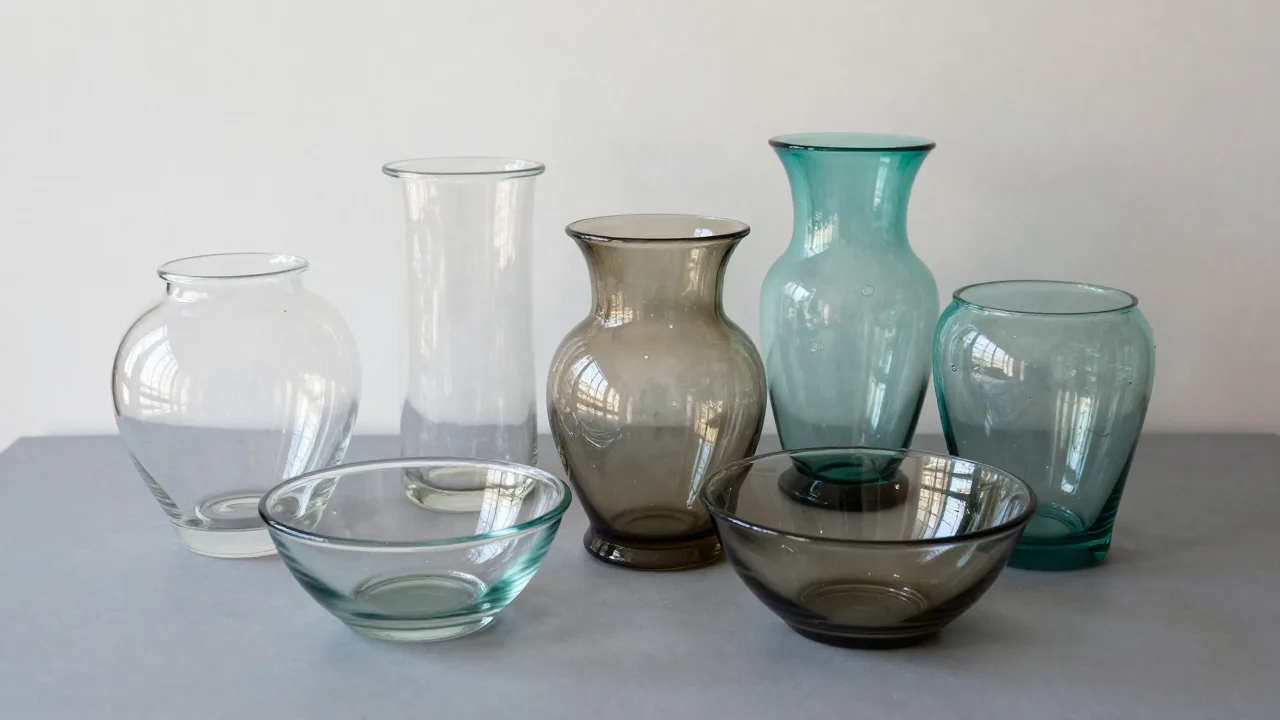
Category: Guides

Antique Identifier

  • Antique Glass Marks: How to Identify Valuable Art Glass & Glassware

    Antique Glass Marks: How to Identify Valuable Art Glass & Glassware

    That beautiful glass vase sitting on your shelf could be a valuable piece of art glass worth thousands, or a modern reproduction worth very little. The difference often comes down to understanding the marks, signatures, and identifying features that distinguish genuine antique glass.

    Unlike pottery or silver, glass marks can be subtle, hidden, or even absent entirely. Many valuable pieces were never marked at all. This makes antique glass identification both challenging and rewarding. Once you know what to look for, you’ll spot treasures others miss.

    This comprehensive guide will teach you how to identify marks on antique glass from the world’s most prestigious makers, from Lalique to Tiffany, Steuben to Baccarat.

    Why Glass Marks Are Different

    Glass marks present unique challenges:

    Not Always Present: Many fine glass pieces were never marked, especially before the 20th century.

    Hard to See: Glass marks can be nearly invisible: acid-etched, lightly engraved, or molded into the glass.

    Easily Faked: Signatures can be added to unmarked pieces fraudulently.

    Wear and Damage: Marks on glass can be scratched, worn, or ground off.

    Paper Labels: Many pieces had only paper labels, now long lost.

    Despite these challenges, understanding glass marks is essential for authentication and valuation.

    Italian art glass is usually labeled rather than marked, so a Venini or Seguso attribution rests on the sticker and the technique; reading Murano labels and signatures covers the Vetro Artistico Murano code system and how each furnace signed.

    Types of Glass Marks

    Glass marks fall into several categories:

    Molded Marks

    • Raised or recessed letters/symbols in the glass
    • Created when glass was formed in mold
    • Cannot be added later (good authentication)
    • Often on base or hidden areas

    Acid-Etched Marks

    • Frosted/matte appearance
    • Applied with acid-resistant stencil
    • Common on French art glass
    • Can be felt as slightly textured

    Engraved Marks

    • Cut into glass surface with wheel or point
    • Artist signatures often engraved
    • Can be examined under magnification
    • Harder to fake convincingly

    Painted/Enameled Marks

    • Applied as decoration
    • Can wear off over time
    • Period-appropriate style important
    • Some factories used specific colors

    Paper Labels

    • Often lost over time
    • Very valuable when present
    • Style indicates period
    • Reproductions exist

    Pontil Marks

    • Not a “mark” but an identifying feature
    • Rough or polished area where glass was attached to pontil rod
    • Style indicates age and quality
    • Ground and polished = higher quality

    French Art Glass Marks

    French art glass represents some of the most valuable and collectible pieces.

    Lalique

    René Lalique (1860-1945) created some of the most recognizable art glass.

    Mark Evolution:

    MarkPeriodNotes
    “R. LALIQUE”1920s-1945Most valuable period
    “R. Lalique France”Pre-1945Various styles
    “LALIQUE” (no R.)Post-1945After René’s death
    “Lalique France”Post-1945Current production
    “Lalique ® France”ModernRegistered trademark

    Mark Locations:

    • Base (most common)
    • Hidden areas on figurals
    • Near design elements

    Mark Styles:

    • Engraved (wheel or diamond point)
    • Molded (raised or recessed)
    • Acid-etched (frosted appearance)

    Authentication Tips:

    • Pre-1945 pieces with “R. LALIQUE” most valuable
    • Engraved signatures often in script
    • Molded marks in block letters
    • Check for model numbers (often present)
    • Beware of added signatures on unmarked pieces

    Red Flags:

    • “R. LALIQUE” on post-1945 style pieces
    • Signatures that look too new/crisp
    • Inconsistent mark style for claimed period
    • Signatures placed oddly

    Gallé

    Émile Gallé (1846-1904) pioneered cameo glass techniques.

    Mark Types:

    During Gallé’s Lifetime (to 1904):

    • “Gallé” in script, often engraved
    • “Cristallerie d’Émile Gallé”
    • Sometimes with cross of Lorraine

    After His Death (1904-1914):

    • Star after “Gallé” signature (★)
    • Indicates posthumous production
    • Still valuable, slightly less than lifetime

    Later Production (1914+):

    • “TIP GALLÉ” (pressed glass, less valuable)
    • Various marks on reproduction pieces

    Mark Locations:

    • Often in cameo relief (part of design)
    • Base on some pieces
    • Within decorative elements

    Authentication:

    • Cameo signatures should match carving style
    • Period-appropriate glass techniques
    • Quality of cameo work
    • Star indicates post-1904

    Daum

    Daum Frères (Daum Nancy) produced exceptional art glass.

    Marks:

    • “DAUM NANCY” with cross of Lorraine (✚)
    • “Daum Nancy France”
    • Often acid-etched or engraved
    • Cross of Lorraine is key identifier

    Periods:

    • Art Nouveau (1890s-1914): highest values
    • Art Deco (1920s-1930s): very collectible
    • Post-WWII: modern production

    Authentication:

    • Cross of Lorraine should be present
    • Quality of decoration
    • Period-appropriate techniques
    • Signature style matches period

    Other French Makers

    Baccarat:

    • Circular acid stamp
    • “BACCARAT” text
    • Paper labels (often lost)
    • Modern: acid-etched “BACCARAT FRANCE”

    Saint-Louis:

    • “ST. LOUIS” or “St Louis”
    • Paper labels
    • Acid stamps on modern pieces

    Schneider/Le Verre Français:

    • “SCHNEIDER”
    • “LE VERRE FRANÇAIS” or “CHARDER”
    • Often engraved
    • Art Deco period most valuable

    American Art Glass Marks

    Tiffany

    Louis Comfort Tiffany (1848-1933) created America’s most famous art glass.

    Mark Types:

    Favrile Glass:

    • “L.C.T.” (Louis Comfort Tiffany)
    • “L.C. Tiffany”
    • “L.C. Tiffany Favrile”
    • “Tiffany Favrile”
    • Often engraved on base

    Tiffany Studios (Lamps & Decorative):

    • “TIFFANY STUDIOS NEW YORK”
    • Model numbers
    • “Tiffany Glass & Decorating Company” (early)

    Mark Locations:

    • Base of vases
    • Edge of lamp shades
    • On metal fittings

    Numbering System: Numbers on Tiffany glass indicate:

    • Production sequence
    • Sometimes prefixed with letters
    • Can help authenticate and date

    Authentication:

    • Quality of iridescence
    • Weight and feel of glass
    • Correct numbering format
    • Period-appropriate techniques
    • Provenance when possible

    Red Flags:

    • Modern copies exist
    • Signatures can be added
    • Check quality, not just mark
    • “Too good” condition suspicious

    Steuben

    Steuben Glass Works (1903-2011) produced fine American glass.

    Mark Evolution:

    PeriodMarks
    Early (1903-1932)Fleur-de-lis, “STEUBEN” acid stamp
    Carder Period“AURENE” for aurene glass
    Later (1933-2011)“STEUBEN” script or block
    ModernEngraved “STEUBEN”

    Frederick Carder Era (1903-1933):

    • Most collectible period
    • “AURENE” marks on aurene glass
    • Fleur-de-lis symbol
    • Various color names marked

    Later Steuben:

    • Clear crystal focus
    • Engraved signatures
    • Designer signatures sometimes
    • High quality, lower values than Carder

    Quezal

    Quezal Art Glass (1901-1924) made Tiffany-style glass.

    Marks:

    • “QUEZAL” engraved
    • Sometimes on base
    • Quality iridescent glass
    • Often confused with Tiffany

    Durand

    Durand Art Glass (1924-1931) produced brief but quality production.

    Marks:

    • “DURAND” engraved across pontil
    • Sometimes with “V” (Victor Durand)
    • Limited production period
    • Highly collectible

    Other American Makers

    Fenton:

    • “FENTON” in oval (after 1970)
    • Earlier pieces often unmarked
    • Paper labels
    • Logo evolved over time

    Imperial:

    • “IG” or “IMPERIAL”
    • Various marks by period
    • Cross marks

    Cambridge:

    • “C” in triangle
    • “NEAR CUT”
    • Paper labels

    Heisey:

    • “H” in diamond
    • Distinctive and consistent
    • Highly collectible

    Fostoria:

    • Often unmarked
    • Paper labels
    • “Fostoria” acid stamp (some periods)

    European Glass Marks

    Bohemian/Czech Glass

    Historic glassmaking region with many factories.

    Common Marks:

    • Often unmarked historically
    • “BOHEMIA” (20th century)
    • “CZECHOSLOVAKIA” (1918-1992)
    • “CZECH REPUBLIC” (1993+)
    • Individual factory marks vary

    Moser:

    • “MOSER” engraved
    • “MOSER KARLSBAD”
    • High quality, collectible
    • Distinctive cutting and engraving

    Loetz (Lötz):

    • Often unmarked
    • “LOETZ AUSTRIA” (some pieces)
    • Paper labels
    • Quality iridescent glass (Tiffany-like)
    • Attribution often by style

    Venetian/Murano Glass

    Italian island famous for centuries of glassmaking.

    Marks:

    • Many pieces unmarked
    • “MURANO” text
    • “MADE IN ITALY”
    • Factory-specific labels
    • Artist signatures (modern)

    Major Makers:

    • Venini (V with VENINI or label)
    • Barovier & Toso
    • Seguso
    • Archimede Seguso (signature)

    Authentication Challenges:

    • Many unmarked pieces
    • Labels often lost
    • Modern reproductions common
    • Style identification important

    Scandinavian Glass

    Orrefors (Sweden):

    • “ORREFORS” engraved
    • Designer signatures
    • Model numbers
    • “Of” monogram (some periods)

    Kosta Boda (Sweden):

    • “KOSTA” or “KOSTA BODA”
    • Artist signatures
    • “KB” marks

    Iittala (Finland):

    • “IITTALA” text
    • Designer names
    • “i” logo (modern)

    Holmegaard (Denmark):

    • “HOLMEGAARD”
    • Designer signatures
    • Labels

    British Glass

    Webb:

    • “WEBB” or “THOMAS WEBB”
    • “WEBB CORBETT”
    • Acid stamp or engraved
    • Famous for cameo glass

    Stevens & Williams:

    • “S&W” marks
    • “BRIERLEY”
    • Paper labels

    Whitefriars:

    • Often unmarked
    • Paper labels
    • Distinctive styles identify

    Edinburgh/Scottish:

    • “EDINBURGH CRYSTAL”
    • Various maker marks

    Pressed and Pattern Glass Marks

    American Pressed Glass

    Identifying Features:

    • Mold seams visible
    • Pattern names in marks
    • Maker marks on base

    Major Makers:

    • Boston & Sandwich: Rarely marked, identify by pattern
    • Gillinder: “GILLINDER” sometimes
    • U.S. Glass: “US” marks
    • Indiana Glass: Various marks

    Depression Glass

    Mass-produced 1920s-1940s colored glass.

    Marks:

    • Often unmarked
    • Pattern identification crucial
    • Some maker marks exist:
      • Federal Glass: “F” in shield
      • Anchor Hocking: Anchor symbol
      • Hazel-Atlas: “H” over “A”
      • Jeannette: “J” in triangle

    Carnival Glass

    Iridescent pressed glass (1908-1930s primarily).

    Identification:

    • Molded patterns key
    • Maker identification by pattern
    • Northwood: “N” in circle (most valuable)
    • Fenton: Often unmarked early
    • Imperial: Iron cross, “IG”
    • Millersburg: No mark, identify by pattern

    How to Examine Glass Marks

    Equipment

    Basic:

    • Good light source
    • Magnifying glass
    • Black light (UV): reveals repairs, some signatures

    Advanced:

    • Jeweler’s loupe (10x)
    • LED flashlight
    • UV flashlight
    • Camera with macro

    Examination Process

    Step 1: Overall Assessment

    • Quality of glass
    • Weight and feel
    • Style and period
    • Condition

    Step 2: Locate Marks

    • Turn piece over, examine base
    • Check inside rim
    • Look at pontil area
    • Examine decorative elements
    • Check for paper label residue

    Step 3: Identify Mark Type

    • Molded, etched, or engraved?
    • How was it applied?
    • Period-appropriate technique?

    Step 4: Document

    • Photograph marks clearly
    • Note location and style
    • Record any numbers

    Step 5: Research Use the Antique Identifier app for instant identification, or consult reference books and online databases.

    Authentication Red Flags

    Watch for these warning signs:

    Signature Issues

    Too Crisp: Old signatures show wear; brand-new looking marks on “antique” glass are suspicious.

    Wrong Style: Signature style should match the period claimed.

    Wrong Location: Marks in unusual places warrant scrutiny.

    Added Later: Signatures can be engraved onto unmarked pieces. Compare to known authentic examples.

    Quality Mismatches

    Mark vs. Quality: A Tiffany signature on mediocre quality glass is suspicious.

    Style vs. Mark: A modern style piece with antique marks doesn’t compute.

    Condition vs. Age: Perfect condition on supposedly century-old glass raises questions.

    Common Fakes

    Tiffany: Most commonly faked American art glass Lalique: “R. Lalique” marks added to post-1945 pieces Gallé: Signatures added to unmarked cameo glass Carnival glass: Fake Northwood “N” marks

    Dating Glass by Marks

    Quick Reference

    Mark FeatureDate Indication
    “R. LALIQUE”1920-1945
    “LALIQUE” (no R)Post-1945
    “Gallé” with star1904-1914
    “CZECHOSLOVAKIA”1918-1992
    “CZECH REPUBLIC”1993+
    “WEST GERMANY”1949-1990
    “Made in Occupied Japan”1945-1952
    “Nippon”1891-1921
    Depression glass patterns1920s-1940s

    Country of Origin Dating

    Same rules as other antiques:

    • Country name only: 1891-1914
    • “Made in [Country]”: 1914+

    Building Glass Mark Expertise

    Study Authenticated Pieces

    • Visit museum glass collections
    • Attend auction previews
    • Handle pieces at reputable dealers
    • Compare marks on documented examples

    Focus Areas

    Glass is vast, specialize:

    • French art glass (Lalique, Gallé, Daum)
    • American art glass (Tiffany, Steuben)
    • Pattern glass (pressed, Depression, Carnival)
    • Modern studio glass
    • Regional focus (Bohemian, Venetian, etc.)

    Use Technology

    The Antique Identifier app accelerates learning:

    • Photograph marks and pieces
    • Get instant identification
    • Learn as you use
    • Build reference collection

    Key Resources

    • Reference books by specific makers
    • Auction catalogs with images
    • Museum collection databases
    • Collector organization resources

    Frequently Asked Questions

    How do I identify unmarked glass?

    Many valuable glass pieces are unmarked. Identify by style, quality, technique, and comparison to marked examples. The Antique Identifier app can help identify pieces by their overall appearance, not just marks.

    Can glass marks be faked?

    Yes, especially on valuable makers like Tiffany and Lalique. Signatures can be engraved onto unmarked pieces. Always evaluate quality, style, and technique alongside marks.

    Why do some Lalique pieces say “R. Lalique” and others just “Lalique”?

    “R. LALIQUE” indicates pieces made during René Lalique’s lifetime (died 1945). After his death, the “R” was dropped. Pre-1945 pieces are generally more valuable.

    Is unsigned glass worthless?

    Absolutely not. Many valuable antique pieces were never signed. Quality, rarity, and condition matter more than marks. Some unsigned pieces are museum quality.

    What does a star after Gallé’s signature mean?

    A star (★) after the Gallé signature indicates the piece was made after Émile Gallé’s death in 1904 but before the factory closed in 1914. Still valuable, but slightly less than lifetime pieces.

    Marked and unmarked glass: what to weigh

    Antique glass marks require more detective work than pottery or silver marks, but understanding them opens doors to identifying valuable pieces that others overlook. From Lalique’s elegant etchings to Tiffany’s engraved signatures, each mark tells a story of origin, age, and authenticity.

    Remember that many fine glass pieces are unmarked. Style, quality, and technique matter as much as marks. Use tools like the Antique Identifier app to help identify both marked and unmarked pieces, and always evaluate the whole picture.

    Happy glass hunting!
  • Antique Silver Hallmarks: Complete Guide to Reading Silver Marks

    Antique Silver Hallmarks: Complete Guide to Reading Silver Marks

    A British hallmark can show five marks: maker, standard, assay office, date letter and, from 1784 to 1890, a duty head. Here is how to read each one.

    Read the marks as a set, not one by one: the town mark tells you which office’s date letter cycle to use, and the standard and duty marks narrow the period before you open a chart. This guide covers British marks first, then American, French, German and Russian ones, how to tell silver plate from sterling, and what marked pieces sold for at a dated auction in October 2026.

    What marks make up a British silver hallmark?

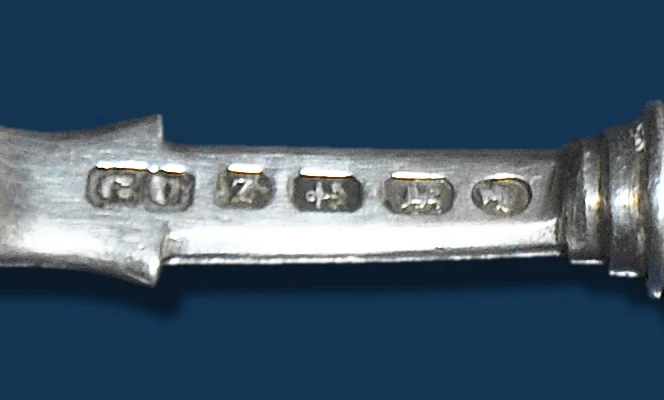
    A row of hallmarks on the stem of a Birmingham silver spoon by George Unite
    Marks on a Birmingham silver spoon by George Unite, dated 1899 in its Wikimedia Commons record, including the maker’s mark GU, a date letter, the anchor of Birmingham and the lion passant. Image source. CC BY-SA 2.0, photo by Jojorei, via Wikimedia Commons

    A full British mark combines a maker’s mark with marks struck by an assay office after the silver was tested. In everyday use all of them together are called the hallmark, though strictly the maker’s mark is a separate thing and the two are often confused: the maker’s mark names who sent the piece in, the office’s marks say it passed the test.

    Mark What it looks like What it tells you In use from
    Maker’s (sponsor’s) mark Initials in a shaped punch Who sent the piece for testing England, 1363
    Standard mark Lion passant for sterling in England; a thistle at Edinburgh, later a lion rampant; a crowned harp at Dublin The silver meets the standard England, 1544
    Town mark Leopard’s head for London, anchor for Birmingham Which assay office tested it Leopard’s head first required in 1300
    Date letter One letter in a shaped shield The year of assay England, 1478
    Duty mark The monarch’s head in profile Silver duty was paid 1784 to 1890

    One period breaks the pattern. From 1697 the higher Britannia standard of 95.8% silver was compulsory, and the lion passant was replaced with the figure of Britannia and the London leopard’s head with a lion’s head erased. Sterling was authorised again from 1 June 1720, and Britannia has remained an optional standard since. A lion’s head erased is therefore a Britannia mark, used alongside the figure of Britannia, not a sterling mark. In practice, if a London piece shows a lion’s head and a figure of a woman where you expected the walking lion, check its date letter against 1697 to 1720 first.

    Which town mark belongs to which assay office?

    The town mark names the assay office that tested the piece. Four offices still operate in the United Kingdom: London, Birmingham, Sheffield and Edinburgh.

    Town mark Assay office Dates
    Leopard’s head London, at Goldsmiths’ Hall From 1300
    Anchor Birmingham Opened 31 August 1773
    Crown, later a rose Sheffield First piece marked 20 September 1773; the rose replaced the crown on silver after the Hallmarking Act 1973
    Castle Edinburgh First Scottish hallmarking act in 1457
    Tree, bird, fish and bell Glasgow Office closed 31 March 1964
    Half a leopard’s head and half a fleur-de-lys, later a mark from the city arms York Assaying granted in 1423; final closure around 1857
    Figure of Hibernia, introduced in 1730 as a duty mark (the crowned harp beside it is the standard mark) Dublin Company of Goldsmiths founded in 1637

    Two details catch people out. The rose belongs to Sheffield, not York: when the Sheffield office opened, lots were drawn for the marks and Sheffield chose the crown. From 1904 it used a rose for gold, and after the Hallmarking Act 1973, Sheffield lost its crown mark for silver after 200 years and used the rose on both. At Dublin, the crowned harp is the fineness mark for sterling, and a Hibernia mark was introduced on 25 March 1730 to show that duty had been paid; it is now used on all Irish-made articles hallmarked at Dublin, which is why it serves as the Dublin mark. The York Assay Office used half a fleur-de-lys and half a leopard’s head, and after the offices reopened in 1701 its city mark changed to reflect the city arms.

    If the town mark matches none of these, the piece may come from an office that has closed. Closed offices include Chester (closed 24 August 1962), Glasgow (closed 31 March 1964), Exeter (closed 1883) and Newcastle (closed 1884).

    How do you read a British date letter?

    A date letter gives the year only when you also know the assay office and the cycle, because the same letter returns every twenty years or so. At London, according to a date letter article by the Association of Small Collectors of Antique Silver, each series refers to 20 years, starting with the date letter a and ending with u or v, and the letters j, v (or u), w, x, y and z were left out.

    In the 1776 cycle, for example, a stands for 1776-77, o for 1789-90, s for 1793-94 and u for 1795-96. Counting on from a and skipping j gives the whole cycle; each year starts on 29 May, the day the London letter changed between 1700 and 1974:

    Letter Year Letter Year
    a 1776-77 l 1786-87
    b 1777-78 m 1787-88
    c 1778-79 n 1788-89
    d 1779-80 o 1789-90
    e 1780-81 p 1790-91
    f 1781-82 q 1791-92
    g 1782-83 r 1792-93
    h 1783-84 s 1793-94
    i 1784-85 t 1794-95
    k 1785-86 u 1795-96

    The letter style changes with each cycle. A history of the date letter by David McKinley for ASCAS quotes the 1756 minutes of the Goldsmiths’ Company, which list the earlier alphabets and set the next one:

    London cycle starting Letter style
    1696 Great Court Hand
    1716 Great Roman (capitals)
    1736 Little Roman (small letters)
    1756 Great Old English (capitals)
    1776 Little Roman again

    The same small Roman letters were used at London in four cycles, so the letter alone does not settle the year. The other punches do:

    London cycle with small Roman letters Clues that separate it
    1736 to 1755 In the first years (a to c), leopard’s head in a punch with a pointed shield and lion passant in a rectangle with rounded corners; the punch shapes changed from the letter d
    1776 to 1795 In the first years (a to c), leopard’s head in a plain oblong punch and lion passant in a punch with a pointed base or an oval
    1816 to 1835 The duty mark should always be present; from the letter f the leopard’s head is no longer crowned
    1896 to 1915 The duty mark is no longer struck

    Two London letters are easy to mix up: the small o for 1789-90 is hard to tell from the capital O for 1809-10, but from 1810 the leopard’s head on flatware was struck at 90 degrees to the other marks, so on a spoon or fork with a turned leopard’s head the o is certainly 1809-10. Other offices ran their own cycles, which is why the town mark has to be read first. Our year-by-year guide to silver date letters shows the letters themselves.

    How can you date British silver quickly?

    Before you open a date letter chart, a few marks narrow the range on their own:

    What you see What it tells you
    Figure of Britannia, with a lion’s head erased at London Britannia standard: compulsory 1697 to 1720, optional after
    Monarch’s head in profile, with no commemorative year Duty period, 1784 to 1890
    London leopard’s head without a crown, on sterling with a date letter 1821 or later
    Sheffield crown on silver Before the changes that followed the Hallmarking Act 1973
    York town mark Before the York office closed around 1857
    Town mark of an office that has since closed, such as Chester or Glasgow Before 1962 (Chester) or 1964 (Glasgow)

    A head is not always a duty mark. Voluntary commemorative marks were introduced for the Silver Jubilee of King George V and Queen Mary in 1935, and followed for the Coronation in 1953, the Silver Jubilee in 1977, the Millennium in 2000, the Golden Jubilee in 2002, the Diamond Jubilee in 2012 and the Platinum Jubilee in 2022, as the Assay Office London explains; read the date letter before you date a piece by a head. A missing duty head does not prove a date by itself: in the London 1816 cycle, for example, small items exempted from duty can lack it. Auction catalogues often write a London date as two years, such as 1774-75, because the London letter did not change on 1 January: it was originally the mark of the Assay Master, who was sworn in every May, and from 1700 to 1974 it changed on 29 May. Only from 1975 did it change on 1 January.

    What do modern British hallmarks look like?

    Modern British marks are simpler. Under the 1999 changes the date letter is no longer a compulsory part of the hallmark, and the compulsory part now consists of the sponsor or maker’s mark, the assay office mark and the standard of fineness, for sterling 925 parts in 1,000. The Hallmarking Act 1973 made Britain a member of the Vienna Convention, and silver tested in a member country can carry the Common Control Mark: balance scales with a mark in the shape of the letter M for silver. On recent pieces a town mark alone may not show that the piece was tested in Britain: in July 2016 the Birmingham Assay Office began striking Birmingham hallmarks in Mumbai, India, and marks struck outside the UK must be distinguishable from those struck in the UK.

    What do American silver marks mean?

    American silver has no national hallmarking system like Britain’s, so you read a maker’s name or mark together with a word for the standard. Two words matter most, COIN and STERLING, and their meaning was fixed by federal law only in 1906; before then no federal law set what either word meant.

    Gorham shows how the change happened. In 1868 Gorham abandoned the coin silver standard (900/1000) and adopted the sterling standard of 925/1000. Its holloware also carries year marks: letters of the alphabet A through Q were used from 1868 through 1884, after which symbols were adopted for each year until 1933. National rules came later: a federal law of 13 June 1906, now 15 U.S.C. 296, allows the word sterling only on silver of 925 parts in 1,000 and the word coin only on silver of 900 parts. Under 15 U.S.C. 297, silver plate may not be stamped with the word sterling or the word coin.

    For American pieces dated by maker rather than by law, compare coin silver with sterling, check Gorham’s date symbols and look the name up among American makers’ marks.

    How do you read French, German and Russian silver marks?

    Continental marks state the standard as a number or a symbol rather than with a lion:

    Country Mark What it means
    France, 1838 to 1973 Head of Minerva 950/1000 or 800/1000 silver on large objects
    Germany, from 1888 Crescent and crown, with a number National mark; fineness 800, 830, 835, 900, 925 or 935
    Germany, before 1888 Town mark with a loth number 12 loth = 750, 13 = 812, 14 = 875, 15 = 937
    Russia 84, 88 or 91 (zolotnik) 84 = .875, 88 = .9166, 91 = .9479

    In France the Minerva heads ran from 10 May 1838 until 1973, and small objects of 800 silver took a boar’s head (Paris) or a crab (departments). Germany unified its hallmarking system in 1888 with the national crescent and crown, and no official mark is prescribed for German silverplate. German silver jewellery more often carries only the silver content number. Among Russian standards, 84 zolotnik is the most common. Our overview of silver purity marks around the world covers other numbers you may meet.

    Do not read the words German silver or nickel silver as a silver mark. Nickel silver contains no silver: it is copper and nickel with zinc added, so a piece stamped that way is base metal, often the base under plating.

    How do you tell sterling from silver plate by the marks?

    Plate marks describe how a piece was made, not how much silver it contains. EPNS means electroplated nickel silver: nickel silver first became popular as a base metal for silver-plated cutlery, notably the wares called EPNS. Words such as Triple or Quadruple indicate the number of coatings the base metal received in electroplating, and our page on A1, Triple Plate and IS marks explains the grade words. In the United States federal law bars plated wares from being stamped sterling or coin.

    Plate can also carry marks that imitate a hallmark. Electroplate marks were often inspired by the hallmarking used for sterling, with the maker’s initials inside a series of squares, circles or shields, and these are called pseudo hallmarks. Check whether the marks agree with each other:

    What you see What it usually means
    A row of small shields with initials, plus EPNS, EP or A1 Plate with pseudo hallmarks
    A row of symbols, but no town mark you can match to an assay office Not a British hallmark; treat it as plate or another metal until tested
    A town mark, a standard mark and a date letter that fit the same office and period A British hallmark

    Old Sheffield plate is a separate material, and the place to look is the rims, edges and other points of wear: copper showing through there is its classic sign. Thomas Boulsover developed it in the 1740s by fusing sterling silver to copper, and electroplating replaced it in the 1840s. If the marks leave you unsure, our guides to telling sterling from silver plate, telling pewter from silver and the acid test versus the ice test explain the physical checks.

    What is hallmarked silver worth?

    Sterling has a metal value that follows its weight, because sterling is 92.5% silver by weight; plated pieces do not, because the base metal under the plating is worth very little. Beyond the metal, the maker, the assay office, the date and the form decide the price. The results below all come from one Bonhams online sale, Ayrshire Farm: The Sandy Lerner Collection Part II, held 18 to 29 October 2026. Prices include the buyer’s premium, so they show what the buyer paid, not what the seller received.

    Three comparisons from the same sale show why the marks matter. The Hester Bateman wine funnel weighs less than a third of the Sheffield inkstand but sold for more. The Edwardian rose bowl weighs about as much as that 1775 inkstand, yet sold for less than half as much. The coin silver butter dish and the Gorham bowl weigh about the same, yet the dish sold for almost twice as much. These were solid silver pieces from one private collection, so they show how marks move prices, not what everyday silver or silver plate is worth. Weight sets a floor for sterling; the maker, place and date read from the marks, together with the form and condition, explain most of the rest.

    To price your own piece, read the marks first, weigh it, and look for sold auction results for the same maker, office and type of object; an asking price is not a sale. The weight also lets you work out the melt value of sterling, a useful floor, and family flatware is worth checking by its pattern as well as its weight. When you are ready, compare where to sell antique silver.

    Can an app help you read a hallmark?

    An app can give you a first reading from a photo, which you then check against the tables above. Antique Identifier: Antiqly identifies antiques from a photo and suggests a name, period, origin and a short history of the piece. It is a free download on the App Store for iPhone and iPad and on Google Play for Android; it is a subscription app, and scans require a subscription or a one-time scan purchase. If a maker’s mark is visible, Antiqly describes it and gives its interpretation with a confidence level, and you can add up to four extra photos, such as the maker’s mark, the base or the back, plus a short note to steer the identification. It works from photos and does not test the metal.

    What should you do with your marked silver now?

    1. Photograph the whole row of marks in sharp side light, and note where on the piece they are.
    2. Read the town mark first, then the standard mark, the duty head and the date letter, and match them with the tables above.
    3. Weigh the piece, then compare sold auction results for the same maker, office and form before you decide to keep, use or sell it.
    4. If the marks disagree with each other or with the style of the piece, or the maker is a notable one, show it to the silver specialist of an auction house before you sell.
  • Best Online Antique Appraisal Sites (2026)

    Best Online Antique Appraisal Sites (2026)

    Mearto charges $25 an item and ValueMyStuff $28 a credit for a written online appraisal by a specialist, with an answer typically within 48 hours. We make Antiqly.

    This page compares the main options by price, turnaround and who does the appraisal, and it shows when an online appraisal is not enough, such as for a large tax deduction. Prices and service details come from each service’s own pages, read in October 2026, and the services are grouped by the job you need done, not ranked. If you are still deciding between an online and an in-person appraisal, our guide to online versus in-person antique appraisal covers that choice first.

    Which online appraisal service fits your item?

    The right service depends on what you need the answer for. A written valuation from a person, a sale estimate from an auction house, sold prices you research yourself and a quick first lead from a photo are four different jobs, and each service below does one of them.

    Service Best for What you get Who looks at your item Price as of October 2026 Turnaround
    Mearto One piece you may sell at auction Written online appraisal with a fair market value range A specialist $25 for one item; 3 for $70 Typically within 48 hours
    ValueMyStuff A PDF certificate with an insurance value Online appraisal with auction value, insurance value and a PDF certificate A team of over 60 auction house specialists $28 for one credit; 3 credits for $70 48 hours (Standard) or 24 hours (Express)
    Sotheby’s seller portal A higher-value piece you are ready to consign An auction estimate for a possible sale; specialists follow up if it suits a current sale Sotheby’s specialists Not stated on the submission page Usually within three weeks
    JustAnswer Antiques A quick question about a mark or an object An answer to a specific question Experts verified by JustAnswer Not listed on its antiques page Experts online around the clock
    WorthPoint Collectors who research prices often A database of past sales that you search You Subscription You search it yourself
    An appraiser from the ASA directory Tax deductions and other formal reports A formal appraisal report A credentialed appraiser Set by each appraiser Agreed with the appraiser

    Two things decide most cases. If you need a document for a tax deduction, start with a credentialed appraiser. If you only want to know whether a piece is worth more attention, a written online appraisal or your own sold-price research is usually enough.

    What does Mearto charge, and what do you get?

    Mearto charges $25 for one online appraisal, according to its pricing page as of October 2026. Packs lower the cost per item:

    Pack Mearto price (October 2026) Cost per item
    1 appraisal $25 $25.00
    3 appraisals $70 $23.33
    5 appraisals $90 $18.00
    10 appraisals $170 $17.00

    Mearto’s FAQ describes what the fee buys: a short description and two values. The first is a fair market value range, Mearto’s estimate of the likely auction price, based on recent auction results for comparable items. The second is either a suggested asking price or an automatically calculated insurance value. A specialist typically answers within 48 hours, and you can message that specialist through the platform. Mearto says many of its specialists run their own appraisal practices and have worked for auction houses such as Bonhams, Sotheby’s and Christie’s.

    Read two details before you pay. When an online appraisal is marked “conditional”, the value assumes the item is authentic, because Mearto says it cannot verify the authenticity of every item within its 48-hour turnaround. Mearto also says its focus is helping customers sell at auction through Catawiki, so expect an offer to sell.

    Two terms work in your favor. According to Mearto’s terms of use, one credit covers one item or a set of like items that would logically be sold together as a single lot at auction, such as a set of China dishes, and credits do not expire. The same terms say that if you have complied with your obligations and do not receive your online appraisal, or are otherwise dissatisfied, you are entitled to a full refund of your original purchase price.

    What does ValueMyStuff charge, and what do you get?

    ValueMyStuff sells credits rather than single appraisals: one credit costs $28 on its US pricing page as of October 2026, and the per-credit price falls as you buy more. A Standard appraisal (48 hours) uses one credit and an Express appraisal (24 hours) uses two.

    Credits ValueMyStuff price (October 2026) Price per credit
    1 $28 $28.00
    3 $70 $23.33
    5 $99 $19.80
    10 $195 $19.50
    30 $570 $19.00
    100 $1,800 $18.00

    One Express appraisal bought with single credits therefore costs $56. Credits don’t have any expiration date, and the company says it cannot guarantee response times on weekends and holidays. On the UK pricing page one credit costs £25. If ValueMyStuff asks you for more information and cannot get it, its terms of use say it may end the contract and refund what you paid less its reasonable costs; once the appraisal has been fully performed, you lose the right to cancel.

    According to its how-it-works page, ValueMyStuff assigns an expert from its team of over 60 auction house specialists, and the report comes as a printable PDF certificate covering attribution, description, auction value and insurance value. The same page offers help with selling items above a set estimated auction value through its auction house affiliate network.

    Should you send it to an auction house instead?

    Only if you might sell through that auction house. An auction house reviews a submission to decide whether to offer your piece for sale, not to write you an appraisal you can keep. On Sotheby’s seller page, you describe the item and upload 3 to 5 photos; its specialists evaluate it based on criteria including the object’s artist or maker, its provenance and its condition. Sotheby’s says its experts strive to reply to all enquiries usually within three weeks, and its specialists reach out if your property is identified as suitable for sale in the current market.

    A decline from a major auction house tells you the piece is not right for that sale. It does not tell you what the piece is worth elsewhere. For ordinary pieces, the appraisal services point you elsewhere too: ValueMyStuff recommends consulting a reputable local auction house or exploring online selling platforms for items with a lower value, and invites owners to contact it about a sale when the estimated auction value exceeds £1,000 or €1,000.

    When do you need a formal appraisal instead of an online one?

    Get a formal appraisal when someone else will rely on the number, such as the tax authority. For a charitable donation, the IRS says in Publication 561 that a donation of art and collectibles for which you claim a deduction of more than $5,000 must be supported by a qualified appraisal and a Form 8283. Publication 561 adds that a qualified appraisal is made, signed and dated by a qualified appraiser in accordance with the substance and principles of the Uniform Standards of Professional Appraisal Practice (USPAP).

    The Appraisal Foundation, which publishes USPAP, describes it as the national standards for real estate appraisal and other types of appraisal services including personal property. To find a credentialed appraiser for that kind of report, the American Society of Appraisers keeps a Find an Appraiser directory for any type of property.

    Insurance is a separate question. Mearto’s insurance figure is automatically calculated, and ValueMyStuff’s report includes an insurance value, but only your insurer can tell you which document it accepts for scheduling a valuable item. Ask before you pay for any appraisal.

    Where can you check sold prices yourself?

    A sold-price database lets you do the appraiser’s comparison yourself. In its own help article, dated August 2021, WorthPoint describes its Price Guide as sales information on more than 587 million items, with 15 years of historical pricing data aggregated from auction houses and online marketplaces. It is a subscription service, so check the current plan on its site before you sign up; our WorthPoint review looks at whether the subscription suits occasional users.

    Whatever database you use, compare sold prices, not asking prices, and match the maker, model, size and condition as closely as you can. Our guide to looking up antique values like a professional appraiser walks through that search step by step.

    Can an app or a quick question replace an appraisal?

    No. An app or a paid question gives you a lead, not an appraisal you can rely on for a sale, a claim or a tax return.

    Antique Identifier: Antiqly identifies antiques from a photo and suggests a name, period, origin and a short history of the piece. It is available on iPhone through the App Store and on Android through Google Play. You can add up to four extra photos, such as the maker’s mark, the base, the back or damage, plus a short note to steer the identification. The price shown is a range based on comparable secondhand listings, with the number of listings it is based on; it is an estimate, not an appraisal. It is a subscription app; scans require a subscription or a one-time scan purchase. Use it to decide whether a piece deserves a paid human appraisal. Our article on what AI antique appraisal can and cannot do explains the limits, and the Antiqly app page shows how a scan works.

    JustAnswer’s antiques page connects you one-on-one with an antique expert. It says verified antique experts are online around the clock, that no subscription is required and that you pay for the question you want to ask, but it does not show the price on that page, so read the checkout terms before you pay. Collector forums such as Reddit’s r/whatsthisworth can help with a hard-to-identify object, but the answers come from volunteers and carry no accountability.

    How do you spot an appraisal service to avoid?

    Walk away from any service that values your item before it has seen it, or that hides who does the work. These warning signs are worth checking before you pay:

    • A value promised in advance. A service that calls your item valuable before it has seen photos is selling something else.
    • No named experts or credentials. Mearto and ValueMyStuff both describe their specialists’ auction house backgrounds; a service that names no one gives you nothing to check.
    • Pressure to sell or an offer to buy. An offer to sell for you is not a scam sign by itself, since both Mearto and ValueMyStuff offer routes to a sale, but an appraiser who offers to buy the piece has a conflict of interest.
    • Unsolicited contact. An email or call about an item you never submitted is a red flag.
    • A certificate presented as a guarantee. An online appraisal relies on your photos and description; it does not authenticate the piece in hand.

    How should you prepare an item before you submit it?

    Good photos and plain facts make any online appraisal more useful. Photograph the front, back, sides and base in daylight, then take sharp close-ups of every mark, signature, label and repair. Write down the measurements and anything you know about where the piece came from.

    Do not clean or polish the piece first, because the original surface is part of what an appraiser judges. There is no need to mention what you paid; it does not change the market value. Our guide on how to tell if an antique is worth money lists the quick signs that justify paying for an appraisal.

    What should you do with your item now?

    1. Decide what you need the answer for: curiosity or a first lead, a possible sale, or a document for a tax deduction.
    2. For a written online valuation, compare the current prices on the Mearto and ValueMyStuff pricing pages, then submit clear photos of the whole piece and every mark; for a tax deduction, find a credentialed appraiser instead.
    3. Check the result against sold prices for comparable pieces before you sell or insure the item.
  • Free Online Antique Appraisal Options

    Free Online Antique Appraisal Options

    Christie’s, Bonhams and Freeman’s give free auction estimates for pieces they could sell; a written appraisal you can keep costs money, $25 an item at Mearto. We make Antiqly.

    This guide separates the free routes from the paid ones: free auction house estimates, free research you do yourself, and the point where you have to pay an appraiser. Fees and conditions come from each organization’s own pages, read in October 2026. If you already know you need a paid written appraisal, our comparison of online appraisal sites and their prices covers that step in detail.

    What can you get for free, and what costs money?

    Free help exists, but every free option has a condition attached: an auction house wants a piece it can sell, a forum gives you volunteers’ opinions, and a research tool leaves the comparison to you. A written appraisal that you keep and show to someone else is the part you pay for.

    Option Cost What you get The catch
    Auction house estimate (Christie’s, Bonhams, Freeman’s) Free An auction estimate from the house’s specialists Only for pieces that fit the house’s sales; Bonhams calls photo-based estimates preliminary
    Collector forum such as r/whatsthisworth Free to post Opinions from other collectors Volunteer answers, nothing in writing you can rely on
    WorthPoint Price Guide Subscription A searchable archive of past sales records You search and compare the results yourself
    Mearto written appraisal $25 for one item A fair market value range written by a specialist Based on your photos; a conditional value assumes the item is authentic
    Qualified appraisal for a tax deduction Set by the appraiser; the fee cannot generally be a percentage of the appraised value A report made, signed and dated by a qualified appraiser Required for donated art and collectibles above a $5,000 deduction

    Start from what you will do with the number. If you only want to know whether a piece deserves more attention, the free routes are usually enough. If a tax return or an insurer will rely on the figure, budget for a paid appraisal.

    How do free auction house estimates work?

    An auction house estimates your piece for free because it hopes to sell it, so you get a figure only when the piece suits its sales. Christie’s describes its service as a free and confidential estimate from its specialists, with no obligation to sell. You send key details, the purchase history and at least 3 photographs; one form takes up to six items, and Christie’s asks you to expect a response within 3 to 4 weeks. Auction estimates are given only for items for which Christie’s has a category of sale and which meet its minimum consignment value.

    Freeman’s offers complimentary, no-obligation valuations for fine art, jewelry, furniture, design objects and more. Expect feedback and next steps within 7-10 business days; items that fall outside the categories or value ranges typically offered in its sales are not estimated.

    Bonhams answers the cost question in its FAQ: the initial valuation is completely free and confidential with no obligation to sell. You request it through a form that goes to your local Bonhams office, and Bonhams also holds regular valuation events worldwide where specialists assess property free of charge. Skinner, the Massachusetts auction house, now appears under the Bonhams name as Bonhams Skinner, with sales held in Marlborough, Massachusetts and Boston.

    Is a free auction estimate an appraisal?

    No. A free auction estimate is a house’s opinion of what your piece might fetch in its own sale, and the terms limit what you can do with it. Bonhams’ conditions spell this out: its auction estimates are not a representation or guarantee of the actual value or potential selling price; Bonhams assumes that the item is authentic; and estimates are provided only for the owner of the property and may not be used by any other person or for any other purpose. Estimates based on photographs are preliminary only and may change after first-hand inspection and further research.

    For estate tax, market or insurance purposes, Bonhams sends you to its Valuations, Trusts and Estates Department instead of the free form. Silence or a polite no from a major house only means the piece does not fit its sales or its minimum value. For pieces in that position, the free route usually runs through a smaller house:

    1. Search for auction houses in your region that hold sales in your category, such as furniture, silver or pottery.
    2. Open each house’s past results and check that it has sold pieces like yours.
    3. Send the same photos and measurements through that house’s consignment or estimate form, and ask whether the estimate is free before you book an in-person visit.

    If no house will take it, the piece may be worth too little for an auction sale on its own, and your own sold-price research below is the practical way to price it.

    Where can you research sold prices yourself?

    Auction results and price guides let you estimate value yourself: you find pieces like yours that have already sold and compare them. Christie’s results page lists its closed auctions, each with the sale total and a link to view the results lot by lot. On eBay, the Sold items filter on a search shows what comparable pieces actually sold for; eBay may ask you to sign in first. Kovels runs an online price guide that you can filter by keyword, year and category; check what a full entry shows before you join anything. Our list of free antique price guides and online resources collects more of these, and our Kovels review covers its paid side.

    WorthPoint is the paid version of this research: its Price Guide is an archive of past sales records that you reach through a subscription, so try the free routes first. Our WorthPoint review weighs whether the subscription suits occasional users.

    Whichever source you use, match the maker, pattern, size and condition before you trust a sold price, and ignore asking prices. Our guide to looking up antique values like a professional appraiser explains when eBay sold listings help and when auction results are the better guide.

    For an object you cannot name at all, a forum such as Reddit’s r/whatsthisworth can point you to the right category, but the replies come from volunteers and carry no accountability.

    What does a free app download give you?

    A first lead from a photo, not an appraisal: the download costs nothing, but the scans and the result are not a free valuation.

    Antique Identifier: Antiqly identifies antiques from a photo and suggests a name, period, origin and a short history of the piece. It is a free download on the App Store for iPhone and iPad and on Google Play for Android, but it is a subscription app; scans require a subscription or a one-time scan purchase. The price shown is a range based on comparable secondhand listings, with the number of listings it is based on; it is an estimate, not an appraisal. Those listings are asking prices, not sold prices, so check the range against sold results before you rely on it. If a maker’s mark is visible, Antiqly describes it and gives its interpretation with a confidence level. Use that lead to decide which piece deserves a free auction house estimate or a paid appraisal; our article on what AI antique appraisal can and cannot do explains the limits.

    When do you have to pay for an appraisal?

    You pay when someone else has to rely on the figure, such as the tax authority or an insurer. IRS Publication 561 draws the line for donations: if you claim a deduction of more than $5,000 for donated art and collectibles, you need a qualified appraisal and a Form 8283. The appraisal must be made, signed and dated by a qualified appraiser following the Uniform Standards of Professional Appraisal Practice, and the same publication says that, generally, no part of the fee arrangement for a qualified appraisal can be based on a percentage of the appraised value of the property. A fee quoted as a share of the value is a reason to keep looking.

    To find a credentialed appraiser, the American Society of Appraisers runs a Find an Appraiser tool for any type of property. For insurance, ask your insurer which document it accepts before you pay anyone, because a free auction estimate is a sale estimate, not an insurance value.

    Between a free estimate and a formal report sits the paid written online appraisal. Mearto’s pricing page lists $25 for one appraisal as of October 2026, and its FAQ says a specialist typically responds within 48 hours with a fair market value range.

    How do you get a useful answer from a free estimate?

    Send exactly what a specialist asks for, because a free estimate is only as good as the photos behind it. Christie’s asks for clear color images of the front, the back and a detail of the signature or maker’s mark, a description with the material and dimensions, and the provenance, meaning the history of the item and how it was acquired.

    If you cannot find a mark, our guide to where antique hallmarks and maker’s marks are found shows where to look, and our beginner’s guide to identifying antiques helps you name the type of piece first. Do not clean or polish the piece before you photograph it, and send it to a house that actually sells that category.

    Which free appraisal option should you start with?

    Start with your own sold-price research if you only want a rough figure, and with a free auction house estimate if the piece might be valuable and you would consider selling it.

    1. Photograph the whole piece, the back, the base and every mark, and write down the measurements.
    2. Look up sold prices for close matches; if they point to real value, send the photos to an auction house that sells that category for a free estimate.
    3. Pay a qualified appraiser only when a tax return, an insurer or a legal matter needs a written value.
  • Antique Furniture Identification Chart: Free Printable PDF Guide

    Antique Furniture Identification Chart: Free Printable PDF Guide

    Antique furniture is identified by dating four construction details simultaneously: the leg and foot style (which pins the period within 20-30 years), the primary wood species, the type of dovetails and nails, and the original hardware. A genuine Chippendale piece (1750-1790), for example, combines mahogany, hand-cut dovetails, ball-and-claw feet, and cast brass bail pulls secured with cotter pins.

    Why Do You Need an Antique Furniture Identification Chart?

    Identifying antique furniture involves examining multiple elements simultaneously: the legs, the wood type, the construction methods, the hardware, and decorative details. It’s easy to get overwhelmed without a systematic approach.

    An identification chart helps you:

    • Compare features side-by-side across different periods
    • Spot key identifying characteristics at a glance
    • Avoid common misidentifications that could cost you money
    • Build your knowledge through repeated reference
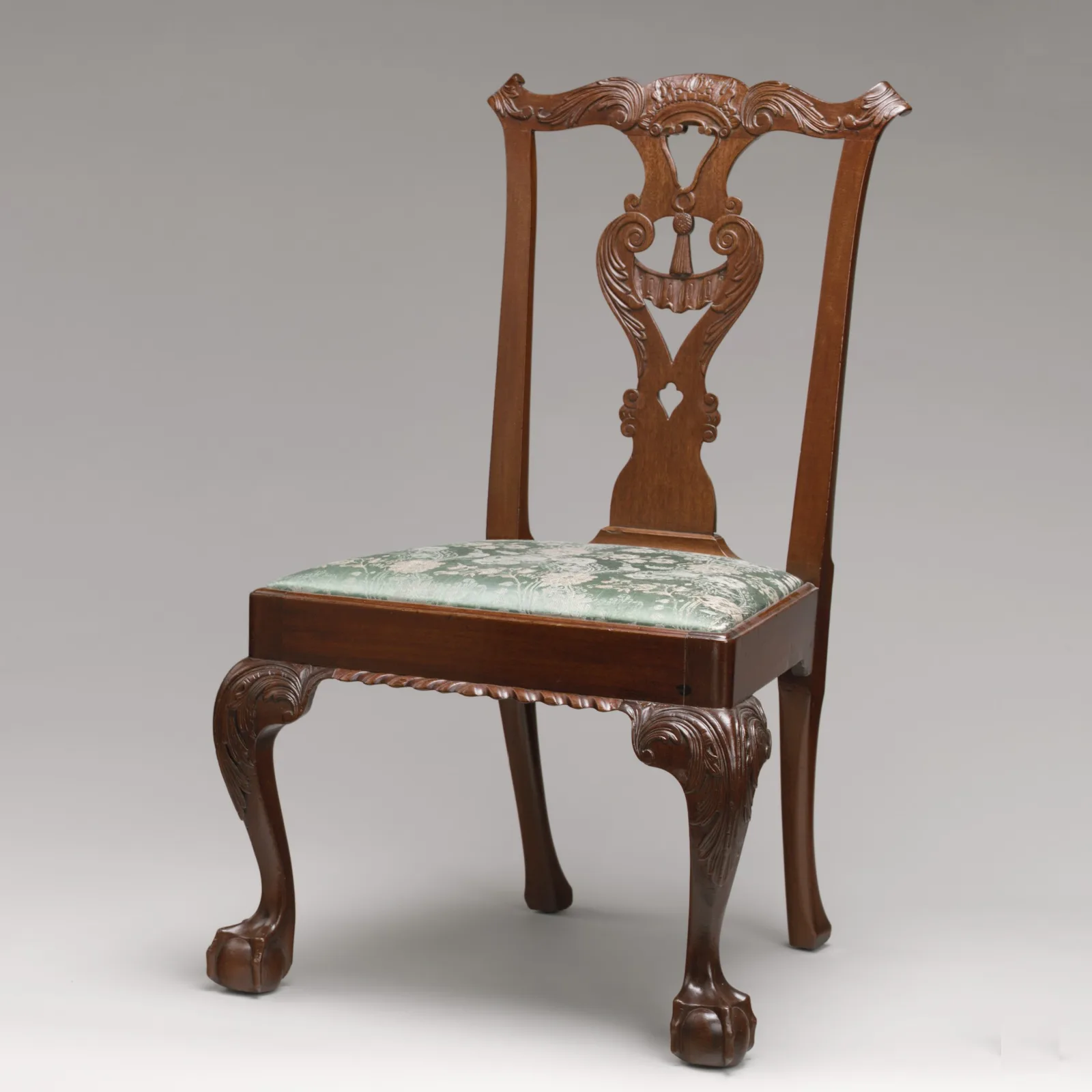
    Mahogany Chippendale side chair with cabriole legs and ball-and-claw feet, New York, 1765 to 1775
    A New York Chippendale side chair with cabriole legs and ball-and-claw feet.

    For even faster identification, you can use the Antique Identifier app to snap a photo and get instant results. But having a solid foundation of knowledge always helps.

    What Are the Main Antique Furniture Periods and Their Key Identifiers?

    Quick Reference by Period

    PeriodDate RangeLeg StylePrimary WoodKey Identifier
    Jacobean1600-1690Bulbous turned, barley twistOakHeavy, dark, geometric carving
    William & Mary1690-1730Trumpet turned, inverted cupWalnutMarquetry, bun feet
    Queen Anne1700-1755Cabriole with pad footWalnut/MahoganyS-curved legs, shell carving
    Chippendale1750-1790Cabriole with ball-and-clawMahoganyPierced splats, ornate carving
    Hepplewhite1780-1800Straight, taperedMahoganyShield-back chairs, inlay
    Sheraton1785-1820Turned, reededMahogany/SatinwoodRectangular forms, delicate
    Empire1800-1840Columns, scrolls, paw feetMahoganyBold, heavy, animal motifs
    Victorian1837-1901Various revival stylesWalnut/RosewoodOrnate, heavily carved
    Arts & Crafts1880-1920Square, simpleQuarter-sawn oakVisible joinery, honest
    Art Nouveau1890-1910Organic curvedVariousFlowing whiplash curves
    Art Deco1920-1940Geometric, chromeExotic veneersBold shapes, glamorous

    How Do I Identify Antique Furniture by Its Legs and Feet?

    The legs and feet are often the quickest way to identify a furniture period. Here’s your complete reference guide:

    Turned Leg Styles

    Bulbous Turning (1600-1690)

    • Large, melon-shaped bulges
    • Found on Jacobean tables and court cupboards
    • Usually oak
    • Often combined with block sections

    Barley Twist / Spiral Turning (1660-1700)

    • Continuous spiral carved into the leg
    • Popular in late Jacobean and Carolean periods
    • Can be single or double spiral
    • Revival versions common in Victorian era

    Trumpet Turning (1690-1730)

    • Shaped like an upside-down trumpet
    • Signature of William & Mary period
    • Usually walnut
    • Often connected by flat stretchers

    Inverted Cup Turning (1690-1730)

    • Cup shape with widest part at top
    • Also William & Mary period
    • Frequently combined with trumpet turnings
    • Ball or bun feet below

    Bobbin Turning (1660-1700)

    • Series of ball shapes stacked vertically
    • Common on chairs and small tables
    • Often called “spool turning”
    • Victorian revival versions exist

    Cabriole Leg Variations

    The cabriole leg (that distinctive S-curve) appears in several periods but with different feet:

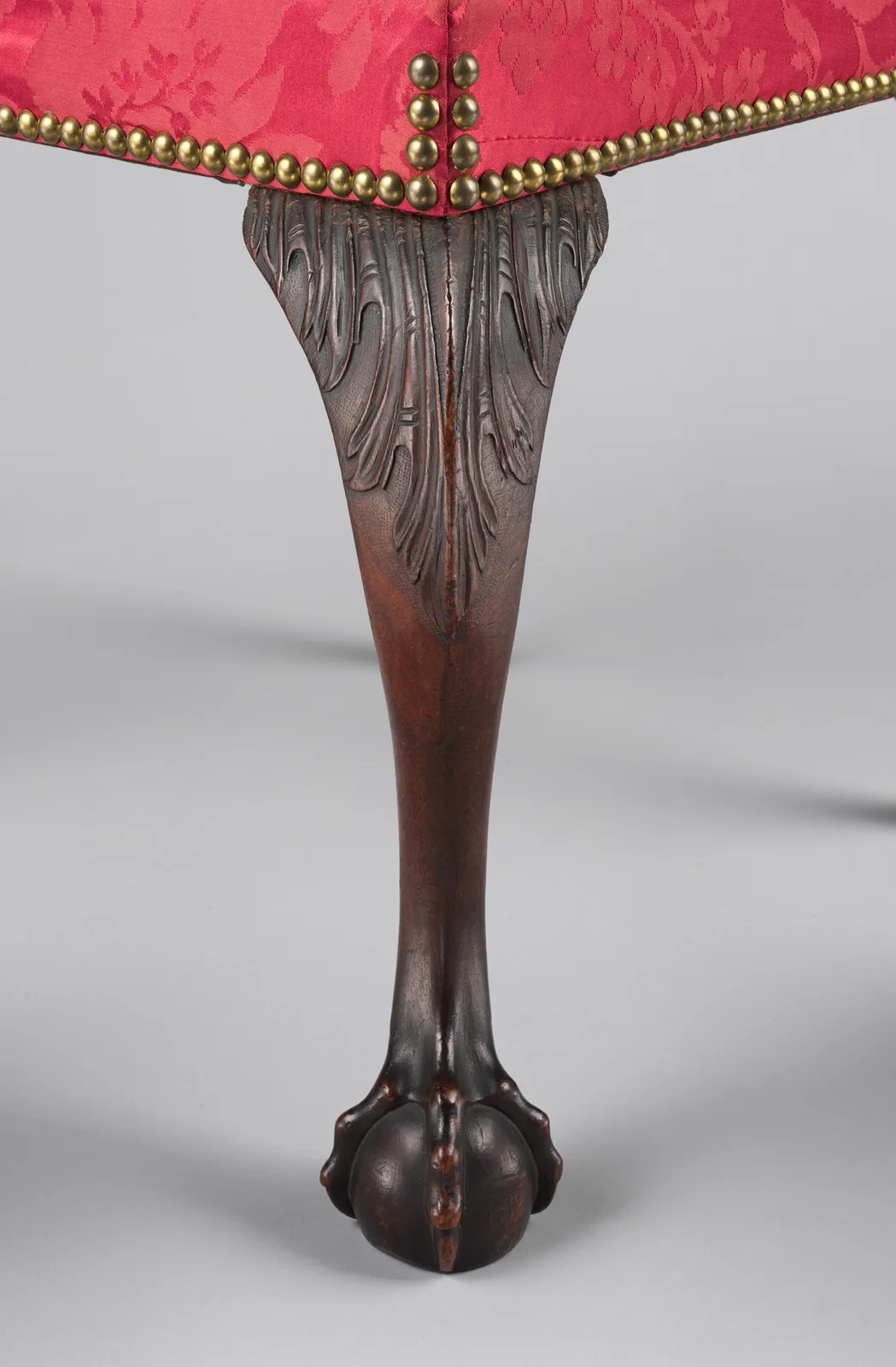
    Close-up of a carved ball-and-claw foot on a cabriole leg
    A hand-carved ball-and-claw foot on a cabriole leg.
    PeriodKnee DecorationFoot TypeAdditional Features
    Queen Anne (early)Plain or shellPad footSimple, elegant curves
    Queen Anne (late)Shell carvingTrifid footMore elaborate
    ChippendaleAcanthus leavesBall-and-clawCarved knees
    Irish ChippendaleLion masksHairy pawVery distinctive
    French ProvincialCarved flowersScroll footLighter appearance

    Straight Leg Styles

    Marlborough Leg (1755-1790)

    • Straight, square in cross-section
    • Sometimes with block foot
    • Associated with Chippendale (straight leg variant)
    • Often has inside chamfer or groove

    Tapered Leg (1780-1820)

    • Straight but narrows toward foot
    • Square or round cross-section
    • Signature of Hepplewhite style
    • May end in spade foot

    Reeded Leg (1785-1820)

    • Parallel grooves carved along length
    • Sheraton signature element
    • Usually round cross-section
    • Often tapered as well

    Saber Leg (1800-1840)

    • Curved outward like a sword
    • Empire and Regency periods
    • Common on chairs
    • Usually square cross-section

    Foot Identification Chart

    Foot TypePeriodDescription
    Bun foot1690-1730Flattened ball shape
    Ball foot1690-1750Round sphere
    Pad foot1700-1755Rounded cushion on disk
    Trifid foot1730-1760Three-toed, Philadelphia
    Slipper foot1720-1755Elongated pad foot
    Ball-and-claw1750-1790Claw grasping ball
    Spade foot1780-1810Tapered rectangle
    Bracket foot1700-1830Right angle with curve
    Ogee bracket1750-1800S-curved bracket
    French foot1780-1820Outward curving bracket
    Paw foot1800-1840Animal paw (lion, eagle)
    Scroll foot1830-1860Curved scroll shape

    For the visual companion to this leg chart, the guide on how to date an antique chair by its leg style walks through each turning and cabriole shape with reference photos from authenticated period pieces.

    Which Woods Were Used in Each Antique Furniture Period?

    Understanding wood types helps narrow down both the period and geographic origin of a piece.

    Primary Woods by Period

    PeriodPrimary WoodCharacteristics
    JacobeanOakHeavy, prominent grain, dark patina
    William & MaryWalnutGolden brown, often as veneer
    Queen AnneWalnut → MahoganyTransition period
    ChippendaleMahoganyReddish-brown, fine grain
    FederalMahogany with inlaysSatinwood, holly accents
    EmpireMahogany, often figuredFlame or crotch grain
    VictorianWalnut, RosewoodDark, heavily figured
    Arts & CraftsQuarter-sawn OakProminent ray flake
    Art DecoExotic veneersMacassar, zebrawood

    Secondary Woods and Geographic Origin

    Secondary woods (used inside drawers, for backboards, etc.) help identify where furniture was made:

    Secondary WoodLikely Origin
    White pineNew England
    Yellow pineSouthern United States
    Tulip poplarMid-Atlantic (Philadelphia, NY)
    Atlantic white cedarCoastal areas
    ChestnutContinental Europe
    Oak (as secondary)England
    Deal (Scots pine)England
    BeechFrance, Germany

    How Do I Identify Original Hardware on Antique Furniture?

    Original hardware is a strong indicator of period. Here’s how to identify it:

    Drawer Pull Evolution

    PeriodPull StyleMaterialAttachment
    1690-1720TeardropCast brassSingle post through wood
    1720-1780Bail (willow)Cast brassTwo posts, cotter pin
    1780-1810Oval plateStamped brassBolts through oval plate
    1810-1840Round rosetteStamped/pressedBolt through rosette
    1840-1870Fruit/leaf carvedWoodIntegral to drawer
    1870-1900Ornate stampedBrass/bronzeMachine screws
    1900-1920Simple/missionIron, copperExposed screws
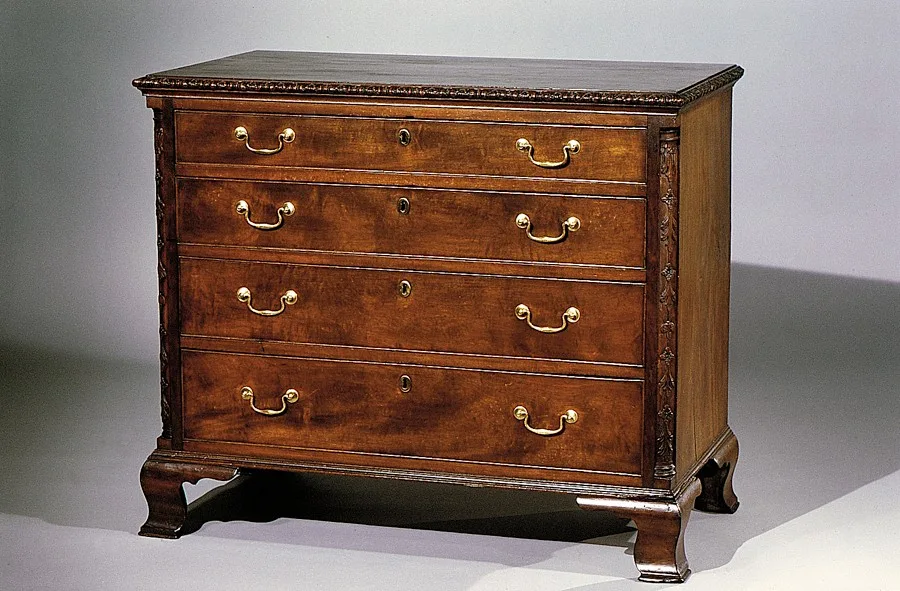
    Philadelphia mahogany chest of drawers from 1780 to 1790 with brass bail pulls
    A Philadelphia chest of drawers from 1780 to 1790 with its brass bail pulls.

    Hinge Identification

    PeriodHinge TypeNotes
    Pre-1700Strap hingeHand-forged iron
    1700-1800H-hinge, HL-hingeCast or wrought
    1780-1850Butt hingeRectangular, visible
    1850+Concealed hingeHidden when closed

    Lock Evolution

    Early locks (pre-1800) were hand-made with irregular mechanisms. Machine-made locks with uniform parts indicate 1830s or later. If a lock looks “too perfect,” it’s probably a replacement.

    For a deeper reference on drawer pulls and hinges across decades, the companion guide on the secret language of furniture hardware documents the exact shapes and attachment methods by decade.

    What Construction Methods Reveal the True Age of Antique Furniture?

    How a piece is built reveals as much as how it looks.

    Dovetail Analysis Chart

    Dovetail TypeDate RangeCharacteristics
    Hand-cut (early)Pre-1700Large, irregular, few in number
    Hand-cut (refined)1700-1890More uniform but still irregular spacing
    Machine-cut1890+Perfectly uniform, many small pins
    Router-cut1950+Rounded corners, extremely uniform
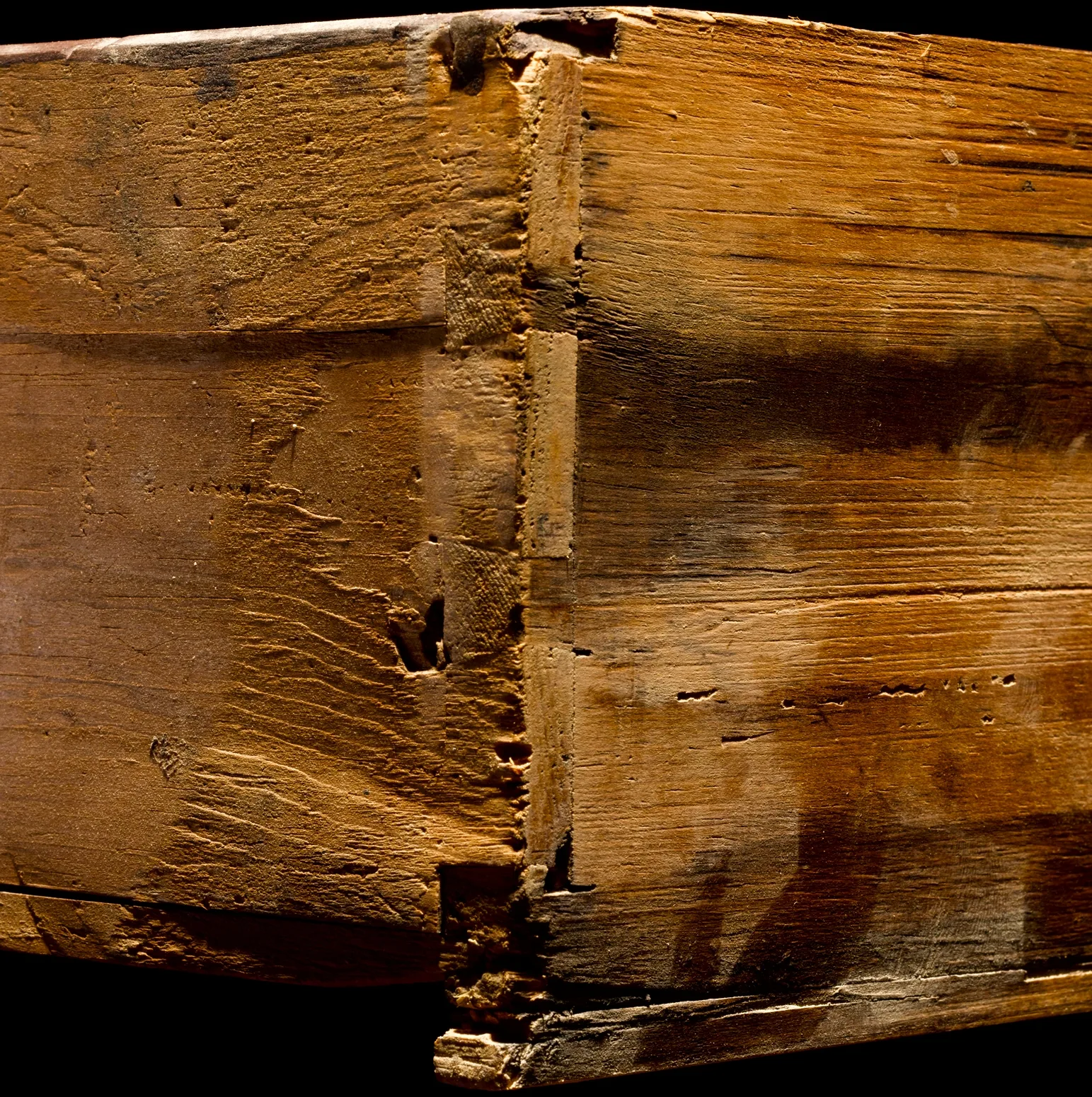
    Hand-cut dovetails on an old drawer, with narrow, unevenly spaced pins
    Hand-cut dovetails: narrow pins with uneven spacing.

    How to Check:

    1. Pull drawer out completely
    2. Look at corners where sides meet front
    3. Count the dovetails and observe spacing
    4. Note whether pins and tails are uniform

    Nail and Screw Identification

    Fastener TypeDate RangeIdentification
    Hand-forged nailPre-1800Square shaft, irregular head
    Cut nail1790-1900Rectangular shaft, machine-made
    Wire nail1890+Round shaft, circular head
    Hand-made screwPre-1850Off-center slot, blunt tip, irregular threads
    Machine screw (early)1850-1890Centered slot, blunt tip
    Modern screw1890+Pointed tip, uniform threads

    Saw Mark Analysis

    Look at unfinished surfaces (backboards, drawer bottoms, inside of case pieces):

    Saw Mark PatternDate RangeDescription
    Straight parallelPre-1850Hand saw or up-and-down mill saw
    Curved arcs1850-1900Circular saw
    Straight fine lines1880+Band saw
    No visible marks1900+Planed smooth

    Dovetail analysis is the most reliable single dating tool for case pieces. The focused guide on 1800s dresser identification through dovetail joints and nails goes deeper on reading spacing, pin shape, and machine-cut transitions.

    How Do I Identify Antique Chairs by Style and Back Shape?

    Chairs are among the most common antique furniture pieces. Here’s how to identify them:

    Chair Back Styles

    StylePeriodShapeKey Features
    Wainscot1600-1690Tall rectangularCarved panels, arms
    Banister-back1700-1750Vertical slatsTurned bannister-shape splats
    Fiddle-back1720-1760Vase shapeSingle solid splat, Queen Anne
    Pierced splat1755-1790Decorative cutoutsChippendale signature
    Shield-back1780-1800Shield outlineHepplewhite signature
    Square-back1790-1820RectangularSheraton signature
    Lyre-back1800-1820Lyre shapeFederal/Empire
    Balloon-back1840-1870Round balloonVictorian
    Ladder-backVariousHorizontal slatsCountry, Shaker

    Chair Arm Identification

    Arm StylePeriodDescription
    Scrolled1690-1730Tight scroll at end
    Shepherd’s crook1750-1790Curved like a crook
    Reeded1790-1820Parallel grooves
    Scrolled volute1810-1840Empire spiral
    Finger-rolled1840-1880Carved finger grip

    How Do I Identify Antique Case Pieces Like Chests and Desks?

    Case pieces (chests, desks, cabinets) have their own identification features.

    Chest of Drawers Evolution

    PeriodConfigurationTopBase
    Jacobean2-3 drawersFlat, heavy moldingStile feet
    William & Mary3-4 drawersFlatBun or ball feet
    Queen Anne4-5 drawersFlatBracket feet
    Chippendale4-5 drawersSometimes bonnet topOgee bracket or ball-claw
    Hepplewhite4 drawersFlatFrench feet
    SheratonBow or serpentineFlatTurned feet
    Empire4 drawers, columnsOverhangingPaw feet or scrolls

    Desk Identification

    Desk TypePeriodFeatures
    Slant-front1700-1800Hinged writing surface
    Secretary1750-1840Bookcase on slant-front desk
    Tambour1790-1820Flexible sliding doors
    Partners desk1800-1900Drawers on both sides
    Davenport1840-1900Small, slanted top, side drawers
    Roll-top1870-1920Flexible cylinder cover

    What Are the Main Antique Table Types by Period?

    Table Types by Period

    Table TypePeriodIdentifying Features
    Trestle table1600-1700Vertical supports, stretcher
    Gate-leg1650-1750Swinging leg supports drop leaf
    Butterfly1700-1750Wing-shaped leaf supports
    Tea table1730-1800Small, often with gallery
    Tilt-top1750-1800Top tilts vertical, tripod base
    Pembroke1760-1830Small drop-leaf, one drawer
    Card table1750-1840Folding top, often half-round
    Pier table1800-1860Against wall, often with mirror
    Parlor table1840-1900Marble top, Victorian
    Library table1850-1920Large, drawers, leather top

    Pedestal and Tripod Base Chart

    Base TypePeriodDescription
    Turned pedestal1730-1800Single turned column
    Urn pedestal1760-1800Urn shape, Chippendale
    Pillar and scroll1820-1850Empire style
    Split pedestal1830-1860Pedestal divides for extension

    How Do I Use This Antique Identification Chart Step-by-Step?

    Step-by-Step Process

    Step 1: Date the Construction

    • Check dovetails, nails, and saw marks
    • This gives you a “not earlier than” date

    Step 2: Identify the Wood

    • Primary wood suggests period
    • Secondary wood suggests origin

    Step 3: Examine Legs and Feet

    • Often the clearest period indicator
    • Compare to the charts above

    Step 4: Study the Overall Form

    • Heavy = earlier (Jacobean, William & Mary)
    • Curved and light = mid-18th century (Queen Anne, Chippendale)
    • Straight and delicate = late 18th century (Federal)
    • Heavy again = early 19th century (Empire)
    • Ornate = Victorian
    • Simple = Arts & Crafts

    Step 5: Check Hardware

    • Is it original or replaced?
    • What period does it suggest?

    Step 6: Verify with Technology

    Common Identification Mistakes to Avoid

    1. Assuming heavy = old: Empire furniture is heavy but only 1800s
    2. Trusting hardware alone: Hardware is often replaced
    3. Ignoring secondary woods: They’re as important as primary
    4. Confusing revivals with originals: Victorian Chippendale revival is NOT 18th century
    5. Overlooking regional variations: American Queen Anne differs from English

    What’s Included in the Free Printable PDF Guide?

    We’ve condensed the most essential information into a printable PDF format that you can take with you to antique shops, estate sales, and auctions.

    What’s Included:

    • Period timeline with key characteristics
    • Leg and foot identification visuals
    • Wood identification guide
    • Hardware dating chart
    • Construction analysis checklist
    • Quick-reference pocket guide

    This PDF pairs perfectly with the Antique Identifier app. Use the chart for preliminary identification and the app for instant AI-powered confirmation and valuation.

    How Can I Tell American Antique Furniture From English?

    Key Differences

    FeatureEnglishAmerican
    ScaleGenerally smallerLarger (bigger rooms)
    OrnamentationMore elaborateMore restrained
    WoodsImported mahogany, local oakNative walnut, cherry, maple
    Secondary woodsOak, deal (pine)Poplar, white pine
    HardwareOften gilded or ornateSimpler brass

    American Regional Characteristics

    Boston/New England:

    • Bombé (swelled) case pieces
    • Japanned decoration
    • Block-front desks and chests
    • Lighter proportions

    Philadelphia:

    • Most elaborate American furniture
    • Trifid feet on Queen Anne
    • Richly carved Chippendale
    • Influenced by London styles

    New York:

    • Dutch and English influences
    • Square proportions
    • Distinctive claw-and-ball (squared)
    • Heavy, substantial feel

    Newport:

    • Shell-carved block fronts
    • Understated elegance
    • Goddard-Townsend school
    • Highly valued today

    Southern:

    • Simpler designs
    • Local woods (walnut, yellow pine)
    • British influences
    • Less documented makers

    What Factors Determine the Value of Antique Furniture?

    While this identification chart focuses on style rather than value, here are factors that affect worth:

    Positive Value Factors

    • Original finish intact
    • Original hardware present
    • Documented maker or provenance
    • Rare form or regional example
    • Excellent condition
    • Historical significance

    Negative Value Factors

    • Replaced parts or hardware
    • Refinished surfaces
    • Structural repairs
    • Missing elements
    • Common form
    • Poor condition

    Authentication Red Flags

    • Construction methods don’t match supposed period
    • Wood species inconsistent with claimed origin
    • “Too perfect” condition for stated age
    • Conflicting style elements
    • Suspiciously low price

    The Antique Identifier app can help you assess value by comparing your piece to recent auction results and market data.

    No single clue is ever enough. A piece is convincing when the dovetails, the secondary wood, the leg style, and the hardware all point to the same decade. When one of those four things does not match (hand-cut dovetails paired with wire nails, for example), you are almost always looking at a marriage, a later repair, or a fake.

    Keep this chart on your phone for the next estate sale. Start at the legs, work down to the feet, pull a drawer to examine the joinery, flip the piece to read the secondary wood, then cross-check the hardware. Ten minutes of systematic examination will keep you from paying Chippendale prices for a Victorian revival.

    Frequently Asked Questions

    How do I tell if a piece of furniture is truly antique or a reproduction?

    True antique furniture shows consistency between four construction details at once: hand-cut dovetails with irregular pin spacing, period-correct hardware with cotter-pin attachment, a primary wood species appropriate for the claimed era, and a secondary wood consistent with a known regional origin. A piece that combines hand-cut dovetails with wire nails, for example, is almost always a reproduction, a marriage, or a later repair. Examining all four points together is more reliable than any single clue.

    What wood tells you that furniture is American rather than English?

    Secondary wood is the strongest regional indicator. White pine points to New England, yellow pine points to the Southern United States, and tulip poplar points to the Mid-Atlantic region including Philadelphia and New York. English pieces typically use oak or deal (Scots pine) as secondary wood and often feature imported mahogany as the primary wood. Turn the piece over and examine drawer bottoms, backboards, and the insides of case pieces to read the secondary wood.

    Are square nails a reliable sign of old furniture?

    Square or cut nails suggest pre-1890 construction but are not a guarantee on their own. Hand-forged square nails appear in pre-1800 pieces and show irregular head shapes. Machine-cut square nails with rectangular shafts were produced between 1790 and 1900. After 1890 the wire nail took over. A piece with both square nails and machine-cut dovetails is typical of the mid-to-late 19th century. Always cross-check nail type against dovetail construction and hardware to confirm the period.

    What is a cabriole leg and what period does it indicate?

    A cabriole leg is the distinctive S-curved leg that swells outward at the knee and tapers toward the foot. It first appears in Queen Anne furniture around 1700 with a simple pad foot, continues into the Chippendale period (1750-1790) with carved knees and ball-and-claw feet, and was revived extensively during the Victorian era. The combination of cabriole leg plus ball-and-claw foot plus mahogany primary wood is the classic signature of American Chippendale.

    Can I identify the period of antique furniture just by the hardware?

    Hardware is a strong clue but not sufficient on its own because hardware is frequently replaced. Original period-correct hardware dates a piece to no earlier than the hardware style. A piece with 1720-1780 cast brass bail pulls attached by cotter pins could be genuine Queen Anne or Chippendale, unless the rest of the piece disagrees. Always pair hardware assessment with dovetail analysis, wood identification, and leg style to arrive at a confident period estimate.

    From silver hallmarks to porcelain maker marks, the app suggests the item type, period and a value range.

    See How It Works →

    ED

    About Antique Identifier Editorial

    Antique Identifier Editorial writes practical guides for identifying and dating antiques.

  • Antique Furniture Periods Chart: Free 1600-1940 Timeline with Pictures

    Antique furniture periods span 1600–1940 across 11 major styles, from heavy Jacobean oak to glamorous Art Deco geometry, each identifiable by distinctive legs, woods, and motifs. This chart and timeline gives collectors, dealers, and inheritors a fast visual reference to date and identify any piece.

    Not sure which period your piece is? The Antiqly antique identifier app dates furniture from a photo and gives a value range.

    Quick Reference: Antique Furniture Periods Chart (1600-1940)

    Here’s your complete timeline of furniture periods at a glance:

    PeriodDatesCountry of OriginPrimary WoodSignature Feature
    Jacobean1600-1690EnglandOakHeavy carved geometric patterns
    Carolean (Restoration)1660-1689EnglandWalnut, oakBarley-twist turning, caned seats and backs
    William & Mary1690-1730England/DutchWalnutTrumpet-turned legs
    Queen Anne1700-1755EnglandWalnut/MahoganyCabriole legs with pad feet
    Chippendale1750-1790EnglandMahoganyBall-and-claw feet
    Federal/Hepplewhite1780-1820AmericaMahoganyShield-back chairs, inlay
    Sheraton1785-1820EnglandMahogany/SatinwoodReeded legs, rectangular forms
    Empire1800-1840France/AmericaMahoganyBold columns, animal motifs
    Regencyc. 1800-1830EnglandRosewood, mahoganySabre legs, brass inlay, Greek and Egyptian motifs
    Victorian1837-1901EnglandWalnut/RosewoodOrnate carvings, heavy forms
    Edwardian1901-1910EnglandSatinwood, mahoganyLight Sheraton-revival forms with inlaid stringing
    Arts & Crafts1880-1920England/AmericaQuarter-sawn OakVisible joinery, simple lines
    Art Nouveau1890-1910France/BelgiumVariousFlowing organic curves
    Art Deco1920-1940FranceExotic woodsGeometric shapes, bold colors

    English dealers use reign names that do not appear on the American side of the chart: Carolean for the walnut furniture of Charles II, Regency for the classical revival around the years when the future George IV was Prince Regent (1811-1820), and Edwardian for the pale, inlaid revival pieces of Edward VII’s short reign.

    Now let’s dive deeper into each period so you can identify them with confidence.

    Jacobean Period (1600-1690)

    The Jacobean period represents the earliest furniture that most collectors encounter. Named after King James I (Jacobus in Latin), this style dominated English furniture making for nearly a century. The Victoria and Albert Museum holds an outstanding reference collection of Jacobean case pieces that illustrates the period’s characteristic heavy construction.

    Visual Identification Guide

    What to Look For:

    • Extremely heavy construction using thick oak boards
    • Geometric carved patterns (diamonds, lunettes, arcades)
    • Turned legs with bold turnings, often spiral “barley twist” designs
    • Stretchers positioned low, close to the floor
    • Gate-leg tables with multiple turned legs
    • Dark, almost black patina from centuries of oxidation

    Common Pieces:

    • Court cupboards
    • Press cupboards
    • Joint stools
    • Wainscot chairs
    • Refectory tables
    • Blanket chests

    Jacobean Legs and Feet

    The legs are perhaps the easiest identification feature. Look for:

    • Bulbous turned legs (melon-shaped)
    • Barley twist turnings
    • Block-and-turn patterns
    • Simple ball feet

    Important Note: Victorian-era reproductions of Jacobean furniture are very common. Original pieces will show genuine wear, hand-cut joinery, and irregular tool marks. Use the Antique Identifier app to help distinguish originals from later copies.

    William & Mary Period (1690-1730)

    When William of Orange and his wife Mary took the English throne in 1689, they brought Dutch design sensibilities that transformed furniture fashion. This period marks a transition from heavy oak to elegant walnut.

    Visual Identification Guide

    What to Look For:

    • Walnut veneer over secondary woods
    • Intricate marquetry patterns (seaweed, floral, arabesque)
    • Trumpet-shaped or inverted cup leg turnings
    • Flat, serpentine stretchers forming X or H shapes
    • Bun feet or ball feet
    • Teardrop-shaped brass drawer pulls

    Common Pieces:

    • Highboys (tall chests on stands)
    • Lowboys (dressing tables)
    • Gateleg tables
    • Caned chairs
    • Secretaries with slant fronts

    William & Mary vs. Earlier Styles

    The key difference is lightness. While Jacobean furniture sits heavily on the ground, William & Mary pieces appear to stand on tippy-toes with their delicate turned legs and stretchers.

    The introduction of veneer is also significant. Earlier periods used solid wood, but William & Mary craftsmen discovered that thin slices of expensive walnut over cheaper woods allowed for dramatic visual effects.

    Queen Anne Period (1700-1755)

    Many collectors consider Queen Anne the most graceful of all furniture periods. The style is named after Queen Anne who reigned 1702-1714, but the style persisted for decades after her death. The Metropolitan Museum of Art houses an exceptional collection of American Queen Anne pieces that demonstrates regional variation across colonial centers.

    Visual Identification Guide

    The Cabriole Leg - THE Defining Feature: This distinctive S-curved leg flows outward at the knee, then curves inward at the ankle before ending in a foot. It’s so strongly associated with this period that “cabriole leg” and “Queen Anne” are almost synonymous.

    Foot Styles:

    • Pad foot (simple rounded cushion shape)
    • Slipper foot (elongated pad)
    • Trifid foot (three-toed, common in Philadelphia)
    • Drake foot (resembling a duck’s webbed foot)

    Other Characteristics:

    • Fiddle-back or vase-shaped chair splats
    • Curved top rails on chairs (yoke-shaped)
    • Shell carvings on chair crests and table knees
    • Minimal stretchers: cabriole legs were strong enough alone
    • Walnut (early) transitioning to mahogany (later)

    American Queen Anne

    American craftsmen created their own interpretations of the Queen Anne style. Regional differences help identify where a piece was made:

    RegionCharacteristics
    PhiladelphiaTrifid feet, elaborate carving, larger scale
    NewportUnderstated elegance, pad feet
    BostonJapanned decoration, compass seats
    New YorkSquare seats, heavier proportions

    Chippendale Period (1750-1790)

    Thomas Chippendale’s 1754 book “The Gentleman and Cabinet-Maker’s Director” made him the most famous furniture designer in history. The style bearing his name represents the height of Georgian craftsmanship. Auction records at Heritage Auctions consistently show that Philadelphia Chippendale pieces achieve among the highest prices of any American furniture period.

    Visual Identification Guide

    The Ball-and-Claw Foot: This iconic foot features a carved claw (usually with three or four talons) grasping a ball. It evolved from Chinese designs depicting a dragon’s claw holding a pearl.

    Three Style Variations:

    1. English Chippendale (Rococo)
      • Asymmetrical carved decoration
      • C-scrolls and S-scrolls
      • Naturalistic motifs (leaves, flowers, ribbons)
    2. Chinese Chippendale
      • Straight legs with fretwork
      • Pagoda-shaped pediments
      • Latticework and geometric patterns
      • Bamboo-style turnings
    3. Gothic Chippendale
      • Pointed arches
      • Tracery patterns
      • Cluster columns
      • Quatrefoil motifs

    Chair Identification:

    • Pierced splats with elaborate patterns
    • Serpentine top rails with carved ears
    • Square legs (straight Chippendale) or cabriole legs (rococo)
    • Wider, more comfortable seats than Queen Anne

    Case Piece Features:

    • Broken pediment tops with finials
    • Ogee bracket feet or ball-and-claw feet
    • Elaborate brass hardware
    • Blocked fronts on New England pieces

    Chippendale Reproductions

    Be careful: Chippendale style has been reproduced more than any other period. The “Centennial” reproductions from the 1870s-1880s can fool inexperienced buyers. Later Colonial Revival pieces from the 1920s-1940s are also common. Checking comparable sold examples through WorthPoint’s auction archive can help you spot price outliers that may signal a reproduction.

    Look for these signs of age:

    • Hand-cut dovetails with irregular spacing
    • Wear in logical places (feet, arms, seat fronts)
    • Secondary woods appropriate to origin
    • Original brasses leaving shadow marks

    For instant authentication help, try our Antique Identifier app. It can detect many reproduction indicators.

    Federal Period (1780-1820)

    The Federal period represents America’s first truly national furniture style, developing after independence from Britain. It encompasses both Hepplewhite and Sheraton influences.

    Hepplewhite Style

    George Hepplewhite’s designs, published posthumously in 1788, emphasized:

    Legs:

    • Straight, tapered legs (square or round cross-section)
    • Spade feet or simple tapered ends
    • No cabriole legs

    Chair Backs:

    • Shield shape (most iconic)
    • Heart shape
    • Oval shape
    • Delicate carved or pierced splats

    Decoration:

    • Contrasting wood inlays
    • Bellflower drops
    • Urns and swags
    • Feathers and wheat sheaves
    • Eagle motifs (very American)
    • Paterae (oval medallions)

    Sheraton Style

    Thomas Sheraton’s designs appeared slightly later with subtle differences:

    • More rectangular chair backs
    • Extensive use of reeding (parallel carved grooves)
    • Turned and reeded legs
    • More architectural, less curvy
    • Use of exotic veneers

    Federal Period Woods

    Primary wood was typically mahogany, but the inlay work is what makes Federal furniture special:

    • Satinwood for light contrast
    • Holly or boxwood for lines and banding
    • Ebony for dark accents
    • Bird’s eye maple for figure

    Empire Period (1800-1840)

    The Empire style originated in Napoleonic France and spread across the Western world. It’s dramatically different from the delicate Federal style that preceded it.

    Visual Identification Guide

    Proportions: Bold, heavy, monumental. Empire furniture makes a statement.

    Key Features:

    • Columns (often gilded or ebonized) as structural elements
    • Scroll-shaped supports
    • Animal paw feet (especially lion’s paws)
    • Eagle heads and wings
    • Swan neck curves
    • Lyre shapes
    • Ormolu (gilded bronze) mounts on French pieces

    Materials:

    • Dark mahogany, often figured or flame grain
    • Marble tops on tables and case pieces
    • Gilding and bronze mounts
    • Black ebonizing for contrast

    American Empire

    American Empire (1815-1840), sometimes called “Classical American,” is generally simpler than French Empire:

    • Less ormolu, more stenciled decoration
    • Larger scale (American rooms were bigger)
    • More reliance on figured veneers
    • Pillar-and-scroll designs

    Notable Makers:

    • Duncan Phyfe (New York)
    • Charles-Honoré Lannuier (New York)
    • Anthony Quervelle (Philadelphia)

    Victorian Era (1837-1901)

    Queen Victoria’s long reign saw dramatic changes in furniture styles. The Victorian era actually encompasses several distinct sub-periods:

    Victorian Sub-Periods Chart

    Sub-PeriodDatesKey Characteristics
    Early Victorian1837-1850Continuation of late Empire forms
    Gothic Revival1840-1865Pointed arches, church-like motifs
    Rococo Revival1845-1870Exuberant curves, carved flowers
    Renaissance Revival1860-1885Architectural forms, medallions
    Eastlake1870-1890Rectilinear, incised decoration
    Aesthetic Movement1875-1890Japanese influence, ebonized wood
    Colonial Revival1880-1920Return to 18th-century American styles

    Rococo Revival (Belter Furniture)

    John Henry Belter of New York perfected laminated rosewood construction that allowed for incredibly elaborate pierced carving. His pieces feature:

    • Extravagant carved roses, grapes, and vines
    • Serpentine curves everywhere
    • Tufted upholstery
    • Finger-molded frames

    Belter furniture is highly collectible and quite valuable today. Kovels’ price guides document strong and consistent auction demand for authenticated Belter parlor suites.

    Renaissance Revival

    This heavier style features:

    • Architectural elements (columns, pediments)
    • Incised line decoration
    • Applied busts and medallions
    • Walnut with burl panels
    • White marble tops

    Eastlake Style

    Charles Eastlake advocated for “honest” construction and simpler designs:

    • Rectangular forms
    • Incised geometric decoration
    • Turned spindles and galleries
    • Less carving, more machine-made elements
    • Often ebonized with gilded highlights

    Arts & Crafts Movement (1880-1920)

    The Arts & Crafts movement was a reaction against Victorian excess and industrial mass production. It celebrated handcraft and honest construction. The Smithsonian Institution’s American art collections document how the movement shaped design reform on both sides of the Atlantic.

    Visual Identification Guide

    Construction Philosophy: Don’t hide the joinery. Celebrate it!

    Key Features:

    • Through-tenons visible on surface
    • Exposed pegs
    • Visible dovetails
    • Simple, rectilinear forms
    • Quarter-sawn white oak (showing ray flake)
    • Hand-hammered copper or iron hardware
    • Leather or canvas upholstery

    Major Makers:

    MakerLocationIdentifying Marks
    Gustav StickleySyracuse, NYRed decal or branded mark, “Als Ik Kan” motto
    L. & J.G. StickleyFayetteville, NY“Onondaga Shops” label
    Stickley BrothersGrand Rapids, MI“Quaint Furniture” label
    RoycroftEast Aurora, NYOrb and cross mark
    LimbertGrand Rapids, MIBranded mark with “Limbert’s Arts Crafts”

    Mission vs. Arts & Crafts

    “Mission” style is often used interchangeably with Arts & Crafts, but Mission specifically refers to simpler, more severe pieces supposedly inspired by California mission furniture. All Mission is Arts & Crafts, but not all Arts & Crafts is Mission.

    Art Nouveau (1890-1910)

    Art Nouveau was a brief but brilliant flowering of artistic furniture that embraced organic, flowing forms.

    Visual Identification Guide

    The Whiplash Curve: This sinuous, S-shaped curve appears everywhere in Art Nouveau design, from chair backs to table legs to cabinet handles.

    Nature Motifs:

    • Flowers (lilies, irises, orchids, poppies)
    • Vines and tendrils
    • Dragonflies and butterflies
    • Peacock feathers
    • Female figures with flowing hair
    • Waves and water plants

    Materials:

    • Exotic woods carved into organic shapes
    • Inlays of fruitwood, mother-of-pearl
    • Stained glass panels
    • Bronze or gilt bronze mounts

    Notable Designers:

    • Émile Gallé (Nancy, France)
    • Louis Majorelle (Nancy, France)
    • Hector Guimard (Paris)
    • Carlo Bugatti (Italy)
    • Charles Rennie Mackintosh (Scotland)

    Art Nouveau furniture is relatively rare compared to other periods and commands premium prices at auction.

    Art Deco Period (1920-1940)

    Art Deco embraced the machine age with bold geometric designs and glamorous materials. It represents the last major historical furniture period before mid-century modern.

    Visual Identification Guide

    Shapes:

    • Bold geometric forms
    • Circles, sunbursts, chevrons
    • Stepped profiles (like skyscrapers)
    • Symmetrical compositions

    Materials:

    • Exotic veneers (macassar ebony, zebrawood, amboyna, burled walnut)
    • Lacquer in bold colors (red, black, cream)
    • Chrome and glass
    • Shagreen (ray skin)
    • Parchment
    • Ivory inlay (now illegal to trade)

    Surface Treatments:

    • High-gloss lacquer finishes
    • Bookmatched veneers
    • Geometric marquetry

    Notable Designers:

    • Émile-Jacques Ruhlmann (the master)
    • Jean Dunand (lacquer specialist)
    • Jules Leleu
    • Paul Frankl (American)
    • Donald Deskey (American)

    Art Deco vs. Art Moderne

    “Art Moderne” or “Streamline Moderne” appeared in the 1930s with even simpler forms:

    • Teardrop and torpedo shapes
    • Horizontal speed lines
    • Chrome banding
    • Waterfall curves on case pieces
    • More machine-made, less handcraft

    How to Use This Furniture Periods Chart

    When trying to identify a piece of antique furniture, follow these steps:

    Step 1: Observe the Overall Form

    Is it heavy or light? Angular or curved? This narrows down the era immediately.

    Step 2: Examine the Legs and Feet

    Legs are often the quickest identifier:

    • Bulbous turnings = Jacobean
    • Trumpet turnings = William & Mary
    • Cabriole with pad foot = Queen Anne
    • Cabriole with ball-and-claw = Chippendale
    • Straight tapered = Federal
    • Columns or scrolls = Empire
    • Turned spindles = Victorian/Eastlake
    • Square with visible joinery = Arts & Crafts
    • Geometric chrome = Art Deco

    Step 3: Check the Wood

    Primary and secondary woods help date and locate origin.

    Step 4: Study the Hardware

    Original hardware style matches the period. Replaced hardware leaves tell-tale signs.

    Step 5: Look for Maker’s Marks

    Many pieces are signed, stamped, or labeled.

    Step 6: Verify with Technology

    Use the Antique Identifier app to snap a photo and get instant period identification, plus estimated values.

    Printable Furniture Periods Chart

    Want to keep this information handy while shopping? We’ve created a simplified reference chart:

    1600-1700: Age of Oak

    • Jacobean (1600-1690): Heavy oak, geometric carving

    1700-1800: Age of Walnut & Mahogany

    • William & Mary (1690-1730): Walnut veneer, trumpet legs
    • Queen Anne (1700-1755): Cabriole legs, shell motifs
    • Chippendale (1750-1790): Ball-and-claw, pierced splats

    1780-1840: Neoclassical Era

    • Federal/Hepplewhite (1780-1820): Inlay, shield backs
    • Sheraton (1785-1820): Reeding, rectangular forms
    • Empire (1800-1840): Columns, animal motifs

    1837-1920: Victorian & Reform

    • Victorian (1837-1901): Ornate, multiple revival styles
    • Arts & Crafts (1880-1920): Simple, visible joinery

    1890-1940: Modern Movements

    • Art Nouveau (1890-1910): Organic curves
    • Art Deco (1920-1940): Geometric glamour

    Common Questions About Furniture Periods

    How do I know if my furniture is genuinely antique?

    True antiques are generally considered to be at least 100 years old. Look for:

    • Hand-cut joinery (irregular dovetails)
    • Appropriate wear patterns
    • Period-correct hardware
    • Secondary woods matching the supposed origin
    • Proper patina and oxidation

    Why do furniture periods overlap?

    Style changes didn’t happen overnight. New styles took years to spread from urban centers to rural areas. Craftsmen continued making older styles while new ones emerged. And dates given are approximate. Styles transitioned gradually.

    What’s the most valuable furniture period?

    It depends on the specific piece, maker, condition, and current market trends. Generally, 18th-century American pieces (Queen Anne and Chippendale) command the highest prices at auction. Art Nouveau and Art Deco by famous designers also bring strong prices. If you need a formal valuation, a certified appraiser through the International Society of Appraisers can provide a documented opinion of value.

    Can I identify furniture periods from a photo?

    Yes! While hands-on examination is ideal, photos can reveal many period indicators. The Antique Identifier app uses AI to analyze photos and identify periods, styles, and estimated values instantly.

    Using the chart to date a piece

    Understanding furniture periods transforms how you see antique furniture. What once looked like “just old furniture” becomes a window into history. You can see the Dutch influence in William & Mary pieces, feel the revolutionary spirit in Federal designs, and appreciate the handcraft ethos of Arts & Crafts makers.

    Keep this furniture periods chart handy as a reference, and don’t hesitate to use modern technology like our Antique Identifier app when you need quick identification help. With practice, you’ll be dating furniture like an expert in no time.


    ED

    About Antique Identifier Editorial

    Antique Identifier Editorial writes practical guides for identifying and dating antiques.

  • Identifying Antiques in 2026: A Practical Guide for Beginners

    Identifying Antiques in 2026: A Practical Guide for Beginners


    You Don’t Need to Be an Expert to Identify Antiques

    Most beginners think antique identification requires years of study.
    That used to be true.

    In 2026, you don’t need to be an expert, you need a process.

    Identifying antiques is about learning what to look for first, not memorizing prices or styles.


    Buccellati maker's mark stamped on antique silver

    Step 1: Ignore Value, Focus on Identity

    The biggest beginner mistake is chasing value too early.

    Instead, ask:

    • What type of object is this?
    • What was its original function?
    • Does it show signs of age or imitation?

    Value comes later. Identity comes first.


    Step 2: Look for Physical Clues

    When identifying antiques, these clues matter most:

    Construction

    • Hand-cut joints vs machine-cut
    • Irregular tool marks
    • Solid materials instead of composites

    Wear

    • Natural patina, not artificial aging
    • Wear in logical places (handles, edges, bases)

    Marks & Signatures

    • Maker’s marks
    • Hallmarks
    • Stamps or labels

    No mark doesn’t mean fake, but fake marks are common.


    Step 3: Context Beats Guessing

    An object without context is hard to identify.

    Ask:

    • Where was it found?
    • Was it part of a set?
    • Does the style match the era it claims?

    Context eliminates half of false assumptions instantly.


    Step 4: Use Visual References, Not Memory

    Books are useful, but slow.

    Modern identification relies on:

    • Visual comparison
    • Pattern recognition
    • Reference libraries

    This is why image-based tools outperform text-based guides.


    Common Beginner Mistakes to Avoid

    • Assuming “old” means “valuable”
    • Trusting seller descriptions blindly
    • Ignoring repairs or modifications
    • Comparing only by style, not construction

    Every beginner makes these mistakes. The goal is to make them once, not repeatedly.


    A Practical Shortcut for Beginners

    Instead of jumping between blogs, forums, and books, many beginners now start with visual identification apps.

    These tools help you:

    • Identify category and era
    • Spot red flags early
    • Understand what details matter
    • Learn why something may or may not be antique

    👉 Identify your antique with the app
    🔗 https://apps.apple.com/app/id6751417557?pt=128215051&ct=bil-x

    Think of it as a learning companion, not a replacement for expertise.


    Final Thought

    Antique identification in 2026 isn’t about knowing everything.
    It’s about knowing where to start.

    And starting right saves you years of wrong assumptions.

  • Antique Identifier App: Identify Antiques and See Their Value

    Antique Identifier App: Identify Antiques and See Their Value

    Snap a photo, get an antique ID and a value range

    AI identification, period and an estimated value from comparable listings.

    Identify Now
    Free to download on iPhone and Android
    On the App Store and Google Play
    1. Snap a photo
    2. Identify
    3. Get value

    We make Antiqly. Antique Identifier: Antiqly is an app for iPhone (App Store) and Android (Google Play) that identifies antiques from a photo. If the piece has a stamp or maker’s mark, the app reads the mark along with the object, and identifications that include a mark are much more likely to land on the right maker and value. Once the item is identified, Antiqly checks the mark against its own reference data, searches marketplaces such as eBay for similar items, and combines those prices into an estimated value range.


    To see the kind of answer it produces before installing it, try the antique photo identifier on this site: one photo, a likely identification and a rough value range.

    What Is Antique Identifier?

    Antique Identifier is a mobile app that lets you identify antiques from a photo, analyze similar items on the market, and estimate their real-world value using visual matching and historical data. Instead of flipping through a printed price guide, you point your camera at the object and get a first answer in the app.

    Take a photo, and the app reads the object and any visible marks.

    It is a starting point for research, not a replacement for it.


    Key Features of Antique Identifier

    🔍 Identify Antiques from a Photo

    Snap a photo to identify antiques, vintage items, collectibles, ceramics, art objects, coins, and more. The AI looks at shape, materials, hallmarks and design details to suggest what the object is, and tells you how confident it is.


    💰 Discover Estimated Market Value

    Learn the price range of your item based on:

    • Similar antiques sold online
    • Market listings
    • Condition comparisons

    Useful for sellers, buyers and collectors. For sold-price history, a database such as WorthPoint complements the app’s estimate, which is built from current listings.


    📚 Learn the History Behind Every Item

    Each object tells a story. Antique Identifier provides historical context including:

    • Origin and cultural background
    • Estimated time period
    • Maker or style (when available)

    That context is often what makes an identification useful: where a piece came from affects both its story and its value.


    🔗 Compare Similar Antiques Visually

    See real visual matches from the market and auctions. Compare pricing and condition to see how your item fits into today’s market.


    📂 Build Your Personal Antique Collection

    Save identified items into your personal inventory:

    • Organize your collection
    • Track estimated values
    • Keep a digital record of your antiques

    Ideal for long-term collectors and estate planning.


    📄 Export Detailed PDF Reports

    Generate professional PDF reports for:

    • Insurance documentation
    • Selling listings
    • Personal records

    Clear, structured and easy to share. A PDF report is not a formal appraisal: when one is needed for high-value items, the International Society of Appraisers can connect you with a credentialed professional whose written opinion insurers and estates accept.


    Who Is Antique Identifier For?

    • Collectors who want to understand and manage their collections
    • Resellers & flippers hunting undervalued items at flea markets and estate sales
    • Inherited item owners unsure about the value of family antiques
    • Curious users interested in history, art, and vintage objects

    If you have ever asked “Is this worth anything?”, this app is for you.


    What Makes Antiqly Different

    Unlike generic search tools, Antiqly is built specifically for antiques. It combines AI visual recognition with marketplace comparisons and historical context in one simple interface.

    ✔ Reads maker’s marks and hallmarks
    ✔ Shows a value range, not a single number
    ✔ No technical knowledge required

    It can still be wrong, especially on rare pieces, reproductions and anything without a mark, so treat the result as a first opinion.


    Pricing

    Antiqly is free to download. Identifications need a subscription or a one-time purchase, which includes:

    • Identifications with mark reading
    • Detailed value estimates
    • In-depth historical insights
    • Your saved collection and PDF reports

    Plans are weekly or yearly subscriptions, or a one-time lifetime purchase, and are managed through your App Store or Google Play account.


    Frequently Asked Questions

    What does the Antiqly app do?

    Antiqly identifies antiques and collectibles such as ceramics, silver, coins, furniture, art objects and vintage items from a photo, and gives an estimated value range and historical context. The value range is built from current marketplace listings for similar items rather than a fixed price guide. It is free to download on iPhone and Android; identifications need a subscription or a one-time purchase.

    How accurate is AI antique identification?

    AI identification works best on common categories such as ceramics, glassware, coins and furniture styles, and when the photo shows distinctive features (maker’s marks, hallmarks or decorative motifs) clearly. It is less reliable on rare pieces, reproductions and unmarked objects. For rare or extremely high-value pieces, a certified appraiser from the International Society of Appraisers should be consulted to supplement the AI result.

    Can I use the app to value inherited antiques?

    Yes. Antiqly is useful for people who have inherited items and need a quick starting point for valuation. Simply photograph each piece and the app returns an estimated price range based on comparable listings. For estate and probate purposes, you may also want to verify high-value items through auction records on WorthPoint or consult a certified appraiser.

    What types of antiques can the app identify?

    The app identifies a broad spectrum of antiques and collectibles, including pottery and porcelain, silverware, vintage jewelry, coins and medals, oil paintings, furniture, clocks, and decorative objects from cultures worldwide. The AI draws on visual patterns, stylistic details and period-specific design.

    Is Antiqly free?

    Antiqly is free to download from the App Store and Google Play and does not require an account. Identifications need a weekly or yearly subscription or a one-time lifetime purchase. Identified items can be saved to your collection, so you can keep a record of what you own.

    How do antique apps compare to professional appraisals?

    AI-powered apps like Antiqly are useful for fast, everyday identification and ballpark valuations, for example at flea markets, estate sales, or when deciding whether to research an item further. Professional appraisals conducted by members of the Appraisers Association of America provide legally defensible written opinions required for insurance, donation tax deductions, or high-stakes sales. Think of the app as your first-line research tool and the appraiser as your final authority for significant items.


    Start Identifying Antiques Today

    Before you sell, donate or give a piece away, find out what it is.

    Download Antique Identifier: Antiqly on the App Store, or get it on Google Play, and see an estimated value for the antiques you find.

    👉 Your next great discovery is just one scan away.

    Download Antiqly on the App Store

    Download Antique Identifier - Antiqly on the App Store
    ED

    About Antique Identifier Editorial

    Antique Identifier Editorial writes practical guides for identifying and dating antiques.

  • How to Identify Antiques: A Beginner’s Guide (With Real Examples)

    How to Identify Antiques: A Beginner’s Guide (With Real Examples)

    An antique is generally an object more than 100 years old; you identify one by checking materials, construction, marks and wear against documented examples.

    What is classed as an antique?

    An object is classed as an antique when it is more than 100 years old; that is the line written into customs and tax law and the one dealers and auction houses work to. British tax guidance states it directly: “The legal definition of an antique is an item, other than a work of art or a collectors’ item, which is over one hundred years old” (HMRC, VAT Notice 718). The United States customs regulation on antiques works to the same century: its test for an antique made with protected animal materials is that “The article is not less than 100 years of age” (19 CFR 10.53). As this guide is updated in 2026, the line falls at roughly 1926, so a piece made before the mid-1920s qualifies and a piece from the 1930s does not yet, however old it looks.

    The 100-year rule describes age, not quality or price. Plenty of objects that clear it were mass-produced and survive in quantity, while some younger pieces are rarer and more sought after than genuinely antique ones. Objects that miss the line by a few decades are usually called vintage, and “retro” describes a style rather than an age; our antique vs vintage vs retro cutoffs work through the production years for each term. Once you know a piece is old, the separate question of whether it is worth anything is covered in our 15 expert tips for spotting valuable pieces.

    When the production date is unknown, which is the normal situation, identification rests on physical evidence: what the object is made of, how it was put together, what marks it carries, how it has worn, and how closely it matches documented examples. The five steps below take those in order, and the museum records further down show what each kind of evidence looks like on a real object.

    Step 1: Examine the materials

    Start with what the object is made of, because materials rule things out faster than they rule anything in. Solid timber shows continuous grain that runs through edges and onto unfinished secondary surfaces such as drawer bottoms and backboards; veneer over a core shows a grain that stops at the edge. Hand-blown glass tends to carry a rough or ground pontil scar under the base, tiny seed bubbles and a slight asymmetry, whereas pressed glass shows mould seams and a crisp, repeated pattern. Ceramics divide into earthenware, stoneware and porcelain, each with a different weight, translucency and ring, and the metals a beginner meets most often are brass, bronze, cast iron, pewter and silver, the last of which is usually marked; our beginner’s guide to identifying antique silver covers how to tell solid silver from plate.

    Some materials point to later production. Injection-moulded plastic, chipboard or MDF, foam upholstery and machine-uniform surfaces belong to the twentieth century or later, and modern screws or staples in an undisturbed joint say the same. Early plastics such as celluloid and Bakelite do turn up on genuinely old pieces, so a plastic handle or knob alone settles nothing, and old material can be reused in a new object just as new parts are fitted to old ones.

    Treat the material as one witness among several. If you cannot tell whether a component is original or a later replacement, record the identification as inconclusive rather than confirmed, and move to the construction.

    Step 2: Look at construction and tool marks

    Corner of an old drawer where a pale unfinished side meets a darker front
    Pull the drawer out: the corner joint and the unfinished secondary wood are clues the front never shows.

    Construction shows how an object was made, and how it was made narrows when. Turn furniture over and pull the drawers out: hand-cut dovetails are slightly uneven, with a scribe line where the maker marked out the pins, while machine-cut ones are identical and evenly spaced; irregular, slightly curved saw marks on hidden surfaces come from a hand or early mill saw; seat rails and spindles shaped with a draw-knife show faceting rather than a perfectly round section; and a solid top that was once round becomes slightly oval as the wood shrinks across the grain over decades. Our guides to dating furniture by its nails, screws and hinges and to dovetail joints versus nails on 1800s dressers show these details with examples.

    Fasteners give some of the firmest not-before dates a beginner can use. The cross-recess screw was devised by Henry F Phillips, whose United States patent for it was granted on 7 July 1936 (US patent 2,046,343), so a Phillips-head screw in an undisturbed joint means that joint was made or repaired after that date; slotted screws, cut nails and wooden pegs are consistent with earlier work but were also used long afterwards. Staples and wire nails in original positions point the same way as the Phillips screw. On glass, mould seams running up the body and over the rim mean the piece was pressed or mould-blown rather than free-blown; on ceramics, a printed pattern that repeats exactly is a transfer print, and a foot ring with small unglazed stilt marks was fired standing on supports. The table sets out what each clue can and cannot carry.

    Clue What it suggests What it does not prove
    Uneven, scribed dovetails Hand-cut joinery, usually before machine production An exact date; reproduction furniture is still hand-cut
    Phillips-head screw in an original hole The joint was made or repaired after the 1936 patent That the whole piece is later; screws are replaced
    Draw-knife facets and turned members Workshop or country production by hand and lathe Age on its own; the same methods are used today
    Pontil scar and seed bubbles in glass Free-blown glass Antiquity; studio glass is still blown by hand
    Mould seams on glass Pressed or mould-blown, factory production Modern manufacture; pressed glass has a long history
    Transfer-printed pattern on pottery Factory decoration rather than hand painting That the piece is common or recent; some prints are early and scarce
    Shrinkage, oval tops, gaps at joints Decades of seasonal movement in solid wood Which decades; kiln-dried timber can also move

    These clues are cumulative. One of them suggests a period; several pointing the same way, with nothing contradicting them, make a case. A single modern fastener in an otherwise consistent piece is more likely a repair than proof of a fake, and the way to tell is to look at whether the hole and the surface around it were disturbed.

    Step 3: Check marks, stamps and signatures

    A mark is the fastest route to a maker, a country and a date, and it is also the easiest part of any object to fake. Look on the base of ceramics and glass, on the back of a spoon or fork handle, on the underside and backboards of furniture, on the sides and edges of chair seats, inside lids, on clock movements rather than only on dials, and on the reverse of paintings and frames. Photograph what you find in raking light before you try to read it.

    British silver is the clearest example of a mark that can be read precisely. A hallmark, in the London Assay Office’s definition, “is a set of component marks applied to articles of the precious metals gold, silver, platinum or palladium”, and the date letter that collectors rely on is described there as “A non-compulsory mark, the date letter changes annually on January 1st” (Assay Office London, what is a hallmark). Read together, the town mark, standard mark, date letter and maker’s mark place a piece to a city, a year and a workshop; our British silver hallmark chart gives the cycles, and our note on what EPNS means on silver explains the plated marks that imitate them. Registered designs are the other precisely datable mark on British ceramics, glass and metalwork: The National Archives explains that “The fact that a design has a diamond mark at all tells you that it dates from between 1842 and 1883” (registered designs 1839–1991), and later pieces carry a registered number, “Rd No”, instead, as the celery vase in the examples below does. Both give the date the design was registered, which is a not-before date for the object, not the day it left the factory.

    Most marks are less obliging. Factory backstamps changed over time and were copied, painted marks were added to unmarked pieces, and famous names were borrowed by competitors, so a mark has to be matched to a documented reference before it means anything. Our guide to antique marks and signatures and the beginner’s guide to European pottery marks cover the main categories. If a mark cannot be matched, its meaning stays uncertain, and a mark never confirms age or value by itself: it narrows the search, and the rest of the object has to agree with it.

    Step 4: Read wear and patina carefully

    Genuine wear sits where hands, feet, floors and cloths actually touched the object over a long time, and nowhere else. On a chair the front stretcher is worn on top where feet rested, the arms are smooth and darker where palms sat, and the back legs are scuffed low down; drawer runners are grooved along their length; a table edge is softened where sleeves crossed it; the high points of chased or engraved silver are rubbed while the recesses keep their detail; and the base of a glass or a plate carries a haze of fine scratches running in every direction from years of being set down and turned. Colour follows the same logic: wood darkens where light reached it and stays paler under a lamp base or inside a closed cupboard, and brass and copper dull where they were not handled.

    Artificial ageing gets the pattern wrong. Distressing that is evenly spread, wear on surfaces that were never touched in use, dents on protected inside faces, scratches that all run the same way, bright new wood showing through a darkened surface, and a dark stain that pools in carving instead of building up gradually, all suggest a surface made to look old. Our guide to telling new wood from century-old patina shows the difference on furniture in detail.

    Scratches, chips and discoloration on their own do not prove anything. Wear only supports an identification when it is consistent with how that kind of object was actually used, and a piece can be old and heavily restored, or new and convincingly distressed. When the wear looks decorative rather than functional, treat the piece as unverified and look harder at the construction and marks.

    Step 5: Compare with documented examples

    The most reliable check a beginner can make is to set the object beside dated examples in museum and auction records. Large museums publish their collection databases online with a photograph, a date or date range, the materials and techniques, the marks, and often the reasoning behind an attribution; the Victoria and Albert Museum records used in the next section are examples, and its database, like The Metropolitan Museum of Art’s, can be searched free by object type, material and maker. Auction archives add realised prices, which are different from asking prices, and specialist dealers’ catalogues add close photographs of construction and marks.

    Search for the object type and material first, then narrow by any feature you can see, such as a pattern name, a mark or a construction detail, and read the marks and description fields rather than only looking at the photograph. Compare proportions, the placement and form of any mark, the secondary surfaces and the wear, not just the front view. Our guide to online valuation tools and collection databases lists the main free and paid archives and what each is good for, and our explanation of how appraisers determine antique value shows how professionals use the same records.

    A close resemblance means your object belongs to the same family as the documented one; it does not make it the same age, because reproductions are made by copying exactly these museum pieces. The strongest result of a comparison is a date range and a maker or region to test against the material, construction, marks and wear you have already recorded.

    Real examples from museum records

    The examples below are documented objects in public collections, linked to their records, chosen because each shows one kind of evidence doing its work. We have not handled any of them; the observations and dates are the museums’ own, and the lesson drawn from each is ours.

    A stamped Windsor armchair, 1830–1850

    The Victoria and Albert Museum’s Windsor armchair by Thomas Simpson is made, in the museum’s words, of “Yew, beech, ash and elm, turned, shaped with a draw-knife, turned and carved”, and it carries the maker’s mark “T. SIMPSON BOSTON”; the record notes that Simpson “stamped his name on the side of the seat” and worked in Boston, Lincolnshire, from about 1819 to 1860. Three lessons follow for a beginner. Mixed timbers are normal in country furniture, not a sign of a marriage of parts; the mark is on the seat edge rather than underneath, which is why every surface has to be checked; and even with a named maker the museum gives a twenty-year date range, because the stamp identifies a workshop that traded for four decades, not a year. The chair is comfortably more than 100 years old and so an antique by any definition, and it is the kind of object a beginner can realistically meet.

    A hallmarked silver teaspoon, London 1830–31

    The V&A’s fiddle, thread and shell pattern teaspoon is “Marked on the back of the handle with London hallmark, duty sterling, date letter for 1830-31, maker’s mark of Jonathan Hayne”. Here the mark does what a mark can do at its best: city, standard, year and maker in one strike. The same record makes the opposite point about style, noting that the fiddle shape with shell and thread pattern “dates from about 1810 and became very popular. It is still produced today.” A spoon of this pattern could have been made in 1830 or last year, and only the hallmark, not the shape, tells you which; that is why reading marks comes before judging style.

    A transfer-printed Jubilee plate, 1887

    The V&A’s octagonal Jubilee plate by Wallis Gimson & Co. is lead-glazed earthenware, transfer-printed with Queen Victoria and Prince Albert, and its description records “Registration number 63164”; the record lists the design registered in 1886 and the plate made in 1887. It is a commemorative souvenir of a kind produced in enormous quantities, and it is now well past the 100-year line, so it is at once a genuine antique and a common object. Two things for a beginner to notice: a registered number dates the design, and the museum still dates the object itself from the event it was made for, and “antique” and “rare” are separate questions.

    A pressed-glass celery vase, 1888–1900

    The V&A’s Sowerby celery vase is press-moulded glass marked “Rd No 113660”, which the record ties to a registration date of 13 November 1888, together with the factory’s moulded peacock-head trademark. The museum nonetheless dates the vase to 1888–1900, because a registered number is a not-before date and the mould stayed in use. Mould seams and a moulded trademark are not flaws here; they identify the technique and the maker, and they are exactly what to look for on pressed tableware of this period.

    An unmarked carved armchair, London, about 1755–1765

    The V&A’s carved mahogany armchair attributed to Vile and Cobb carries no maker’s mark, and its record shows what happens next. The chairs were “formerly attributed to William Hallett, on the strength of the payments to him in the accounts of the 4th Earl of Shaftesbury”, but the museum now notes that they “are unlikely to date from before 1755 at the very earliest” and that William Vile, Hallett’s former principal journeyman, “is quite likely to have retained the custom of Lord Shaftesbury”. This is what identification without a mark honestly looks like, even for a national museum: a ten-year date range, a maker proposed from documents and style, and an attribution that was revised when the dates were checked. A beginner facing an unmarked chair should expect to land in the same place, with a period and a region rather than a certain name.

    Object and record date Evidence that identifies it What that evidence does not settle
    Windsor armchair, 1830–1850 Maker’s stamp on the seat side; draw-knife and lathe work The year of manufacture within the maker’s working life
    Silver teaspoon, 1830–31 London hallmark with date letter and maker’s mark Anything from the pattern, which is still made
    Jubilee plate, 1887 Transfer print, registration number, dated event Rarity; it is antique and common at the same time
    Celery vase, 1888–1900 Registered number and moulded factory trademark The exact year; registration is a not-before date
    Carved armchair, 1755–1765 Household accounts, style and the makers’ working dates The maker, which remains an attribution

    Common beginner mistakes

    The commonest beginner mistake is treating age and value as the same thing, when the Jubilee plate above shows they are not. The others are nearly as familiar. Relying on a single clue, usually a mark, when marks are the most copied feature of any object; accepting an asking price seen online as evidence of what a piece is worth, when only a realised sale is; missing repairs, replaced parts and “married” pieces assembled from two objects, which is why the underside and the joints matter more than the front; assuming that hand-made means old, when studio potters, glassblowers and cabinetmakers still work by hand; and cleaning, polishing or refinishing a piece before it has been identified, which removes the very wear and surface that would have helped, a point our guide to restoring versus preserving antique furniture makes at length.

    The habit that avoids all of these is to write down what you can see before you decide what it means. Material, construction, marks, wear and the closest documented match, each recorded separately, will either agree or they will not, and when they do not agree the honest conclusion is “uncertain” rather than the most flattering option.

    What to do with your object now

    Take these three steps with the object in front of you, in order, and stop when the evidence stops.

    1. Record it. Photograph the whole object in daylight, then the underside or back, every mark, every joint or seam and the worn areas, and measure it. If you want a quick first suggestion of what it is and roughly when it was made, the Antique Identifier: Antiqly app is free to download with in-app purchases on iPhone and iPad and on Android, and returns candidate names and periods to check against the steps above; it does not authenticate anything.
    2. Match the marks and the type. Look up any mark in our marks and signatures guide, then search a museum collection database for the object type, material and any pattern or feature you found, and note the date range and maker of the closest documented match.
    3. Decide what the evidence supports. If the material, construction, marks and wear agree with a documented example more than 100 years old, you can reasonably call the piece an antique and describe it as that period and type; if you intend to sell or insure it, get a written appraisal, for which the American Society of Appraisers’ directory, which “has thousands of designated appraisal professionals throughout the world” (ASA, Find an Appraiser), is one place to start. If the clues disagree, record the object as unidentified with the evidence attached, which is a better position than a confident wrong answer.
  • Online Antique Valuation: Digital Tools and Resources for Collectors

    Online Antique Valuation: Digital Tools and Resources for Collectors

    Online antique valuation means combining three kinds of tool: a photo identification app, a database of completed sales and a museum reference collection.

    How online antique valuation works

    Every online valuation is a comparison: the tool matches your object against records of objects like it and reports what those records say. That is why the three tool types below do different jobs. A photo identification app narrows what the object is, a database of completed sales shows what comparable pieces changed hands for, and a museum or mark reference confirms the maker, place and period. None of them examines the object in your hands, so the output is a starting range, not a verdict.

    If you want a first estimate before reading further, our free appraisal you can run from a single photo walks through the same sequence in one page.

    Tools that identify an object from a photo

    A photo tool answers “what is this?” before anything can answer “what is it worth?”, and two are worth starting with.

    Antique Identifier: Antiqly

    Antique Identifier: Antiqly is a photo identification app. Its store listings describe it as free to download with in-app purchases, on iPhone and iPad and on Android. You photograph a piece and it returns a suggested identification and an estimated market value. The limits set out later in this guide apply to it exactly as they apply to every other photo tool: it reads pictures, not objects.

    Google Lens

    Google Lens is general visual search rather than an antiques tool. Google’s own product page describes it as a way to “Identify what you see” using your camera or an existing image, which makes it useful for matching a china pattern, a textile design or a printed mark against pictures published elsewhere. What it returns is visually similar images, not completed sales, so it tells you what a piece resembles and leaves the value question open. Our guide to Google Lens for antiques goes through where it works and where it misleads.

    Databases that show what comparable pieces sold

    This is the step that produces a number, and the databases differ mainly in how much history they hold and what they charge for it.

    WorthPoint is the largest. Its own help pages describe the Price Guide as delivering sales information on more than 587 million items, built from 15 years of historical pricing data aggregated from the world’s leading auction houses and online marketplaces. Those figures come from WorthPoint’s own help article, which carries a 2021 date, so read them as the company’s description of its own database rather than an audited count. Access is a paid subscription, and WorthPoint states in its trial help page that a trial gives seven (7) free lookups to use within seven (7) days, whichever limit you reach first. Our WorthPoint review looks at whether that subscription earns its keep.

    Marketplace and auction archives are the free counterpart. Completed listings on general marketplaces cover everyday objects in the greatest volume, while auction aggregators such as LiveAuctioneers and Invaluable carry hammer results from houses that never appear on those marketplaces. Our roundup of free antique price guide resources collects the no-cost options in one place.

    Whichever you use, the discipline matters more than the source: read several comparable results rather than one, match condition before you match shape, and work from completed sales rather than asking prices. An asking price records what a seller hoped for.

    Where the number comes from What it holds Access
    WorthPoint Price Guide Sales information on more than 587 million items, by the company’s own account Paid subscription, trial limited to seven lookups in seven days
    Completed marketplace listings Everyday objects in volume, recent sales only Free
    Auction aggregators Hammer results from auction houses worldwide Free to search, registration varies
    Museum collections Documented objects with maker, place and date, and no prices at all Free

    Museum and mark references that date a piece

    Reference collections turn a guess into an attribution, because they show documented objects whose maker, place and date are already established.

    The Victoria and Albert Museum invites you to Search more than 1.3 million objects in its online collection, which is the fastest way to put a ceramic, a textile or a piece of metalwork beside a documented example. The Metropolitan Museum of Art publishes its open-access collection data through a public API and states that “we do not require API users to register or obtain an API key to use the service”, which is why Met records surface inside so many third-party lookup tools.

    For maker’s marks, check the scope of a reference before you trust it. The Marks Project is free and academic, but it describes itself as a “Dictionary of American Ceramics, 1945 onward”, so it will tell you nothing about a Victorian English backstamp. A mark database that does not cover your object’s country and period will not announce the gap; it will simply return nothing, and an empty result is not evidence about the piece itself. For furniture, our guide to antique furniture valuation online explains which construction details carry more weight than a label.

    Where an online valuation falls short

    Every tool above builds its answer from photographs and past sales, and four things routinely break that answer.

    Condition is the first and the largest. Photographs hide chips, hairline cracks, replaced hardware, overpainting and old repairs, and for most ordinary objects condition moves the number further than attribution does. The second is thin comparables: rare, regional or unusually large pieces may have no close match in any archive, and a range assembled from three unlike objects is not a range. The third is mislabelled listings, because reproductions are sold under period names every day, which means an archive of completed sales can quietly contain pieces that were never what they were called. The fourth is the outlier, since one exceptional result is an anecdote rather than a market.

    There is also a distinction no app can close. A valuation is an opinion about what a piece might fetch. An appraisal is a signed document from a credentialed professional, written to a standard that institutions accept. In the United States the IRS states that “Many, but not all, charitable contributions require a qualified appraisal completed by a qualified appraiser”. An online estimate does not meet that standard, and neither does a screenshot of a completed listing. When you need the document, the American Society of Appraisers keeps a directory of designated appraisers and says it has thousands of designated appraisal professionals throughout the world. Our guide to how professional appraisers determine value explains which of the three value figures a report actually commits to, and our guide to AI appraisal accuracy covers how much weight an automated estimate can carry.

    When you need a signed, in-person appraisal

    Go to an appraiser rather than an online tool when someone else will rely on the number: an insurer, an estate, or a tax return. The insurer Chubb’s collector’s guide to appraisals says reports should follow the “Uniform Standards of Professional Appraisal Practice (USPAP), which are the Congressionally-authorized and widely recognized standards for appraisers”, and that a full report gives a “Firm statement of value” rather than a range, together with the date of inspection.

    Ask which value you need before you book. Insurance usually wants replacement value, and Chubb notes that “replacement value is higher than fair market value”; a sale or a tax filing uses fair market value. For a US charitable deduction above $5,000 on art or collectibles, the IRS requires a qualified appraisal and Form 8283, and the same Publication 561 requires an appraisal fee that is set independently of the appraised value. For jewelry it is more specific still: “Gems and jewelry are of such a specialized nature that it is almost always necessary to get an appraisal by a specialized jewelry appraiser.”

    Frequently Asked Questions

    Which app should I use to identify an antique from a photo?

    Any of the photo identification tools will give you a name and a rough period in seconds, and that is the right thing to want from them. Antique Identifier: Antiqly is free to download with in-app purchases on iPhone and Android. Whichever tool you pick, the identification it returns is a hypothesis: confirm the maker against a mark reference and the value against completed sales before you act on it.

    How accurate are online antique valuations?

    They are most reliable for common objects with many recent, well-documented sales, and least reliable for rare, regional or condition-sensitive pieces where few comparables exist. Accuracy also depends on the archive behind the tool: WorthPoint’s own help pages put its Price Guide at more than 587 million items, while a free search reaches far less. Treat any online figure as a range to test rather than a price to quote.

    What is the difference between an appraisal and a valuation?

    A valuation is an informal estimate of what a piece might sell for, which is what apps, price databases and completed listings produce. An appraisal is a formal, signed document from a credentialed professional, and it is what insurers, executors and tax authorities ask for. The two are not interchangeable: an online estimate will not satisfy the documentation rules the IRS sets out, and a professional appraisal is not something an app can issue.

    Can I trust antique prices listed on eBay or other marketplaces?

    Work from completed sales, not from asking prices. An active listing shows what a seller hopes to receive and can sit unsold for months, while a completed sale shows what somebody actually paid. Read several completed results for pieces in comparable condition, ignore the single spectacular outlier at either end, and remember that a mislabelled listing sells under the mislabelled name.

    How do I identify a maker’s mark?

    Photograph the mark in strong, raking daylight against plain white paper, then match it against a reference whose scope actually covers your object. Museum collections such as the V&A online catalogue are the safest starting point for European ceramics, glass and metalwork, because every record there is a documented object. Specialist databases are narrower than their names suggest, so check the period and country a database covers before you conclude that a mark is unrecorded.

    Are there free alternatives to a paid price database?

    Yes, and for common objects they are usually enough. Completed listings on general marketplaces, free searching on auction aggregators such as LiveAuctioneers and Invaluable, and museum collection catalogues together cover most of what a paid subscription offers for everyday pieces. Our roundup of free antique price guide resources lists them, and our review of ValueMyStuff covers what a paid human opinion adds.

    What to do with your piece next

    Two hands holding a pale ceramic bowl upside down on a sheet of white paper, showing a plain, unmarked foot rim
    The first step in the closing list: the base held over plain white paper, with the whole foot rim in view.

    Work through this in order and stop as soon as the answer is good enough for what you actually need.

    1. Photograph it properly: the whole object in daylight, then the base or underside, any mark, the joints or seams, and every flaw, all against plain paper. Most identifications that fail online fail because of the photographs.
    2. Identify, then price. Run the photographs through an identification tool to get a name and a period, then search that name in an archive of completed sales and read at least five results for pieces in comparable condition.
    3. Decide whether the range is enough. If the number only has to satisfy your curiosity or a casual sale, it is. If it has to satisfy an insurer, an executor or a tax authority, book a credentialed appraiser and treat everything above as preparation for that appointment.
Download Antique Identifier App
Scan to Download
Identify antiques instantly with AI
Free to download
🔍 IDENTIFY NOW 🔍 IDENTIFY NOW