Depression glass identification relies on recognizing specific patterns, colors, and mold marks produced between 1929 and 1939. Authentic pieces often have minor flaws like straw marks or bubbles, which reproductions lack. To determine value, look for rare colors in patterns like Royal Lace (cobalt blue) or Cameo (green), checking for sharp mold lines and consistent coloring.
What is Depression Glass and Why Does It Matter?
Depression glass was mass-produced glassware distributed free or at low cost during the Great Depression. It was often given away in oatmeal boxes or at movie theaters.
Because it was made cheaply, imperfections were common. However, today, condition is everything. A condition report on a high-value piece should note any chips (“fleabites”) on the rim or cracks.
Identifying the specific manufacturer, like Hocking Glass Company, Federal Glass, or Jeannette Glass, is key to accurate attribution.
Mold seams and small bubbles are normal on pressed 1930s glass.
How Can I Tell if My Glass is Real or a Reproduction?
The market is flooded with reproductions, especially in popular patterns like Cherry Blossom.
Genuine Depression glass often has “straw marks” (thin lines that look like scratches but are from the mold) and air bubbles. Reproductions often look too perfect or feel too heavy.
Real pieces also show wear consistent with age on the base. If the bottom is pristine after 90 years, proceed with caution. Forgery detection often comes down to the weight and the feel of the pattern’s relief.
Which 5 Patterns Are Worth the Most Money in 2026?
While many patterns are common, these five consistently command high prices at auction houses.
1. Royal Lace (Hazel Atlas)
This is the holy grail for many. The cobalt blue color is incredibly rare and sought after. A full dinner service can reach a significant auction estimate.
Look for: A square-ish design with three floral clusters.
Pro Tip: Be careful of “Hazel Atlas” reproductions; the originals have sharper mold details.
2. Cameo (Hocking Glass)
Also known as “Ballerina” or “Dancing Girl,” this pattern features a figure in a cameo.
Key Value: The green color is iconic, but yellow can also be valuable.
Red Flag: Watch for the “rope” edge. If the rope detail is muddy or indistinct, it might be a repro.
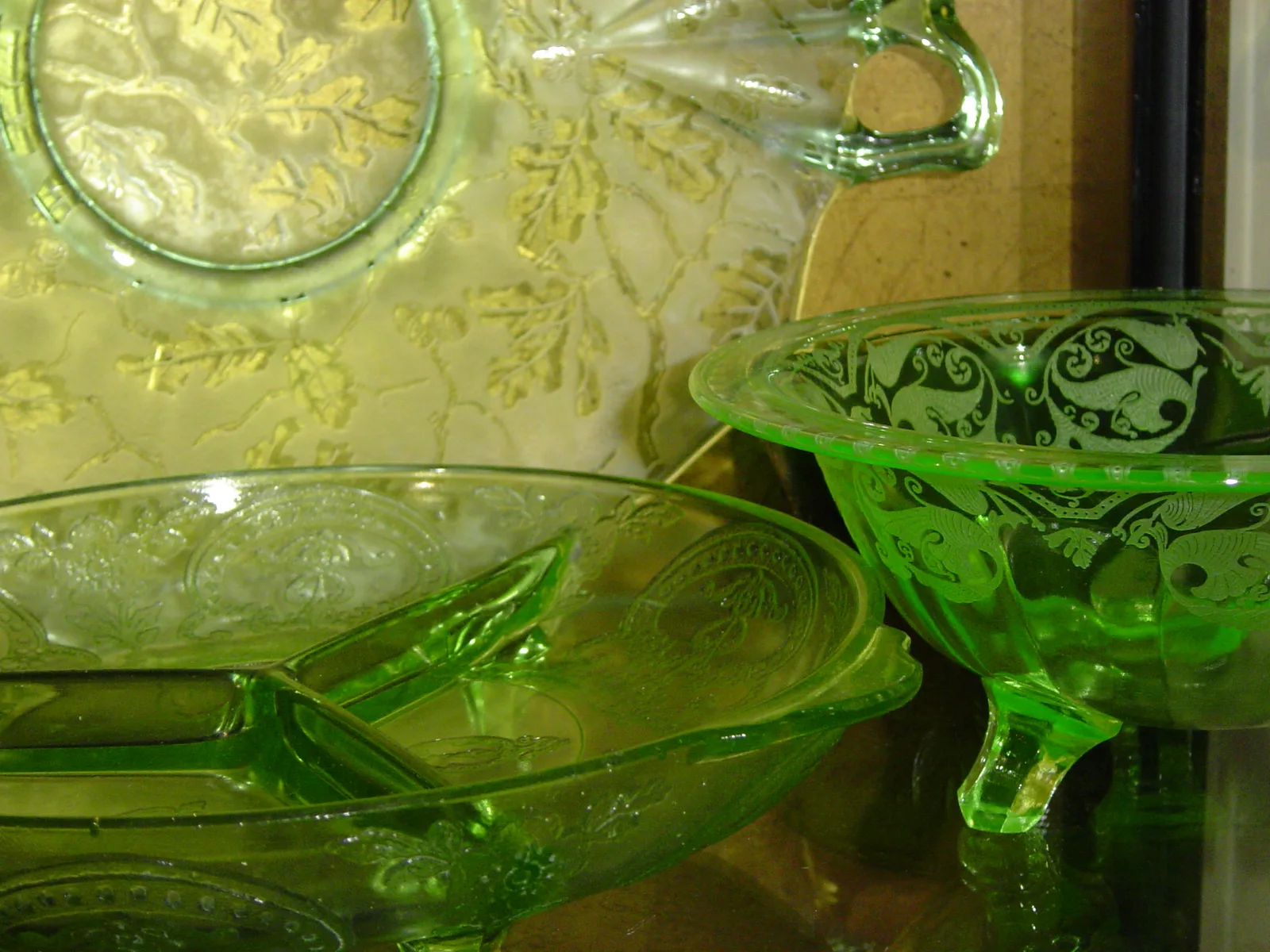
Green Depression glass. Photo: holly from asheville, NC, CC BY 2.0
3. American Sweetheart (MacBeth-Evans)
This pattern is known for its distinct, translucent Monax (white) and Cremax (cream) colors, though pink and red are the big winners.
Design: Intricate scrolls and medallions.
Market Insight: The fair market value for red pieces is significantly higher than the translucent white versions.
This delicate opacity is quite different from the clarity of cut glass, which relies on geometric incisions for brilliance.
4. Mayfair (Hocking Glass)
Often called “Open Rose,” this pattern features square shapes and a prominent rose design.
Top Pick: The “cookie jar” in pink or green is a major find.
Warning: This pattern has been heavily reproduced. Authentic cookie jars should have the pattern on the bottom; some fakes do not.
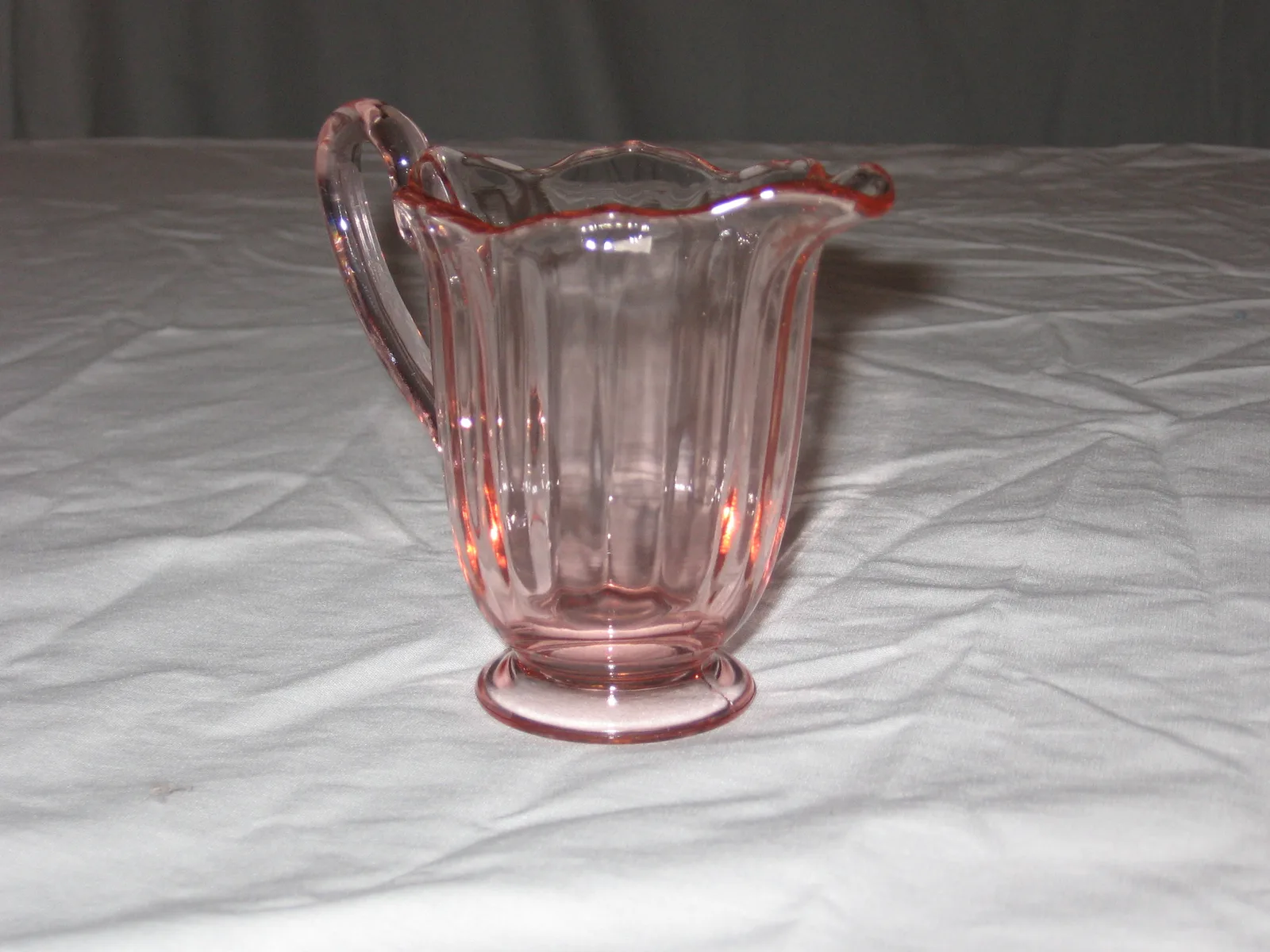
Pink Depression glass. Photo: Kdm85, CC BY-SA 3.0
5. Cherry Blossom (Jeannette Glass)
This is perhaps the most famous pattern, featuring cherries and leaves.
Rarity: The “Delphite” (opaque blue) color is extremely rare.
Authentication: Real plates have a smooth center; many reproductions have faint, messy veins in the leaves that shouldn’t be there.
How Do I Determine the Value of My Find?
Value depends heavily on rarity (color and piece type) and condition. A pitcher is almost always worth more than a saucer.
To get a true replacement value for insurance, check sold listings on eBay, not just asking prices. Dealers at an antique dealer shop or show will usually price items at retail, which is higher than what you might get selling it yourself.
If you find a piece with damage, restoration or conservation is rarely worth the cost for Depression glass unless it is an exceedingly rare item.
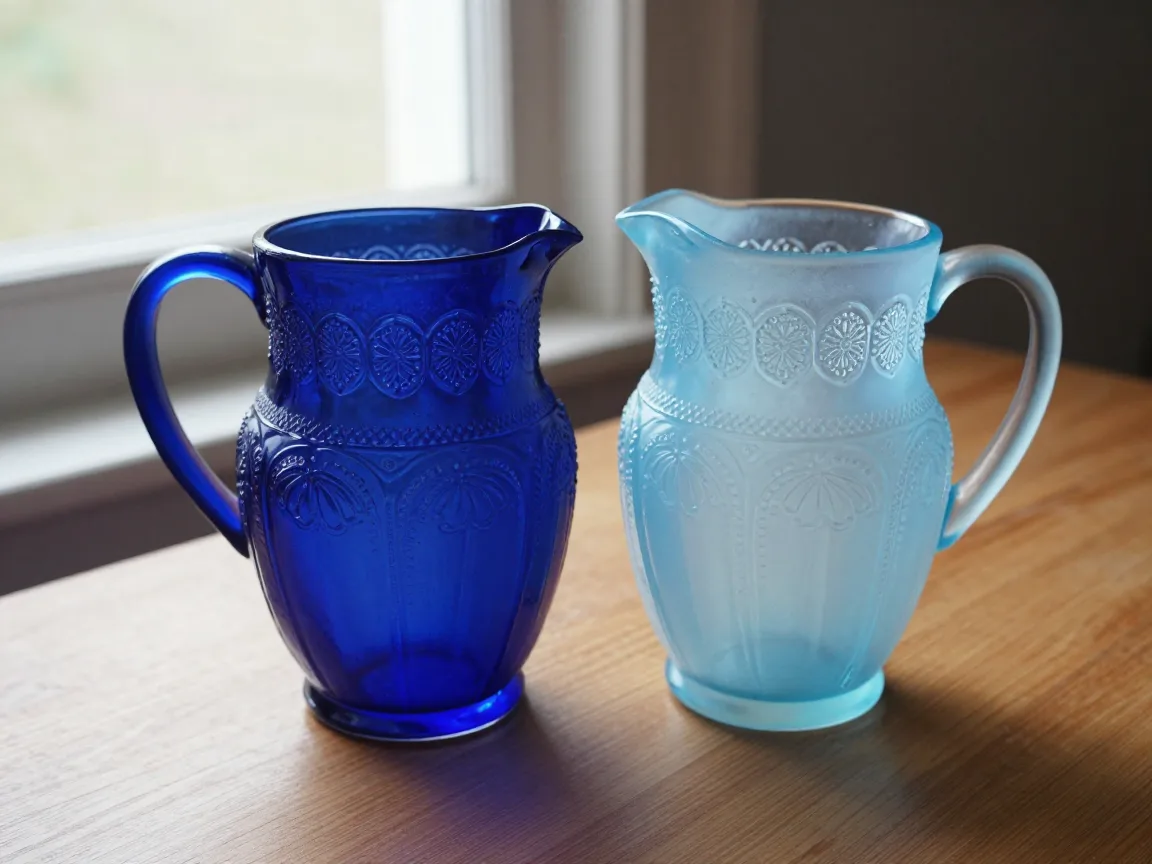
Cobalt blue is deeper and darker than the lighter blues of the period.
Where Can I Find Valuable Depression Glass?
The thrill is in the hunt. Estate sales in the Midwest are goldmines.
Thrift stores can be hit or miss, but items are often misidentified. Look for that tell-tale greasy feel and soft colors.
Online collector markets are great for specific pieces, but beware of shipping costs for fragile items. Always ask for a detailed description of chips or cracks before buying.
Building a collection takes patience. Don’t be afraid to carry a pocket light to check for cracks. Learning to distinguish pressed glass techniques from blown variants will serve you well. Happy hunting!
Royal Doulton identification relies heavily on analyzing the backstamp. The famous “Lion over Crown” mark appears after 1902. For accurate dating between 1928 and 1954, look for a small number near the crown and add it to the year 1927. Earlier Doulton Lambeth wares often use impressed artist initials for attribution.
How do I identify early Doulton Lambeth marks?
Before the company received the “Royal” warrant, they were simply known as Doulton. If you find heavy, salt-glazed stoneware, you are likely looking at early pieces produced at the Lambeth factory between 1815 and 1956.
These items rarely have the printed lion stamp. Instead, look for an impressed oval mark that reads “DOULTON LAMBETH.”
Pro Tips for Early Wares:
Check for Artist Initials:Doulton Lambeth wares often feature incised initials on the base (like George Tinworth or Hannah Barlow). This attribution significantly increases the auction estimate.
Look for “England”: If the word “ENGLAND” appears under the mark, the piece was made after 1891 to comply with US tariff laws.
Material Matters: Early production focused on industrial ceramics, faience, and majolica before moving into fine bone china.
An impressed Doulton Lambeth mark on salt-glazed stoneware, about 1895.
What does the standard Royal Doulton lion mark mean?
The most recognizable symbol in pottery identification is the lion standing on a crown. King Edward VII granted the Royal Warrant in 1901, and the company adopted this logo in 1902.
If you see this mark without a crown, it is likely a later generic crest or a specific variation, but the standard authentication standard involves both the lion and crown.
How do I calculate the exact year using the number system?
This is the “secret code” that many pickers miss. Between 1928 and 1954, Royal Doulton added a small number to the right of the crown backstamp.
To find the production year, you simply add that number to the year 1927.
Examples:
A “1” means 1928 (1927 + 1).
A “10” means 1937 (1927 + 10).
A “20” means 1947 (1927 + 20).
This rule applies to many character jugs, Toby jugs, and figurines from the mid-20th century. If you don’t see a number, you have to rely on the style of the text or the registration number (RdNo).
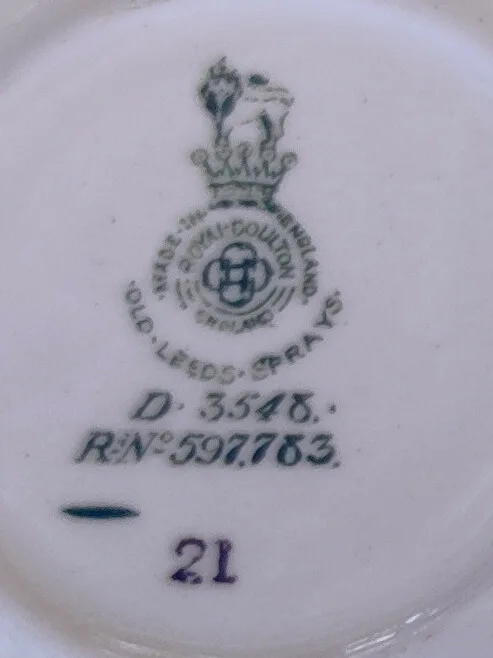
A Royal Doulton backstamp. A small number beside it can be added to 1927 to get the year. Photo: Andy Mabbett, CC BY-SA 4.0
Where are the date letters located on older pieces?
For pieces produced between 1872 and 1954 (specifically on earthenware and stoneware), there is often an impressed letter code. This is distinct from the printed backstamp.
You need to look for a small impressed letter code on the bottom. For example, the letter “A” indicates distinct years based on the cycle.
However, interpreting these requires a reference chart, as “A” could mean 1882 depending on the accompanying logo. This is similar to the complexity involved when we discuss Decoding Meissen Porcelain Marks, where subtle variations change the entire timeline.
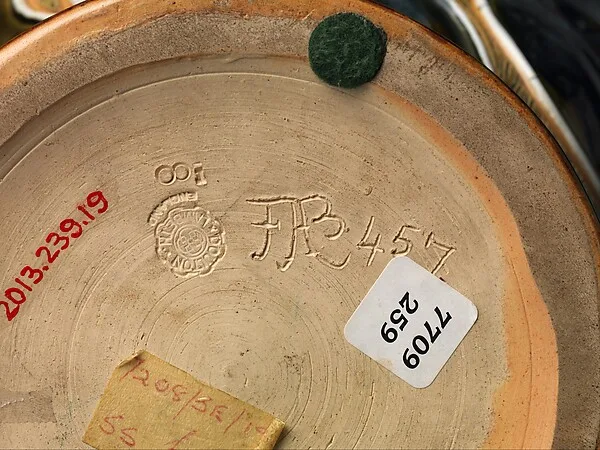
Printed or impressed marks and incised numbers sit side by side on many older Doulton bases. Photo: Ashmolean Museum, CC BY 4.0
How can I spot a fake or damaged piece?
Forgery detection is critical in the antique market. While Royal Doulton is faked less often than Meissen, reproductions do exist.
More commonly, you need to watch out for professional restoration. A restored piece has significantly lower replacement value than one in original condition.
Red Flags:
Poor Definition: Authentic figurines have crisp toes, fingers, and facial features. Since slip casting molds degrade over time, a blurry or undefined face suggests a late run or a copy.
Yellowing: Over time, old repairs and glues turn yellow. Use a UV blacklight to check the condition report of the head and hands.
Modern Barcodes: If you see a barcode sticker or a gold “Made in Indonesia” sticker, the piece is modern (post-2000s) and generally holds less value than UK-made pieces.
Genuine figures show crisp modeling in small details such as hands and faces.
What determines the value of my Royal Doulton?
Just because it’s old doesn’t mean it’s retirement money. The fair market value depends on three things: provenance, rarity, and condition.
Standard dinner services often have low resale value today. However, rare Doulton Lambeth art pottery, prototype character jugs that were never mass-produced, or specific color variations of standard figures command high prices.
Before paying for an expensive appraisal, check the base for drill holes. A hole drilled through the mark usually indicates the item was sold as a “second” (factory reject) or was converted into a lamp, which destroys its collector value.
Conservation of these pieces is vital; never wash antique pottery in a dishwasher, as the heat can craze the glaze and ruin the value.
Mastering Royal Doulton identification takes practice. By looking for the artist initials on early stoneware and doing the math on the mid-century date codes, you can confidently separate common thrift store finds from true investment pieces. Happy hunting.
A 1920s vanity typically commands a fair market value between $250 and $800 for standard mass-produced veneers, while high-end Art Deco examples featuring exotic woods like zebrawood or bird’s eye maple can reach $1,500 to $2,500 at auction. Key valuation factors include the presence of the original matching bench, the condition of the mirror silvering, and intact waterfall or book-matched veneers.
*
How can I identify the specific style of a 1920s vanity?
The 1920s was a transitional decade. You will generally encounter two distinct styles, and knowing the difference is crucial for accurate attribution.
1. Traditional Revival: These pieces look back to the past. They often feature Queen Anne legs (curved) or turned spindle legs. They are usually made of dark mahogany or walnut veneers. While pretty, they are common in the collector market and generally worth less.
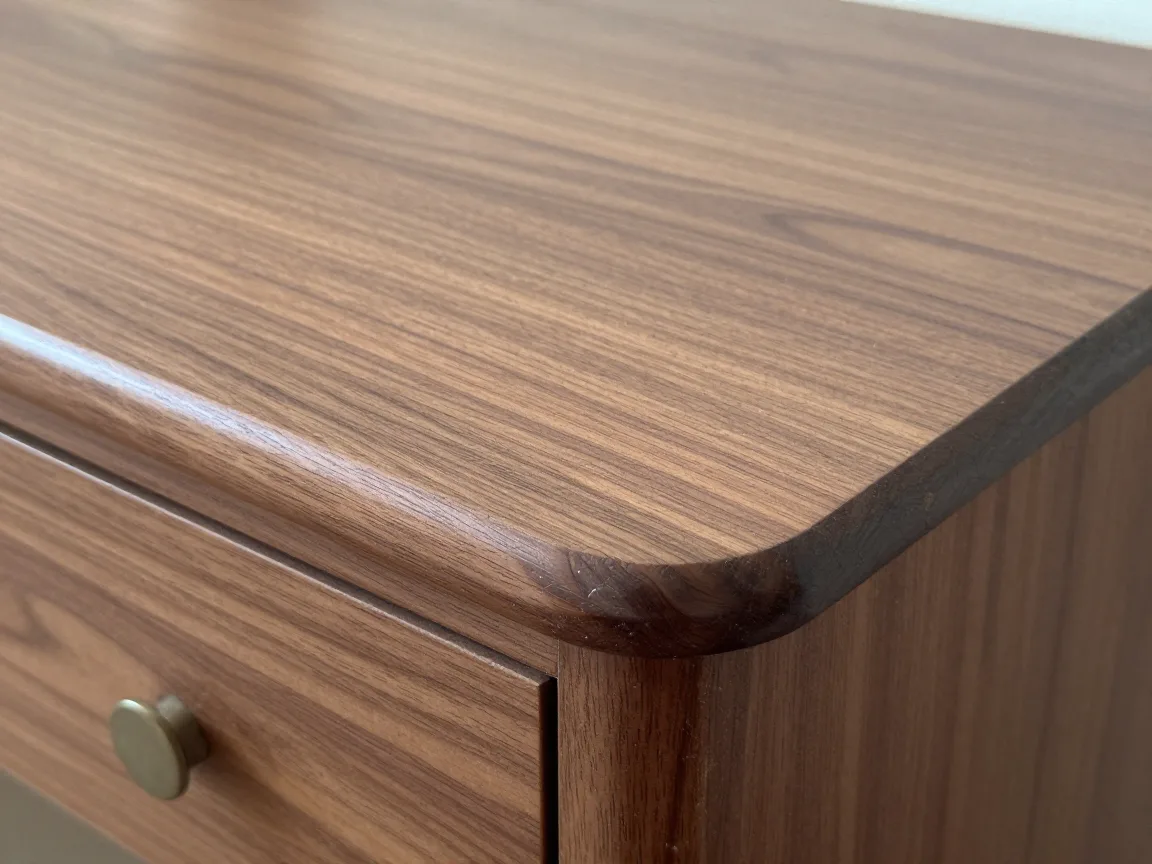
2. Art Deco / “Waterfall” Style: This is where the money often is. These vanities feature rounded, cascading edges on the front (the “waterfall”), geometric shapes, and large, frameless mirrors (often round or etched).
Pro Tip: Look for Bakelite or catalin handles. Original plastic hardware from this era is a massive plus for authentication.
The rounded waterfall edge with continuous veneer grain is typical of late 1920s and 1930s vanities.
What specific materials drive up the value?
In the 1920s, furniture makers loved veneer. But not all veneer is created equal.
Standard walnut or mahogany is reliable, but it won’t drive a high auction estimate. To find the real value, look for exotic wood patterns. Burl wood, Tiger Oak, and Zebrawood veneers were used on premium models.
Check the secondary woods (the wood inside the drawers). High-end manufacturers like Berkey & Gay or Widdicomb used solid oak or maple for drawer sides, whereas cheaper department store brands used rough pine.
How does the mirror condition affect the appraisal?
The mirror is often the most fragile part of a vanity.
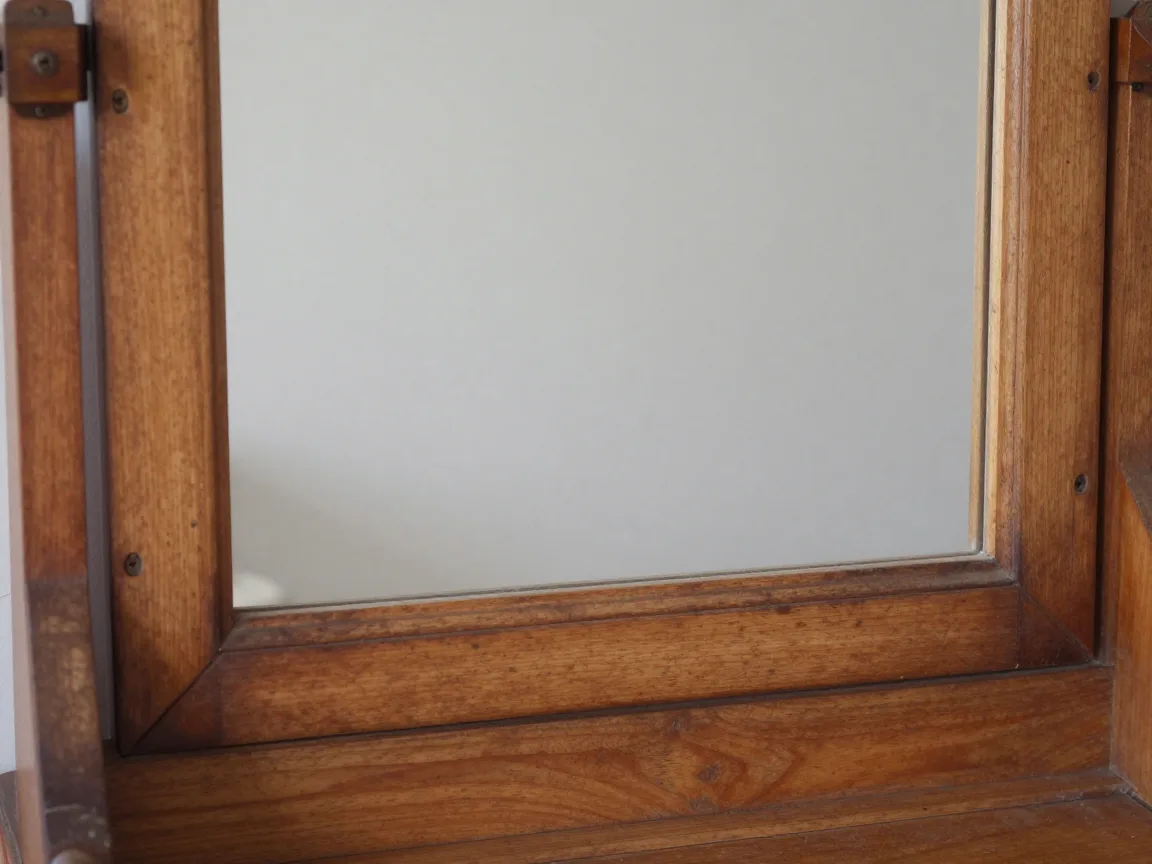
Inspect the glass first. You are looking for “foxing”: those cloudy, silver-grey spots or streaks that appear behind the glass.
Minor Foxing: Acceptable and can even add character (patina).
Major Desilvering: If the reflection is obscured, the value drops.
Restoration of a mirror is expensive (often $200+). If the mirror needs resilvering, deduct that cost immediately from the asking price to determine the item’s actual worth.
Desilvering shows as cloudy grey or dark spots, usually starting at the edges.
How can I tell if the construction is high quality?
Flip the drawers over.
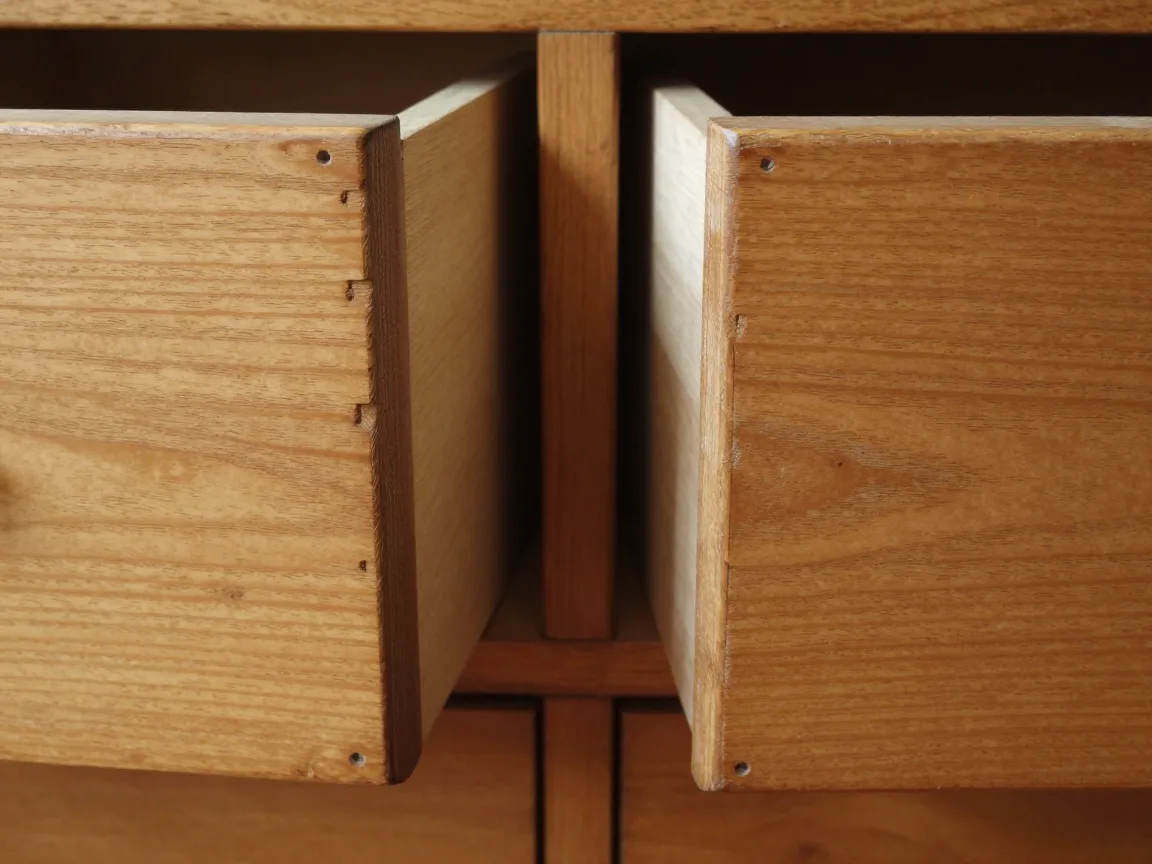
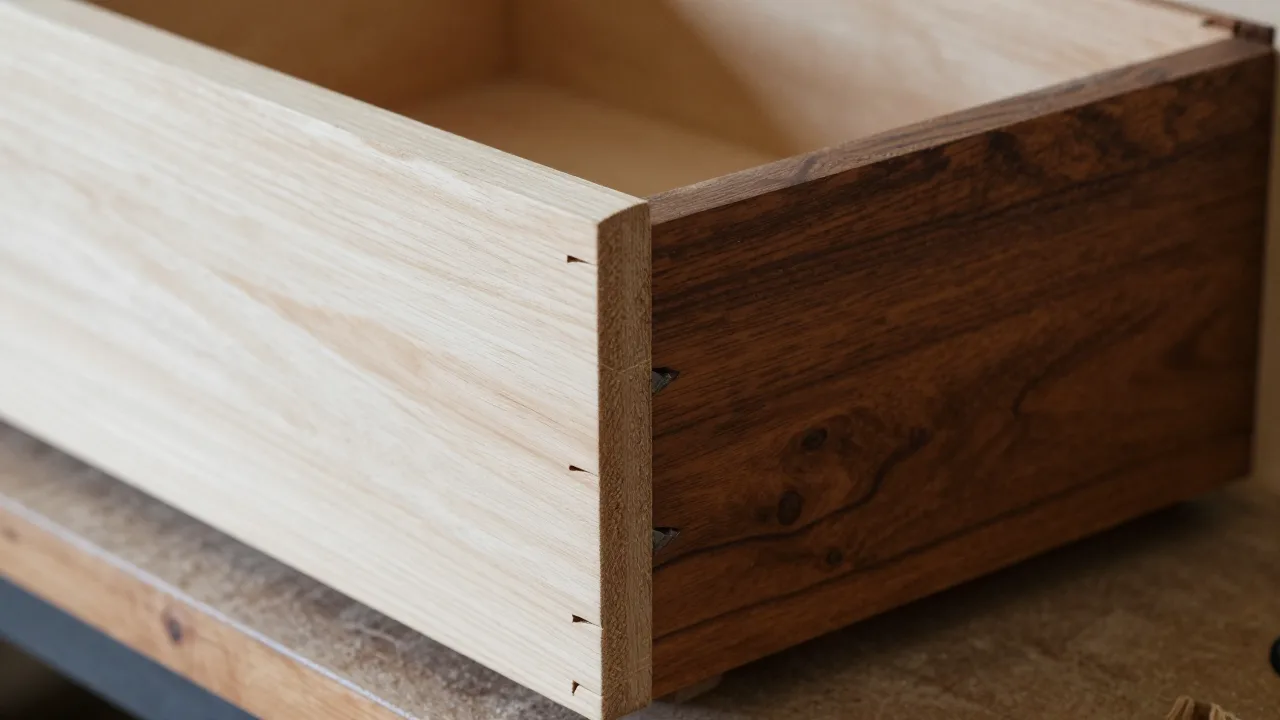
You want to see dovetail joints. These are the interlocking “teeth” that hold the drawer front to the sides. In the 1920s, these were standard, but the width of the dovetails tells a story.
Fine hand-cut dovetails are very narrow. Machine-cut dovetails (common in the 20s) are wider and uniform. If the drawer is held together with staples or nails only? Walk away. That is a low-quality piece with low replacement value.
If the piece has legs, their shape matters. This technique is similar to what we cover in our guide on How to Date an Antique Chair by Its Leg Style, where the foot type can instantly date a piece.
Dovetailed drawer corners point to better construction than nailed ones.
What are the “Red Flags” of a fake or altered piece?
Forgery detection on vanities usually involves spotting “marriages.”
A “marriage” is when a mirror from one vanity is bolted onto the base of another.
How to check: 1. Look at the back. Are there extra screw holes where a different mirror bracket used to be? 2. Check the wood finish match. Does the mirror frame match the base exactly in color and grain? 3. Check the hardware. Do the handle styles match on all drawers?
If the provenance isn’t clear, trust the physical evidence. A married piece has significantly lower value to an antique dealer.
Empty screw holes on the mirror back can mean the mirror was moved from another piece.
Where should I sell my 1920s vanity?
If you have an appraisal in hand, you need the right venue.
Local Auctions: Best for high-end Art Deco pieces. An auction house can reach collectors looking for specific styles.
Facebook Marketplace / Craigslist: Best for standard “brown furniture” vanities. Shipping these items is a nightmare, so local pickup is king.
Consignment Shops: Good if you don’t want the hassle, but expect them to take 40-50%.
Remember, conservation matters. Don’t paint it! “Shabby chic” painting destroys the historical integrity and value of 1920s veneers.
A 1920s vanity is more than just a place to powder your nose; it is a snapshot of an era moving from Victorian rigidity to Jazz Age freedom. By examining the veneer, checking the dovetails, and assessing the mirror condition, you can confidently determine if you are looking at a $200 utility piece or a $1,500 investment. Happy hunting.
Antique trunks are primarily identified by their profile and hardware. Steamer trunks (c. 1870-1920) are flat-topped for stacking in ship cabins, often covered in canvas or leather. Jenny Lind trunks (c. 1850-1870) feature a distinctive hourglass or keyhole shape when viewed from the side, named after the famous “Swedish Nightingale” singer.
How can I tell the difference between a Steamer trunk and a Jenny Lind trunk?
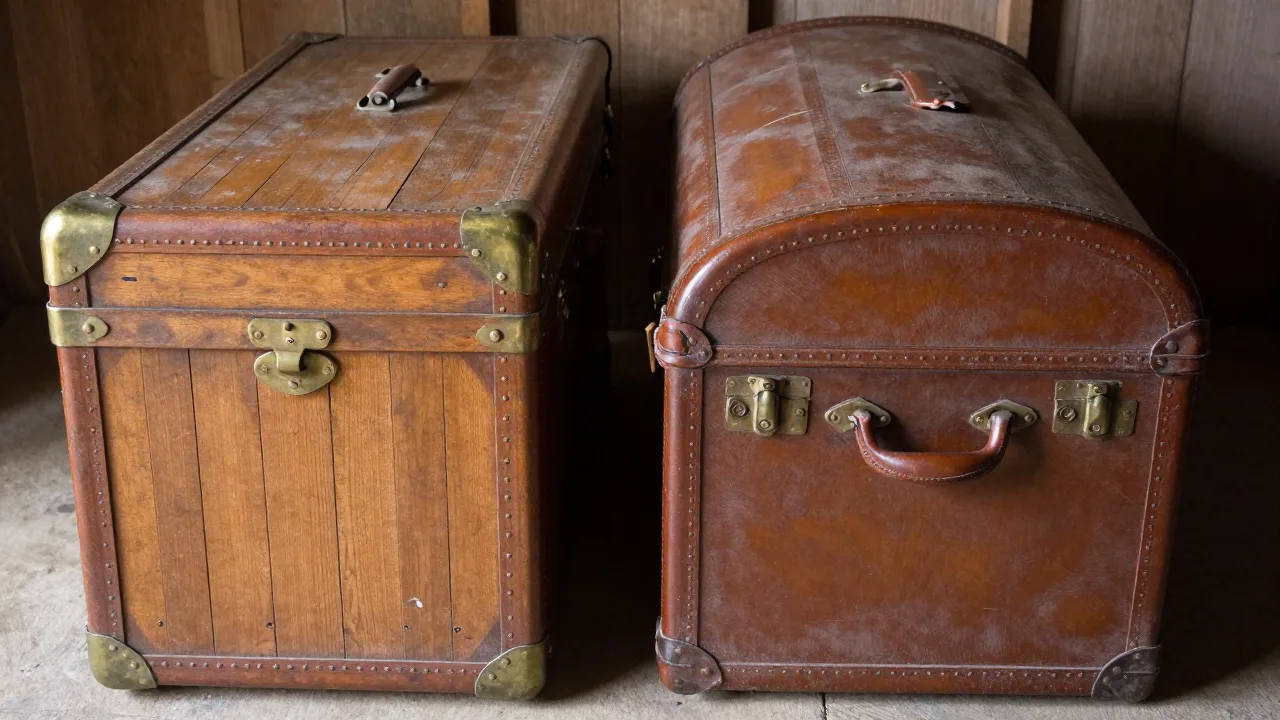
The silhouette is your first clue. Steamer trunks, sometimes called “flat-tops,” were designed for the golden age of travel. Their flat lids allowed them to be stacked in the cargo hold of a steamship.
Because they are flat, these are highly desirable in the modern collector market for use as coffee tables. They often feature canvas coverings, hardwood slats, and heavy metal hardware.
Steamer trunks are flat-topped; Jenny Lind trunks have rounded, curving tops and ends.
Jenny Lind trunks are older and distinctively shaped. Look at the trunk from the side. If it resembles a loaf of bread or a keyhole (curving in at the middle and widening at the top and bottom), it is likely a Jenny Lind.
These were often finished with brass buttons and leather straps. Because of their awkward shape, they cannot be stacked, which sometimes impacts their fair market value for decorative use, though their provenance makes them historically significant.
Where should I look for maker’s marks or labels?
Proper attribution is critical for determining value. The first place to look is the interior. Many manufacturers pasted elaborate Victorian lithographs or trade cards on the inside of the lid.
If the paper lining is gone, check the hardware. High-quality locks made by companies like Eagle Lock Co. or Corbin will often have patent dates stamped directly into the metal.
Check the brass lock: many carry a stamped patent date that gives the earliest production year.
Finding a patent date doesn’t date the trunk perfectly, but it establishes the earliest possible production year. This method of examining hardware is similar to techniques we discuss in our guide on The “Maker’s Mark” on Furniture.
What materials indicate a genuine antique trunk?
Counterfeits in the trunk world are rare, but modern reproductions exist. A key element of authentication is examining the exterior covering.
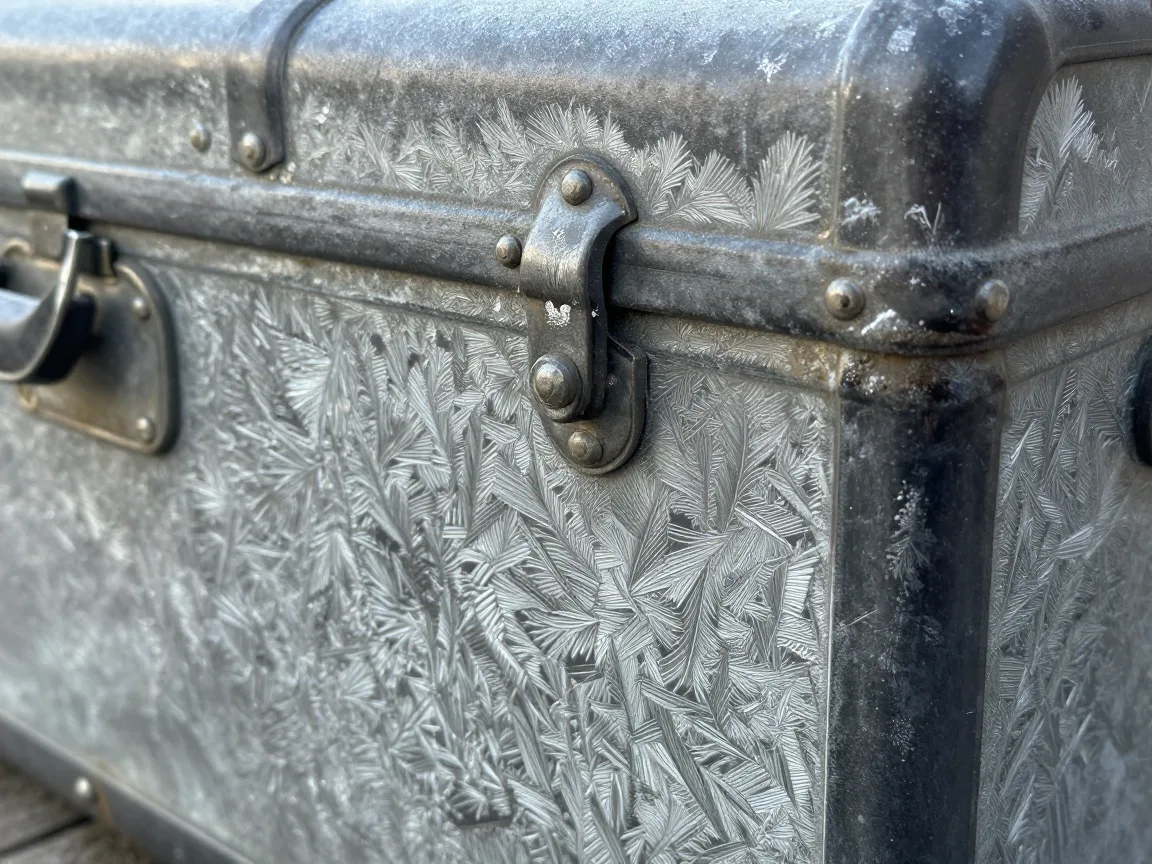
From the 1880s to the 1900s, crystallized tin (or “crystallized metal”) was very popular. This metal was treated with chemicals to create a shimmering, frost-like pattern that is nearly impossible to replicate today.
Crystallized tin has a feathery, frost-like pattern under the varnish.
You may also encounter “embossed tin” pressed to look like alligator skin or basket weave. If the “leather” feels like vinyl or smells like plastic, you are likely looking at a modern reproduction or a clumsy restoration attempt.
How does condition affect the value of my trunk?
Many trunks are ruined by improper cleaning. A condition report for a trunk should note whether the original finish is intact.
Do not paint over the original wood or metal. This destroys the historical integrity and can reduce the auction estimate by 50% or more.
Collectors prefer conservation (stabilizing the item) over aggressive restoration. A missing leather handle is acceptable; a trunk spray-painted gold is not.
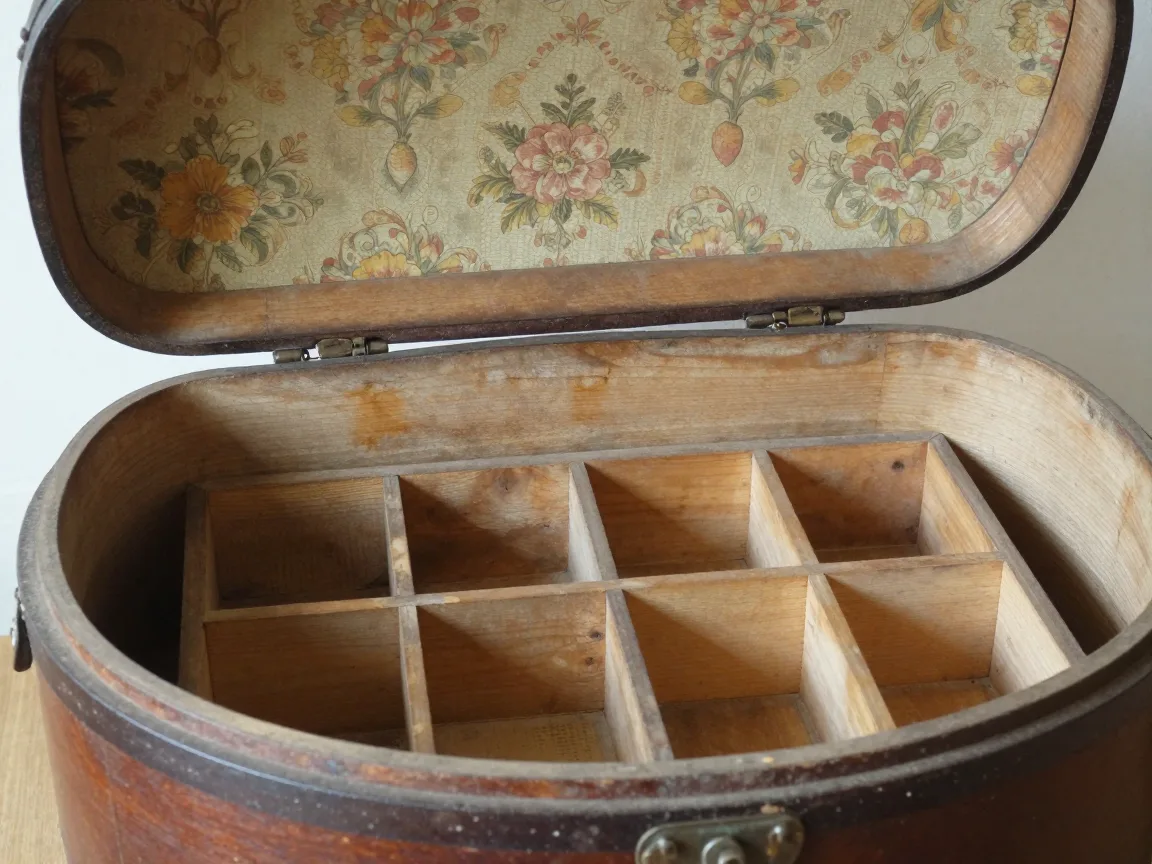
Original paper lining and the inner tray add to a trunk's value.
For forgery detection, look at the slats. Genuine antique trunks used seasoned woods like pine, poplar, or basswood. If the wood looks like modern plywood or particle board, walk away.
What is the market value of antique trunks in 2026?
Values fluctuate, but here is a general appraisal guide for the current US market:
Common Flat-Top Steamer (Unrestored): $50 – $150
Restored Flat-Top (Retail/Decor): $300 – $800
Jenny Lind (Good Condition): $200 – $500
Louis Vuitton or Goyard Steamer: $5,000 – $20,000+
Always check the replacement value for insurance purposes if you acquire a high-end luxury maker. The gap between an antique dealer price and an estate sale find is your opportunity for profit.
Furniture maker’s marks usually hide inside drawers, on back boards or under seat rails; a label, brand or stamp names a maker only if the construction agrees.
A maker’s mark on furniture can be a printed paper label, a name burned or stamped into the wood, a stencil or a metal tag. This guide covers where those marks usually sit, what each type can and cannot tell you, and how to check a mark against the way the piece was built.
Where Should I Check for Hidden Marks on Antique Furniture?
Check the surfaces a buyer rarely sees: drawer bottoms and backs, the inside of the case, the back boards and the underside of seats and seat rails. Locating a signature on a painting is easy; finding one on a highboy or credenza takes detective work, because labels and stamps were put where they would not spoil the design or be rubbed away.
For case goods (dressers, chests, desks), remove the drawers completely. Look on the interior side rails and the drawer bottom, both inside and underneath. The labelled furniture of the Philadelphia joiner William Savery shows how varied the spots are: a study of his labels in Chipstone’s American Furniture journal records one “attached to the bottom of the top drawer” of a dressing table, another “on the till of the chest” and another “on the inside rear seat rail of the armchair”.
For chairs and tables, get underneath them. Turn the chair over and inspect the seat frame and the central support; the same study pictures a side chair whose label is “attached to the underside of the rush seat”. The legs themselves are a separate dating clue, covered in our visual guide to dating chair legs.
Look at the hardware too, but as evidence of age rather than as a signature. Nails, screws and hinges changed over time, and our guide to dating furniture by its hardware shows what each type can and cannot establish.
How Do I Decipher Different Types of Maker’s Marks?
Identify the type of mark first, because a paper label, a brand, a stencil and a metal tag survive, move and get faked in different ways.
Paper labels are glued on, so they tear, fade and fall off. Printed labels predate factory furniture: the Savery labels in the Chipstone study run from the “ca. 1760 label” on a side chair to the “ca. 1785 label” on a chest, and several of them read “Made and Sold by”, so a label could advertise a shop as well as name a maker. If you find one that is peeling, do not glue it back yourself. The American Institute for Conservation advises: “We strongly recommend hiring one of our Professional Members.” An original label left in place keeps its value as provenance.
Branded or stamped marks are burned or pressed into the wood, so they are harder to lose than a label. Gustav Stickley’s Craftsman furniture is the best-known American example; Wikipedia’s Stickley entry describes “his trademark, which includes the Flemish phrase Als Ik Kan inside a joiner’s compass”. A brand does not date a piece by itself, so compare its exact form with a dated reference such as our alphabetical list of furniture makers’ marks or the four American marks in the table below.
Four American marks turn up often enough to be worth recognising on sight. Treat each one as a lead and check the exact form against a dated reference, because all four have been copied.
Maker
Where and when
What the mark looks like
Gustav Stickley (Craftsman Workshops)
Eastwood, New York; Craftsman furniture from about 1901 until the business went bankrupt in 1915
A joiner’s compass with the motto “Als ik kan”, as a red decal on early pieces and later as a brand or paper label
L. & J.G. Stickley
Fayetteville, New York; founded in 1900 by two of Gustav’s younger brothers, Leopold and John George
A decal or brand reading “The Work of L. & J.G. Stickley”, sometimes with “Handcraft”
A stencilled maker’s line on the back rail of the seat. The factory was revived in 1946, so confirm a 19th-century date from the chair’s construction as well as the stencil
Stencils and metal tags are painted, tacked or screwed on. Check that the paint, the screws and the finish around them look as old as the surface next to them.
No. A missing mark is not evidence of a fake, and a mark is not proof of age on its own. Popular Woodworking’s guide to dating furniture from its drawers puts the general rule plainly: “Seldom does one clue provide confirmation of anything.”
Paper labels tear and fall away, so the absence of one tells you little. Attribution then rests on construction details.
Check the drawer joints. The same guide warns that hand-cut dovetails “alone can’t be used to date furniture before the machine age”, because reproduction makers still cut them by hand, while “machine-cut dovetails definitely establish that the furniture is no older than about 1895”. A half-moon pin-and-scallop joint narrows things further: Fine Woodworking’s history of the Knapp joint says a drawer with it was almost certainly “made in a North American factory between 1871 and 1900”.
Be wary when a seller calls a piece a “signed original” but the mark looks brand new or sits in an odd place, such as the top surface. Labels themselves have been faked: the Chipstone study notes that fake Savery labels “include both photographic reproductions and entirely made-up examples”. Wear on and around a mark should match wear on the rest of the piece; our guide to Duncan Phyfe originals and reproductions works through the same check for one maker.
How Does a Maker’s Mark Affect Value?
A genuine, legible mark changes what you can prove about a piece more than it sets a price. It can move an attribution from “in the style of” to a named shop, and the Chipstone study calls makers’ labels “one of the more certain means of maker identification”.
A mark does not override condition. Water damage or a heavy-handed restoration, such as stripping the original finish, still counts against a marked piece, which is why our guide to restoring versus preserving antique furniture matters before any work is done.
The mark also has to agree with the rest of the object. Check that the style, the secondary woods, the joints and the hardware fit the period the mark claims; our guide to valuing antique furniture online shows how age, style and condition are weighed together.
Leave loose or flaking labels to a conservator, and get a qualified appraiser’s written opinion before you sell or insure a piece the mark makes look important; our guide to how professional appraisers work out value explains what to ask for.
Authentic antique settees and sofas are identified by hand-cut joinery (mortise-and-tenon), natural stuffing (horsehair or moss), and specific wood types like mahogany (Federal era) or rosewood (Victorian era). Look for irregular saw marks on the frame’s underside and an absence of Phillips-head screws, which generally indicate post-1930s construction.
*
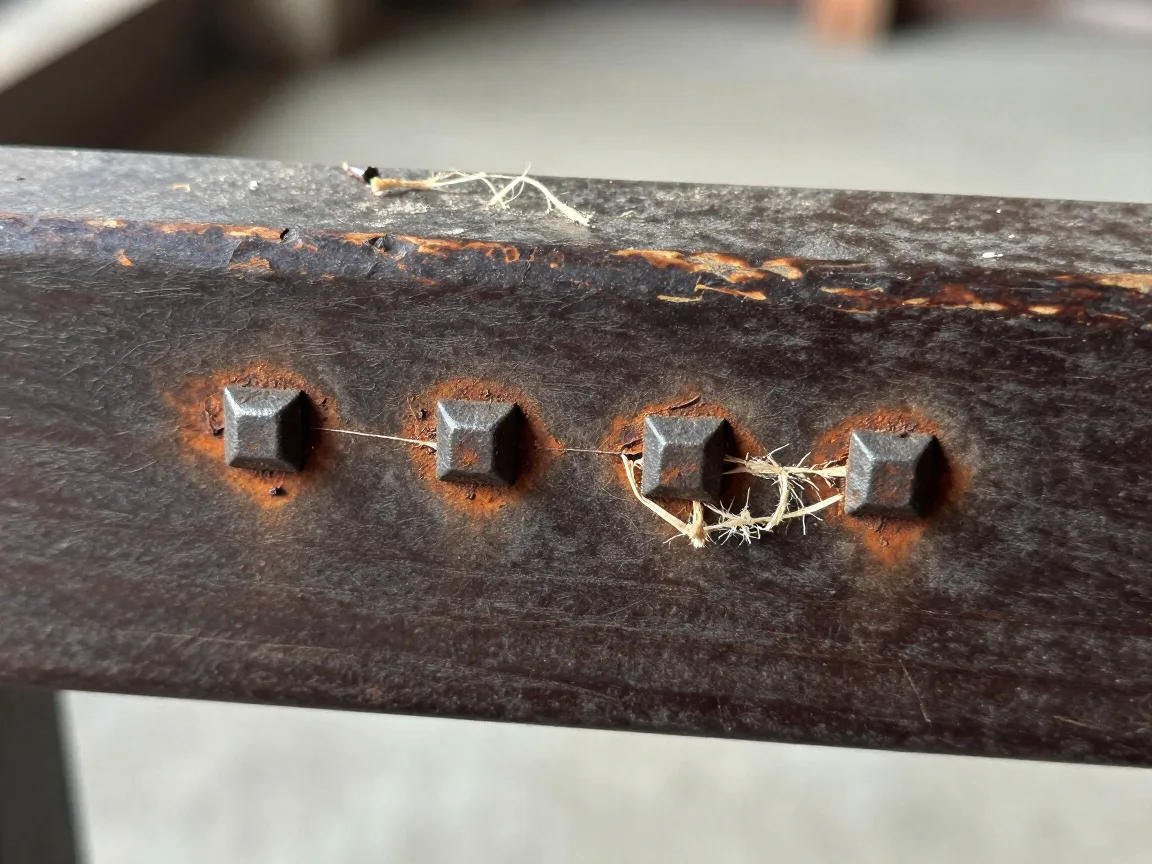
Old frames show dark, oxidized wood and square nails; modern ones show pale wood and staples.
How can I tell if my sofa is actually an antique?
To be considered a true antique by an antique dealer or auction house, the piece must be at least 100 years old.
First, flip the piece over. You want to see the “guts” of the furniture.
Pro Tips for Examination:
Check the Joinery: Look for mortise-and-tenon joints where the wood meets. If you see glue drips that look like modern epoxy or pristine machine-cut dowels, be skeptical.
Inspect the Hardware: Early pieces used square nails or flat-head screws. If you see a Phillips-head screw (the one with the ‘X’), the hardware, and likely the piece, is from the 20th century.
Feel the Weight: Antique hardwoods like walnut and mahogany are heavy. A light frame often suggests later pine or plywood construction.
Check the padding. Squeeze the back or arm. If it crunches, it might be straw or horsehair (good). If it bounces back instantly like a sponge, it’s modern foam (bad).
What does a Federal style sofa (1780-1830) look like?
The Federal period is characterized by grace, symmetry, and straight lines. These pieces were often made of mahogany and featured exposed wood frames.
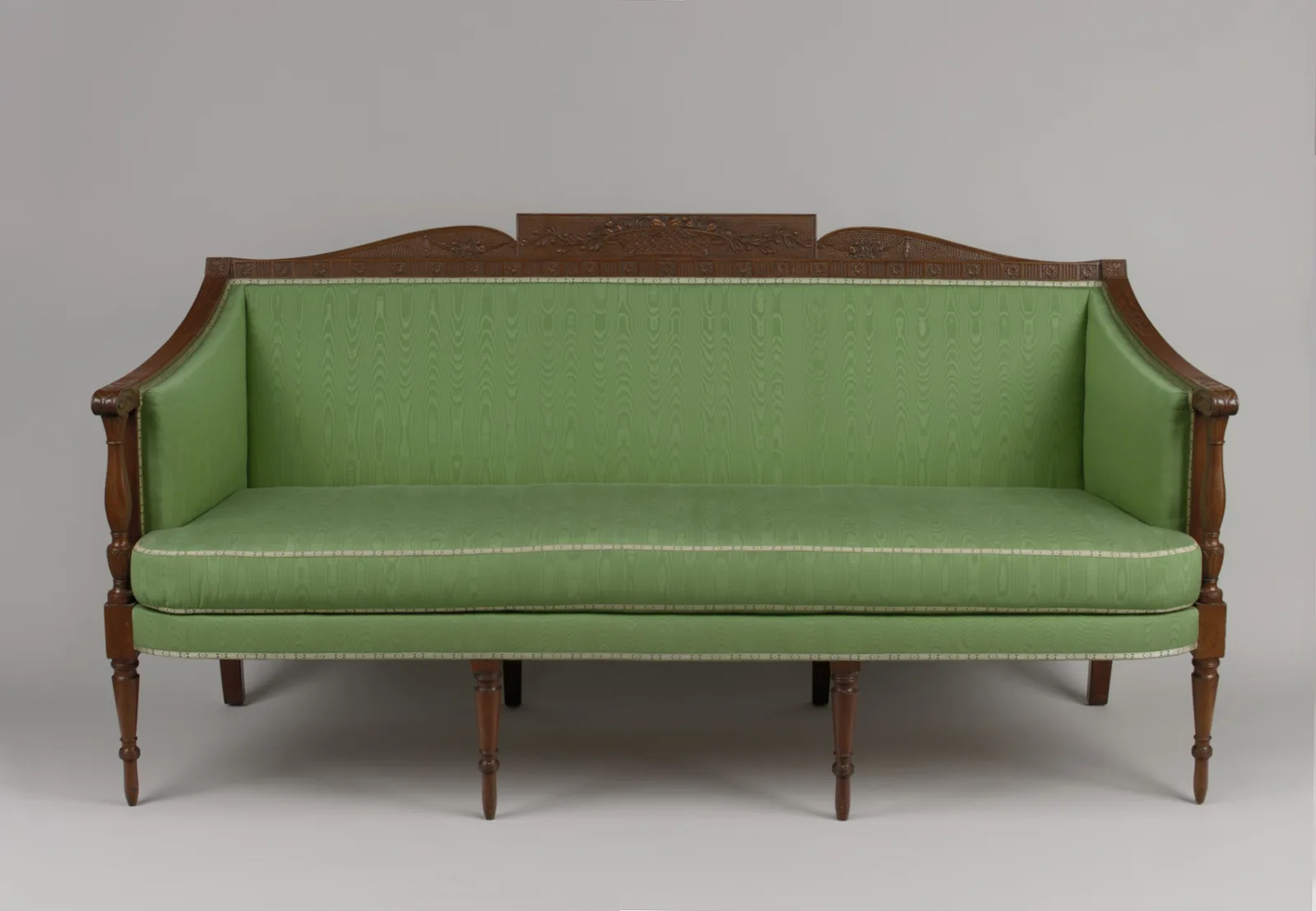
Federal sofas favor straight lines, exposed mahogany and slender legs.
Key identifiers include:
Legs: Tapered, reeded, or ending in a “spade” foot.
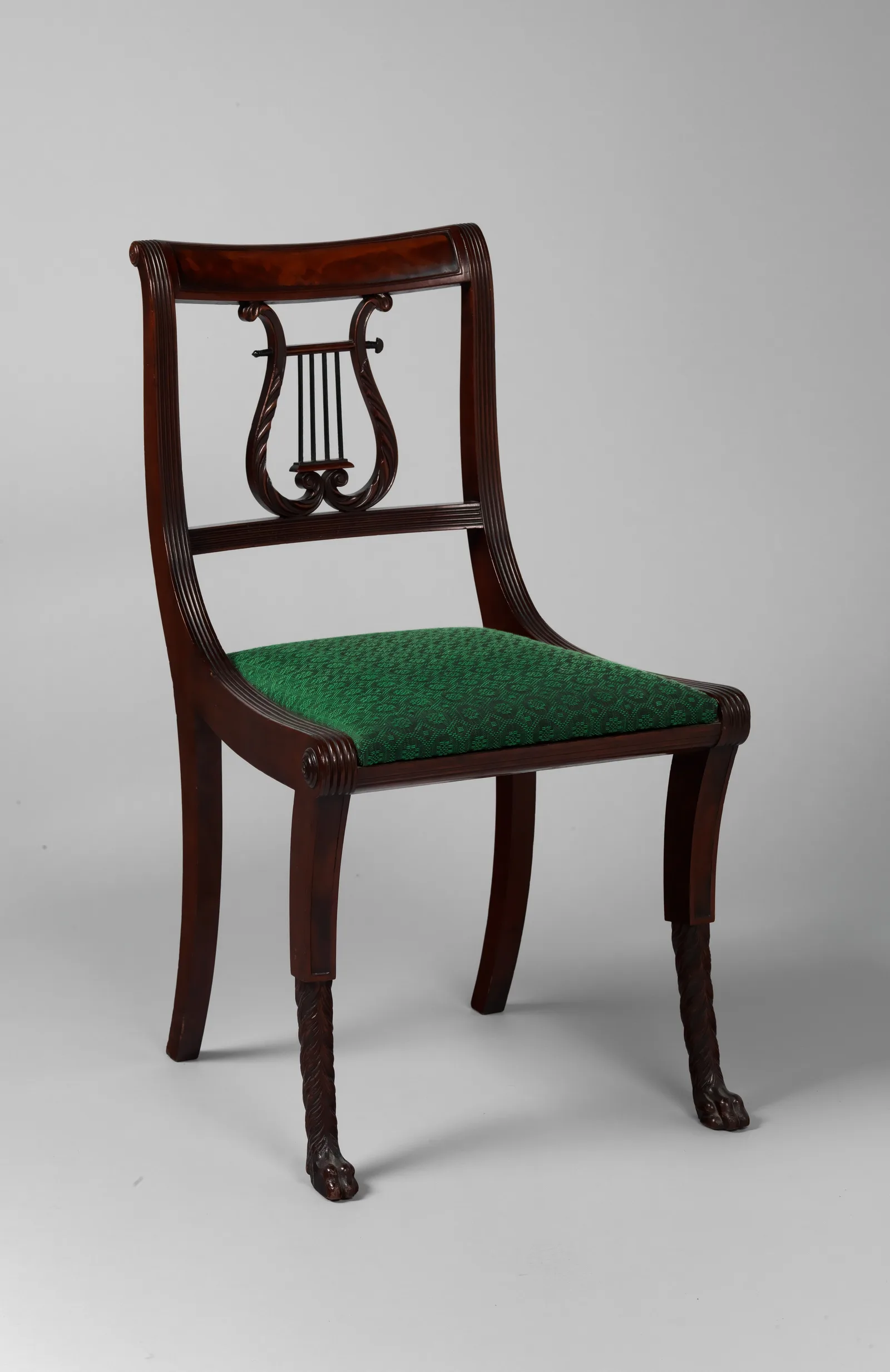
Motifs: Look for carvings of lyres, cornucopias, or eagles.
Shape: Rectangular and stiff, unlike the curvy comfort of later eras.
Attribution is difficult without a label, but styles popularized by Duncan Phyfe are highly sought after. If you spot legs that curve outward (saber legs), you are likely looking at a Grecian influence common in this era.
How do I identify a Victorian settee (1837-1901)?
This is the most common antique seating found in US thrift stores today. The Victorian era prioritized ornamentation over the strict lines of the Federal period.
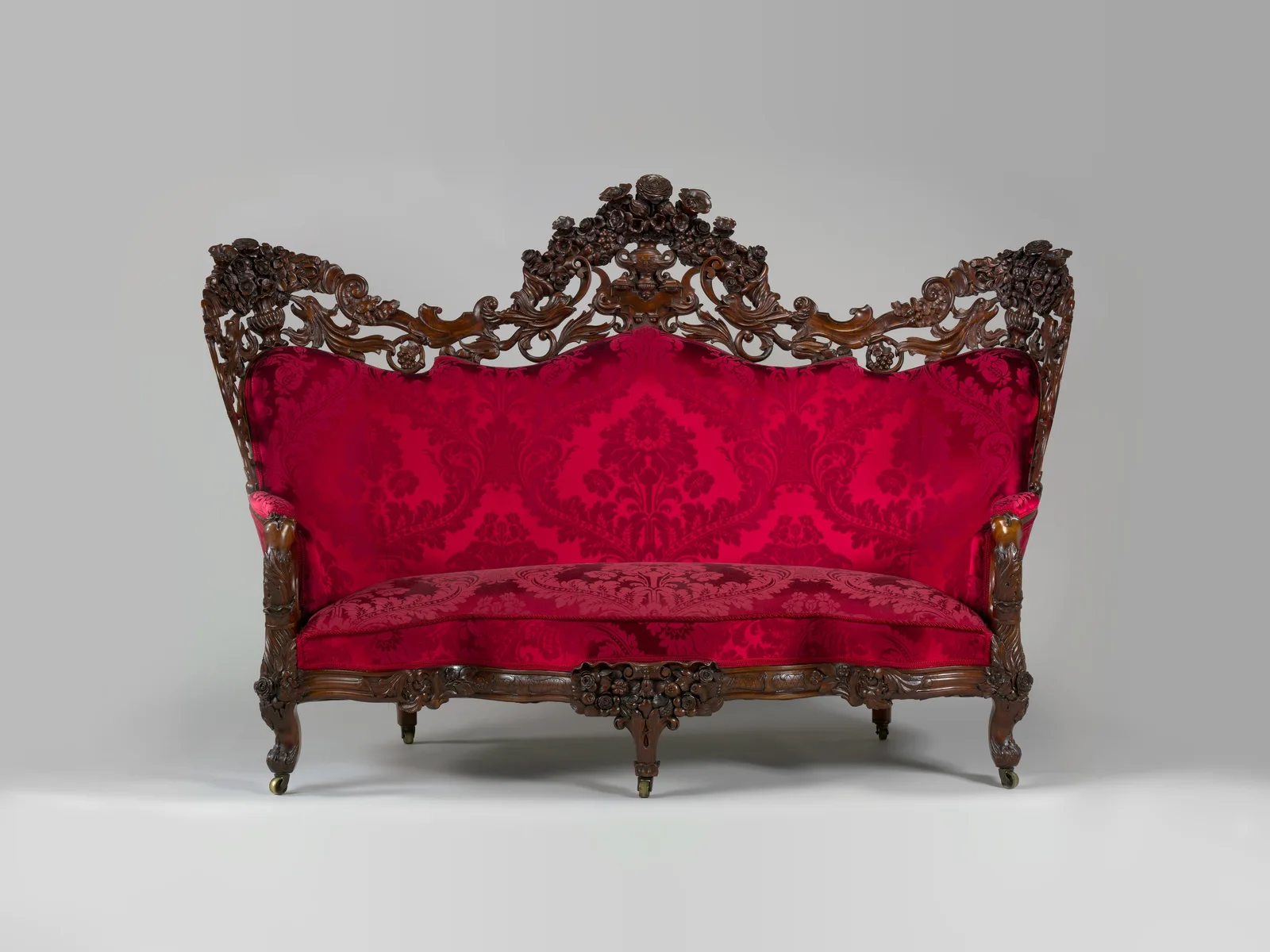
Rococo Revival settees have curving carved frames and high, arched backs.
If your sofa has a high, arched back and lots of curves, it is likely Victorian.
Rococo Revival (1845-1870): Look for cabriole legs, extensive carving (flowers, fruit), and rosewood or walnut frames.
Eastlake (1870-1890): This style moved back toward geometry. Look for incised (carved into the wood) lines, burl veneer panels, and spoon carving.
Condition report is vital here. Because these frames are delicate, check for breaks in the “fretwork” (carved details). This style often utilized deep button tufting.
For specific details on dating legs from this era, checking a dedicated visual guide can help. This technique is similar to what we cover in our guide on Identifying Duncan Phyfe Furniture: 5 Marks of Authenticity, where specific leg curves dictate the decade.
What is the fair market value of an antique sofa in 2026?
Determining fair market value versus replacement value depends heavily on condition and style.
Brown furniture (unpainted wood) has seen a dip in recent years, but exceptional pieces remain high.
Federal Sofas: $1,500 – $8,000+ (depending on the maker).
Victorian Settees: $300 – $1,200. These are abundant, keeping prices lower unless the piece is by a famous maker like John Henry Belter.
Mid-Century Modern (1950s): While not technically “antique” yet (vintage), these are currently outperforming many 19th-century pieces in auction estimates.
Note on Restoration: Original upholstery is rare. A professional conservation job can increase value, but a bad DIY recover with a staple gun destroys provenance and value. If you see modern fabric, look closely at how it was attached.
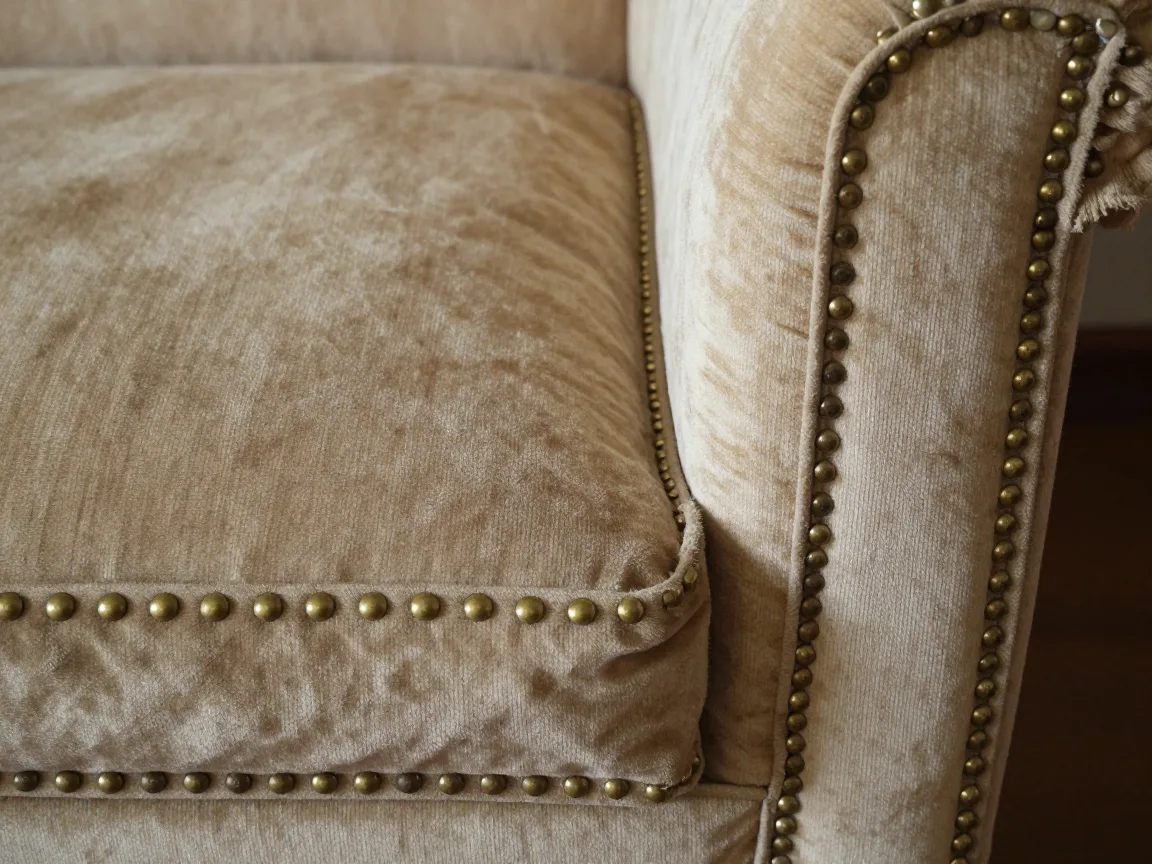
Look at how the fabric is attached: tidy tack rows are older work, rough staples point to a later recover.
How do I spot a fake or reproduction?
Forgery detection in furniture often comes down to the finish and the cut.
1. The “Perfect” Finish: An antique from 1850 should not look brand new. It should have patina: darkening where hands rested, scuffs on the feet. A uniform, glossy spray lacquer is a red flag. 2. Plywood Bottoms: If you turn the sofa over and see a sheet of plywood, it is not an antique. 3. Machine Carving: Run your fingers over the carved details. Is it smooth and perfectly symmetrical? It was likely machine-routered in the 20th century. Hand carving has slight irregularities and sharp edges.
Hand carving shows small irregularities; machine-routed molding looks perfectly even.
Always ask for provenance if buying from a dealer. A receipt from 1950 doesn’t make the sofa an 1850 original; it just means it was bought in 1950.
Identifying antique settees requires looking past the pretty fabric and examining the bones of the piece. By checking the joinery, wood type, and construction methods, you can separate a high-value antique from a modern reproduction. Remember to check underneath for those tell-tale saw marks.
Antique furniture hardware can be dated by examining the casting style, the post mechanism, and the metal composition. William and Mary era (1690–1720) pieces utilize teardrop pulls secured by cotter pins. Chippendale hardware (1750–1790) features large, cast brass “batwing” plates with bail handles. If the back of the post is rough and hand-filed with no threading, the piece likely predates 1800.
*
How can I tell if the hardware is original to the piece?
The first step in any condition report is determining if the knobs or pulls belong to the piece. Hardware was often replaced over centuries due to fashion changes or breakage.
To verify originality, open the drawer and look at the back of the drawer front.
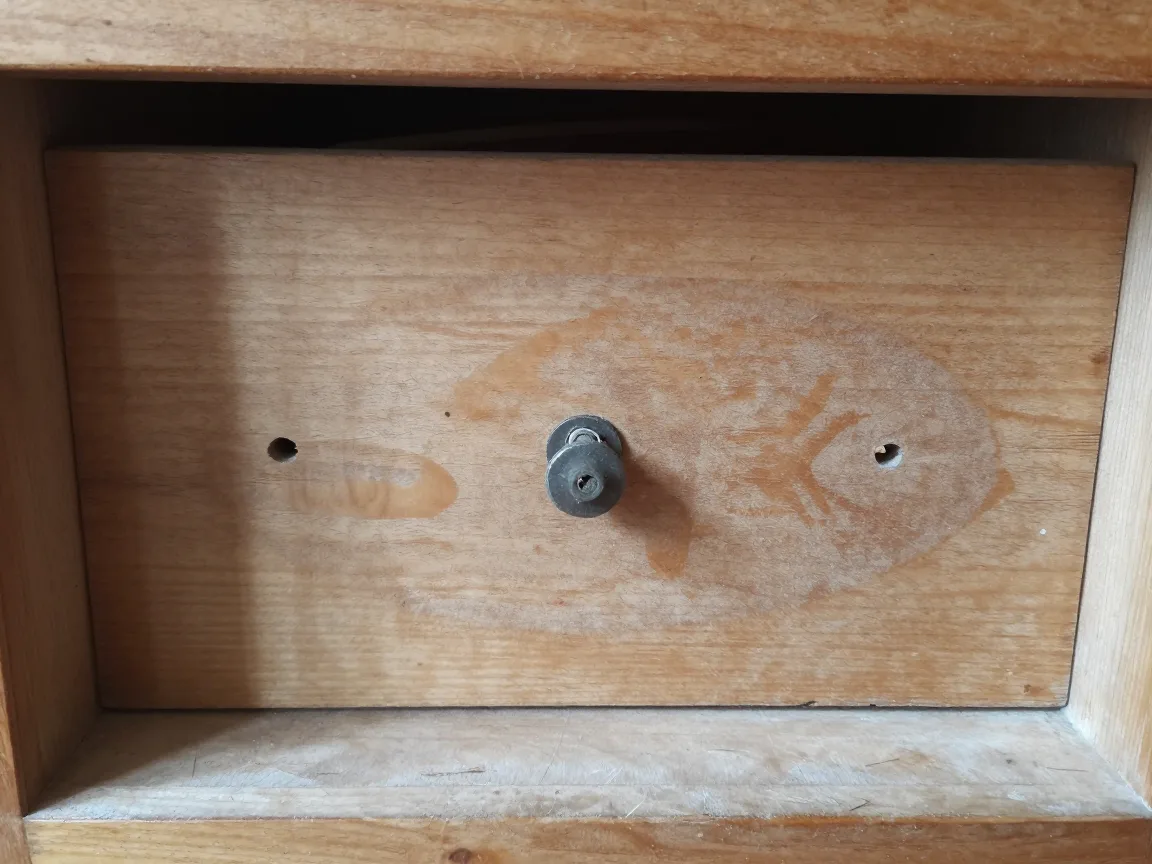
Look for extra holes: If you see plugged holes or empty holes near the current hardware, the pulls have been changed.
Check for “Ghost Marks”: Look at the wood surface behind the plate. A true original will leave a shadow or outline in the finish and oxidation that matches the current hardware shape perfectly.
Examine the Wear: The wear on the hardware should match the wear on the wood. If the drawer front is heavily worn but the brass is pristine, be suspicious.
A faded outline and extra holes show where earlier hardware sat.
What do different hardware styles tell me about the age?
Hardware styles evolved alongside furniture design. Recognizing the silhouette is the fastest way to get an initial attribution for the era.
William and Mary (1690–1720): Look for “teardrop” or “drop” pulls. These hang vertically from a single round backplate.
Queen Anne (1720–1750): The “willow” or “batwing” shape begins to appear, but is often simpler. The bail handle (the part you grab) usually falls against the plate.
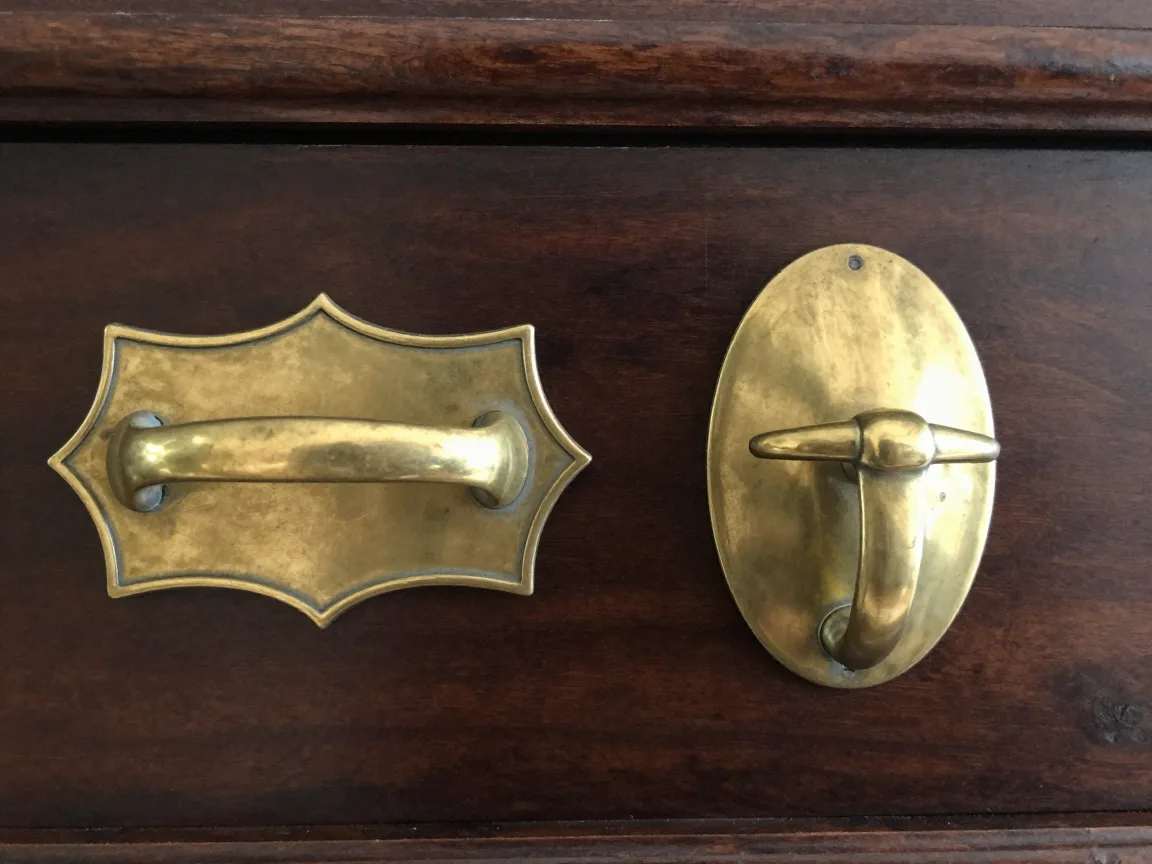
Chippendale (1750–1790): The classic, large “batwing” or “willow” mount. These are elaborate, pierced brass plates.
Hepplewhite & Sheraton (1790–1820): A shift to stamped brass rather than cast. Look for oval or octagonal plates with designs embossed into the metal (eagles, acorns, flowers).
Empire (1820–1840): Glass knobs or heavy brass lion heads with rings.
A shaped Chippendale-style backplate (left) and an oval Federal-style backplate (right).
How do manufacturing techniques reveal the date?
The construction of the hardware is often more telling than the style itself. This is critical for authentication and forgery detection.
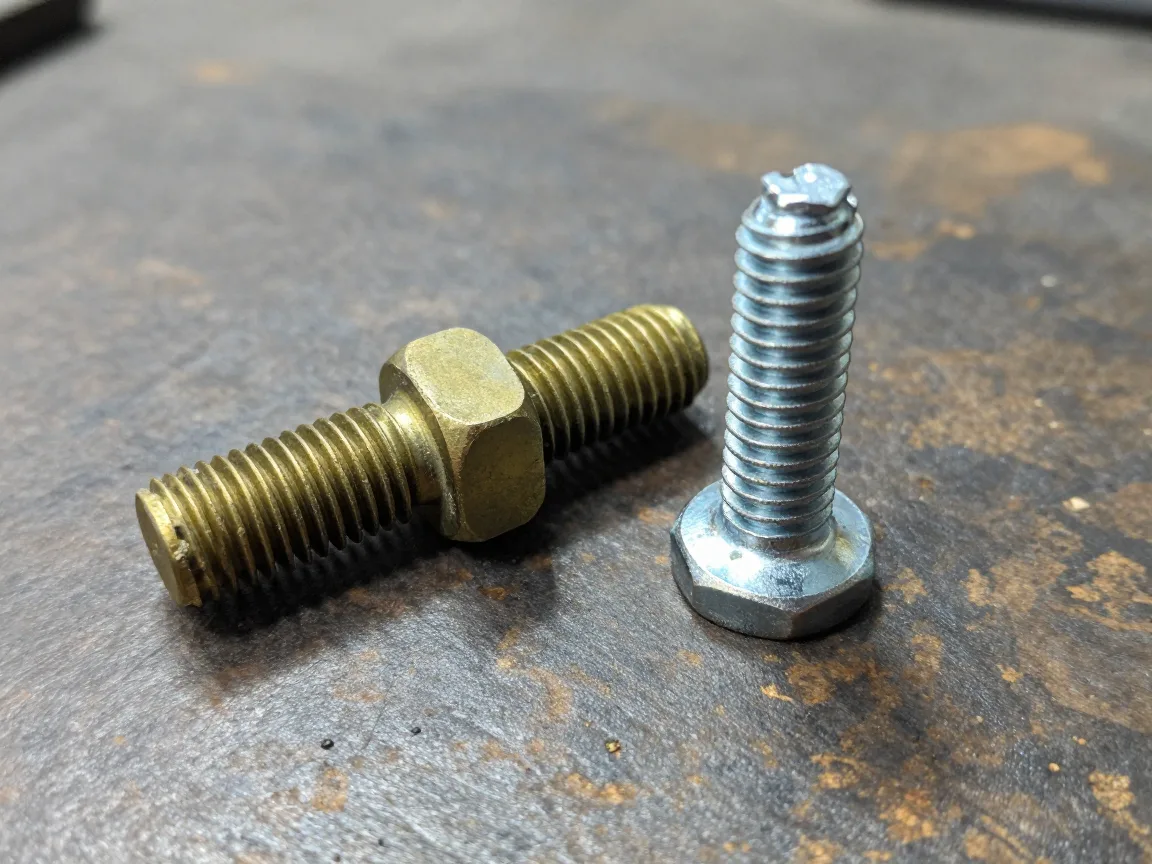
Pre-1800 (Hand-Cast): Early hardware was cast in sand molds. The back of the plates will often be rough or sandy. The posts were not threaded screws. Instead, a wire loop went through the wood and was bent open (clinched) or secured with a cotter pin.
1800–1850 (Early Machine): You start seeing threaded posts, but the threads are often hand-filed and irregular. The nuts are usually round or rough squares, not the perfect hex nuts we see today.
Post-1850 (Industrial): Uniform machine-cut threads and standardized screws appear. If you see a Phillips head screw, the hardware is definitively from the 20th century or later.
This evolution in manufacturing is similar to the structural changes we discuss in our guide on Identifying Duncan Phyfe Furniture: 5 Marks of Authenticity, where the transition from hand-carved to machine-assisted work helps date the piece.
An old brass bolt beside a modern steel bolt; compare thread shape and finish.
Does replacing the hardware affect the antique’s value?
Yes, significantly. In the collector market, original hardware is paramount.
A piece with its original brasses commands a higher fair market value than one with replacements. If you are browsing an auction house catalog, you will often see “brasses replaced” noted in the description; this is a signal that the auction estimate might be lower.
If you possess a piece with missing pulls, aim for conservation rather than modernization. Source period-correct replacements from an antique dealer rather than buying shiny reproductions from a hardware store.
Keep in mind that high-value case pieces often feature veneer or complex inlay around the hardware. Clumsy replacements can damage these delicate surfaces, further reducing the value.
Clumsy hardware changes can chip the veneer around keyholes and pulls.
What are the red flags of fake antique hardware?
When you are at an estate sale, use these quick checks to spot a reproduction:
Artificial Aging: If the brass has a dark, uniform brown coating that looks painted on, it is likely “antiqued” modern metal. Genuine patina is uneven, darker in the crevices and lighter on the high points where fingers touch.
Seam Lines: Modern cast hardware often has a visible seam line along the side of the handle where the mold halves met. Antique hand-casting was usually filed smooth.
Too Much Uniformity: On a true antique, the left handle might be slightly different from the right handle. Hand-made items have variance. Perfect uniformity is a sign of modern mass production.
Always check the construction of the furniture itself as well. If the hardware looks 18th century, but the drawer uses machine-cut dovetail joints rather than hand-cut ones, the hardware is likely a reproduction added to a later piece.
Mastering the language of hardware takes practice, but it is one of the most reliable skills for an appraiser. By looking past the style and examining the nuts, bolts, and casting marks, you can determine if a piece is a masterpiece or a clever fake. When in doubt, let technology aid your eye.
To date a dresser to the 1800s, pull a drawer out and read the joinery: uneven hand-cut dovetails point to before about 1860, perfectly uniform machine-cut dovetails to after about 1890, and the scallop-and-peg Knapp joint to 1870 to 1900.
Pull a drawer out and look at the joint where the side meets the front.
How can I tell if my dresser is truly from the 1800s?
The quickest way to date a dresser isn’t by looking at the ornate front, but by looking at the “ugly” parts. You need to pull a drawer all the way out and examine the construction.
Before 1860, almost all furniture was made by hand. If your dresser is from the early 1800s (Empire or Federal periods), the craftsmanship will look imperfect.
Key indicators of early 19th-century work include:
Thick Veneers: Early veneers were saw-cut and are much thicker (1/8 inch) than modern shaved veneers.
Asymmetry: If you measure the drawers, the top one might be slightly different in size than the bottom one. They aren’t interchangeable.
Unfinished Backs: The back of the dresser should look rough, often with unfinished wood that has darkened naturally (oxidized) over 200 years.
What is the difference between hand-cut and machine-cut dovetails?
This is the “Holy Grail” of dresser identification. Dovetail joints are the interlocking teeth that hold the drawer front to the sides.
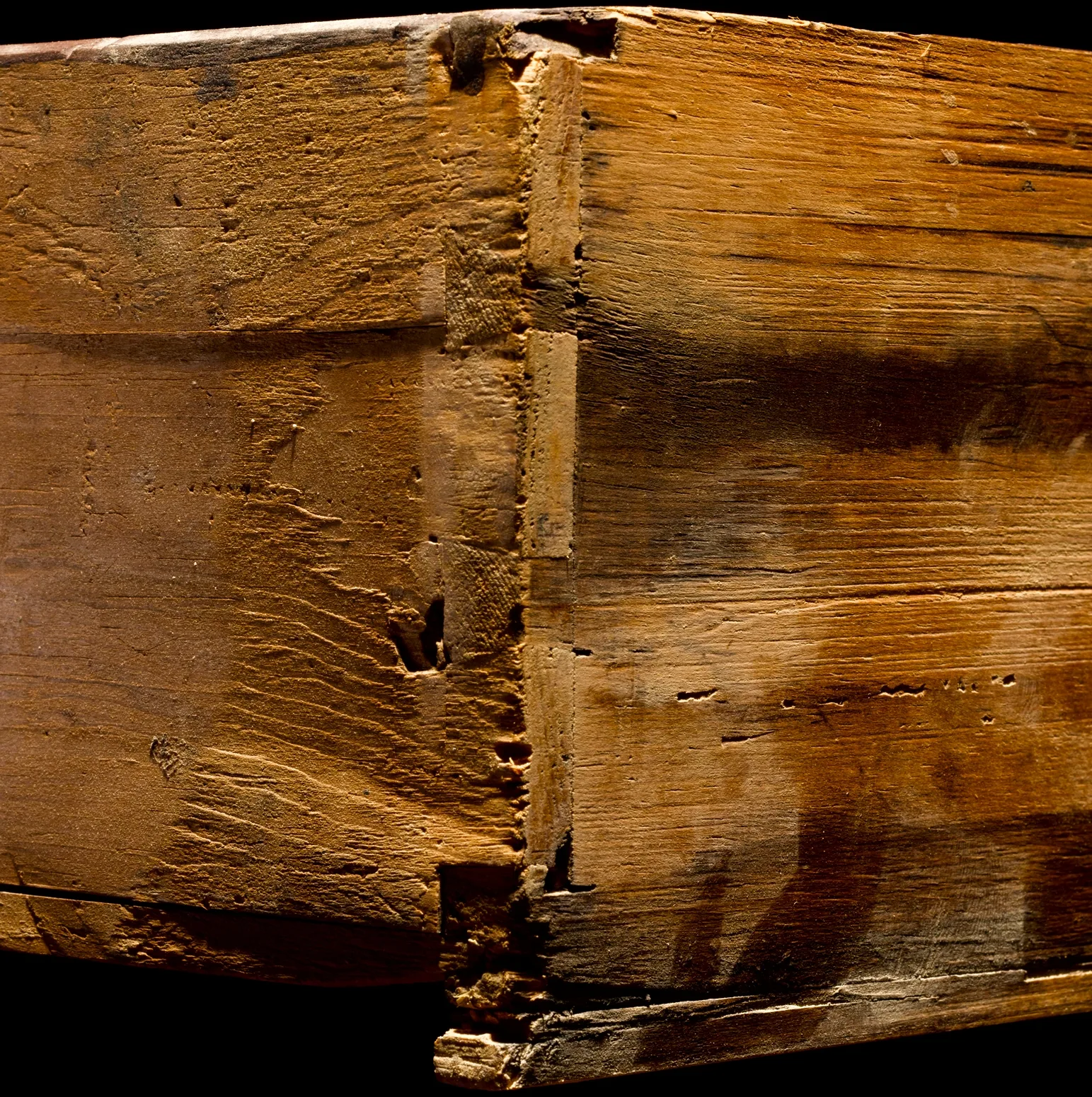
Hand-Cut Dovetails (Pre-1860): If the “tails” are skinny and the “pins” are wide, or if they are spaced unevenly, they were likely cut by hand. Look closely, you might even see thin scribe lines where the carpenter marked the wood with a blade before cutting. This almost guarantees the piece is pre-Civil War.
Uneven spacing and hand tool marks point to hand-cut dovetails.
Machine-Cut Dovetails (Post-1890): By the late Victorian era, factories took over. Machine-cut dovetails are perfectly uniform. The pins and tails are exactly the same size and spacing. While still antique, these pieces are generally less valuable than their handmade predecessors.
The Knapp Joint (1870–1900): If you see a joint that looks like a scallop and a peg (often called a “pin and crescent” style), you have hit a specific jackpot. This is the Knapp Joint. It was the first machine-made drawer joint, used almost exclusively between 1870 and 1900. It’s a dead giveaway for dating a piece to the late 19th century.
From about 1870 to 1900, check the drawer corners for the round pin-and-scallop Knapp joint.
Do nails or screws indicate a fake antique?
Not necessarily, but the type of nail matters immensely.
If you see shiny, round-headed wire nails, the piece is likely from the 20th century or has been repaired recently. Wire nails didn’t become dominant until the 1890s and early 1900s.
Square Cut Nails: In the 1800s, nails were cut from sheets of iron. They have square or rectangular heads and a blunt tip. If you look at the back of the dresser or the bottom of a drawer and see square nail heads, you are likely looking at a piece made before 1890.
Pro Tips for Screws:
Off-Center Slots: Handmade screws (pre-1850) often have slots that aren’t perfectly centered.
Flat Bottoms: Early screws had flat tips, not pointed ones. They required a pilot hole to be drilled first.
Gimlet Points: Pointed screws appeared around 1850.
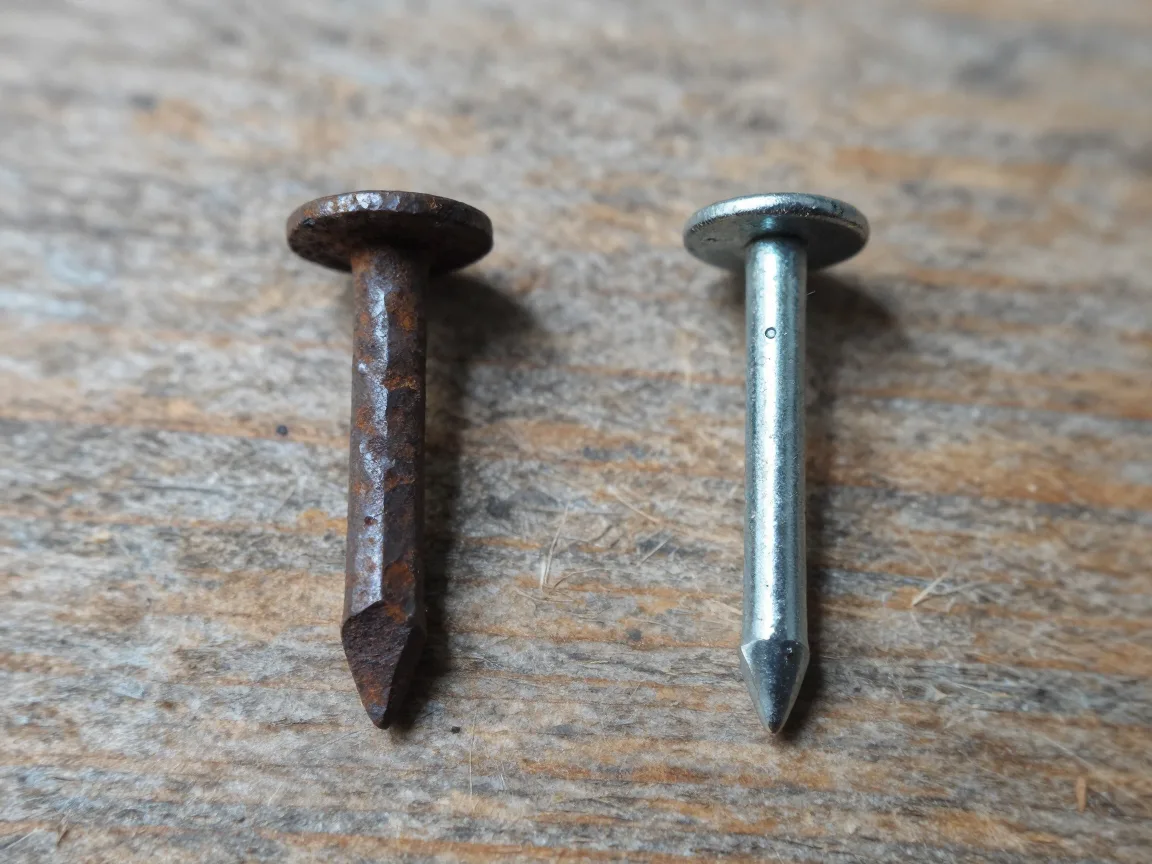
Old cut nails have a squared, tapered shank; a modern wire nail is round.
What about saw marks on the drawer bottom?
Flip that drawer upside down. The bottom panel usually tells the final part of the story.
Straight Saw Marks: Before the mid-19th century, lumber was cut in pit saws or water-powered up-and-down mills. This left straight, parallel saw marks across the wood. If you feel ridges running perpendicular to the grain, it’s a strong sign of early 1800s or older origin.
Circular Saw Marks: Circular saws became common around 1850. These leave curved, arc-like scratches on the wood. If you see these arcs on the rough, unfinished bottom of a drawer, the dresser is likely from the mid-to-late 1800s.
If the wood is perfectly smooth with no saw marks at all? It was likely planed by machine, indicating a later Victorian or 20th-century piece.
How much is my 1800s dresser worth in 2026?
Value is driven by demand, condition, and origin. Brown furniture (traditional wood antiques) has seen fluctuating prices, but high-quality 1800s pieces remain desirable.
Federal/Empire (1800-1840): A genuine mahogany chest in original condition can fetch $800 to $2,500+ at auction.
Victorian Cottage (1860-1890): These often painted or pine pieces are popular for farmhouse decor. Values range from $300 to $800.
Eastlake (1870-1890): Known for shallow carving and geometric lines. A clean Eastlake dresser usually sells for $400 to $900.
Red Flag: Be careful of “married” pieces, where a vintage top has been screwed onto an unrelated antique base. Check that the wood grain and wear patterns match from top to bottom.
To date an antique chair, read the leg and foot style first, then check the joinery and wear under the seat; style alone gives a range of decades.
Which leg styles help date an antique chair?
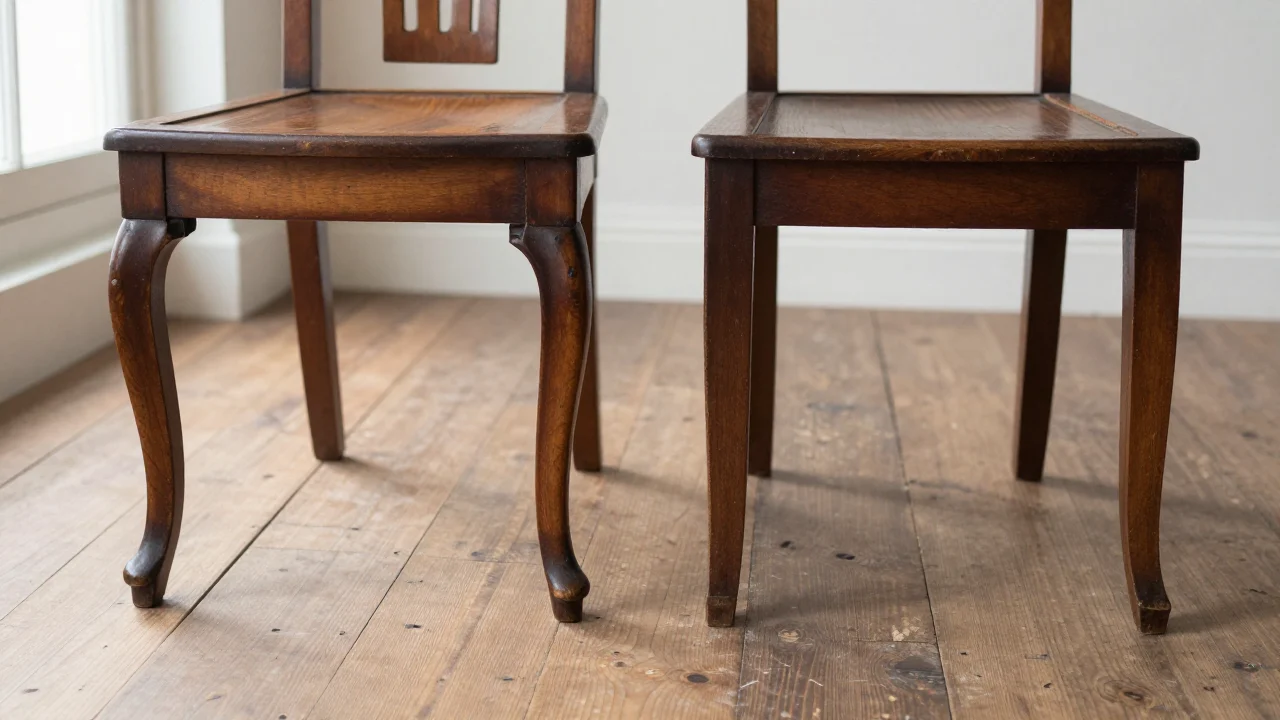
Leg and foot shapes are the quickest first clue, because each style was fashionable for a limited period. Every style was also copied later, so use the table to sort a chair into a likely period, then check its construction to see whether it is a period piece or a later version.
Leg and foot
Style it points to
When the style was in fashion
S-curved cabriole leg with a pad (club) foot
Queen Anne
From the mid-1720s to around 1760
Cabriole leg with a ball-and-claw foot
Chippendale, though also found on earlier Queen Anne-period chairs
Chippendale style from the 1750s (Director, 1754); also seen earlier
Straight, square Marlborough leg, often with stretchers
Later Chippendale
From about 1760 or 1765
Square tapered leg with a spade foot
Hepplewhite
Between about 1775 and 1800
Slender tapered leg, square and inlaid, or reeded
Sheraton
The 1790s and early 19th century
Leg usually straight rather than curved
Federal (United States)
Approximately 1789 to 1823
Elaborately turned leg (turning was reused in later periods)
William and Mary
1700 to 1725 in Britain, until about 1735 in America
Plain or spiral turned leg with stretchers
Jacobean, especially chairs from the time of James I
The Jacobean period ran from 1603 to about 1689
Earlier styles, revived or modified
Victorian revival
1837 to 1901
Plain country-made chair in an older style
Country version of an earlier fashion
Often later than the style itself; country towns were often behind London in style
The dates are the periods when each style was fashionable, taken from the sources linked below. They do not date a single chair. Because Victorian and Edwardian chairs share several leg profiles yet fall into different decades, the comparison in Is It Victorian or Edwardian? Key Differences for Quick Identification is worth reading alongside any leg-based assessment.
How do cabriole legs help pinpoint the date?
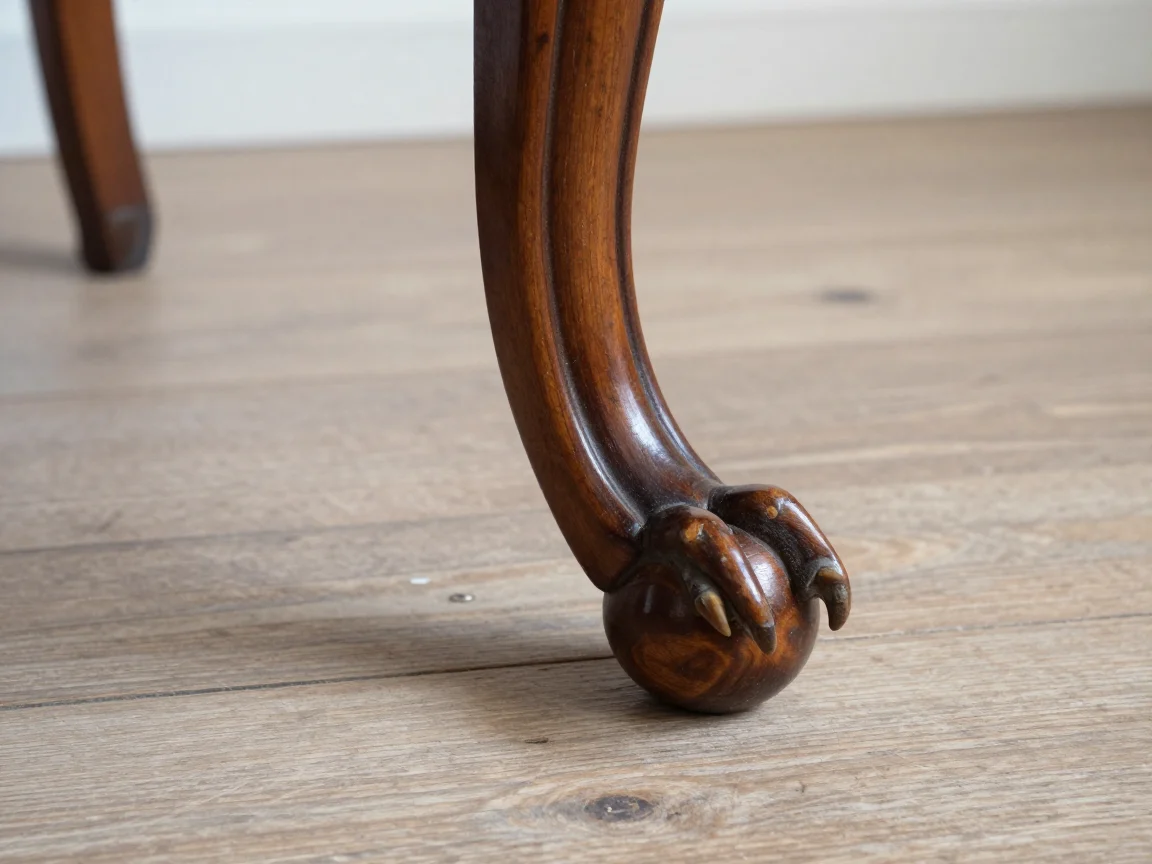
A carved claw gripping a ball at the end of a cabriole leg.
A cabriole leg usually points to an 18th century style or a later revival of it, and the foot narrows the window further. The leg is shaped in two curves: the upper curve always bows outward, while the lower curve bows inward (cabriole leg). In England, this design was characteristic of Queen Anne and Chippendale furniture.
Pad foot (Queen Anne): the plain, rounded pad foot is the typical ending of a Queen Anne cabriole leg. The name Queen Anne predominantly describes decorative styles from the mid-1720s to around 1760, although Queen Anne herself reigned from 1702 to 1714 (Queen Anne style furniture). In America, Queen Anne styles came into use in the 1720s and 1730s. Carving, when present, is usually a shell or scroll on the crest rail or the knees.
Ball-and-claw foot (often Chippendale): this carved claw gripping a ball is commonly associated with Chippendale-style furniture. Thomas Chippendale published his pattern book, The Gentleman and Cabinet Maker’s Director, in 1754 (Thomas Chippendale). Lucy Abbot Throop’s 1920 period-style guide, Furnishing the Home of Good Taste (full text on Project Gutenberg), says Chippendale carved the knees of his cabriole legs with cartouches and leaves, and that there were several variations on the claw and ball foot. The same guide’s Queen Anne chapter, which uses that name loosely for the whole period of Dutch influence, says the legs ended in claw and ball and pad feet, so a ball-and-claw foot alone does not prove a Chippendale-period date.
The two feet can also appear on one piece: an American card table dated 1760 to 1785 has claw-and-ball feet in front and pad feet at the back. Read the front and back legs separately before you decide which period the chair belongs to.
What does a straight, square leg tell you about age?
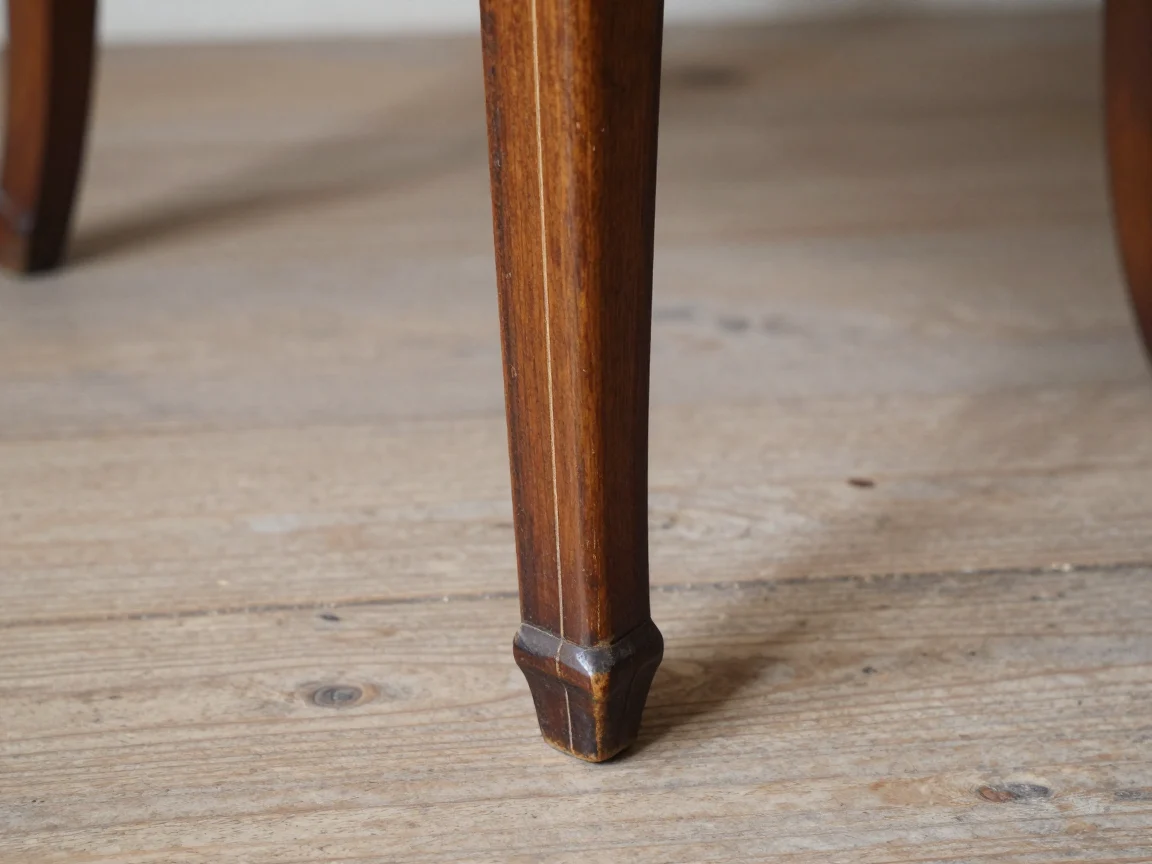
A square tapered leg ending in a spade foot, the leg form described for Hepplewhite-style chairs.
On a chair in the Chippendale tradition, a straight, square leg points to about 1760 or later; earlier turned and rural chairs can also have straight legs, so read the leg together with the back and the joinery. Chippendale began to use the straight leg for his chairs in about 1760 or 1765, and his straight-legged chairs usually had four stretchers (Furnishing the Home of Good Taste). Chairs with this plain, square leg are often called Marlborough-leg chairs: in Philadelphia, pairs of Marlborough-leg armchairs made about 1766 are attributed to the cabinetmaker Thomas Affleck.
Lighter, tapered legs came next. The light, elegant style named after George Hepplewhite was fashionable between about 1775 and 1800 (George Hepplewhite), and its chairs stand on straight or tapering legs with spade feet. No furniture made by Hepplewhite or his firm is known to exist, so the name describes a style, not a maker. Thomas Sheraton’s name is associated with the styles of furniture fashionable in the 1790s and early 19th century (Thomas Sheraton). Sheraton-style legs taper and are either square or reeded, and the square ones are usually inlaid.
In the United States, the Federal style overlaps these decades: it dates approximately 1789 to 1823 and has legs that are usually straight rather than curved (Federal furniture). If your chair has curved, reeded saber legs or a lyre splat, the guide on Identifying Duncan Phyfe Furniture: 5 Marks of Authenticity will help you determine whether you are looking at a genuine American Federal piece or a later reproduction.
Not sure what you’ve got?
Photograph the legs, the feet and the joinery under the seat. Antiqly suggests a period and origin from your photos. It is on iPhone and on Android through Google Play.
Can turned or spiral legs indicate a specific era?
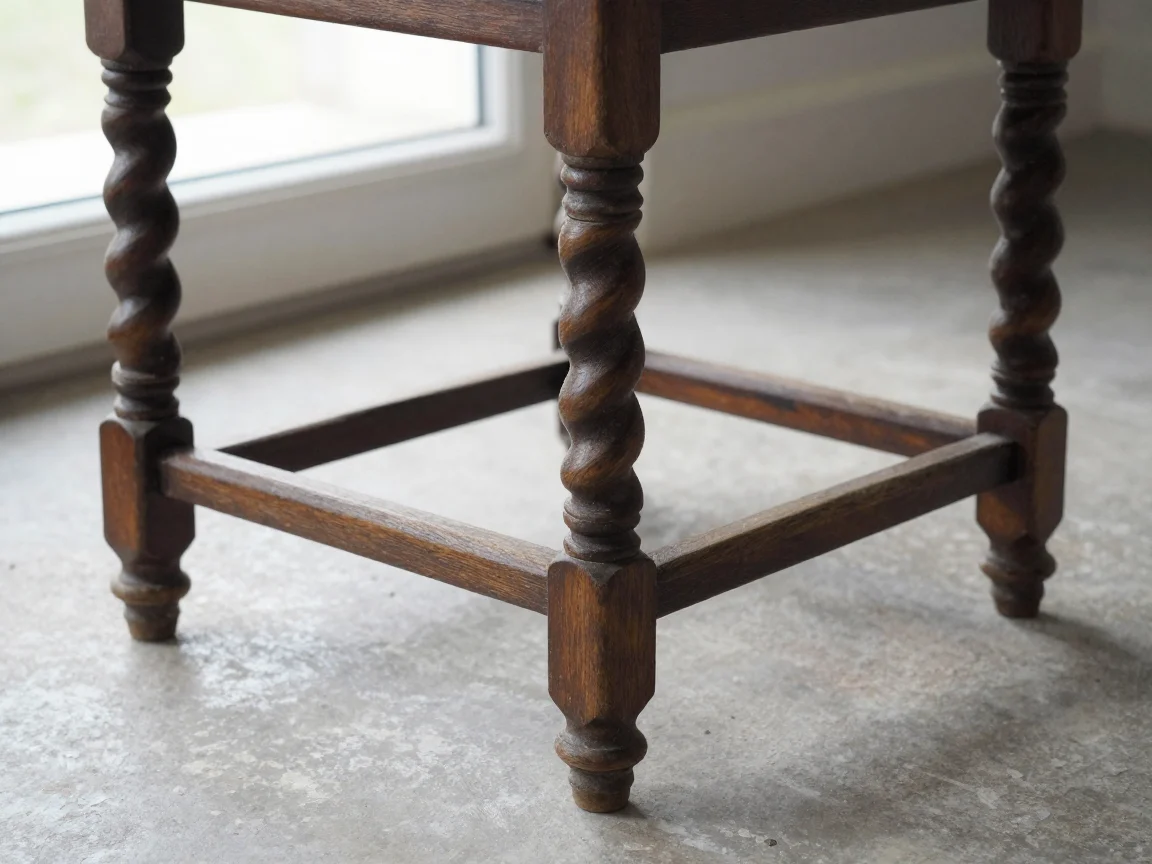
Spiral, or barley-twist, legs joined by stretchers; check the wear on the twists and the joints before trusting the style.
Turned legs can point to the late 17th and early 18th centuries, but they need the most checking, because turning was used again in many later periods. Furniture in the William and Mary style, common in Britain from 1700 to 1725 and in America until about 1735, featured elaborate woodturning (William and Mary style). The earlier Jacobean period ran from 1603 to about 1689, and Throop’s guide describes chairs from the time of James I as square and strong, with plain or spiral turned legs and stretchers.
Spiral, or barley-twist, legs can be reproduced as well. Throop illustrates a reproduction Jacobean buffet and notes that the spiral carving of the legs is too sharp and thin, so the shape of the twist itself can give a copy away. Wear is a separate check: a chair offered as 17th century usually shows softened edges on its twists and feet, and crisp, unworn edges are a reason to look more closely at the wood and the joints.
Bobbin furniture, also known as spool furniture, is a style of table or chair with lathe-turned legs (bobbin). The name describes the turning, not a date, so confirm the age from construction.
Victorian chairs are the hardest to date by the leg alone. No single furniture style dominated the Victorian period: designers used and modified many styles from earlier periods, and Gothic and Rococo revival were the most common (Victorian decorative arts). The Victorian era covers Queen Victoria’s reign, from 20 June 1837 until her death on 22 January 1901 (Victorian era). A cabriole leg on a Victorian chair is therefore a revival, not a Queen Anne original, and construction is what separates the two.
How can I tell if the legs are original or replacements?
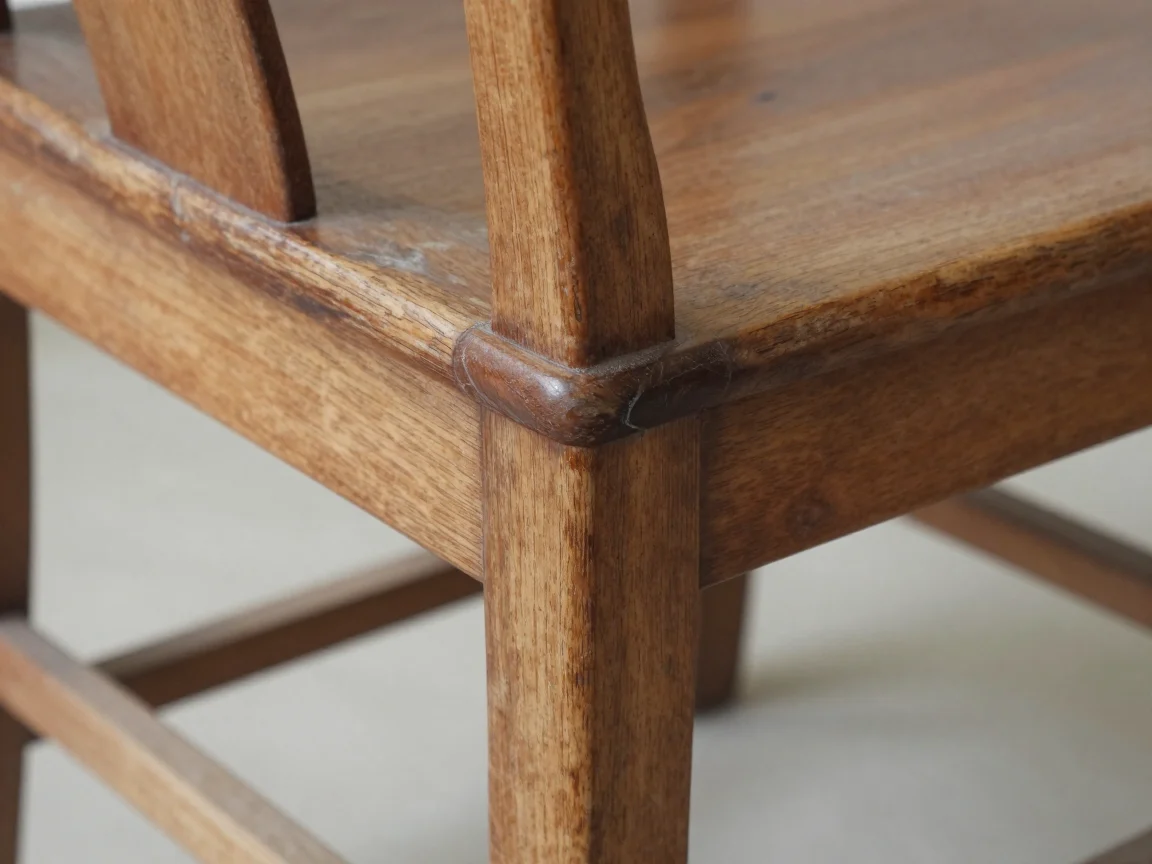
Compare the color and tool marks of each leg with the seat rail it joins.
Turn the chair over and compare each leg with the seat rail it joins: original legs and rails usually show a similar age, color and tool marks. A chair can combine an older back and seat frame with later legs, so check all four joints, not just one.
Unfinished wood inside the joints and under the seat often darkens with age. If a joint looks much lighter or fresher than the rail around it, the leg may have been replaced or the joint reworked. Replacement legs are sometimes stained or distressed to look old; Detecting Reproductions: How to Tell New Wood from 100-Year-Old Patina covers what to look for under UV light and at the grain level.
Saw marks on hidden surfaces add a second clue. Boards sawn on a sash sawmill have straight saw marks at a right angle to the length of the board, while a circular sawmill leaves curved marks (Ledyard Sawmill guide to identifying saw marks). The circular saw was invented in the late 18th century and was in common use in American sawmills by the middle of the 19th century (circular saw), so on American furniture, arc-shaped marks usually point to the mid-1800s or later. Furniture made elsewhere may follow a different timeline. The same Ledyard guide warns that dating boards by saw marks needs to be done with great caution, because periods in which different types of sawmills were used overlap by many decades.
A pad foot is the plain, rounded foot at the end of many Queen Anne cabriole legs. Furniture writers also call it a club foot; club feet are also known as duck, Dutch, or pad feet (furniture foot types).
Which antique chair leg style is most valuable?
No leg style is valuable on its own. Price depends on whether the chair is a period piece or a later revival, its maker or region, its condition and whether the legs are original, so a ball-and-claw foot on a reproduction does not make it an 18th century chair. For a value, look for dated sold results of chairs of the same form and period, and ask a furniture specialist about anything that may be early.
Do straight tapered legs always mean Hepplewhite?
No. A square tapered leg with a spade foot matches Hepplewhite designs, but Sheraton-style legs also taper, and the Hepplewhite style was copied for a long time: The Cabinet-Maker and Upholsterer’s Guide, published from his designs by his widow Alice in 1788, influenced cabinet makers and furniture companies for several generations, and their work in turn influenced copies of the original designs and variants of them through the 19th and 20th centuries. Check the back, the seat rail joinery and the hardware before you settle on a date.
Can leg style alone tell me if a chair is Victorian?
No. Victorian designers revived many earlier styles, so the leg narrows the possibilities but does not settle them. An 18th century leg shape combined with later construction, such as circular saw marks, can suggest a Victorian revival or a later reproduction.
What should you do with your chair now?
Photograph each leg from the side, each foot, and the underside of the seat where the legs meet the rails.
Match the leg and foot to the table above, then check whether the joints, saw marks and hardware agree with that period. If they disagree, the chair may be a later copy or have replaced legs.
For value, compare dated sold results for chairs of the same form and period, and ask a furniture specialist about anything that may be 18th century.
If you would like a first lead from a photo, Antiqly is available on iPhone through the App Store and on Android through Google Play. It suggests a name, period and origin from a photo, and you can add up to four extra photos, such as the feet or the underside of the seat. It is a subscription app, and scans require a subscription or a one-time scan purchase. Check any suggestion against the clues above.
A genuine Duncan Phyfe piece comes from the New York workshop of the Federal-period cabinetmaker (roughly 1795 to 1848). Check the saber leg first, reeded on period work, and remember that the style was mass-produced again in the 1930s and 1940s.
Want to confirm a genuine Duncan Phyfe? The Antiqly antique identifier app checks the style and estimates value from a photo.
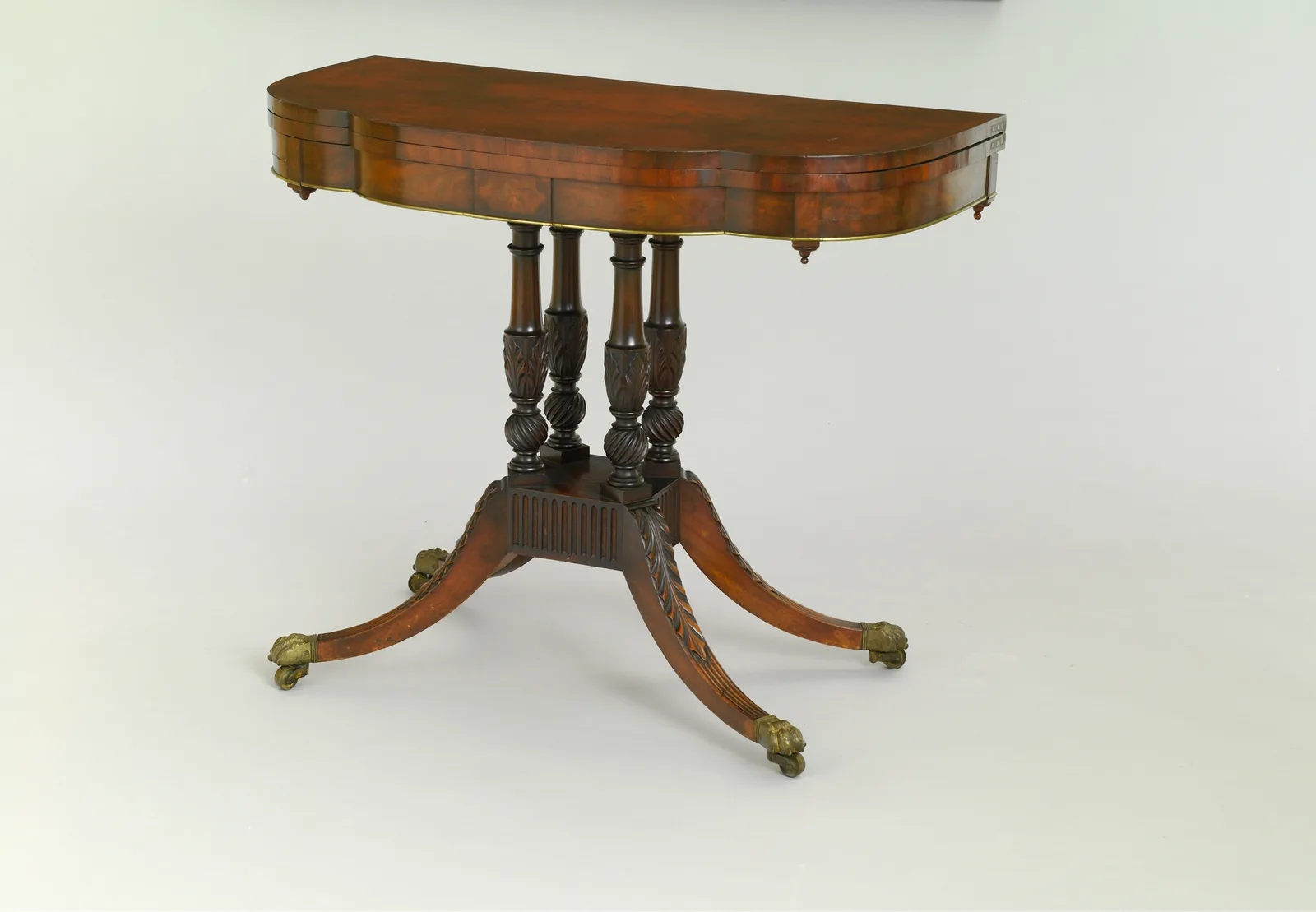
A Duncan Phyfe card table at The Met: the same pedestal and saber-leg base appears on his dining tables.
What Defines the Duncan Phyfe Style?
Duncan Phyfe was not just a furniture style; he was a real person. A Scottish immigrant who set up shop in New York City, he became the most famous American cabinetmaker of the Federal Period (roughly 1795–1848).
His work is known for perfect proportions and high-quality materials. He didn’t invent new shapes as much as he refined European Neoclassical styles into something distinctly American.
However, be careful. The “Duncan Phyfe style” was heavily revived and mass-produced in the 1930s and 1940s. Knowing the difference relies on inspecting the construction and the wood quality.
How Do I Recognize the Distinctive Legs and Feet?
The most immediate giveaway of a Phyfe piece is the leg. You are looking for the saber leg (sometimes called a sweep leg).
These legs curve outward in a graceful, concave shape, mimicking the curve of a cavalry saber.
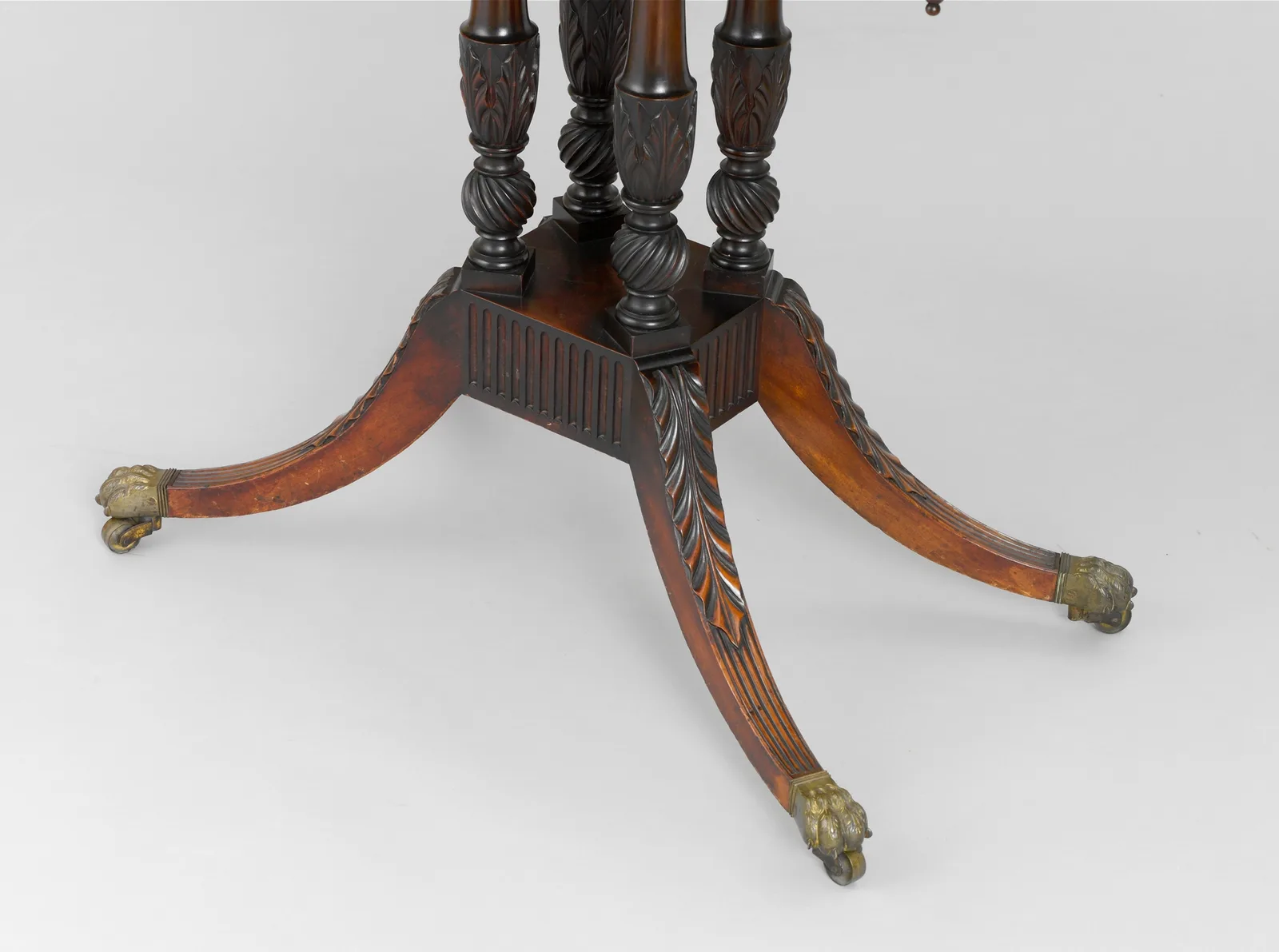
Saber legs often end in cast brass paw feet on New York Federal furniture.
On genuine period pieces, these legs are often reeded, meaning they have thin, convex ridges carved along the top surface.
Look at the feet. Phyfe often used brass paw feet or simple brass caps.
Pro Tip: On a true antique, the brass will have a deep, dark patina, not a shiny, bright gold finish.
Pro Tip: If the foot is carved wood painted to look like brass, you are likely looking at a later reproduction.
Which Decorative Motifs Should I Look For?
Phyfe was restrained with his decorations, but he had favorites. He avoided the heavy, chunky carving of the later Victorian era.
Instead, look for these specific, classical motifs carved into chair backs or table aprons:
The Lyre: A harp-like instrument, extremely common on chair backs.
Cornucopias: Horns of plenty.
Wheat Sheaves: Bundles of wheat tied together.
Thunderbolts: Tied in a bow (a nod to Roman/Greek influence).
A carved lyre splat, one of the classical motifs found on Phyfe-style chairs.
If the carving looks clumsy, shallow, or machine-routed, walk away. Genuine Phyfe carving is crisp, deep, and hand-finished.
Is the Wood High-Quality Mahogany?
Duncan Phyfe was obsessed with quality. He almost exclusively used Santo Domingo mahogany (also known as Cuban mahogany).
This wood is dense, heavy, and has a deep, rich reddish-brown color that darkens with age.
In contrast, 20th-century reproductions often used stained birch or maple to mimic the look of mahogany.
Test the Weight: Lift one end of the chair or table. Genuine Cuban mahogany is surprisingly heavy.
Check the Grain: The grain should be tight and straight.
Aged mahogany shows a warm reddish-brown patina and a tight, even grain.
Where Can I Find the Maker’s Mark or Label?
Here is the frustrating reality for appraisers: Duncan Phyfe rarely signed his work.
Unlike modern manufacturers, cabinetmakers of the early 1800s didn’t brand every piece. Occasionally, you might find a paper label glued to the underside of a table or the inside of a drawer, but these have often dried up and fallen off over the last 200 years.
If you do see a brand stamped “Duncan Phyfe” into the wood, proceed with caution. This often indicates a company manufacturing in the Phyfe style during the 20th century, rather than the master himself.
Authentication often comes down to: 1. Provenance: A documented history of ownership. 2. Construction: Hand-cut dovetails and hand-threaded screws. 3. Secondary Woods: The use of ash, poplar, or pine for the hidden interior parts.