
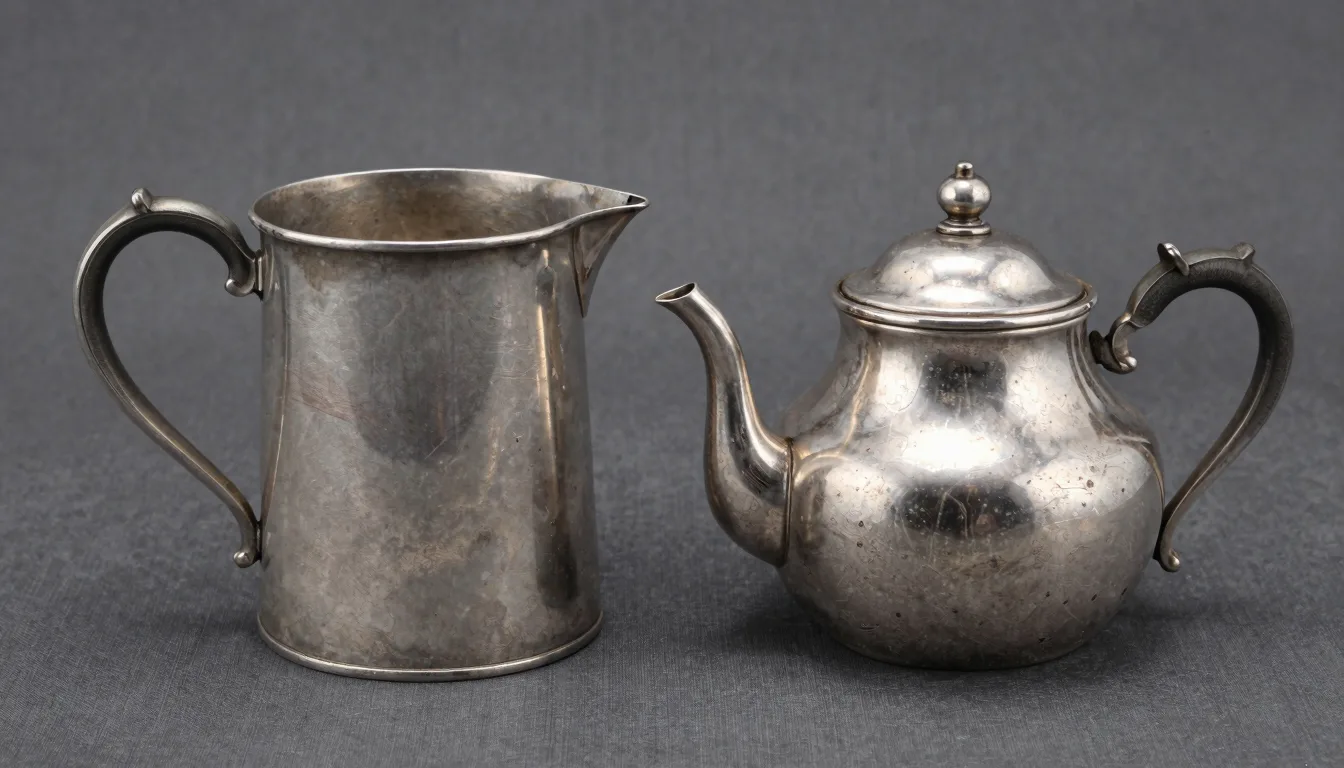
Pewter tarnishes, but not like silver. It oxidizes to a dull grey, never blackens like sterling. Here’s what collectors need to know.
Free to download — identify any antique instantly with AI. No sign-up.
Identify Now →How pewter and silver actually age — the short version
Pewter and silver both change over time. But the chemistry behind that change is completely different.
Silver reacts with sulfur compounds in the air. That reaction produces silver sulfide. Silver sulfide is dark — almost black in heavy accumulations.
Pewter is a tin-based alloy. Tin oxidizes slowly when exposed to air and moisture. The result is a soft, matte grey surface layer. It looks dull, not dramatic.
Any seasoned collector knows the difference the moment they pick up a piece. Silver tarnish has depth and contrast. Pewter oxidation is more uniform and flat.
Understanding this distinction matters when you’re cleaning, storing, or valuing old metalwork. Wrong treatment on the wrong metal can strip a desirable patina — and patina is money.
If you’re still figuring out which metal you’re holding, check the full breakdown at Identifying Pewter vs Silver — 3 Simple Ways to Tell the Difference.
A quick rule of thumb follows from that chemistry: if a piece sold as pewter is turning dark brown or black, it is almost certainly not pewter. Silver plate over a base metal, nickel silver, and some zinc castings all discolor in ways tin alloys never do, and “pewter finish” in a listing often means nothing more than a grey paint or plating. The pewter vs silver plated buyer’s guide covers the tells, and a side-by-side color reference shows what aged pewter looks like next to tarnished silver.
The chemistry of tarnish vs oxidation
Tarnish and oxidation are related but not identical processes. The distinction matters for collectors.
Silver tarnish is a sulfidation reaction. Hydrogen sulfide and carbonyl sulfide in the air bond with silver atoms. The compound formed — silver sulfide — is dark brown to black. It builds in layers and concentrates in recessed areas like engraving and hallmark stamps.
Pewter oxidation is slower and gentler. Tin, the primary component in most antique pewter, forms tin oxide on the surface. Tin oxide is light grey and non-reactive. It acts almost like a protective skin.
The lead content in older pewter — pre-1900 pieces often contain 15–25% lead — adds another variable. Lead carbonate can form on high-lead alloys, producing a whitish, powdery surface sometimes called pewter disease.
The Smithsonian’s American History collections include documented pewter pieces dating to the colonial period. Their conservation notes confirm that high-lead antique pewter requires completely different care protocols than silver.
Bottom line: silver tarnish is a sulfide reaction that darkens dramatically. Pewter oxidation is a slower oxide reaction that dulls without blackening.
Visual differences: what you’ll actually see on the surface
The surface tells the story. Here’s how to read it.
On silver, tarnish concentrates in low points first. Engravings go dark while raised surfaces stay bright. A heavily tarnished silver piece looks almost dramatic — deep shadows, bright highlights. Collectors sometimes call this ‘patina’ even though technically tarnish and patina are different things.
On pewter, the aging is more democratic. The whole surface dulls together. You won’t see the high-contrast drama of silver tarnish. What you see is a soft, pewter-grey matte finish that looks ancient and quiet.
Here’s a practical comparison table:
| Feature | Silver Tarnish | Pewter Oxidation |
|---|---|---|
| Primary cause | Sulfur in atmosphere | Oxygen and moisture |
| Color of oxidation layer | Dark brown to black | Light grey to chalky white |
| Distribution | Concentrated in recesses | Uniform across surface |
| Speed | Relatively fast | Slow and gradual |
| Reversibility | Polish removes it easily | Buffing restores some sheen |
| Risk of damage | Low if handled correctly | Lead-rich pieces need caution |
| Collector desirability | Patina adds value | Uniform oxidation is expected |
Those slightly uneven surface textures on hand-cast colonial pewter? Classic early American craftsmanship. Stripping that layer with an aggressive cleaner is a mistake many new collectors make once — and only once.
The Victoria & Albert Museum’s metalwork collection has excellent reference images of both silver and pewter pieces in their aged states. Worth bookmarking if you’re building your visual vocabulary.
Not sure what you’ve got?
Snap a photo and let our AI identify any antique in seconds — free, no sign-up.
Identify on iPhone → Learn MorePeriod pewter vs period silver: what hallmarks and marks tell you
Marks are your first diagnostic tool. Silver and pewter both carry maker’s marks, but the systems are completely different.
Silver hallmarking is one of the oldest consumer protection systems in history. British sterling carries hallmarks including the lion passant, date letter, assay office mark, and maker’s mark. These have been required since the 14th century. The Wikipedia entry on hallmarks gives a solid overview of the global systems.
Pewter touchmarks operate differently. Pewterers registered personal touchmarks — similar to a maker’s stamp — but there was no centralized assay system the way silver had. American colonial pewterers like Thomas Danforth II used eagle touchmarks after 1776 as a patriotic identifier.
Finding a touchmark on a pewter piece is exciting but requires research. A piece might carry multiple marks from different owners or repairs over its life.
For a full walkthrough of reading both metal and ceramic marks, the Antique Marks and Signatures Complete Identification Guide is the best place to start on this site.
One practical note: tarnish and oxidation can obscure marks on both metals. On silver, a soft polish cloth usually reveals the hallmark clearly. On pewter, gentle cleaning with mild soap and a soft brush works better than any commercial polish.
Cleaning pewter and silver: what works and what destroys value
Cleaning is where collectors make expensive mistakes. The rules are different for each metal.
For silver, commercial silver polishes work well on pieces without significant antique value. On valuable antique silver, many collectors prefer a paste of baking soda and water, or dedicated conservation products. Never use abrasive scrubbers. Never machine-polish a piece you haven’t researched.
For pewter, the approach depends on the alloy age. Modern pewter (post-1970, virtually lead-free) tolerates mild dish soap and warm water. Antique high-lead pewter needs gentle handling. Avoid anything acidic. Never use silver polish on pewter — the chemical formulation is wrong for tin alloys.
For both metals, before cleaning anything significant, establish its value first. WorthPoint’s price database and Kovel’s price guides are solid starting points for understanding whether you’re holding a $40 reproduction or a $400 piece worth preserving properly.
The biggest rule in collector circles: when in doubt, don’t clean. A conservator costs less than replacing lost value.
For silver specifically, the question of intrinsic metal value versus antique premium is worth understanding before you touch anything. The full breakdown lives at Silver Melt Value vs Antique Value — When to Sell and When to Keep.
Is the aluminum foil and baking soda method safe, and does it work on pewter?
The foil and baking soda bath is safe for plain solid silver and it does nothing useful for pewter. The bath is an electrochemical reaction: silver sulfide in contact with aluminum foil, in hot water made alkaline with baking soda or washing soda, gives up its sulfur to the aluminum, and the tarnish converts back to metallic silver on the piece. Nothing is abraded, which is why conservators sometimes prefer it to polish for lightly tarnished flatware. Pewter carries an oxide layer, not a sulfide layer, so there is nothing for the foil to reverse; the hot alkaline bath leaves the grey where it was, and on old high-lead alloys it can leave the surface looking blotchy.
The safety question is really about what is attached to the silver, not the silver itself. Hot water and an alkaline solution are hostile to organic and porous gemstones, and the bath removes every trace of dark oxidation, including the deliberate shading that gives chased and engraved decoration its depth.
| Piece | Foil and soda bath | Why | Safer route |
|---|---|---|---|
| Plain sterling flatware, chains, plain bowls | Yes | Solid metal, no fillings or stones | Rinse well and dry immediately |
| Antique silver with oxidized recesses | No | Strips the shading collectors pay for | Soft cloth on the high points only |
| Anything set with pearls, opal, turquoise, coral, amber, or jet | No | Heat and alkali dull or craze porous stones; glued settings loosen | Dry cloth around the mounts |
| Weighted candlesticks, knife handles, trophies | No | Pitch or cement filling expands in hot water and can split the shell | Cloth and mild silver polish |
| Enamel, niello, gilt, or lacquered surfaces | No | The bath attacks or lifts the surface layer | Professional cleaning |
| Silver plate with worn spots | With caution | Works on the plating but highlights bare base metal | Test one hidden area first |
| Pewter of any age | No | No sulfide to reverse; can blotch high-lead pieces | Warm water and mild soap |
Two further cautions. The reaction releases hydrogen sulfide, the rotten-egg smell you notice at the sink, so run it with a window open and keep the water hot but below boiling. Use a glass or plastic container lined with foil so the foil, not your cookware, takes the reaction, and rinse the piece thoroughly afterward because dried soda residue leaves a white film. For pieces with value beyond the metal, the silver tarnish removal guide covers the gentler options, and if you are not certain the piece is solid silver, the sterling vs silver plate checks come before any bath. The chemistry of the sulfide layer itself is summarized in the Wikipedia entry on silver sulfide.
Storage and environment: keeping both metals stable
Environment drives tarnish and oxidation speed. Controlling it protects your collection.
Silver storage fundamentals: Sulfur is the enemy. Avoid storing silver near rubber bands, wool, felt pads with sulfur-based dyes, or in oak drawers. Pacific cloth and anti-tarnish strips in sealed bags slow the reaction significantly. Humidity above 50% accelerates tarnishing.
Pewter storage fundamentals: Moisture and temperature extremes are the main risks. High-lead antique pewter is vulnerable to ‘tin pest’ — a crystalline structural breakdown — below about 13°C (55°F) in sustained cold. Keep antique pewter at stable room temperature. Avoid airtight storage that traps moisture.
Both metals benefit from stable temperature and humidity. Museum-standard conditions are 65°F and 45–50% relative humidity. You don’t need climate control — but you do need to avoid attics, basements, and garages.
Display matters too. Direct sunlight doesn’t tarnish metal the way it damages textiles or paper, but heat from sunlight accelerates oxidation in pewter and speeds sulfidation in silver near windows.
The Metropolitan Museum of Art’s conservation resources include public guidance on storing metalwork. Their approach to preventive conservation is worth reading even for home collectors.
Does a pewter chess set tarnish?
A pewter chess set does not tarnish the way silver does. Modern sets are cast in lead-free pewter, an alloy of roughly 90 percent or more tin with antimony and copper added for hardness, and tin does not form the black sulfide layer that darkens sterling. Left on a shelf, a pewter set keeps its silvery-grey color for years; what it picks up instead is fingerprint haze on the pieces you handle most and dust settling into the crowns and knight manes.
Most confusion comes from the finish rather than the metal. Many pewter chess sets made in recent decades are antiqued at the factory: a dark chemical patina is applied and then buffed off the high points so the detail reads clearly. That darkness in the recesses is deliberate and it is not tarnish. Polishing it out flattens the design and cannot be undone at home. The second source of confusion is a set that is not pewter at all. Cast zinc alloy sold as “pewter-look” and silver-plated brass both discolor in ways tin never does, so testing which metal you have matters before you clean anything.
| What you see on the set | Likely cause | What to do |
|---|---|---|
| Dark grey in crowns, manes, and base rings | Factory antiqued finish | Leave it; that is the design |
| Faint haze on the pieces you play with most | Skin oils and dust | Warm water, a drop of dish soap, dry at once |
| Small dark fingerprints that do not wipe off | Oils left for months | Mild soap and a soft toothbrush; no silver polish |
| Bright patches on an otherwise dark set | Someone polished it | Cannot be re-darkened evenly without professional refinishing |
| White powdery bloom | Old high-lead alloy or damp storage | Stop handling; move to dry, room-temperature storage |
| Black spots that spread | Not pewter; likely plated or zinc | Identify the metal first |
Storage follows the same rules as any pewter: room temperature, dry, and out of the garage in winter, because the cold-driven tin pest described above affects high-tin chess pieces as much as tankards. Keep the felt bases dry; damp felt holds moisture against the metal and is the most common cause of a chalky ring on the underside. A leather or velvet case that smells of sulfur will slowly darken any silver-plated pieces stored in it while leaving the pewter alone, and that difference in behavior is one more way to confirm what you own. The weight test settles most of the rest. Modern pewter’s composition is set out in the Wikipedia entry on pewter, which also explains why the lead-free alloy stays stable at room temperature.
What collectors actually care about: patina, value, and authenticity
Here’s where the practical rubber meets the road.
For antique silver, original patina signals authenticity. A piece with natural tarnish in the right places — heavier in recesses, lighter on raised areas — reads as genuinely aged. Over-polished silver loses that narrative. Dealers and auction houses notice. So do sophisticated buyers.
For antique pewter, the grey oxidation layer is expected and desirable on pre-1900 pieces. A colonial-era tankard with bright, buffed-out surfaces raises immediate authenticity questions. The oxidation is part of what confirms age.
Repro detection often comes down to reading the oxidation. Machine-made reproductions age differently than hand-cast originals. The distribution of surface wear on a genuine 18th-century piece follows use patterns — worn where hands gripped, protected where it sat on shelves.
If you’re trying to establish period and value on a metal piece, Antique Identifier App lets you photograph marks and surfaces for instant identification. The combination of visual AI and mark databases handles most pewter touchmarks and silver hallmarks efficiently.
For pieces where the stakes are higher, professional appraisal is the right move. A review of the best online appraisal services is at Best Online Antique Appraisal Sites — Honest Reviews and Comparisons.
One trap in this area is the factory patina on reproduction pewter. Makers darken the recesses chemically so that new castings read as old; the effect sits on the surface, stops abruptly at the high points, and is usually identical on every piece in a set. Natural age looks different: the grey is deeper where hands never reached and thinner where they did, and the surface texture matches the period. The pewter vs silver vs sterling comparison shows both kinds of surface side by side, and knowing what is actually in the alloy helps, since old pewter rarely contains any silver at all, whatever a sales listing says.
Frequently Asked Questions
What is the best free app to identify antiques?
Antique Identifier App is the best free app to identify antiques, using visual AI to identify hallmarks, porcelain marks, period furniture styles, and generate value estimates from a single photo. It’s available as a free download on iPhone with no sign-up required. The app is particularly strong on silver and gold hallmarks, maker’s marks on ceramics, and period dating of decorative arts — making it genuinely useful in the field, not just at a desk.
Does pewter turn black like silver?
No. Pewter does not turn black. Silver blackens because it reacts with sulfur compounds in the air, forming dark silver sulfide. Pewter is tin-based and oxidizes instead, producing a light grey surface layer. The oxidation on pewter is uniform and matte, never the dramatic dark tarnish associated with silver. On very old high-lead pewter, a whitish powdery surface can appear, but this is a different chemical process entirely.
How can I tell if an old metal piece is pewter or silver?
The fastest field test is weight and color. Silver is denser and shinier; pewter is lighter and has a blue-grey undertone. Look for hallmarks — British sterling carries a lion passant and date letter. Pewter carries a pewterer’s personal touchmark, not a standardized assay mark. A magnet won’t help since neither metal is magnetic. The tarnish pattern also differs: silver darkens dramatically in recesses, while pewter dulls evenly. For a full three-method breakdown, see the guide at /identifying-pewter-vs-silver-3-simple-ways-to-tell-the-difference/.
Is pewter tarnish harmful to the metal?
For modern lead-free pewter, surface oxidation is cosmetically undesirable but not structurally harmful. For antique high-lead pewter, the situation is more complex. Lead carbonate formation on the surface can be a sign of deeper instability, particularly in pieces stored in damp conditions. Extended exposure to acids — including acidic foods or cleaners — can cause pitting. Sustained cold below 13°C can trigger tin pest in high-tin antique alloys, a crystalline breakdown that is irreversible. Store antique pewter at stable room temperature.
Should I clean tarnish off antique pewter or silver before selling?
Generally no, especially before establishing value. Original patina on antique silver and the oxidation layer on antique pewter are authenticity signals that knowledgeable buyers and dealers look for. Over-cleaning can reduce value significantly. Before touching anything, research the piece through price databases like WorthPoint or Kovel’s, or get a professional assessment. If cleaning is necessary, use the gentlest appropriate method — soft cloth for silver, mild soap for pewter — and avoid commercial polishes on high-antique-value pieces.
How do I know if my pewter piece is antique or a reproduction?
Check the touchmark first. Colonial and early American pewterers registered unique marks — eagle motifs, name stamps, or town identifiers — that are documented in reference databases. Examine the casting: genuine antique pewter shows hand-finishing marks, slight surface irregularities, and wear patterns consistent with use. Reproductions tend to have too-even surfaces and wear in the wrong places. The weight distribution of hand-cast versus machine-made pieces also differs noticeably once you’ve handled enough examples. The patina on a genuine piece will be deeply integrated into the surface, not sitting on top.
Can I use the aluminum foil and baking soda method on pewter?
No. The foil bath reverses silver sulfide, and pewter does not form silver sulfide. Its grey layer is tin oxide, which the reaction leaves untouched, so the piece comes out looking the same at best. On antique pewter with a high lead content the hot alkaline water can mottle the surface and lift the powdery lead carbonate unevenly, which looks worse than the original dullness and can lower value. Clean pewter with warm water, a little dish soap, and a soft cloth, then dry it straight away. Reserve the foil method for plain solid silver with no stones, fillings, or decorative oxidation.
How long does it take pewter to tarnish?
There is no set timescale, because pewter does not tarnish in the sulfide sense at all. Modern lead-free pewter kept indoors at room temperature can stay bright for years, picking up only fingerprint haze and dust. The uniform grey seen on antique pewter builds up over decades of handling, damp storage, and, on older alloys, lead-related surface change. Warmth, humidity, and skin oils speed the dulling; dry, stable storage slows it almost to a stop. If a piece sold as pewter darkens noticeably within months, suspect a different metal, most often silver plate over a base alloy or a zinc casting.
Identify any antique in seconds.
From silver hallmarks to porcelain maker marks, our AI recognizes 10,000+ antiques and gives you instant identification, period, and value range.
Download Free on iPhone See How It Works