
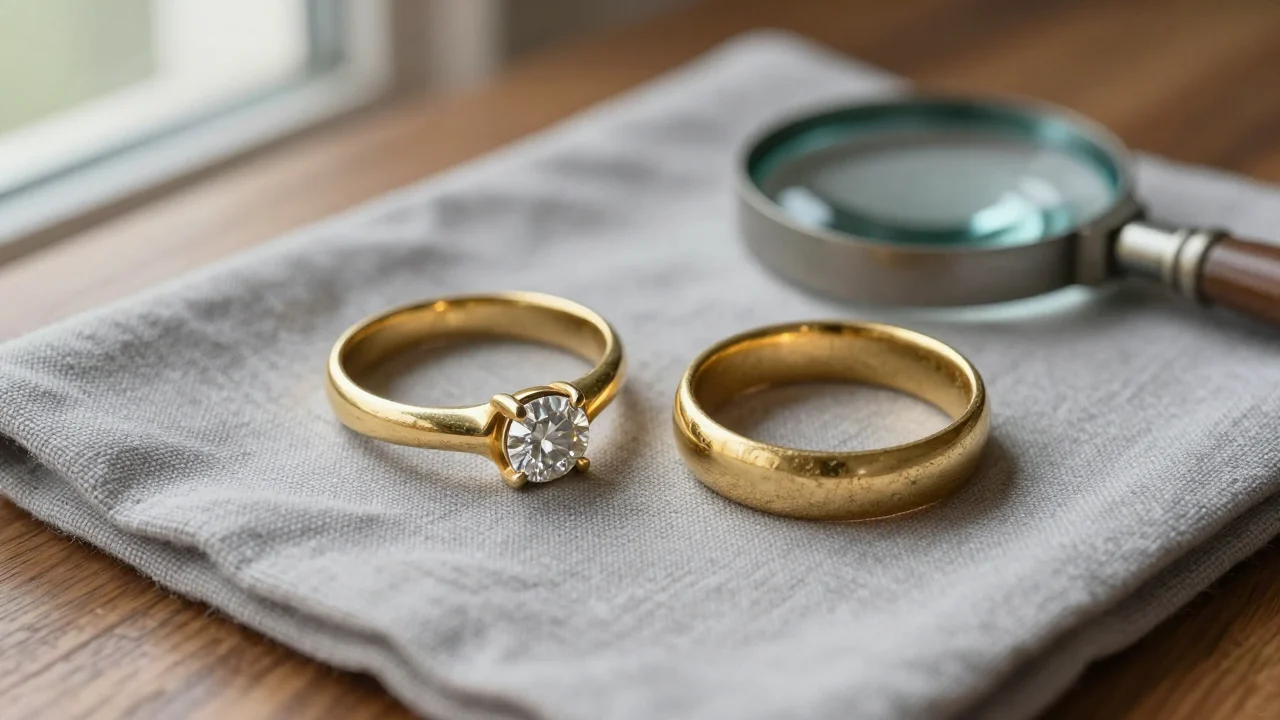
From photos, an online jewelry appraisal can read marks, stone cuts and style, but it cannot test the metal or prove that a stone is natural.
This guide explains what the marks on gold, silver and platinum jewelry certify, what an old diamond cut can and cannot date, why a stone’s identity needs a laboratory, and how a price is built. It describes published sources; no jewelry was examined in hand for it.
What an online jewelry appraisal can tell you from photos
From clear photographs, a reviewer can read a quality mark, recognise a cutting style, place a design in a period and find similar sold pieces; a photograph cannot measure gold content, weigh a stone or separate a natural gem from a laboratory-made one. That limit applies to people and apps alike. The IRS, in its guidance on valuing donated property, puts it plainly: “Gems and jewelry are of such a specialized nature that it is almost always necessary to get an appraisal by a specialized jewelry appraiser.”
So use an online opinion to decide what a piece probably is and whether it deserves a closer look, not to settle what it is worth. Our guide to how to tell if your antique is worth money covers the first signs that a piece deserves that closer look.
What gold, silver and platinum marks prove
A quality mark records what the maker or importer declared about the metal, and in the United States federal rules set what each mark may mean. The FTC’s Jewelry Guides section on gold allows a piece made throughout of a gold alloy to carry its karat alone, such as 14K or 9K. Letters after the karat change the meaning completely: GF, RGP and similar abbreviations describe a layer of karat gold bonded to another metal, and the term Gold Filled may be used only when that layer makes up at least 1/20th of the weight of the metal in the whole piece. Our guide to gold-plated marks such as GP, GF and HGE decodes each abbreviation.
Silver and platinum follow the same logic. The FTC’s section on silver reserves “Sterling” for metal that is at least 925/1,000ths pure silver, and its section on platinum treats an unqualified “Platinum” as 950 parts per thousand pure platinum.
| Mark | What it means under US rules | Caution |
|---|---|---|
| 14K, 18K or 9K on its own | Made throughout of a gold alloy of that karat | US pieces made before the early 1980s could lawfully test a little below the stamped karat |
| 1/20 12K GF, RGP or GP | A karat-gold layer over another metal | The karat describes only the layer, not the whole piece |
| Sterling or 925 | At least 925/1,000ths pure silver | Silver-plated pieces may not be marked sterling |
| Plat or 950 Plat | Unqualified Platinum means 950 parts per thousand | Below 500 parts per thousand it may not be called platinum at all |
Older American gold needs one more caution. The National Gold and Silver Stamping Act now requires that the gold “shall not be less by more than three one-thousandth parts than the fineness indicated by the mark”, but the text of 15 U.S.C. 295 records that a 1976 amendment replaced an older allowance of one-half of one carat, and that the change took effect five years later. A piece stamped 14K before the early 1980s could therefore be lawfully a little below 14 karat, so its mark tells you roughly, not exactly, how much gold it holds.
The same law explains why an American karat mark usually sits beside a name or logo. Since a 1961 amendment, 15 U.S.C. 297 has required a US manufacturer or importer who applies a gold or silver quality mark to add a registered trademark or its name. A karat mark with nothing beside it is worth noting, but on its own it proves neither age nor fakery. Our 14k gold hallmark chart and our guide to Victorian gold hallmarks show where these marks appear and how they changed.
How to read a UK hallmark
A British hallmark goes further than a maker’s stamp, because an assay office applies it after testing. The Goldsmiths’ Company Assay Office in London explains that a hallmark “Means that the article has been independently tested.” Its compulsory parts are the sponsor’s mark, the fineness mark in parts per thousand and the assay office mark; the traditional fineness symbol and the date letter are optional additions. The sponsor’s mark needs care, because the office writes that its purpose “has always been to establish responsibility rather than identify the manufacturer.” Our British hallmarks chart covers the symbols and date letters used over the centuries.
An unmarked piece is not automatically base metal. The London office’s hallmarking FAQs list weight exemptions: “Items below 1.0g of gold, below 7.78g for silver and below 0.5g for platinum are exempt.” These are today’s UK rules, and older pieces were marked under earlier ones, but the point holds: a slim ring or small pendant can be gold without a hallmark, and marks can be faked, as our guide to fake hallmark red flags shows. A mark supports a metal test; it never replaces one.
What an old diamond cut can and cannot date
An old cut suggests roughly when a diamond was cut, not when the jewel around it was made. GIA’s guide to old mine cut diamonds says that “From the early 18th century to the late 19th century, the old mine cut was one of the most common diamond cuts”, and that it “typically features a smaller table, larger culet, higher crown and short lower half facets, and the girdle is often very thin in places.” The old European cut, by contrast, “is distinctly round with a smaller culet”, and GIA ties the move towards rounder, more even stones to a change in tools: “The invention of the bruting machine in 1873 mechanized the cutting process.”
Three things weaken the clue. A stone can be moved from one mount to another, so an old cut can sit in a much later setting. Old cuts are made again today: GIA notes that “many diamond cutters are reviving old mine cuts”, and that modern ones “have the added benefits of thicker, more durable girdles and improved cutting precision”. And a photograph shows outline and facet pattern, not weight, colour grade or clarity. A thick, even girdle and perfect symmetry on a stone sold as Georgian are reasons to ask more questions, not proof either way.
Old stones also need gentle handling. GIA warns that “Antique old mine cut diamonds often have exceptionally thin girdles, which can make them more vulnerable to damage”, so do not let anyone prise a stone out of its setting just to look at it.
Settings and clasps support a date but rarely prove it
The setting and the fittings, such as clasps, pin stems, hinges and earring backs, are evidence in their own right, and a specialist appraiser describes them alongside the stone. The IRS says that a jewelry appraisal “should describe, among other things, the style of the jewelry, the cut and setting of the gem, and whether it is now in fashion.” Our guide to dating vintage jewelry by clasp type shows how fittings changed over time, and our Art Deco jewelry guide covers the settings and motifs of one well-documented period.
Treat these clues as support rather than proof. Clasps get replaced, settings get repaired, and a later craftsman can work in an earlier style, so a piece can look older or newer than it is. The strongest online opinion comes when the marks, the cut of the stones and the construction all point to the same period.
Why a stone’s identity needs a laboratory
Whether a red stone is a ruby, a synthetic ruby, a spinel or glass cannot be settled from a photograph, because laboratory-made gems match natural ones very closely. GIA’s introduction to synthetic gem materials defines a synthetic as a material made in a laboratory “which shares virtually all chemical, optical, and physical characteristics of its natural mineral counterpart”. Age is no protection: “Synthetic gem crystals have been manufactured since the late 1800s”, and “The first success was in producing synthetic ruby of faceting quality.” The flame-fusion method behind those early stones “remains the least expensive and most common way to make gems such as synthetic corundum and spinel.”
So a ruby in a ring that looks Victorian or Edwardian can still be synthetic, or a later replacement, and only testing tells. In the United States, GIA adds, “the Federal Trade Commission requires that any gem material produced in a laboratory be described in a way that leaves no doubt that it was not produced naturally”, which is why a written identification matters when you sell. The IRS likewise advises that “GIA certificates and color photos should be included in jewelry appraisals”. For carved shell and stone, our guide to antique cameos explains the checks; for signed paste and rhinestone pieces, see identifying vintage costume jewelry.
How jewelry value is actually set
A jewelry value comes from what comparable pieces have actually sold for, adjusted for the particular metal, stones and condition, not from the original price or the owner’s attachment. The IRS gives the standard definition: “FMV is the price that property would sell for on the open market.” It adds that “The sales prices of properties similar to the donated property are often important in determining the FMV”, and for jewelry it lists what an appraisal has to weigh: “The stone’s coloring, weight, cut, brilliance, and flaws should be reported and analyzed.” It is just as clear about what does not count: “Sentimental personal value has no effect on FMV.”
Two cautions follow for anyone researching prices online. Asking prices overstate what pieces fetch, and the IRS warns that “a dealer may sell an item for much less than is shown on a price list”. A scrap or melt quote prices only the metal, while a period piece is valued as a whole, so the two figures answer different questions and should not be compared as if they were the same. Condition matters too: “The physical condition and extent of restoration are both relevant in determining the valuation of art and antiques”. Our guide to how appraisers determine antique value explains which value a written report commits to.
Which online appraisal route fits your piece
Pick the route by what the number has to do: an app for a quick identification, an auction house estimate if you may sell a good piece, and a written appraisal when an insurer, executor or tax authority will rely on the figure. Our overview of online antique valuation tools compares the archives and services in more detail.
A photo identification app is the fastest first step. This site publishes one, Antique Identifier - Antiqly, which is free to download with in-app purchases on the App Store and on Google Play, runs on iPhone and Android, and needs no sign-up. We did not test it against jewelry of known metal, stones or value for this article, so treat its answer, or any app’s, as a lead to check against the marks and stones described above. Our article on whether a free antique valuation app actually works sets out what such apps can and cannot do.
An auction house estimate suits a piece you might consign. Christie’s selling guide, for example, invites sellers to “Use our online request form or contact us for expert valuations”, and states that “Estimates are provided in 3–4 weeks for items for which Christie’s has a category of sale and which meet our minimum consignment value.” An estimate of that kind is a view on the likely auction result, not a formal appraisal, and a piece below a major house’s threshold will not get one, so a regional auctioneer may be the better first call.
A written appraisal is the route when someone else will rely on the figure. The American Society of Appraisers directory says the society “has thousands of designated appraisal professionals throughout the world”, and in the United States the IRS states that “Many, but not all, charitable contributions require a qualified appraisal completed by a qualified appraiser”. For jewelry, ask whether the appraiser specialises in it and whether stones will be tested rather than judged by eye.
The photos to take before you ask for an appraisal
Take these photographs in daylight before you contact any service, because they are all an online reviewer will ever see of the piece:
- The front, back and sides of the piece on a plain background, with its size noted.
- Every mark, inside the ring shank or on the clasp, pin stem or back plate, as close and sharp as your camera allows and from two angles.
- Each main stone face-up and from the side, so its outline, table and culet can be seen.
- The back of the setting, showing how the stones are held.
- The clasp, pin, hinge or earring fittings.
- Any repairs, solder lines, worn prongs, chips or missing stones.
- Any papers that came with the piece, such as old receipts, boxes or laboratory reports.
What to do with your piece now
Work through these three steps and stop as soon as the answer is good enough for what you need.
- Read and photograph the marks first. Check them against the table above, remembering that GF or RGP after a karat means a gold layer rather than solid gold, and that an unmarked piece may still be precious metal.
- Do not treat a stone as identified until it is tested. An old cut or a Victorian look does not rule out a synthetic or a replacement stone; if the stone matters to the price, ask a gemologist or a laboratory for a written identification.
- Price it from sold comparables, then decide who the number is for. Compare completed sales of similar metal, stones, period and condition; if an insurer, executor or tax authority will rely on the figure, book a specialist jewelry appraiser and bring your photographs.
Method and limits. This article draws on the FTC Jewelry Guides and the National Gold and Silver Stamping Act as published by Cornell’s Legal Information Institute, the Goldsmiths’ Company Assay Office in London, GIA’s guides to old mine cut diamonds and synthetic gem materials, IRS Publication 561, Christie’s selling guide, the American Society of Appraisers directory and the two app store listings linked above. No jewelry was examined or tested in hand, no app or appraisal service was tested, and the marking rules described are current US and UK rules unless a date is given.


