
American furniture styles from 1620 to 1940 form a datable sequence, and each period is recognized by its legs and feet, woods, ornament and joinery.
This guide is published by Antique Identifier – Antiqly, which makes a photo identification app that is free to download on iPhone and free on Android with no sign-up. It is a review of the published museum and reference sources linked in the text, mainly the Metropolitan Museum of Art’s essays on American furniture; no piece was examined for it and it quotes no prices. The dates are for high-style American production, and they overlap: a style reached Boston or Philadelphia years before it reached a country workshop, so treat every range as a centre rather than a boundary. For the same periods shown with photographs, see our visual guide to antique furniture styles, and for a one-page version, the printable furniture periods chart.
Period table: American furniture styles, 1620–1940
The table below gives each American style its approximate dates and the tells to look for, legs and feet first, then ornament and wood, so that a piece can be placed in a period before the sections that follow name the makers, pattern books and museum evidence behind each row.
| Style | American dates | Key tells: legs and feet, ornament, woods |
|---|---|---|
| Seventeenth-Century (Pilgrim century) | 1620–90 | Straight oak members joined at right angles; low, horizontal and massive; low-relief carving, applied mouldings, turnings and paint |
| William and Mary (Early Baroque) | 1690–1730 | Slender, vertical chairs on turned posts and legs; case pieces raised on turned legs; dovetailed cases; figured veneers; japanning begins |
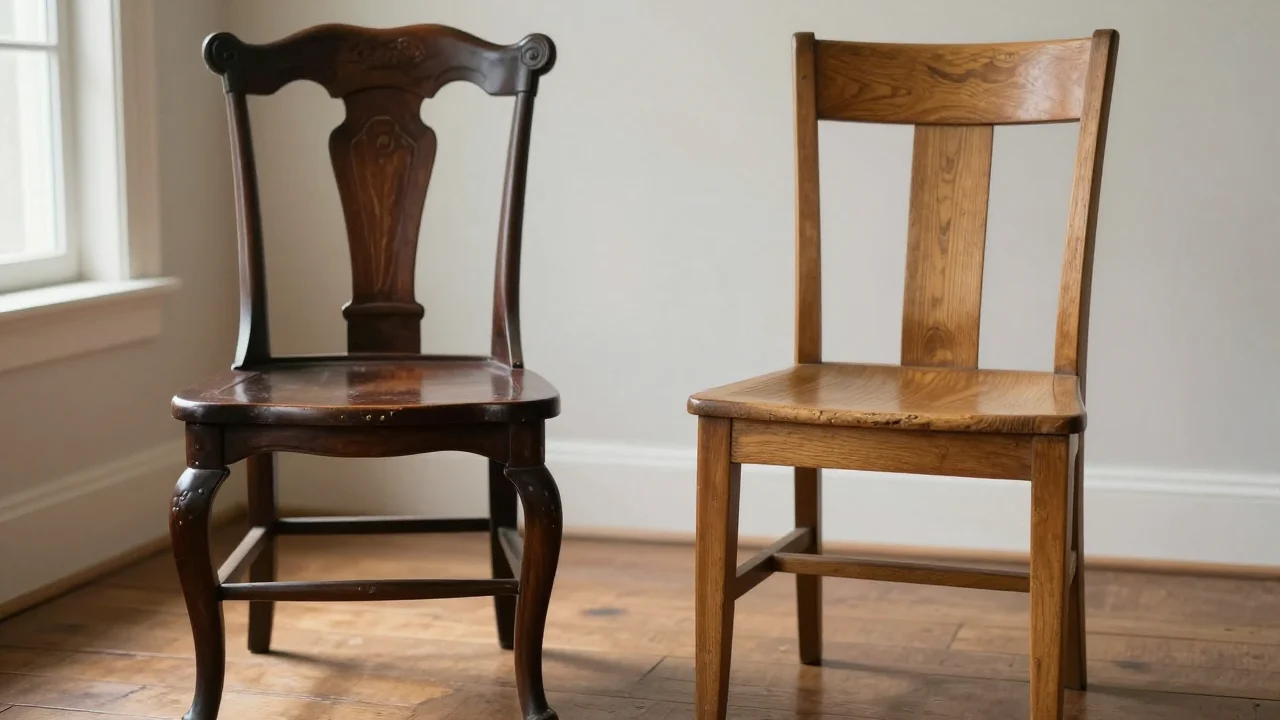
| Queen Anne (Late Baroque) | 1730–60 | Vase-shaped splat, S-curved cabriole legs, pad or slipper feet; restrained ornament; black walnut, often stained to look like mahogany |
| Chippendale (Rococo) | 1755–90 | Square seat frames, straight stiles and flaring ears; pierced carved splats; claw-and-ball feet; Caribbean mahogany with naturalistic carving |
| Federal (Neoclassical; Hepplewhite and Sheraton) | about 1790–1815 | Clean lines and geometric shapes; straight rather than curved legs; shield-shaped chair backs; contrasting veneers, inlays and eagle motifs |
| Empire and Grecian (Greek Revival) | about 1805–40 | Three-dimensional classical ornament: carved figures, curule legs, columns with rope-twist carving, animal-paw feet; figured mahogany and rosewood veneers, applied brass, gilt stencilling |
| Gothic Revival | 1840s–70s | Lancet (pointed) arches, trefoils and quatrefoils; formal high-backed chairs; favoured for libraries and dining rooms |
| Rococo Revival (Modern French) | 1840s–60s | Curving, elaborately carved parlor suites; laminated rosewood shaped in steam moulds, then carved |
| Renaissance Revival | 1860s–70s | Classical acanthus, anthemion and scroll motifs; coordinated parlor and bedroom suites; rosewood with incised and gilded decoration and mother-of-pearl medallions |
| Eastlake (Modern Gothic) | late 1870s–80s | Rectilinear, angular and notched; geometric ornament, spindles, incised lines; oak and cherry, also ebonized factory wood |
| Art Nouveau | about 1895–1910 | Organic forms from nature with asymmetrical curves and flourishes; mostly European production |
| Arts and Crafts (Craftsman, Mission) | 1897–1920s | Rectilinear; honest construction, simple lines, exposed joinery; simply treated woods, typically oak |
| Colonial Revival | 1876–1940 and later | Free interpretations of Queen Anne, Chippendale and Federal forms, often larger and exaggerated; factory and custom work |
| Art Deco | 1920s–30s | Geometric forms; ornament of figures, animals, flowers, plants and abstract geometry; exotic woods, lacquer, sharkskin, ivory |
| Early modernism and Streamline Moderne | 1928–40 | Undecorated geometric or aerodynamic forms; tubular steel, chrome, glass, plywood; Scandinavian wood from the mid-1930s |
Dates for the same styles differ between reference works, and the Victorian revivals in particular ran side by side rather than in sequence, which is why the table gives decades for them rather than single years.
Seventeenth-Century and William and Mary styles, 1620–1730
The earliest American furniture divides into two styles: the Seventeenth-Century style of 1620–90 and the Early Baroque, or William and Mary, style of 1690–1730, and the two are told apart by proportion and construction. The Metropolitan Museum’s essay on American furniture of 1620–1730 describes the first as furniture frequently made of straight oak members joined at right angles, sturdy and massive, with low, horizontal proportions, and explains that because the outlines were rigidly rectilinear, makers added interest with low-relief carving, applied mouldings and turnings, and paint. Two trades made it: joiners, who fitted straight sawn and planed wood together with rectangular mortise-and-tenon joints, and turners, who shaped parts on a lathe; the Met notes that turned chairs were cheaper than joined ones because their parts came quickly off the lathe and were held by simple round mortise-and-tenon joints. Very few of these makers can be named today, the Ipswich, Massachusetts, joiners William Searle and Thomas Dennis being the best documented.
The William and Mary style broke with that horizontal massing. Chairs became more slender and vertically oriented, with tall backs and gracefully turned posts and legs, and case pieces were lifted off the floor on delicately turned legs. The new height was made possible by dovetailing, the joint in which case sides and fronts are fastened with interlocking pieces shaped like a dove’s tail; dovetails allowed thinner boards and lighter, more vertical construction. Veneers of highly figured wood were glued to case fronts and table tops for pattern and colour, and new specialized forms, dining tables, high chests, desks and easy chairs, appeared with the early eighteenth-century concern for comfort. The Met adds two cautions useful for dating: the style fell out of fashion in the 1720s, and outside the major port cities its influence was minimal, so a turned, veneered high chest is most likely a port-city product.
Queen Anne and Chippendale styles, 1730–1790
Queen Anne furniture is recognized by its curves and restraint, Chippendale by its carving and squarer chairs, and the two overlapped for decades. The Met’s essay on American furniture of 1730–1790 explains that the new style, variously called Late Baroque, Early Georgian or Queen Anne, blended Baroque, classical and Asian influences; by the 1730s Boston makers had developed a standard chair with a vase-shaped splat and S-curved cabriole legs, and Boston shipped thousands of these chairs to other colonies. Black walnut from Virginia and Pennsylvania was the most popular wood of the Queen Anne period (1730–60) and was often stained to resemble imported Caribbean mahogany, which became the wood of choice in the Chippendale, or Rococo, era (1755–90). Japanning, the Western imitation of Asian lacquer painted with chinoiserie scenes, began in the William and Mary years and stayed popular through the 1750s in Boston and New York. Our guide to antique chair leg styles shows the cabriole leg and its feet in detail.
Thomas Chippendale’s The Gentleman and Cabinet-Maker’s Director of 1754 spread the French Rococo taste, but the Met is clear that Chippendale did not invent the richly carved style that now bears his name; he codified the English fashion for blends of Gothic, Asian and French Rococo design. In chairs, the style became more rectilinear, with square seat frames, straight stiles and outward-flaring ears at the top corners; claw-and-ball feet with sharply articulated talons replaced pad and slipper feet, and solid splats gave way to pierced, carved ones. In case furniture Chippendale was an extension of Queen Anne, so a Philadelphia high chest kept its Baroque form and gained carved Rococo ornament.
Regional habits are part of the identification. Boston cabriole legs were somewhat stiff and vertical, while Newport makers favoured more curvilinear legs ending in pointed slipper feet and cut scrolls and scalloped shells into the skirts of high chests and dressing tables; Newport’s Townsend and Goddard families developed the block-and-shell case pieces that have no known parallel in European furniture. Philadelphia, the largest colonial city by the 1750s, produced the most lavish carved interiors and furniture; New York shops followed English forms such as the five-legged card table and the chest-on-chest; and New England makers generally relied on shaped facades rather than carving. The Met also warns that the change from Queen Anne to Chippendale was neither immediate nor universal: outside the major cities it was gradual, and gracefully curved pieces with restrained ornament continued to be produced well after the Revolution, so a plain cabriole-leg chair need not be as early as it looks.
Federal and Empire styles, 1780s–1840s
Federal furniture is flat, delicate and inlaid; Empire furniture is heavier, sculptural and mounted with brass, and the shift between them happened in the first decades of the nineteenth century. The Met’s essay on American Federal-era period rooms defines the Federal era as the three decades that followed the formation of the United States and traces its furniture to the English Neoclassical style publicized in George Hepplewhite’s Cabinet-Maker and Upholsterer’s Guide (1788) and Thomas Sheraton’s Cabinet-Maker and Upholsterer’s Drawing-Book (1793), both widely referenced by American cabinetmakers. The clean lines, delicate forms, geometric shapes, contrasting veneers and decorative inlays of Federal furniture were a dramatic shift away from the Rococo carving of the previous thirty years; the inlaid eagle in an oval at the top of a table leg, for example, is a motif common to Baltimore work. Hepplewhite and Sheraton are names for pattern books, not for separate American periods: the shield-shaped chair back is the feature most often linked to Hepplewhite’s designs, Federal legs are usually straight rather than curved, and American shops drew on both books in the same years.
The Empire taste that followed is described in the same essay through the Richmond Room, whose New York tables and chairs follow an archaeologically correct antique taste that superseded the Neoclassical style and was strongly influenced by French design: motifs from Greece and Rome continued, but as three-dimensional carved figures or applied brass ornament rather than the flat inlay of the Federal style, and the curule or Grecian-cross leg is based on an ancient Roman magistrate’s folding chair. The Met’s essay on Duncan Phyfe and Charles-Honoré Lannuier names the two as the acknowledged leaders of the New York trade in those decades; Phyfe brought lyres, harps and fasces into his furniture, and because his career lasted through the 1840s his shop moved on to the Late Grecian, or Greek Revival, style and then to Rococo and Gothic Revival work. The most elaborate American Empire furniture was made around 1815–25, with columns with rope-twist carving, animal-paw feet and acanthus ornament, while the later, plainer Grecian pieces rely on curved forms, figured mahogany veneers and gilt stencilling. Lannuier trained in Paris and worked from the Directory style through the Consulate and Empire (1804–15) styles, and he labelled and stamped his pieces regularly, whereas Phyfe only rarely attached a trade label. That difference matters for attribution: few objects in the Phyfe style can be conclusively linked to him, and collectors’ interest around 1900 produced a large number of reproductions that still confuse the market, which is why our guide to Duncan Phyfe originals and reproductions treats the name as a style first and an attribution second.
Victorian revival styles, 1840–1880s
Victorian furniture is a parade of revival styles that ran side by side, so it is identified by its ornament and room type rather than by a single date. The Met’s essay on American revival styles, 1840–76 lists Greek Revival, Gothic Revival, Egyptian Revival, Rococo Revival, Renaissance Revival and Néo-Grec, all spread through portfolios, books and journals for cabinetmakers and the general reader, with Greek Revival architecture especially popular in the 1820s and 1830s. Rococo Revival was limited to interiors and furniture, was thought elegantly French and was the favourite for parlors, which held carved suites of two sofas, two armchairs, four side chairs in matching silk, a centre table and an étagère. The best-known maker, John Henry Belter of New York, is known for laminating rosewood in many layers into thin panels that were shaped in moulds with steam and then finely carved, a method widely copied in New York, Philadelphia and Boston, and the Met’s Rococo Revival Parlor shows his laminated and elaborately carved furniture, so a carved laminated back is a Rococo Revival signal rather than proof of Belter. Rooms had their own styles at mid-century, with the Gothic style favored for libraries and dining rooms and the Rococo Revival, also termed Modern French, preferred for parlors. Gothic Revival furniture, with its formal high-backed chairs and medieval references, was always considered preferable for libraries and also appears in dining rooms, and the Gothic villa itself was popularized by the architect Alexander Jackson Davis with Andrew Jackson Downing, whose Architecture of Country Houses (1850) prescribed styles room by room; Renaissance Revival suites furnished bedrooms and reception rooms; and no complete suites of Egyptian Revival furniture are known, so such pieces were occasional or highlight pieces. Our Victorian furniture identification guide goes through each revival with its typical forms.
The Philadelphia Centennial Exposition of 1876 brought objects from around the world before American buyers, and for those who wanted to be thought artistic in the late 1870s and 1880s the favoured furniture was honest Modern Gothic oak, popularized by the British reformer Charles Locke Eastlake in Hints on Household Taste (English edition 1868, American edition 1872). The Eastlake movement as it played out in America was largely a factory phenomenon: manufacturers used the drawings and ideas in the book to create mass-produced Eastlake Style or Cottage furniture with geometric ornament, spindles, low-relief carving and incised lines designed to be affordable and easy to clean. Eastlake preferred oak and cherry, American makers also used ebonized wood, and Eastlake himself disowned what was sold under his name. After the 1870s, the Met notes, taste grew still more eclectic and styles were no longer prescribed for particular rooms, which is why late Victorian pieces often mix revival vocabularies.
Art Nouveau, Arts and Crafts and Colonial Revival, 1890s–1920s
Three currents ran together at the turn of the century: Art Nouveau curves, Arts and Crafts rectilinearity and Colonial Revival copies of eighteenth-century forms, and each is told by its outline. The Met’s survey of design from 1900 to 1925 places Art Nouveau in France and Belgium around the turn of the century, with organic forms inspired by nature and accentuated with asymmetrical curves or elaborate flourishes; the name comes from Siegfried Bing’s Parisian shop L’Art Nouveau, opened in 1895, and poor-quality mass production hastened the style’s demise after 1900. American furniture in this manner is uncommon, and most Art Nouveau furniture found in the United States is European.
The Met’s essay on the Arts and Crafts movement in America dates the American movement from 1897, when Boston founded the first Society of Arts and Crafts in June and Chicago’s society began at Hull House in October. Gustav Stickley, founder of The United Crafts, later the Craftsman Workshops, set out to improve American taste through craftsman or mission furniture with designs governed by honest construction, simple lines and quality material, and published The Craftsman from 1901 to 1916. Related work ranges from the Byrdcliffe colony’s furniture, a study in rectilinearity, simply treated materials and minimal decoration, to Charles Rohlfs of Buffalo, who crafted individual pieces rather than using industrial methods, and Greene and Greene in California, whose Asian-influenced style reached its peak in the bungalow. By the 1920s machine-age modernity had ended the handcrafted phase of the movement. Because Stickley furniture is widely reproduced, a paper label or branded mark needs the checks described in our guide to maker’s marks on furniture.
Colonial Revival is the style most often mistaken for the real thing. Its beginnings are usually attributed to the Centennial Exhibition of 1876, which reawakened Americans to their colonial past, and the movement was ascendant from 1910 to 1930, so a great deal of Queen Anne- and Chippendale-looking furniture in American homes was made between 1876 and 1940. The revival did not copy exactly: the term also covers decorative arts that emulate or draw inspiration from colonial forms, and revival houses and their furnishings tend to be larger than their prototypes and to exaggerate details. Construction, not outline, separates a 1760 chair from its 1920 descendant, as the identification steps below explain.
Art Deco and early modernism, 1920–1940
Art Deco is the ornamented, luxurious style named for the Paris exposition of 1925, and early modernism is its plain, industrial rival, so the two are separated by whether a piece decorates or refuses to. The Met’s French Art Deco essay explains that the Exposition Internationale des Arts Décoratifs et Industriels Modernes gave the style its name; the style had matured by 1925, having flourished after the First World War, and its commercial success kept designers and manufacturers across Europe promoting it well into the 1930s. Its most popular motifs are the human figure, animals, flowers and plants along with abstract geometric decoration, and French designers explored sharkskin, ivory, exotic woods, lacquering and ceramic glazes. The Met’s survey of design from 1925 to 1950 records how Deco waned as the Great Depression made its rich materials seem irrelevant, while the Bauhaus, founded in Weimar in 1919 and closed by the Nazis in 1933, trained the modernists who rejected ornament in favour of form, colour and texture. In the United States the American Designers’ Gallery opened in New York in 1928 with interiors by Ilonka Karasz, Joseph Urban and Donald Deskey, many of them using steel and chrome; Streamline Moderne added aerodynamic forms, and by the mid-1930s consumers turned with relief to the warmer wood-based organic design coming from Scandinavia.
A practical point about the word antique applies to this last period. Under the common hundred-year rule discussed in our guide to antique versus vintage versus retro, furniture made in the late 1920s and the 1930s is not yet antique in 2026; it is collected as vintage design, and this guide includes it because the styles are part of the same sequence.
How to identify a furniture style step by step
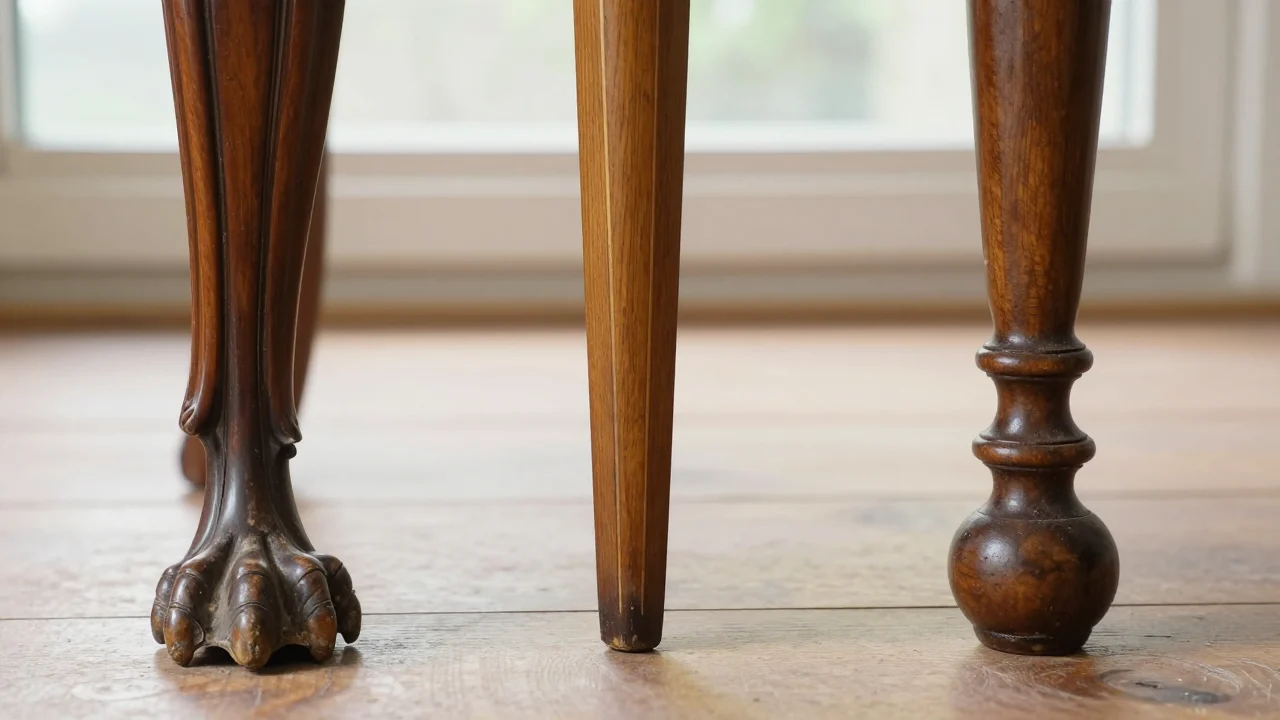
Identify a style by reading the whole piece in a fixed order, form first and construction last, and let construction overrule style whenever the two disagree. Start with outline and proportion: horizontal and massive points to the seventeenth century or to Empire, tall and slender to William and Mary or Federal, curved to Queen Anne and Rococo Revival, square and plain to Arts and Crafts and modernism. Then read the legs and feet, which carry more period information than any other part: boldly turned legs for William and Mary, cabriole legs with pad or slipper feet for Queen Anne, cabriole legs with claw-and-ball feet for Chippendale, tapered or reeded legs for Federal, curule frames, columns and paw feet for Empire, and straight square legs for Arts and Crafts. Third, read the ornament and its technique: low-relief carving and paint on oak, figured veneer, japanning, naturalistic Rococo carving, flat inlay, applied brass, laminated and carved rosewood, incised Eastlake lines, exposed Mission joinery or Deco exotic veneers each belong to a narrow band of dates, and our guide to telling new wood from old patina shows how a surface itself ages.
The last step decides the case. Pull a drawer and turn a chair over: dovetailed cases arrived with the William and Mary style, hand-cut dovetails are usually uneven in spacing and width while machine-cut ones are uniform, and the nails, screws and hinges give an earliest possible date that is documented in our guide to dating furniture by its hardware. Secondary woods, saw marks on unfinished surfaces, tool marks inside cases and the consistency of wear across the piece all belong to this step. Marks and labels come last, because labels were rare in the eighteenth century, Phyfe seldom used one, and later makers’ stamps are copied; treat a label as a lead to check, not a verdict. When you want a value for a piece you have dated, our guide to how appraisers determine antique value explains the steps, and our restoration versus preservation guide explains why the surface should be left alone until then.
Common mistakes in dating furniture by style
The commonest error is to read a revival as the period it imitates. Colonial Revival furniture of 1876–1940 reproduces Queen Anne, Chippendale and Federal forms, Phyfe’s designs were reproduced in quantity around 1900, and the Victorian revivals borrowed Gothic, Rococo and Renaissance ornament wholesale, so the outline of a piece sets only an earliest possible date; machine-uniform joinery, modern screws, plywood or wire nails move it forward. The second error is dating by one feature, because styles overlapped for decades: the Met records that curved Queen Anne forms continued to be produced well after the Revolution and that Phyfe’s own shop worked through Grecian, Rococo Revival and Gothic Revival phases, so a cabriole leg, a lyre or a pointed arch is a clue to be weighed with the rest. The third is ignoring region: Boston, Newport, Philadelphia and New York made recognizably different Queen Anne and Chippendale furniture, and a rural shop could lag a port city by a generation. The fourth is missing a marriage, a top and a base or a chair frame and its seat that started life apart; check that woods, colour, wear and construction agree across the whole piece before assigning a period.
Where a photo identification app fits
A photo identification app gives a quick first suggestion of style and period that you then verify with the steps above, and it is not a substitute for turning the piece over. Antiqly is our own app, so read this as the publisher’s view: it is free to download on iPhone and Android with no sign-up, and this article reports no test of it or of any other tool. Whatever you use, photograph the piece in daylight from the front and side, then add close-ups of a leg and foot, the carving or inlay, a drawer side with its dovetails, the hardware and any label or stamp, because those are the details that separate a period piece from a revival.
Frequently asked questions
Are Hepplewhite and Sheraton different periods?
No. Both are names of English pattern books, Hepplewhite’s Guide of 1788 and Sheraton’s Drawing-Book of 1793, that American cabinetmakers used side by side during the Federal era, so the labels describe leg and chair-back types within one period rather than two successive ones.
Did Thomas Chippendale make American Chippendale furniture?
No. American Chippendale furniture was made in Boston, Newport, New York, Philadelphia and smaller towns by colonial cabinetmakers working from the taste that Chippendale’s 1754 Director codified; the Met notes that he did not invent the carved style that carries his name, so American Chippendale is a period and style label, not an attribution to his London workshop.
Is Art Deco furniture antique?
Mostly not yet, under the hundred-year rule most dealers use: only pieces made in 1926 or earlier have reached a century in 2026, so most Art Deco and all early modernist furniture is currently described as vintage design rather than antique, even though it belongs to the same sequence of styles.
